

Federal cannabis policy is changing quickly.
Between developments around rescheduling, changes to the federal definition of hemp, evolving FinCEN guidance, and questions about banking and insurance, there is no shortage of headlines for cannabis businesses to follow.
But headlines alone do not tell businesses what they should actually do.
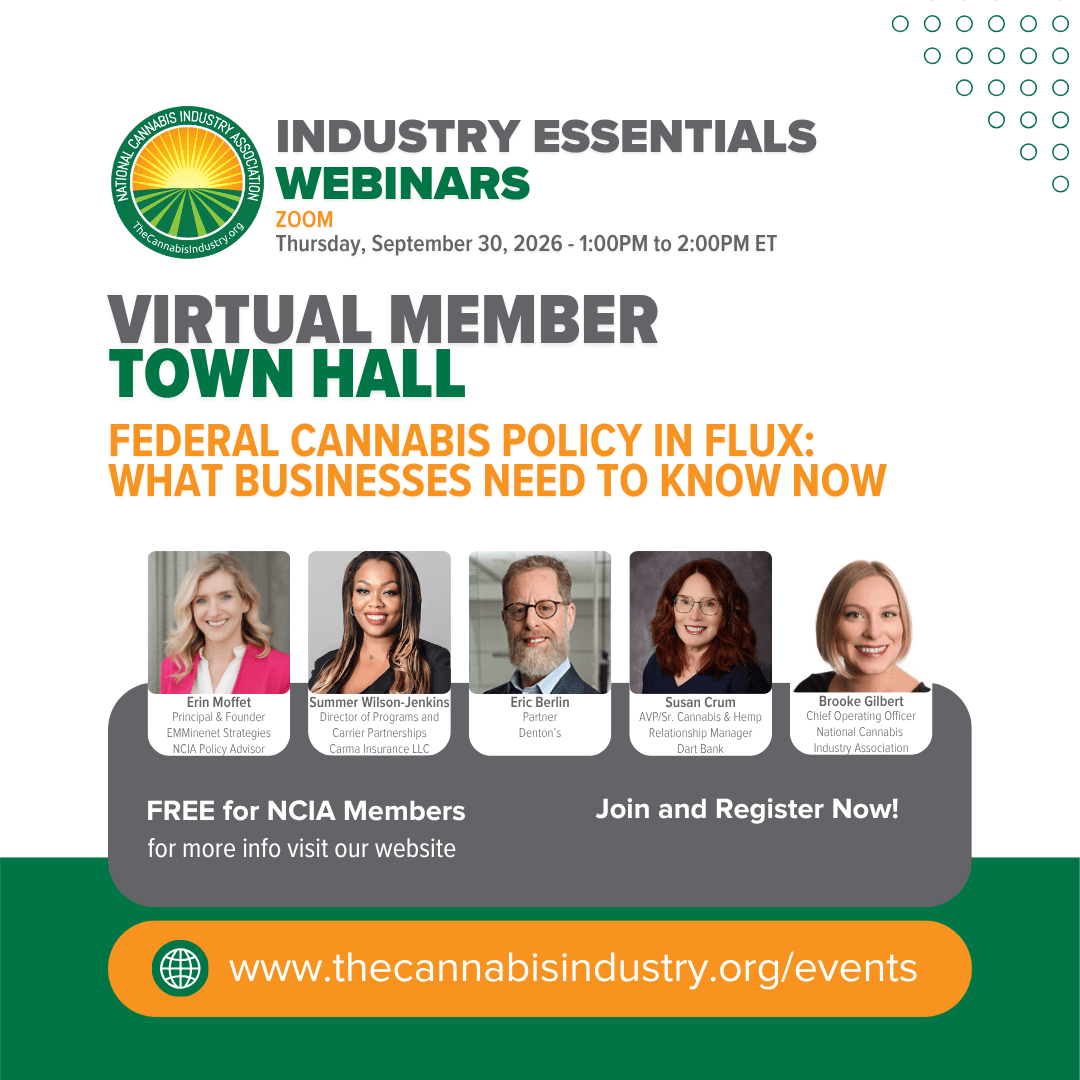
That was the focus of NCIA’s September Member Town Hall, “Federal Cannabis Policy in Flux: What Businesses Need to Know Now,” which brought together experts in federal policy, cannabis law, banking, and insurance to look beyond the headlines and examine the practical implications for businesses.
One theme emerged throughout the conversation:
Businesses need to understand what has actually changed, what remains unresolved, and what they may be assuming has changed before taking action.
Here are several of the key issues businesses should be watching.
Rescheduling: What Has Changed, and What Hasn’t?
One of the most important distinctions discussed during the Town Hall was that “rescheduling” is not a single development with a single set of consequences.
The panel distinguished the federal action affecting state medical marijuana programs from the separate, ongoing process concerning broader rescheduling of non-medical marijuana.
Eric Berlin of Dentons explained that the final rule affecting state medical marijuana programs is in effect, placing those programs in Schedule III and creating a DEA registration pathway for state-licensed medical marijuana operators.
The discussion also highlighted one immediate business implication: the potential effect on Section 280E for state-licensed medical marijuana operators.
At the same time, the broader rescheduling process remains unresolved.
For businesses, that distinction matters.
A federal action that is already legally effective should not be treated the same way as a proposal, pending proceeding, or potential future change.
The takeaway: Before changing a business strategy based on a federal policy headline, determine exactly what action has occurred, what remains pending, and which businesses or activities are actually affected.
Hemp: Definitions Can Have Real Business Consequences
The federal treatment of hemp-derived products was another area of discussion, particularly as changing definitions intersect with marijuana policy and implementation.
At first glance, a change in statutory or regulatory language may seem like a narrow legal issue. In practice, definitions can have consequences far beyond regulatory classification.
They can affect how products are viewed by regulators, financial institutions, insurers, vendors, and other business partners.
That means businesses should consider more than simply asking whether a particular product qualifies as hemp.
They should also ask:
What does that classification mean for the relationships and obligations surrounding the business?
This is especially important as businesses navigate an environment where federal policy, implementation, and industry practices may not all move at the same pace.
A Federal Policy Change Doesn’t Automatically Change Your Bank’s Policy
For many businesses, one of the most practical portions of the discussion focused on banking and financial services.
Susan Crum of Dart Bank emphasized an important distinction: a change in federal policy does not automatically translate into a policy change at every bank, credit union, payment processor, or lender.
Financial institutions have their own compliance programs, risk management frameworks, board oversight, and risk appetites.
As a result, even when federal policy changes, individual institutions may need time to evaluate what those developments mean for their organizations and determine whether they will adjust their policies.
For businesses, that means a headline announcing a federal change should not automatically be interpreted as a promise of expanded access to financial services.
Instead, communication becomes especially important.
Businesses should consider reaching out directly to their financial institutions to:
- Ask whether policies or requirements have changed
- Discuss upcoming changes to the business or its operations
- Confirm that documentation about the business remains accurate
- Understand how the institution currently views the company’s activities
The goal isn’t necessarily to react to uncertainty. It is to make sure the business and its financial partners understand each other’s expectations.
Don’t Overlook the Third Parties Behind Your Business
Another important theme from the discussion was the role of third-party relationships.
A business may understand how a federal development affects its own operations, but that does not necessarily tell the whole story.
Consider the companies and professionals that support the business:
- Banks and lenders
- Payment processors
- Insurance carriers
- Legal and compliance advisors
- Vendors and service providers
- Investors and other financial partners
Each of these organizations may have its own interpretation of regulatory developments and its own risk-management requirements.
That creates a broader question for business leaders:
If federal policy changes, what does that mean for the companies I rely on?
This is an important part of regulatory preparedness that can easily get overlooked.
Insurance: Read the Policy Before You Need It
Insurance was another area where the panel encouraged businesses to take a closer look at what they already have in place.
Summer Wilson-Jenkins of Carma Cannabis Insurance emphasized the importance of understanding policy definitions, exclusions, and coverage conditions rather than assuming that a policy provides coverage simply because the business has purchased it.
This can become particularly complicated for businesses operating around cannabis and hemp.
Terms such as “cannabis,” “hemp,” and “THC” can appear in policy language in ways that create questions about how coverage applies to a particular business or activity.
Those questions may become even more important for businesses that operate adjacent to the plant-touching sector or handle hemp-derived products.
The practical recommendation is simple:
Review your policy before you have a claim.
Businesses should understand what is covered, what is excluded, and whether the policy accurately reflects what the business actually does.
And when the language is unclear, ask an expert.
Five Questions Businesses Should Be Asking Right Now
The Town Hall ultimately pointed toward a practical approach to navigating federal uncertainty.
Rather than waiting for every question to be resolved, businesses can begin by asking:
- What has actually changed?
Separate completed federal actions from proposed, pending, or potential future developments. - What remains unresolved?
Understand where additional regulatory, legal, or administrative action is still required. - Has my financial institution changed its policy?
Don’t assume that a federal development automatically changes your bank, lender, or payment processor relationship. - Does my insurance actually cover what I’m doing?
Review definitions, exclusions, and coverage conditions with someone who understands the business and the policy. - Have I talked with the right experts?
Legal, banking, insurance, and compliance questions increasingly overlap. No business owner is expected to navigate all of them alone.
The Bigger Takeaway
The federal cannabis landscape will continue to evolve, and not every question will be resolved at the same time.
But businesses do not necessarily have to wait for every answer before preparing.
Understanding what has actually changed, maintaining open communication with key service providers, reviewing contracts and policies, and working with qualified professional advisors can all help businesses navigate uncertainty more deliberately.
As the panel discussion made clear, even experts need experts. Legal, banking, insurance, policy, and operational risks increasingly intersect, making trusted relationships and reliable information more important as the federal landscape develops.
Continue the Conversation With NCIA
These are just a few of the practical takeaways from NCIA’s September Member Town Hall, “Federal Cannabis Policy in Flux: What Businesses Need to Know Now.”
The full conversation went deeper into federal rescheduling, hemp policy, FinCEN guidance, banking relationships, insurance coverage, third-party risk, and the practical steps businesses can take as the landscape continues to change.
Want to hear the full discussion? Access the Town Hall recording to hear directly from experts and gain additional perspective on the federal developments shaping the cannabis industry.
NCIA members have access to the recording and exclusive member resources through their membership. Not yet a member? Request access to the Town Hall recording and schedule a call to learn more about how NCIA helps cannabis businesses stay informed, strengthen industry relationships, and shape the policies that affect their future.
Follow NCIA
Newsletter
Facebook
Twitter
LinkedIn
Instagram
–