
Allied Association Blog: Repetitive Motion Injuries and the Importance of Ergonomics in the Cannabis Industry
By Alex Hearding, Chief Risk Management Officer, National Cannabis Risk Management Association
Repetitive motion injuries, also known as musculoskeletal disorders (MSD) are temporary or permanent injuries to muscles, nerves, ligaments, and tendons caused by performing the same motion over and over again. Common repetitive motion injuries are carpal tunnel syndrome and tendonitis. According to the Bureau of Labor Statistics in 2013, repetitive motion injuries cases accounted for 33% of all worker injury and illness cases.
These injuries can be mitigated or controlled through ergonomics. Ergonomics is defined as: “The scientific discipline concerned with the understanding of the interactions among humans and other elements of a system, and the profession that applies theory, principles, data, and methods to design in order to optimize human well-being and overall system performance.” Or more simply put: ‘Fitting the job to the person.’ The goal is to eliminate discomfort and risk of injury due to work. Ergonomics can prevent or reduce work-related MSDs and increase work efficiency.
Every industry and business has tasks that require repetitive motion, the cannabis industry and businesses are no exception. Cannabis operations have some motions and tasks that are similar to many industries, like lifting heavy objects, computer work, and standing for long periods of time. Cannabis operations also have some motions and tasks that are similar to other agricultural operations like pruning and harvesting.
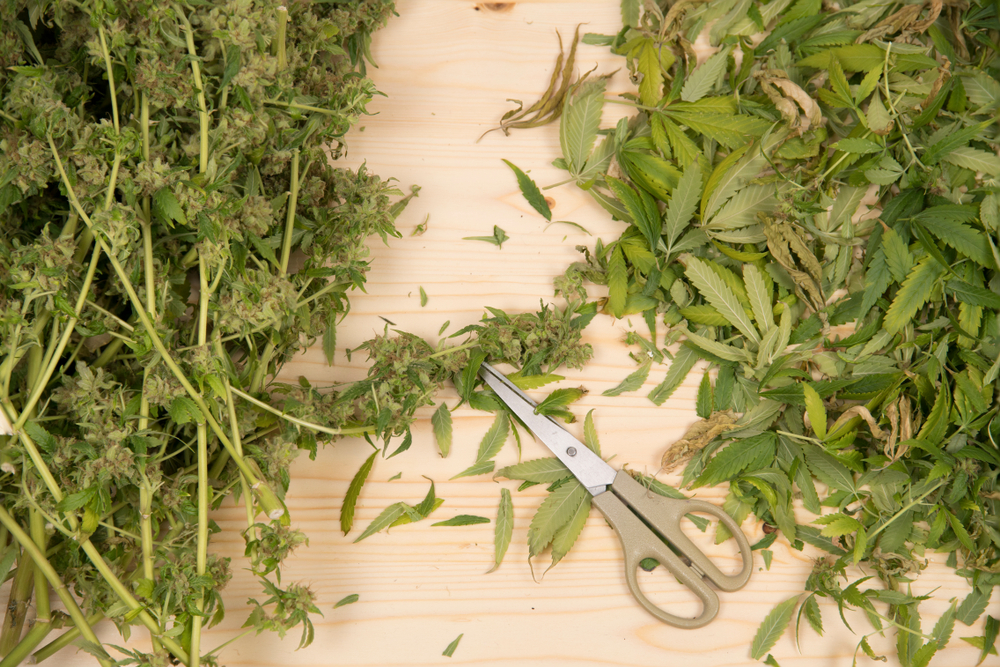
But there is a task and motion in the cannabis industry that is uniquely its own: trimming. There are many different methods to marijuana trimming, including: pre-harvest trimming and pruning, wet trimming, dry trimming, and machine trimming. All trimming methods have the same goal: to manicure the flower (or bud) to its final product ready for the customer or patient. The process is a tedious one where the trimmer removes the leaves of the marijuana flower with scissors while leaving the calyx and resin (the good parts of the bud). The quality of smoke, vapor, and ultimately the consumer’s experience is affected by the quality of the trim job.
Traditionally, most marijuana trimming has been done seasonally around the harvest season. Most cannabis grown outdoors is harvested around October and it is common for cannabis farms to have ‘trim crews’ help them for a couple of months. As medical and adult-use laws expand, so do indoor and greenhouse operations. These operations are capable of ‘perpetual harvests’ meaning they can harvest more often; this has to do with the ability to control light and dark cycles. This means many operations can plan to harvest plants monthly, weekly, or daily if they choose. This has changed the demand for trimmers from largely seasonal you year-round demand, increasing the trimmers’ likelihood of repetitive motion injuries.
There is still a lot of confusion with workers in the industry about their rights. While many states have legalized marijuana, it is still federally illegal. Many workers do not know while it is federally illegal, they still have the same federal worker rights and protections every other U.S. worker has including the rights under the Occupation Safety and Health Act of 1972. Under this law, employers must provide a safe workplace, train employees in the hazards of the workplace, and inform the employees of the rights to report work-related injuries. Cannabis industry workers must also be covered by workers’ compensation if they become injured at work.
The lack of awareness about worker rights has likely led to the under-reporting of these injuries. As awareness of worker rights grows, the reporting workers’ compensation claims of these work-related MSD injuries will likely grow too. Pinnacol, Colorado’s largest workers compensation provider, reported that strains were the most common injury reported by cannabis workers in 2018. This should concern everyone in the industry. Cannabis businesses should heed the warning signs and keep their workers safe by developing their own internal ergonomic processes and practices for their operations.
California is in a unique position as when it comes to cannabis and ergonomics. California is the largest producer of cannabis and has more stringent ergonomic standards. If a California company has more than one employee report a repetitive motion injury, they are required to establish an ergonomic program to reduce repetitive motion injuries. These ergonomic programs require:
- A worksite evaluation
- Control of exposures which have caused the repetitive motion injury
- Training of employees
Additionally employers in California are required to have an effective written Injury and Illness Prevention Program (IIPP), to comply with the California Code of Regulations, title 8, section 3203. The IIPP must include procedures to identify and correct health and safety hazards in the workplace and provide effective training to all employees so they can perform work safely.
The cannabis industry is still immature and searching for best practices of operations. While many workers and operators in the industry understand the need for ergonomic standards the reality is that ergonomic standards still need to be defined. This has been the goal of the National Cannabis Risk Management Association (NCRMA) and Dr. Chris Hughes with Atlas Performance Technologies, LLC. They have developed four courses to educate the industry on ergonomics, including: Introduction to Cannabis Ergonomics, Lift Like a Pro, Prune Like a Pro, and Trim Like a Pro. These courses are available through the NCRM Academy and can be found online here: https://ncrma.net/ncrmacademy/ These courses are designed for entry level cannabis workers to inform them of their rights, the ergonomic hazards, proper hazard controls, and best practices to stay safe and increase productivity.
 Alex Hearding has an educational and professional background as a water and soil scientist and safety professional. He has legally cultivated marijuana as a medical caregiver and as a facility manager in a licensed greenhouse. He has experience starting marijuana businesses including license application, facility design, construction, operational development, and management. He currently provides services including occupational safety & health services and training and risk management for the cannabis industry.
 We need help from workers in the cannabis industry of Colorado to complete an anonymous and confidential 30-45 minute online survey about your work environment and experiences. Ideally, entire organizations will participate (including management and workers) because this will allow us to paint a better picture of what is happening across the entire industry. In return, each person who completes the 30-45 minute survey will receive $20 in cash or a gift card as a “thank you” for your help! As mentioned above, we will also provide survey results and recommendations to the industry when the project is completed.
Follow NCIA
Newsletter
Facebook
Twitter
LinkedIn
Instagram
News & Resource Topics
–
This Just In
How THCa Vapes Are Changing Consumer
Announcing NCIA’s 2026-2028 Board of Directors