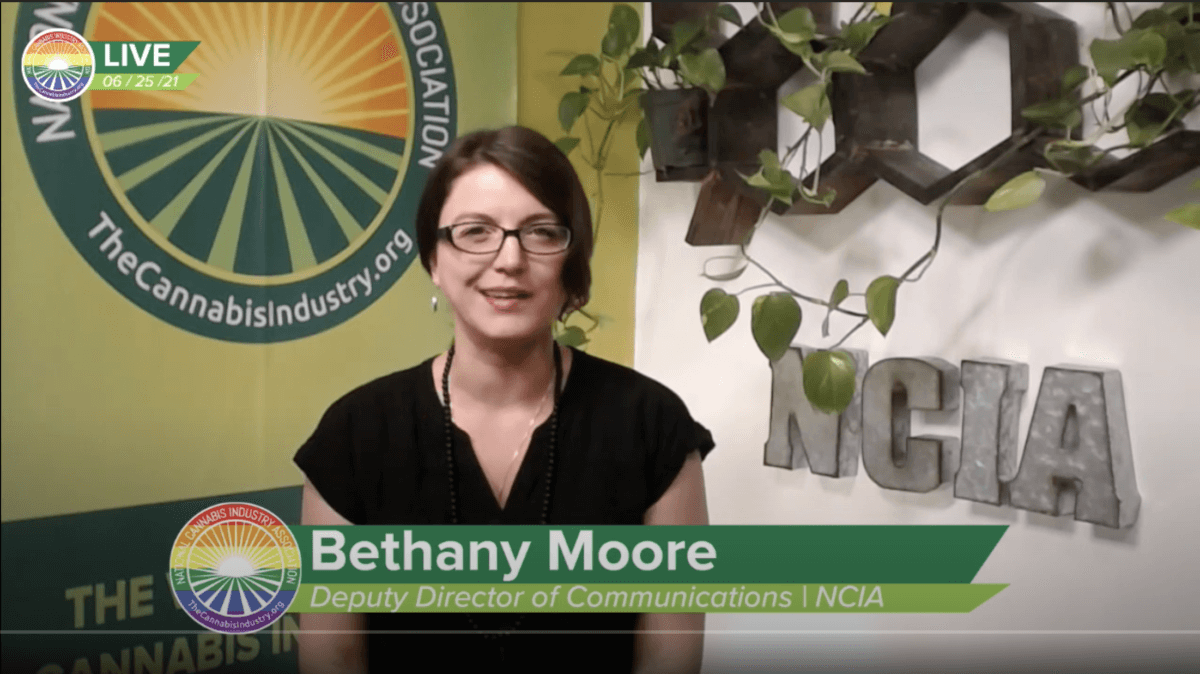
NCIA Deputy Director of Communications Bethany Moore checks in with what’s going on across the country with the National Cannabis Industry Association’s membership, board, allies, and staff. Join us every Friday here on Facebook for NCIA Today Live.
States Still Leading The Way, With Some Stirrings In Congress
By Morgan Fox, NCIA’s Director of Media Relations
As has been so often true in the history of cannabis policy reform (but is starting to change with your help), the biggest news and progress made this week is at the state level. After a long and arduous legislative session, Connecticut lawmakers approved an adult-use bill, which Gov. Lamont signed on Tuesday!
The new law makes adult possession of up to 1.5 ounces legal and will establish a regulated licensing system. Half of all licenses are reserved for social equity applicants, who will also be able to access training, technical assistance, and startup funding. Limited home cultivation will be permitted in stages (medical first, then adults), and limited social consumption will not just be allowed – it will be mandated in municipalities with more than 50,000 residents.
Let’s put this in a national perspective. If you do not include all the years of foundation-building, activism, and lobbying that go into changing cannabis laws, it took two years for voters to approve adult use in the first four legal states starting in 2012. At that time, passing such laws through elected representatives was unheard of. Now in 2021, four state legislatures have approved adult-use bills in the first six months of the year! We’ve come a long way in terms of state policy reform and momentum is only increasing, but we still have a long way to go.
Now let’s move to Congress, where things tend to move a bit more slowly but are nevertheless picking up speed.
Earlier this month, NCIA endorsed the Drug-Impaired Driving Education Act. This bill, introduced by Reps. Kathleen Rice (D-NY) and Troy Balderson (R-OH), would provide grants and resources to states and organizations to engage in evidence-based impaired driving education. NCIA supports this bill because impaired driving is a serious issue that is most effectively combatted through early and consistent educational outreach, which this legislation promotes to the exclusion of unscientific per se limits and unproven chemical testing technology.
In somewhat related news, a massive transit bill is now awaiting a vote in the House of Representatives after recently passing a key committee. This legislation contains a number of provisions related to impaired driving education, the most important cannabis-related item is a provision that would allow researchers to access and study cannabis products that are available to consumers in state-legal markets rather than depend on federally-approved sources. While the DEA has announced that it will begin granting research production licenses to applicants – many of whom have been waiting for years for approval – there is currently only one legal federal cannabis source, and researchers have consistently complained that it is practically useless due to poor quality and contamination.
Moving on to the SAFE Banking Act, Senate sponsors Jeff Merkley (D-OR) and Steve Daines sent a letter to Banking Committee Chairman Sherrod Brown (D-OH) and Senate leadership urging them to take up the bill for consideration as soon as possible. After overwhelmingly passing in the House in April with a bipartisan vote, the bill has been awaiting review in the upper chamber, with some Democrats wanting to wait until a more comprehensive bill is introduced there.
Advocates and congressional supporters are eagerly awaiting the introduction of that legislation from Senate Majority Leader Chuck Schumer, who has been working closely with Sens. Ron Wyden (D-OR) and Cory Booker (D-NJ) since announcing that this effort would be a priority early this year.
The Senate has quite a bit on its plate at the moment, but we expect things to keep ramping up over the coming weeks and months. Stay tuned!
From Sea To Shining Sea: State Cannabis Policy Update
By Madeline Grant, NCIA’s Government Relations Manager
Over the past couple of weeks, we’ve talked a lot about what is happening at the federal level – with the passage of the SAFE Banking in the House of Representative, the reintroduction of the Marijuana Opportunity Reinvestment and Expungement (MORE) Act, and the introduction of many bills, we’ve seen the momentum continue to rise in the 117th Congress. So this week, I’m going to go over numerous updates happening at the state level. When we see movement at the state level, this directly correlates to success at the federal level, although not immediate. Think about it… more constituents voting in support of cannabis initiatives and more state legislators speaking in favor of moving cannabis measures means more overall support in the United States. That support at the local and state levels streamlines up to members of Congress at the federal level. So let’s take a look at a few updates in the states.
Wyoming
In Wyoming, lawmakers failed to pass a bill to legalize marijuana this session. However, last week two measures were submitted to the state to place medical cannabis legalization and adult-use decriminalization measures before voters on the 2022 ballot.
Connecticut
Last week, Governor Ned Lamont (D) said he’ll be upset if the legislature fails to deliver him a bill to legalize marijuana in a special session that is set to take place this week. The Senate approved a legalization proposal in the final days of the regular session last week, but an expected House vote was called off as time ran short in the face of Republican opposition and threats to a filibuster.
Ohio, South Carolina, and West Virginia
The Sensible Movement Coalition (SMC), an Ohio-based marijuana group, is helping campaigns in West Virginia and South Carolina get cannabis decriminalization on their local ballots this year. SMC has traditionally pushed for reforms within Ohio – and has seen multiple successes in getting decriminalization enacted there – they’re now lending expertise to activist-led campaigns in other traditionally conservative states.
Nebraska
Marijuana activists are gearing up for a “mass scale” campaign to put medical cannabis legalization on the state’s 2022 ballot after the state legislature failed to pass a bill to enact the reform this session.
Rhode Island
For the first time in Rhode Island, a bill to legalize cannabis for recreational use has advanced in the state. The Judiciary Committee approved a marijuana legalization bill that’s being championed by leadership in the chamber.
Texas and Louisiana
The governors of Texas and Louisiana on Thursday separately indicated that they will sign marijuana reform bills that have recently been delivered to their desks.
Delaware
A vote on a marijuana legalization bill that was scheduled in the House of Representatives was canceled, despite attempts to propose amendments to reach the three-fifths supermajority support. Rep. Edward Osienski (D), who filed the measure, said lawmakers need more time to consider a series of proposed changes before reaching a consensus and moving forward.
Texas
A newly formed progressive coalition that’s being led by two former Democratic congressional candidates, Julie Oliver and Mike Siegel, is aiming to take cannabis and other issues directly to voters by putting reform measures on local ballots across the state. Although Texas legislators made progress this session on some marijuana policy changes, activists were hoping for more. The new coalition, Ground Game Texas, works to engage voters on issues like marijuana reform that are popular among young people and Democrats.
These are just a few of the many updates that are happening state by state. It’s extraordinary to see the momentum building throughout the country with the help of advocates and public support. I implore you to get involved with state initiatives to propel cannabis policy reform forward, as every person has a voice to be heard. To keep updated on what’s happening at the state level please be sure to check out our state policy map that can be found HERE. Additionally, I would love the opportunity to hear from you about the difficulties you face in the cannabis space. If you have the time please feel free to email me at Madeline@TheCannabisIndustry.org.
State of the States – Cannabis Policy Reform in the Current Legislative Sessions
by Morgan Fox, NCIA Director of Media Relations
The last few weeks have seen quite a bit of excitement for the possibility of comprehensive federal cannabis policy reform being closer than it has ever been, but what about the states?
Historically, the vast majority of progress has been made at the state level, and this year is shaping up to be another one full of victories for legalization advocates as state governments struggle to support their economies, create new tax revenue and job sources, and tackle long-overdue criminal justice reforms.
The overwhelming approval by New Jersey voters of a referendum to make cannabis legal for adults last year has put the spotlight firmly on the Northeast and mid-Atlantic regions. With state legislative sessions already underway, a number of states are already prioritizing legalization much more heavily than in years past even as New Jersey lawmakers struggle to pass enacting legislation to carry out the will of the voters in a fair and equitable manner. It is pretty clear that New Jersey’s neighbors don’t want to be left behind when it starts reaping the benefits of regulated cannabis markets.
Early this year, New York’s Gov. Andrew Cuomo released a statement outlining his plan to make cannabis legal in the state, and just recently added amendments that would allow delivery, clarify the tax system, and reduce penalties associated with some cannabis activities. There are still some concerns with this plan, including the amount of funding that would actually go toward repairing the disparate harms caused by prohibition and the lack of legal home cultivation. Regulated cannabis in New York could be worth more than $3.5 billion and create more than 60,000 jobs, making it one of the largest state cannabis markets in the country.
Meanwhile, in Delaware, a legalization bill that was approved in the state House in 2019 is slated to be reintroduced by the sponsor in the coming weeks. This bill would come on the heels of a report released last month by the state auditor which estimated that Delaware could take in $43 million annually with a 20% excise tax, and create more than 1,400 jobs over a five year period. In what seems to be a disturbing trend in some state legislatures this year, this bill is not expected to initially include home cultivation either.
In Connecticut, however, a new adult-use bill has been introduced that would center on restorative justice and social equity in the industry and would allow adults to grow limited amounts of cannabis in their homes. This bill has strong support in the state legislature but may soon have to compete with Gov. Ned Lamont’s proposal, which is expected to be released soon.
Nearby Pennsylvania is likely to consider adult-use legislation this year, with Gov. Tom Wolf (along with the incredibly supportive and newly internet-famous lieutenant governor) urging lawmakers to address the issue and – earlier this month – calling it a priority for his state’s annual budget proposal. Rhode Island lawmakers are expected to consider legalization again this year as well, and with the departure of Gov. Raimondo, it is more likely that the emphasis will shift away from a state-run model and back to regulating private businesses.
Farther South, Virginia made headlines this month by becoming the first state in 2021 to have both chambers of its legislature approve adult-use bills. Lawmakers are committed to ironing out the differences between the two bills this month during an extended session. With Gov. Ralph Northam in full support, Virginia stands poised to become the 16th state overall to make cannabis legal for adults and the first state to do so in the South, and it would be only the third to regulate cannabis through its legislature.
Adult-use legislation has also been introduced in Maryland, with supporters and cosponsors optimistic that it could be passed this year, though lawmakers there are not as far along in the process as their neighbors in Virginia. And in medical news, advocates in South Carolina are taking another shot at passing a medical cannabis bill there.
There are signs of progress from elsewhere in the nation as well. After running out of time in an emergency session last year, New Mexico’s governor and lawmakers wasted no time in getting back to legalization efforts this year. There are currently several bills being considered, and it appears very likely that some form of adult-use will be approved there this year.
This is just a snapshot of the momentum and positive movement we are seeing at the state level this year. If you are interested in up-to-date information about all cannabis-related state legislation in the U.S., please consider subscribing to Marijuana Moment’sbill tracker.
Unfortunately, the news isn’t all good.
In South Dakota, where voters approved both medical and adult-use initiatives in November by wide margins, advocates have suffered a temporary setback on the adult-use front. After a pair of law enforcement officials sued to have the adult-use bill thrown out because it addresses too many issues for a constitutional amendment, a circuit court judge ruled in their favor earlier this month. This situation is extremely disheartening and outrageous: the will of the people was overturned by a judge who was appointed by a governor who not only actively campaigned against the ballot initiative but also paid for the lawsuit to overturn it with taxpayer money! However, supporters have appealed the decision to the state Supreme Court.
In Montana, where voters also passed an adult-use initiative in November, supporters are faced with another lawsuit on similar grounds that was filed by opponents. However, observers are skeptical of that suit being successful, and lawmakers are moving ahead with developing enacting legislation.
And in Idaho, where a medical cannabis initiative was prevented from getting on the ballot last year, prohibitionist lawmakers are moving forward with a bill that would prevent any future legislation to make cannabis or any other currently illegal substance legal. If passed, this bill would be put before the voters in 2022, where it could very well be on the same ballot as a medical cannabis referendum.
Despite efforts to overturn progress and maintain failed and harmful cannabis policies, things are generally looking up and we expect several states to pass laws to stop arresting cannabis consumers and establish legal, regulated marketplaces in the near future.
 By Morgan Fox, NCIA’s Director of Media Relations
 Over the past couple of weeks, we’ve talked a lot about what is happening at the federal level – with the passage of the SAFE Banking in the House of Representative, the reintroduction of the Marijuana Opportunity Reinvestment and Expungement (MORE) Act, and the introduction of many bills, we’ve seen the momentum continue to rise in the 117th Congress. So this week, I’m going to go over numerous updates happening at the state level. When we see movement at the state level, this directly correlates to success at the federal level, although not immediate. Think about it… more constituents voting in support of cannabis initiatives and more state legislators speaking in favor of moving cannabis measures means more overall support in the United States. That support at the local and state levels streamlines up to members of Congress at the federal level. So let’s take a look at a few updates in the states.
Follow NCIA
Newsletter
Facebook
Twitter
LinkedIn
Instagram
News & Resource Topics
–
This Just In
Committee Blog: Budtenders Make or Break Your Business – A No-Nonsense Guide to Cannabis Retail Staffing
Member Blog: Guaranteeing the First Loan