Member Blog: Where Is Delta-8 THC Legal and Where Is It Banned? CBD Oracle’s Map Has the Answers
Delta-8 THC is probably the most controversial cannabinoid on the planet right now. With the 2018 Farm Bill being widely considered to have removed the THC isomer from the federal list of controlled substances, hemp and CBD companies quickly found a use for their excess CBD isolate. But if you’re considering selling delta-8 THC, federal law is only a part of the picture, and at state level, you have a patchwork of different laws and regulatory schemes to contend with.
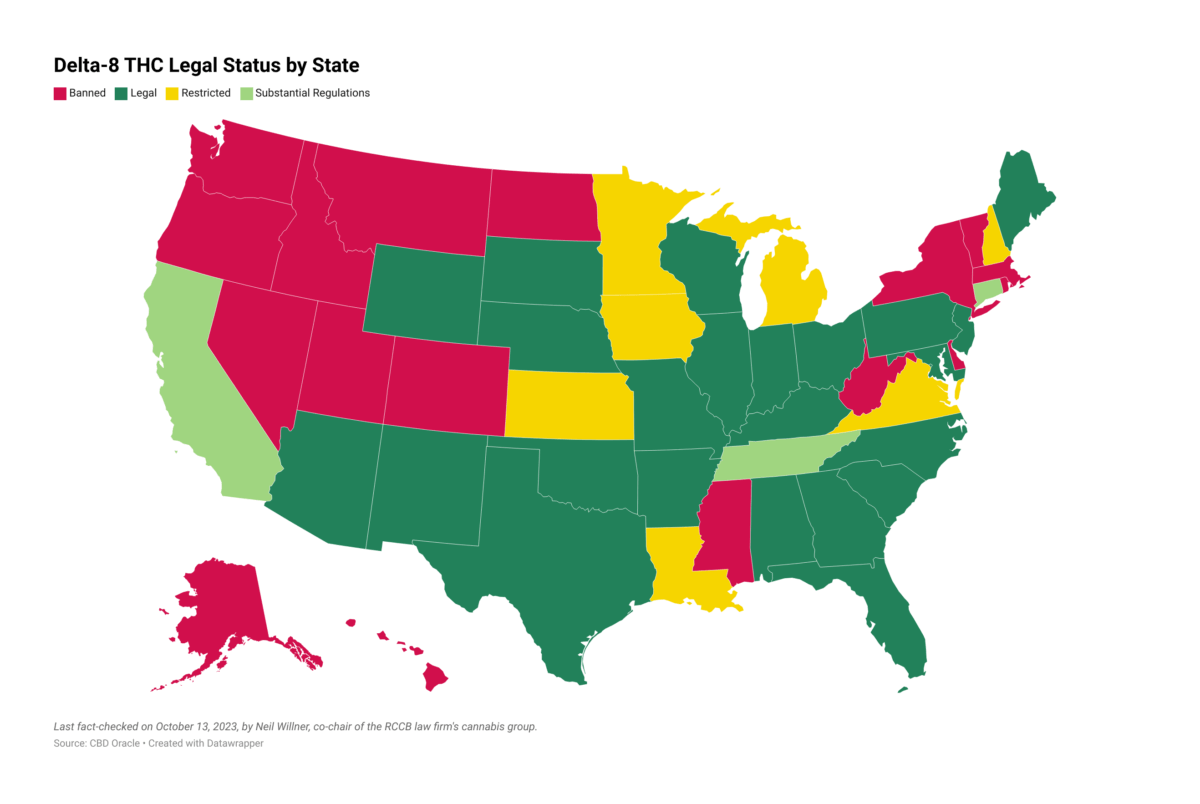
This is why CBD Oracle, working alongside Neil Willner co-chair of the Cannabis Group at Royer Cooper Cohen Braunfeld, has produced a state-by-state map of delta-8 THC’s legality based on extensive reviews of state law. If you want to know what’s going on with delta-8 THC in a specific state, this is one of the best resources around to get the answer you’re looking for.
Delta-8 THC Is Legal in 22 States and 1 District With Limited Regulation
Despite the controversy surrounding delta-8 THC, it remains legal in 22 states and 1 district, with only limited regulation. This covers the following states:
- Alabama*
- Arizona
- Arkansas
- Florida*
- Georgia (?)
- Illinois
- Indiana (?)
- Kentucky*
- Maine
- Maryland* (?)
- Missouri
- Nebraska
- New Jersey
- New Mexico
- North Carolina
- Ohio
- Oklahoma
- Pennsylvania (?)
- South Carolina (?)
- Texas (?)
- Washington D.C.
- Wisconsin
- Wyoming*
Here, a * beside the state’s name means they’ve instituted age restrictions, preventing anybody aged 21 or under from buying delta-8 THC. States marked with (?) are currently involved in legal action about the status of delta-8 THC.
In the majority of these cases, state law basically follows the blueprint laid down by the 2018 Farm Bill with few or no additional rules. In fact, only a handful of states (Alabama, Florida, Kentucky, Maryland and Wyoming) have even passed laws preventing youth from buying delta-8 THC.
Legal actions are ongoing in several states, with the situation being slightly different in each. For instance, in Maryland, the hemp industry won a temporary injunction against the state, preventing the state from enforcing the provisions of House Bill (HB) 556 which relate to hemp until the action is resolved. The bill originally made it so that delta-8 THC products (and most CBD) could only be sold in licensed marijuana dispensaries, but this was deemed by the court to create a monopoly.
Delta-8 THC Is Banned in 17 States and Severely Restricted in 7 More
For every state where delta-8 THC is de facto legal, there is another state which has either banned or severely restricted the cannabinoid. In total, CBD Oracle’s analysis shows that delta-8 THC is banned in 17 states and severely restricted in 7 more. The states with bans are:
- Alaska
- Colorado
- Delaware
- Hawaii
- Idaho
- Massachusetts
- Mississippi
- Montana
- Nevada (technically could be approved for marijuana industry)
- New York (isomerization banned, could theoretically be sold in adult use)
- North Dakota
- Oregon
- Rhode Island
- Utah (possible in medical industry)
- Vermont
- Washington
- West Virginia
And there are severe restrictions – limiting all THCs to be under 0.3% for hemp products, unless otherwise noted – in the following seven states:
- Iowa
- Kansas
- Louisiana (all THCs must be under 8 mg per serving and 1% by dry weight)
- Michigan (all THCs under 0.3% and only marijuana-derived delta-8 allowed)
- Minnesota (all THCs under 0.3% and less than 5 mg per serving)
- New Hampshire
- Virginia (2 mg serving limit or >25:1 CBD:THC ratio)
Exactly how delta-8 THC is banned or restricted varies by state. For instance, while Colorado bans the “isomerization” process used to make delta-8 from CBD, Idaho basically bans anything that contains THC at all, even if it’s just CBD with trace, federally-acceptable levels of delta-9 THC. For the restricted states, most require that all THCs total to under 0.3% by dry weight, which is technically possible for a delta-8 THC product to meet, but essentially none do.
The analysis also revealed that – just like with marijuana – making delta-8 THC illegal doesn’t automatically remove it from a community. In Hawaii and Mississippi, for instance, despite state law banning delta-8 THC, it is still openly sold.
Only Three States Have Substantial Regulations on Delta-8 THC
In California, Connecticut and Tennessee, delta-8 THC is legal but has substantial regulations in place. In California and Connecticut, delta-8 THC is treated as marijuana and is sold as part of the adult use industry. This automatically institutes a wide range of requirements on the cannabinoid, including rules on testing and labeling to ensure safety and transparency for consumers.
Tennessee is the unique case here, where delta-8 THC is regulated as a “hemp-derived cannabinoid” and is legal to sell to adults aged 21 and over. Senate Bill (SB) 378 includes requirements for testing for contaminants, informative labeling and marketing which does not target youths, as well as a 25 mg serving size limit.
The Patchwork of Laws and the Future of Delta-8 THC
The key take-away for sellers of delta-8 THC is that current state regulations are a patchwork, making it very difficult to navigate for even the most responsible of companies. The product you can sell in Arizona without issues is probably not legal in Kansas, and would require batch testing and more to be sold in Tennessee.
This uncertainty may be resolved by the upcoming 2023 Farm Bill, but even this isn’t a sure thing. While the 2018 Farm Bill opened the door to a whole host of products and simply assumed (incorrectly) that the FDA would step up to regulate finished products, the new version might offer the clarity that was lacking. However, it’s just as likely that the bill will redefine “hemp” in a way that excludes delta-8 THC by default.
Pretty much the only thing you can depend on is that you’ll need to keep a close eye on state laws in the coming year. CBD Oracle’s map will be continuously revised to reflect the current legal reality and help responsible hemp companies remain compliant.
______________________________________________________________________________________
Lee Johnson is the senior editor at CBD Oracle, and has been covering science, vaping and cannabis for over a decade. He focuses on research-driven deep dives into topics ranging from medical uses for CBD to industry and user statistics, as well as general guides and explainers for consumers.
CBD Oracle is a cannabis consumer research company working to improve the safety and transparency of cannabis and hemp products, which publishes in-depth scientific, legal and consumer analyses on cannabis and cannabinoids.
Committee Blog: A Novel Cannabinoid Conundrum – Loopholes, Liability, and Legislation
 by Matthew Johnson and Doug Esposito
members of NCIA’s Risk Management and Insurance Committee
For better or for worse, the cannabis industry is easily the most fascinating experiment in state regulation that this country has ever seen.
Rules vary widely from state to state.
Product testing requirements lack uniformity.
Packaging and labeling are a compliance nightmare.
State laws aren’t the only things that vary, though…
Product Liability definitions of what is even ‘covered’ by a cannabis insurance policy range widely between insurance companies. Now, a tidal wave of novel cannabinoid products threatens to upend the traditional American perception of cannabis – and possibly teach a few lackadaisical insurers an expensive lesson.
So, let’s delve into the issues associated with product liability and novel cannabinoids in the American cannabis industry…
American cannabis companies face a daunting task when it comes to navigating the complex and constantly evolving landscape of regulations governing the production, distribution, and sale of cannabis products. With 40 sets of rules governing different state markets, plus a handful of federally licensed businesses, ensuring compliance can seem like an insurmountable challenge.
One of the most significant issues facing cannabis companies is product liability, including the ongoing blight of product recalls. As with any consumer product, there is a risk of harm associated with the usage of cannabis products – things like adverse reactions, contamination, mislabeling, or improper dosage, to name a few. The legal and financial implications of product liability can be severe, including lawsuits, fines, and irreversible reputational damage. Given the complexity of the state-segregated cannabis supply chains and the lack of clear federal guidance, it is additionally challenging for companies to identify and mitigate potential risks.
Traditional cannabis companies must also contend with the emergence of novel cannabinoids. As researchers continue to explore the potential therapeutic benefits of cannabis, previously unknown cannabinoids are being discovered and brought into the mainstream. These compounds may have unique properties and potential therapeutic applications, but they also pose challenges in terms of safety and regulation. For example, some novel cannabinoids may be more potent or have different effects than traditional cannabinoids like THC and CBD. What’s worse, some novel cannabinoid products can even produce substances that are deleterious to human health (for example – the vaporization of THC-O Acetate produces toxic ketene gas).
The challenges associated with product liability and novel cannabinoids highlight the need for clear and consistent regulation of the cannabis and hemp industry. While some states have taken steps to create comprehensive regulatory frameworks for cannabis, the lack of federal guidance has created an incoherent patchwork of rules and regulations that can be difficult for even the most seasoned minds in compliance to navigate.
Without sensible and congruous regulations, companies may be forced to operate in a legal gray area, increasing the risk of non-compliance and potential harm to consumers. In fact, this is exactly what’s happening with the unregulated intoxicating cannabinoid market. A veritable alphabet soup of novel intoxicants like Delta-8 THC, THCP, THC-O Acetate, and others have sprung up to fill the gap in access perpetuated by the federal illegality of ‘normal’ marijuana products. Beyond that, some folks are synthesizing Delta-9 THC (the ‘normal’ THC molecule) from hemp and marketing it as if it were naturally occurring THC from marijuana.
These products are increasingly problematic for cannabis consumers. While intoxicating hemp-derived products are technically legal through a loophole in the Farm Bill, states have had to take action to ban or regulate novel cannabinoid products. The states that haven’t acted are effectively endorsing the sale of untested cannabis goods often derived from federally legal hemp. This means that novel cannabinoid products get a free pass in many areas for heavy metals, mycotoxins, pesticides, residual chemicals, and other contaminants that the regulated marijuana industry must monitor to maintain good standing with a state cannabis program.
As if varying state regulations weren’t enough, insurers’ definitions of what is considered ‘cannabis’ vary widely too. Some policy forms contemplate hemp-derived cannabinoids as ‘cannabis’ and some do not.
A few examples of policy wording are below:
Carrier A:
- “Medical Marijuana means cannabis or marijuana, including constituents of cannabis, THC, and other cannabinoids, as a physician-recommended form of medicine or herbal therapy”
Carrier B:
- Simple exclusion for ‘Hemp-Derived Intoxicating Cannabinoids’
Carrier C:
- “Cannabis” means:
- Any good or product that consists of or contains any amount of Tetrahydrocannabinol (THC) or any other cannabinoid, regardless of whether any such THC or cannabinoid is natural or synthetic.
- The paragraph above includes, but is not limited to, any of the following containing such THC or cannabinoid:
- (1) any plant of the genus Cannabis, or any part thereof, such as seeds, stems, flowers, stalks and roots; or
- (2) any compound, byproduct, extract, derivative, mixture or combination, such as, but not limited to:
- (a) Resin, oil or wax;
- (b) Hash or hemp; or
- (c) Infused liquid or edible marijuana;
- Whether or not derived from any plant or part of any plant set forth in the paragraph above.
From the get-go, you can infer a few things from these definitions/exclusions:
- Carrier A: not an adult-use cannabis company’s best choice as it only defines ‘medical marijuana.’ This could leave the door open for potentially uncovered claims from recreational products.
- Carrier B: insurance company is looking to protect itself from issues with the new wave of novel cannabinoid products – but specifically, only the dozen or so intoxicating cannabinoids that can legally be synthesized from hemp (without testing mandates in most states). An important takeaway is that this definition would cover non-intoxicating cannabinoids like CBN or CBC, even if they were derived from hemp.
- Carrier C: this language is/was commonly used across a number of insurance carriers who cover cannabis. Their policies may carry some restrictions, but this broad definition of cannabis includes synthetic cannabinoids and could expose the carrier to major lawsuits.
Those with broader definitions that include all cannabis-derived products often restrict their product liability coverage in other ways. All things considered, the industry has a long way to go until the available product liability coverage can truly be called comprehensive.
To address these challenges, policymakers, industry leaders, and consumers must work together to create a regulatory framework that protects public health and safety while supporting the growth of the cannabis industry. This should include clear guidelines for product labeling, testing, and dosing to ensure that consumers have access to safe and accurately labeled cannabis products. It should also include provisions for product recalls and liability to protect consumers in the event of unexpected quality control issues.
Additionally, the framework should support ongoing research into the therapeutic potential of cannabis, including novel cannabinoids. This research should be conducted in a manner that ensures the safety and efficacy of new compounds before they are introduced to the market. By creating a robust regulatory framework that balances innovation with consumer protection, we can ensure that the cannabis industry continues to grow and evolve in a responsible and sustainable manner.
As risk professionals in this field, it’s our duty to convey the urgency of these issues and the need for action. By working together to create a regulatory framework that supports both innovation and consumer protection, we can ensure that the cannabis industry continues to thrive while safeguarding public health and safety.
It’s time for policymakers, industry leaders, and consumers to come together to address these critical challenges and build a sustainable future for the American cannabis marketplace that is inclusive of all the various products that can be developed from cannabis.
 Matt Johnson leads the Risk Services division for QuadScore, the nation’s leading cannabis insurer. Matt works to keep the cannabis industry safe from unexpected losses through all manner of risk mitigation techniques, ranging from facility security assessments to fire protection improvements.
Matt has the unique ability to study the claims activity for hundreds of cannabis operators across virtually every active state in the USA. Through this lens, he can offer unique insights into the most common claims and how to prevent them.
In addition to learning from past mistakes, Matt also keeps an eye on future claims drivers from emerging areas such as hemp-derived novel cannabinoids. Before starting with QuadScore, Matt spent a number of years working for a Berkshire Hathaway insurance company.
 Doug Esposito has been a Property & Casualty Specialist with AssuredPartners and leads the firm’s Renewable Energy and Cannabis Practice with specific expertise in these industries. Doug’s current cannabis & hemp practice clients include indoor/outdoor cultivators, manufacturers, distribution companies, dispensaries, non-storefront delivery, labs and property owners, so he knows what challenges are facing the growing industry and is skilled at providing solutions. Doug is also one of AssuredPartner’s experts in alternative risk mechanisms including self-insured and captives programs.
Doug currently serves as the Co-Chair of the California Cannabis Industry Associations’ (CCIA) Risk Management committee and serves on the National Cannabis Industry Associations’ (NCIA) Risk Management & Insurance Committee. He understands the importance and need to educate the insurance carriers and the public on the benefits of cannabis and hemp both medicinally and economically. “I truly respect the spirit of the industry’s medicinal origins and I’m committed to helping build this industry to reach new levels of growth, success, safety and acceptance,” shared Doug.
Follow NCIA
Newsletter
Facebook
Twitter
LinkedIn
Instagram
News & Resource Topics
–
This Just In
How THCa Vapes Are Changing Consumer
Announcing NCIA’s 2026-2028 Board of Directors