Member Blog: Cultivating Safety – Advanced Workers’ Compensation Solutions for Cannabis Businesses
The cannabis industry is experiencing rapid growth, bringing with it unique risks and regulatory challenges, especially in protecting employees. Recognizing the complexities of this industry is crucial for developing comprehensive insurance solutions, particularly in workers’ compensation. This blog explores strategies and insights tailored to navigate the intricacies of cannabis-related businesses.
The Unique Occupational Risks in Cannabis
Occupational hazards in the cannabis industry vary significantly across its different verticals—from cultivation and harvesting to manufacturing, distribution, and retail. Each step of the way introduces specific risks:
Cultivation: Employees may face exposure to pesticides, ergonomic challenges, and the potential for injuries related to manual labor or the operation of agricultural machinery and electrical exposures
Manufacturing: The extraction process involves handling volatile substances, which can pose chemical exposure risks, while the use of heavy machinery introduces the potential for industrial accidents.
Retail and Distribution: Employees in these sectors might encounter security concerns, the risk of theft, and repetitive motion injuries, alongside the unique challenges of delivering products safely.
Recognizing and addressing these varied risks is the cornerstone of an effective workers’ compensation strategy, ensuring that businesses are prepared to support their employees in the event of an occupational injury or illness.
Why Workers’ Compensation Is Essential
Workers’ compensation is not just a legal formality; it’s a cornerstone of your business’s resilience. A well-conceived policy ensures that employees are protected in the event of workplace injuries, which in turn safeguards your business from potentially crippling financial liabilities.
Generic workers’ compensation policies often fall short of meeting the specific needs of the cannabis industry. A focused approach on the unique challenges of cannabis operations, is not only beneficial, but necessary for comprehensive protection. This strategy involves:
Risk Identification and Analysis: Understanding the specific hazards associated with different cannabis industry roles is the first step in crafting effective workers’ compensation policies.
Rapid Claim Resolution: Efficient processing and resolution of claims are vital in controlling costs and supporting injured employees’ return to work. Speedy claim closure not only benefits the employee, but also helps manage the financial impact on the business.
Mitigation and Cost Control: A Proactive Approach
Effective claim resolution and risk mitigation are key for cannabis businesses to control workers’ compensation costs effectively. Leveraging advanced data analytics helps identify claim sources and implement prevention measures, closing claims swiftly and reducing overall insurance costs.
Implementing Robust Risk Management Practices
Significant impacts on the frequency and severity of claims can be achieved with:
Safety Training and Education: Regular programs can help employees avoid injuries and safely navigate potential hazards.
Ergonomic Assessments: Identifying modifications in roles involving manual labor or repetitive tasks can reduce strain and prevent injuries.
Security Measures: Enhancing security can mitigate risks associated with theft, especially important in retail and distribution.
A Case in Point: Swift Resolution for a Cannabis Delivery Company
Consider the case of a cannabis delivery company that faced a workers’ compensation claim when a delivery driver sustained an injury on the job. By employing a focused approach to claim management, including prompt medical evaluation and clear communication channels, Liberty’s intervention led to the claim being settled and closed in under four weeks—a testament to our commitment to fast and effective resolution. This not only minimized the cost to the company, but also allowed the employee to return to work sooner, maintaining productivity and morale.
Beyond Claims: Comprehensive Risk Management
A holistic risk management approach covers all potential risks, from delivery driver incidents to cultivation and retail hazards, ensuring comprehensive coverage.
Choosing a Strategic Partner
Partnering with an insurance provider that understands the cannabis industry’s complexities is critical. Customized strategies in insurance and workers’ compensation can offer unparalleled protection and peace of mind, supporting your business’s growth and resilience.
The Path Forward for Cannabis Businesses
As the cannabis industry evolves, strategic foresight in managing workers’ compensation is essential. Focusing on specific sector needs and prioritizing efficient solutions can create a safer work environment and a more resilient future. With the right strategies and a commitment to safety and efficiency, businesses can navigate these challenges successfully, ensuring protection for employers and their valued employees.
For more information, please reach out toValerie Taylor, Vice President (National Cannabis Practice Leader), Liberty Company Insurance Brokers and Kirk Aguilera, Managing Partner (National Workers’ Compensation Practice Leader).
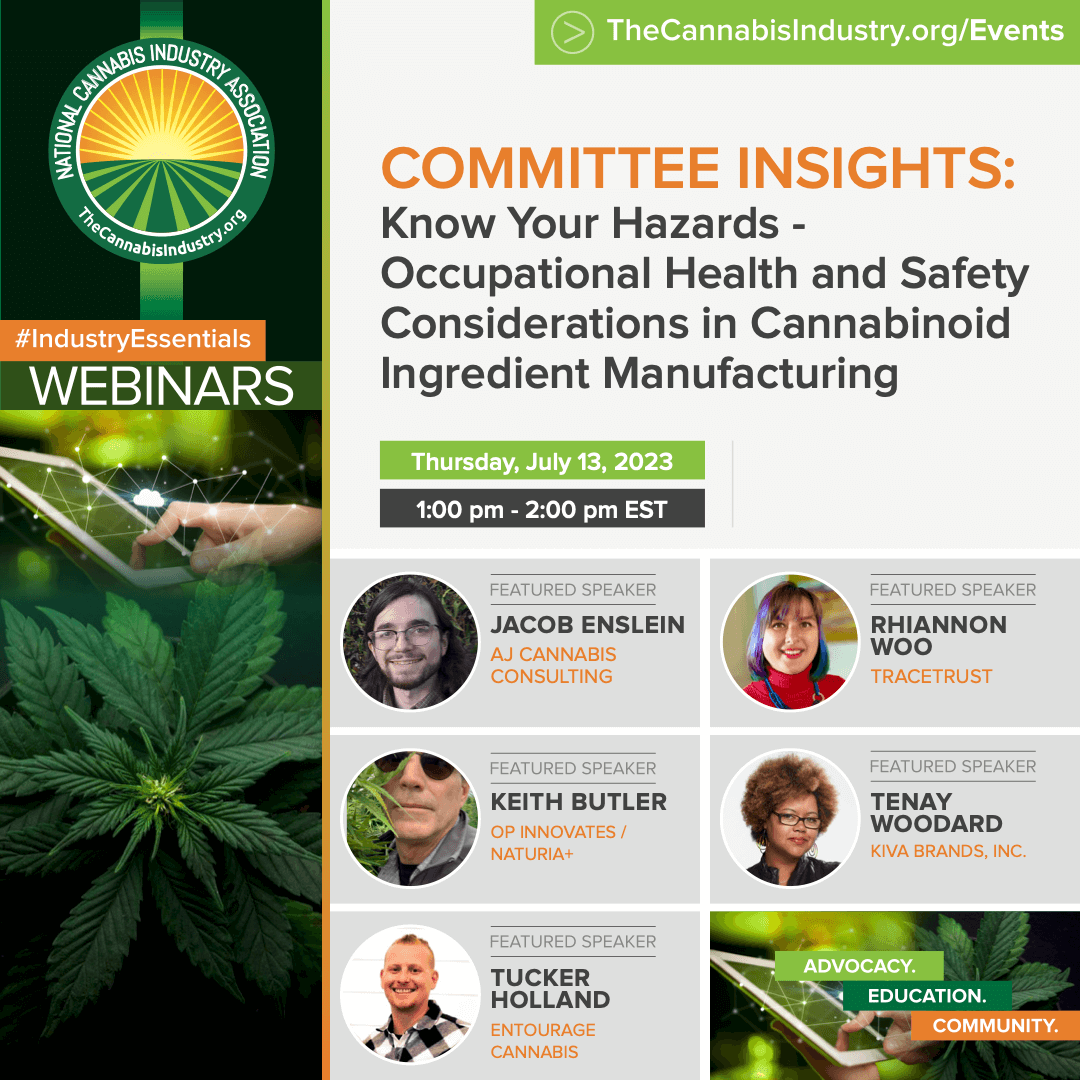
Committee Insights | 7.13.23 | Know Your Hazards – Occupational Health and Safety Considerations in Cannabinoid Ingredient Manufacturing
NCIA’s #IndustryEssentials webinar series is our premier digital educational platform featuring a variety of interactive programs allowing us to provide you timely, engaging and essential education when you need it most.
In this edition of our NCIA Committee Insights series, originally aired on July 13, we were joined by members of NCIA’s Cannabis Manufacturing, Scientific Advisory and Hemp Committees for an in-depth discussion highlighting the occupational health and safety considerations to make during the manufacture of cannabinoids and provide recommendations for mitigating risk.
There is no mistaking that manufacturing cannabinoids is here to stay. It is more and more prevalent to see historically plant/naturally derived bulk ingredients being manufactured in a controlled environment in the lab or through innovative processes like precision fermentation. It is likely that bulk ingredient manufacturing of cannabinoids will go this route too.
For cannabinoids like HHC, that do not exist naturally in the plant or in high enough quantities to be commercially viable for extraction, it is most certainly the case that manufacture of these compounds will occur in the lab. To produce these compounds safely, we can luckily look toward existing regulations and occupational health and safety guidelines for producing novel ingredients for use in foods and non-foods.
Learning Objectives:
• Recognizing common occupational safety hazards associated with manufacturing cannabinoids and recommendation to mitigate these hazards
• Learning the different occupational safety considerations between isolation and purification of naturally occurring cannabinoids and the manufacture (synthesis) of cannabinoids in the lab
• Understanding the special safety considerations that processes like hydrogenation and others have and why these are critical to mitigating liability for your business
Safeguarding Consumers in the Cannabinoid Product Landscape (Part III):
Know Your Hazards – Occupational Health and Safety Considerations in Cannabinoid Ingredient Manufacturing (Part IV): https://bit.ly/3rEUeKP
Concepts for Regulatory Consideration – Shifting the Conversation from “Cannabis vs. Hemp” to “The Cannabinoids” (Part V): https://bit.ly/3P3r5AW
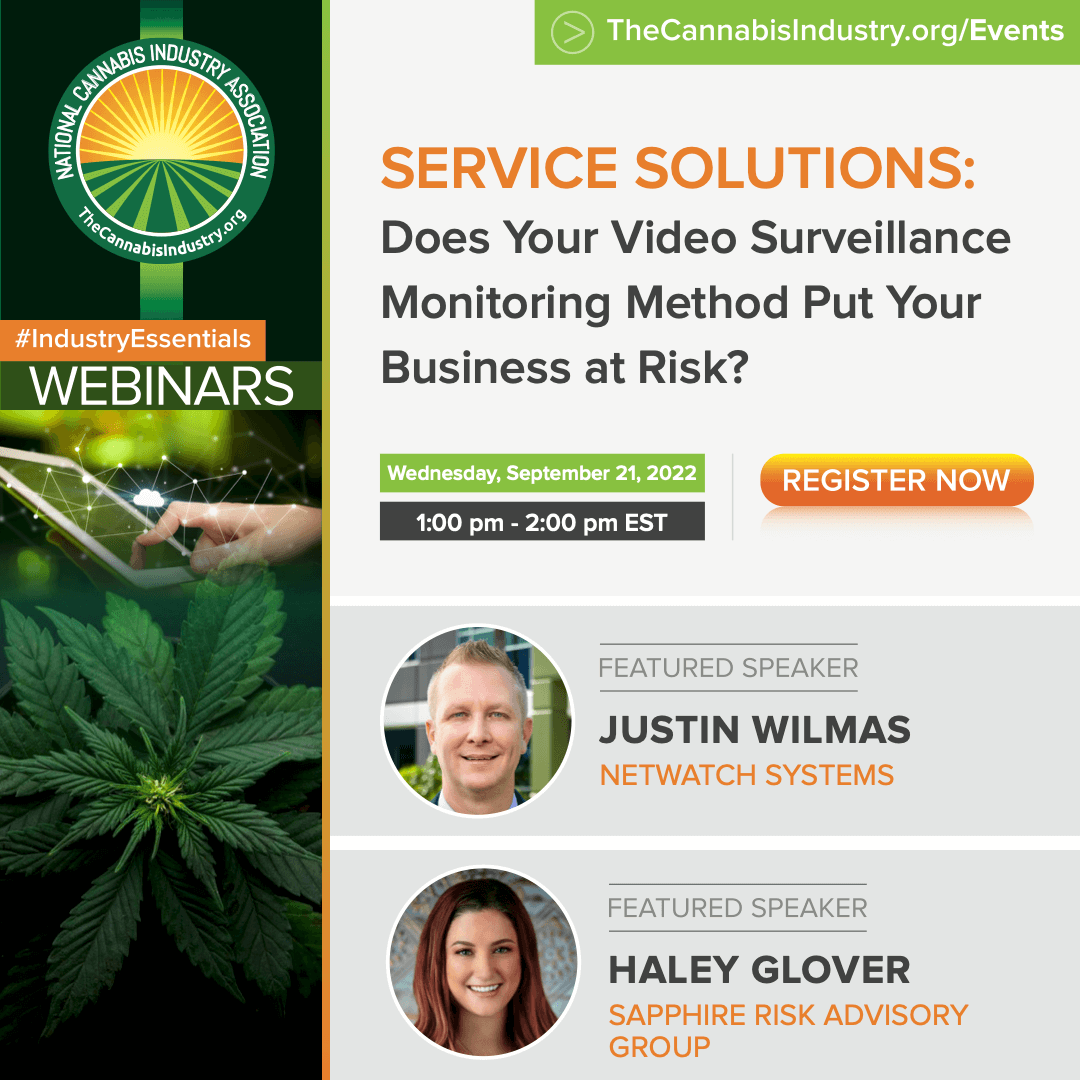
Service Solutions | 9.21.22 | Does Your Video Surveillance Monitoring Method Put Your Business at Risk?
NCIA’s Service Solutions series is our sponsored content webinar program which allows business owners the opportunity to learn more about premier products, services and industry solutions directly from our network of established suppliers, providers and thought leaders.
In this edition originally aired on Wednesday, September 21, 2022 we were joined by the experts from Netwatch North America and Sapphire Risk Advisory Group to discuss the stark differences between the most common methods businesses choose for video monitoring to clear up the confusion about the best method for your type of business.
Every business needs a video surveillance system to guarantee the security of its premises and improve business operations. As a high-risk industry, cannabis businesses have an even greater need for these systems. Cultivation facilities, processing labs, and dispensaries are high-value targets for potential criminals due to the large amounts of currency and cannabis products stored on-site.
In addition, these systems are necessary to remain compliant with local or state law. However, while regulations require cannabis businesses to equip their facilities with a functioning video surveillance system, regulations can be less restrictive about how these systems are monitored. Yet, the method of video monitoring chosen can determine how effective the business can be at reducing and preventing criminal activity.
You’ll leave the program with a roadmap for next steps to take to evaluate the methods currently in place, how best to conduct an assessment and implement new systems to ensure the security of your business AND the safety of your employees.
In this session, you will learn:
• What are the most common video monitoring methods for cannabis businesses?
• How does each method monitor, detect unauthorized activity, and comply with canna regulations?
• What is the best option for your type of business?
41:30 – Audience Q&A (When should I reach out to a PVM company during the cannabis business planning process?)
43:29 – Audience Q&A (What VMS systems does Netwatch currently integrate with?)
44:45 – Audience Q&A (Do insurance companies reward operators for proactive video? Is activity reporting for proactive surveillance a regulatory requirement in MA or other jurisdictions?)
46:42 – Audience Q&A (How does working with a security company like Sapphire help to save my company money?)
48:26 – Audience Q&A (How important and common are camera analytics in the industry?)
52:09 – Audience Q&A (Should I choose the security integrator/manufacturer to work with first or my video monitoring method?)
54:39 – Audience Q&A (How do you get in touch with a risk consultant?)
55:50 – Final Thoughts & Upcoming Events w/ Netwatch & Sapphire Risk Advisory Group
After years of trial and error, the modern extraction equipment and standard operating procedures have removed a significant amount of risk from volatile solvent extraction processes. As more and more states are looking to adopt marijuana policies involving volatile solvent extractions, I wanted to share some insights about safety I have learned in my 5 years of working in and with various extraction labs. Some of this may seem intuitive and obvious, some of it may not.
Employee Safety
Employee safety is the most important facet of safety in an extraction operation. Your employees are your greatest variable, but also the things you want to protect the most. Loss of life or limb is no joke and can often contribute to significant fines, license suspension, or even a total shut down – not to mention the emotional strain an injury-inducing incident can put on everyone.
I like to simplify employee safety into two areas: preparedness and equipment. Although your employees are a large variable in your operation, proper training, protective equipment, and process expertise will keep them safe from all but the direst of situations. Proper training should cover equipment usage, company SOPs, and hazard responses. Hazard responses will include emergency exit strategies, process shutdown, flushing station use, and will generally cover what an employee should do if hazardous conditions become present. Consistent training for your entire team will ensure that employee groups can regulate each other – one employee may catch another employee doing something that violates a company code and can prevent further incidents from occurring.
Equipment, in this case, means the personal protective equipment, or PPE. All extraction processes involve pressure, chemicals, or moving machinery and can cause bodily harm to your employees. At a minimum, employees should habitually wear goggles, gloves, and closed-toed shoes. Given that there are chances for chemical spills and irritation from fine plant matter particles, long sleeves and pants are also recommended – most labs are providing lab coats for their employees to fulfill this need. It is generally advised that you, the employer, should make protective equipment accessible to your employees and not require them to provide their own equipment. If your extraction processes involve hydrocarbons, make sure employees are aware of static build-up from their clothes. It is important to note that PPE generally doubles to prevent foreign materials from contaminating your product – hair and beard nets will provide added protection.
Equipment Safety
I like to consider equipment safety as an extension of employee safety because equipment failure or incident can typically be directly attributed to misuse by employees. Proper training is going to have the greatest impact on equipment safety, but installation, maintenance, and inspections will also dictate the longevity of your product and safe usage by employees. After selecting the proper unit for your operation, you should make sure that the unit is installed by a certified source. Most equipment manufacturers (EM) will offer training for you to have one of your employees be certified, or the EM will have a traveling resource that can visit your facility to ensure that install is done up to their standards. Once your unit has been installed, you need to have a 3rd party inspection done on your equipment and its operating area. One option is Pressure Safety Inspectors (PSI) – most local authorities will be happy to see a PSI stamp of approval and it will likely speed up your inspection process.
After initial equipment set up and approval, equipment safety largely boils down to maintenance and employee inspections. Most extraction units use components that will degrade over time: seals, gaskets, nuts and bolts, solvent lines and filters to name a few. You should implement a consistent replacement schedule, regardless of the appearance of these components, to ensure that they don’t become liabilities.
Beyond components, employees should also be performing regular integrity inspections of all unit vessels – if any damage is apparent, it is paramount that you contact the manufacturer to replace that component. Do not perform repairs on your own.
Facility Safety
Finally, we have facility safety. Luckily, modern technology has largely made facility safety autonomous – smart sensors detect solvents to ramp up airflow, fire suppression systems are automatically deployed, and control spaces can react efficiently to hazardous situations. However, because employees are still present, I do want to point out some areas that may be overlooked when it comes to facility safety.
First, signage. Signage can be anything from exit signs to hazardous material signs to reminders that PPE must be worn inside operating areas. Humans can be lulled into a sense of false security or forget important steps to operating safely and visual reminders go a long way to ensure that your employees are approaching their day to day tasks with the appropriate level of preparedness. Signs will also help employees efficiently vacate a space if there is a hazardous situation present – make sure your doors have panic bars and open outwards!
Another seemingly obvious, but often overlooked area of facility safety is the removal of ignitions sources from areas that contain hazardous materials. You must ensure that all equipment and components in a control area meet the electrical rating specified for that space. For example, a heat gun should never be used to expedite off-gassing of volatile solvents… it still happens more often than you would expect. Static build-up can occur because of certain textiles used in clothes along with plastic trash bags in plastic trash receptacles. Even tools should be spark-proof if they are going to be used in a control area.
Hopefully, some of the above information helps you ensure that your extraction processes are operating as safely as possible. As a parting thought, please listen to your employee’s feedback. If they feel unsafe or are questioning a process, do not write them off. They are on the front lines working in hazardous environments and will often see an issue before it becomes a catastrophe. As always, this is meant to be a guide, and you should always consult local authorities and follow regulations.
Xavier Jaillet has been a part of the cannabis industry since 2013 and worked in both businesses that are plant-touching and those that provide ancillary services to plant-touching operations. A brief stint in the mining, construction and transportation safety sector gave him a unique appreciation for safe operating practices and led him to HAL Extraction. HAL Extraction focuses on improving safety for manufacturing operations by designing smart, efficient, and effective extraction booths.




Follow NCIA
Newsletter
Facebook
Twitter
LinkedIn
Instagram
News & Resource Topics
–
This Just In
How THCa Vapes Are Changing Consumer
Announcing NCIA’s 2026-2028 Board of Directors