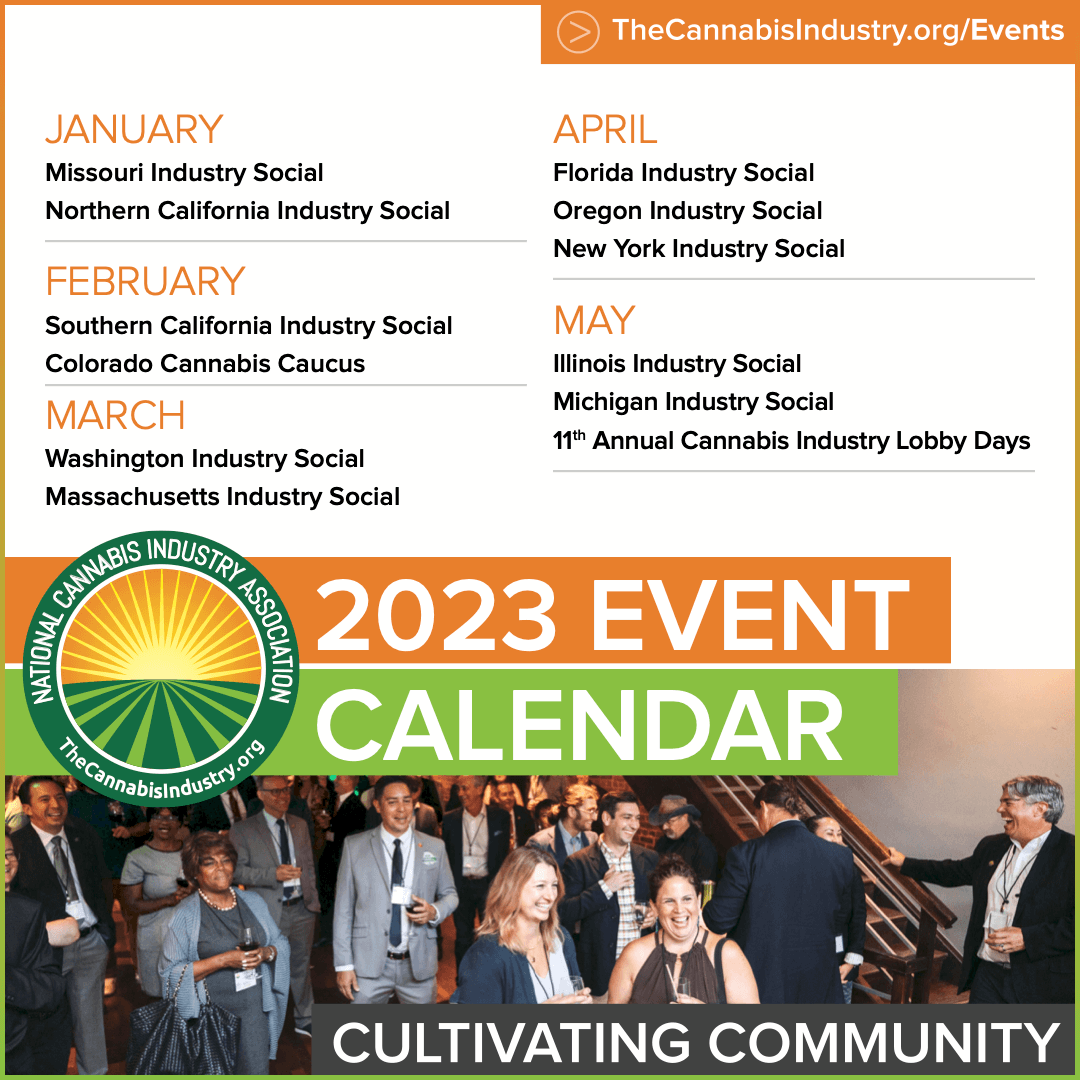
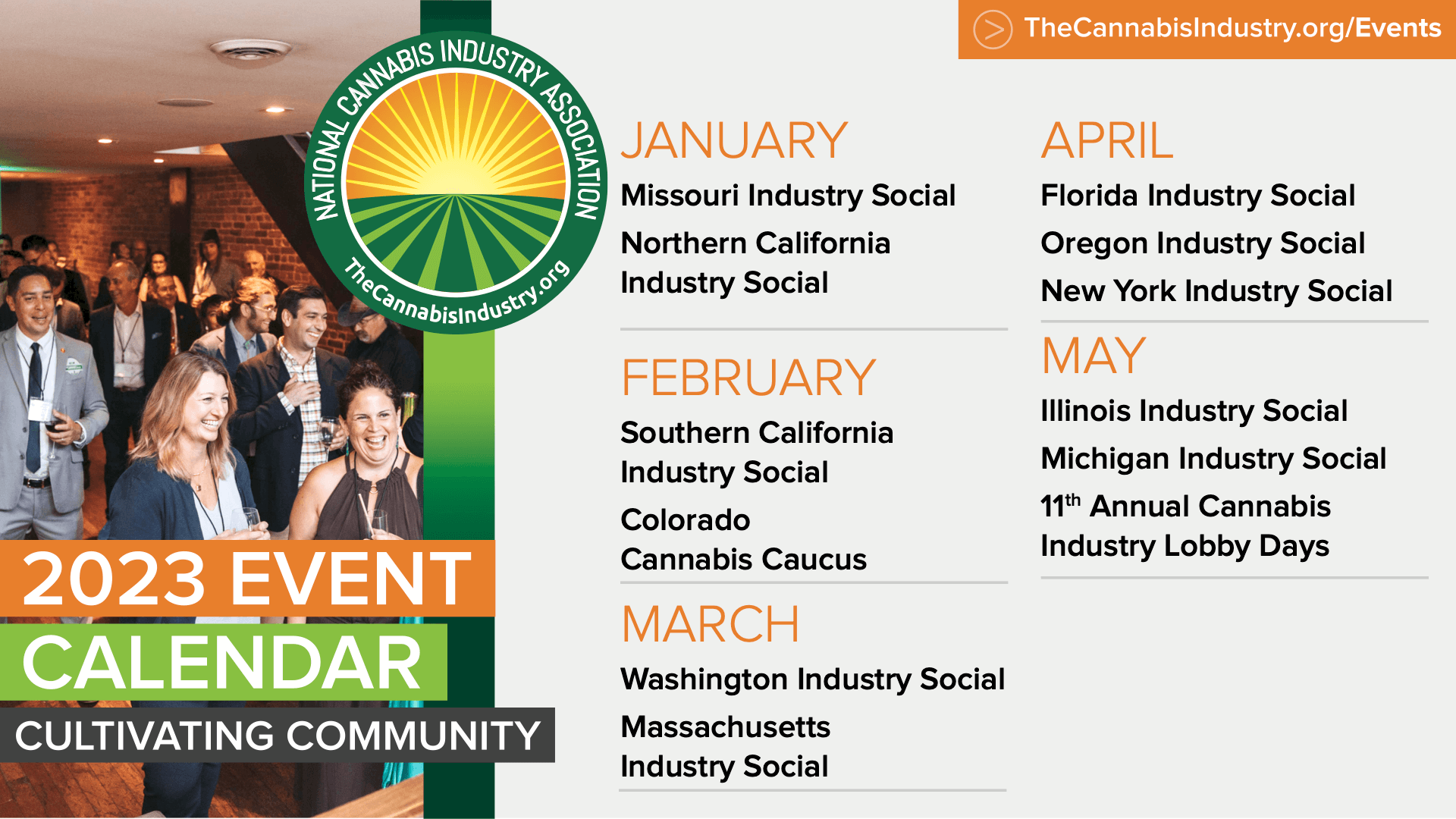
Cultivating Community in a City Near You: Announcing NCIA’s 2023 Event Calendar
It’s been a year of big change for NCIA. As we come to the end of 2022, we want to take a moment to send a message to our members and supporters about these changes, and most importantly, get excited for what’s next for the future of NCIA events.
The End of An Era
The events industry has faced unforeseen challenges these last couple of years, and NCIA was not isolated from these issues. Outside of needing to postpone our large tradeshows until late 2021, we also had to postpone a whole calendar of approximately 40+ events nationwide which was our primary way of connecting our community and meeting with our members face to face. Our team overcame these challenges by building our expansive digital presence and online events program to continue to provide education and exposure opportunities to our members, however this did still require a significant pivot in organizational strategy. Due to the residual hardships brought by the pandemic, we learned earlier this year that the Cannabis Business Summit & Expo was not going to be able to be produced on the scale or quality that we or our members had come to expect throughout the years. So, in tandem with our previous tradeshow co-producers, we made the difficult decision to dissolve our existing partnership and accepted an offer from them to acquire our tradeshow portfolio. For those who have been attending our tradeshows since 2014, we can’t thank you enough for your participation in those events and making them so impactful for the industry. There are too many good memories to revisit, and hope you take a moment to remember some of your personal highlights throughout the years as we look forward to coming together for new events in 2023.
Looking Ahead to 2023
For now, we will be taking a hiatus from the tradeshow space. This will allow our team to refocus our efforts into other impactful networking and educational opportunities. We’re excited to get back to our roots and focus our efforts on intentional and innovative gatherings that connect Main Street cannabis businesses with each other and with NCIA’s advocacy efforts.
We’ve listened to the feedback from our members, and know that in-person networking remains essential to building your business and growing your network. In these uncertain economic times, every dollar spent and any time away from your business impacts your bottom line. As the leading cannabis trade association representing small-business owners, we’re committed to making the investment to meet our members where they are, and to continue facilitating experiences where our members can make key connections with fellow business owners. Moving into 2023, we’re reinvigorating our events program starting with our regional Industry Social and Cannabis Caucus event series, leading into the cannabis industry’s biggest policy and advocacy event of the year: NCIA’s 11th Annual Cannabis Industry Lobby Days.
We invite you to move forward with us as we enter a new chapter in our history. Without further ado, we are excited to announce the lineup of events for the first half of 2023!
Join NCIA to Take Advantage of Complimentary Tickets
As always, NCIA members receive complimentary access to all of these events based on membership level. Looking to have an expanded presence at each event? Consider upgrading your membership today in order to include your entire team or prospective clients.
Huge thanks to the initial sponsors of these events which have made a significant investment in NCIA’s community building efforts moving into 2023! Learn more about each of these pioneering businesses helping drive our mission forward and reach out to schedule a meeting with their team surrounding the upcoming events.
Gold Sponsor
Silver Sponsor
Bronze Sponsor
Support These Events Through Sponsorship
Has your company had trouble breaking through the noise on a crowded expo floor this past year? Is your brand looking for quality B2B connections with market leaders? Want to play a larger role and align your business with NCIA’s community building and educational efforts?
Consider one of our affordable sponsorship packages, starting for as low as $500, which will allow you to reach thousands of leading cannabis businesses while supporting NCIA’s advocacy work on behalf of small cannabis businesses. Contact our team at sponsorship@thecannabisindustry.org to learn more.
In thriving cannabis markets, demand exceeds supply. For successful cultivation businesses, expansion is the logical next step — either through organic growth or the acquisition of operational cultivation assets. Before moving forward with an expansion project, entrepreneurs should carefully determine when is the appropriate time to expand. There are a number of market indicators that can help entrepreneurs decide if expansion is right for them — such as market demand, growth of market, and the potential for adult-use sales.
Current market demand for your product
What is the overall market demand for cannabis, and, more importantly, what is the demand for the cannabis that you cultivate? The answers to this question should be reflected in your sales volume and price point, and it should help influence a company’s decision on whether or not to expand. If you’re wholesaling your product to dispensaries for re-sale, or to large oil extractors of raw cannabis biomass, are you currently selling everything that you grow? Are customers calling you looking for product before it’s even harvested? Or, are you spending hours on the phone trying to unload product before the next harvest? How does your product sell at the dispensary, compared to your competitor? Does it fly off the shelf or frequently find itself discounted as the weekly special?
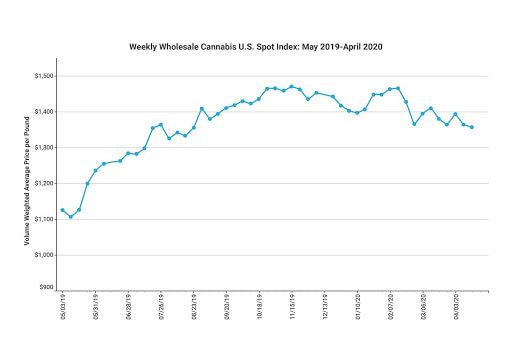
The price at which you’re selling your dried cannabis flower should be an excellent indication of whether or not expansion makes sense. Do you spend much time haggling over money, or can you name your price? In hot new markets, where there are few suppliers and great demand, wholesale cultivators can charge up to $4,000 per pound for indoor-grown cannabis. In more seasoned markets with multiple cultivators, wholesale prices are closer to $1000 to $1500 per pound. The closer your sales are to $4,000 per pound, the more it makes sense to expand.
Figure 9.2 Wholesale prices across the U.S. as of April 2020. Copyrighted by Marijuana Business Daily, MJBizDaily.com. Used with permission.
Size and growth of market
The size and growth rate of a medical cannabis market is a good indicator of whether or not a business should consider expanding. In regions with a medical cannabis program, the percentage of the adult population registered as medical cannabis patients is an excellent indicator of the current size of the medical market. However, a cannabis business considering an expansion should be less concerned with how big the market is today, and more focused on how large it may be tomorrow instead.
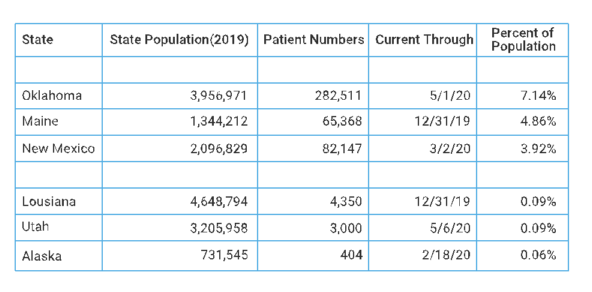
In most U.S. states, about two percent of the adult population become medical cannabis consumers. A rate of lower than one percent is rare. This typically occurs when there are few doctors willing to prescribe cannabis, or there’s a very restrictive list of medical conditions for which cannabis can legally be prescribed. In Oklahoma, more than seven percent of adults are registered cannabis patients, while in Ohio only 0.6% of the adult population have registered as medical patients. If the percentage of adult medical patients in your area is above two percent, it’s a good sign that the medical cannabis industry is thriving. Markets with more patients are more attractive for cultivators to expand.
Figure 9.3 The top three and bottom three U.S. medical cannabis markets by percentage of registered adult patients. Source: Marijuana Policy Project
The rate of new patient registrations is a much better indicator of a given market’s potential for growth. Single-digit increases in new patient registrations year-over-year are not positive indicators. Cultivation businesses considering expansion want to be in states where the number of medical patients is increasing by at least twenty percent annually. This kind of growth would indicate a widespread adoption of medical cannabis and few barriers to receiving a medical cannabis prescription. Florida is an example of a thriving medical cannabis market, where patient registrations increased fifty percent during 2019 alone to over 300,000 patients.This kind of positive growth gives cultivation businesses a good reason to expand.
Competition
However, a robust cannabis market may not make the best expansion opportunity if there are numerous cultivators competing for the same customer base. California and Colorado are established cannabis markets — both medical and [adult-use] — servicing millions of customers each year. That’s exactly the reason expanding in those states may not be as lucrative as opportunities presented by less populated states. In 2019, California sold an estimated $3 billion in recreational cannabis — but there are nearly 3,000 licensed recreational cultivators in the state. In saturated cultivation markets, wholesale flower is quickly relegated to a commodity. Large, established markets, like California and Colorado, don’t hold the same potential value for expansion as a state that may have fewer consumers but is on the cusp of legalization.
Competition doesn’t only come from other licensed commercial cultivators, but from caregivers as well. Caregivers are home growers that are permitted to cultivate plants for medical cannabis patients. Consumers appreciate the personal touch that caregivers offer their clients, and the growers have more flexibility on pricing than do dispensaries. In medical markets, a thriving caregiver industry can seriously hamper retail dispensary sales and lessen the need for wholesale cultivators to supply them. Cultivation businesses should be cautious of expanding into markets with a strong caregiver presence. Coupled with competition from other commercial cultivators, this may not be as lucrative an expansion opportunity as other markets without such a caregiver network.
Adult-use cannabis is coming
The biggest influencing factor for cultivation companies considering expansion should be impending adult-use legislation. Servicing adult-use markets is much easier and more profitable than servicing medical cannabis markets. There are no patients, doctors, or prescriptions involved, and there’s a robust customer base on the very first day of sales. There is no need to develop a demand for recreational cannabis, because it already exists — everywhere! It’s only a question of transitioning paying customers from the illicit market to the legal market.
The ideal situation for expansion is a cannabis business operating a cultivation facility in a medical cannabis market where there’s good reason to believe there will be a transition to recreational cannabis soon. Medical dispensaries are often the first to receive permission to commence recreational sales, since they already have the infrastructure and processes in place. However, these dispensaries never have enough product to meet demand. In an attempt to protect their medical patient base, most fall woefully short of supplying the adult-use market. Expanding cultivation activities in anticipation of recreational use can place a cannabis business in an excellent position to service this new market.
This situation can be even more lucrative if the state that legalizes recreational sales is bordered by states with only medical cannabis laws, or no cannabis legislation at all. Adult-use stores sell to individuals from out of state that are 21 years of age or older, and cross-border traffic contributes substantially to a state’s total recreational cannabis sales. In the first four months of Illinois’ recreational cannabis program, transactions from out-of-state customers accounted for twenty percent of total state sales.
Excerpt from From Seed to Success: How to Launch a Great Cannabis Cultivation Business in Record Time by Ryan Douglas. Douglas is founder of Ryan Douglas Cultivation, a cannabis cultivation consulting firm. He was Master Grower from 2013-2016 for Tweed, Inc., Canada’s largest licensed producer of medical cannabis and the flagship subsidiary of Canopy Growth Corporation.
Your 2016 Cannabis Ballot Initiative Rundown
Michelle Rutter, NCIA
by Michelle Rutter, NCIA’s Government Relations Coordinator
In November, five states will vote on legalizing adult-use cannabis for individuals over 21 – Arizona, California, Maine, Massachusetts, and Nevada – while an additional four states will vote on medicinal cannabis reform – Arkansas, Florida, Montana, and North Dakota. All nine initiatives differ slightly from one another and each has its own unique language.
Below are NCIA’s quick summaries of each of the initiatives. Read up, then visit the campaign sites for more information and how you can help make 2016 another success in the fight to end marijuana prohibition.
ADULT-USE
ARIZONA
The Campaign to Regulate Marijuana Like Alcohol (Proposition 205) legalizes the possession and consumption of marijuana by persons who are over 21 and levies a 15% tax on the sale of cannabis, which would then be allocated to education and healthcare in the state. This would create an estimated $113 million in new tax revenue.
– Allows local governments to regulate and limit cannabis businesses
– If passed, Arizona’s cannabis market is projected to surpass $1 billion within three years
The Adult-Use of Marijuana Act (AUMA) (Proposition 64) legalizes the possession and consumption of marijuana by persons who are over 21 and enacts a 15% sales tax, as well as a cultivation tax of $9.25 per ounce of flowers and $2.75 per ounce for leaves.
– Estimated $1.4 billion in revenues within the first year of a fully operational market
– Written to prevent licenses for corporate or large-scale cannabis businesses for five years, which is in order to deter “unreasonable restraints on competition by creation or maintenance of unlawful monopoly power”
California has the largest state cannabis market (medical or adult-use) in the country, estimated at $2.7 billion in 2016.
The Campaign to Regulate Marijuana Like Alcohol (Question 1) legalizes the possession and consumption of marijuana by persons who are over 21 and enacts a 10% sales tax in addition to the state’s 5.5% sales tax. The first $30 million in tax revenue from cannabis sales would be used for school construction, with any additional revenue allocated to the General Fund.
– Medical cannabis will not be subjected to the 10% sales tax
– Caps the number of cannabis stores and cultivators until 2019 and 2022, respectively
The Campaign to Regulate Marijuana Like Alcohol (Question 4) legalizes the possession and consumption of marijuana by persons who are over 21 and creates a Cannabis Control Commission of three members appointed by the state Treasurer, which would generally administer the law governing cannabis use and distribution, promulgate regulations, and be responsible for the licensing of commercial cannabis establishments. It also creates a Cannabis Advisory Board of 15 members appointed by the Governor.
– Enacts an excise tax of 3.75%, in addition to the state sales tax
– A city or town could impose a separate tax of up to 2%
The Campaign to Regulate Marijuana Like Alcohol (Question 2) legalizes the possession and consumption of marijuana by persons who are over 21 and designates the Nevada Department of Taxation to issue licenses to cannabis retailers, suppliers, testing facilities, and distributors.
– Gives local governments control over cannabis business locations, and forbids businesses to operate near schools, childcare facilities, houses of worship, and certain community facilities.
– Enacts a 15% excise tax on wholesale sales of cannabis, in addition to the existing sales tax which would apply to the retail sale of cannabis
– Revenue generated from these taxes would be used to support K-12 education
There are two competing initiatives on the 2016 ballot: the Arkansas Medical Cannabis Act (AMCA) and Arkansas Medical Marijuana Amendment of 2016 (AMMA), known as Issue 7 and Issue 6, respectively. The main differences lie in patient card fee limits, the organizations that would implement the program, the distribution of sales tax revenue, and whether certain patients could cultivate their own medicine. As of October 2016, Issue 7, the Arkansas Medical Cannabis Act (AMCA) was struck from the ballot. The initiative will still appear on the ballot, but the results will not be counted.
Arkansas Medical Cannabis Act (AMCA):
– Sets a cap on the fees required to get dispensary and cultivation licenses and the fees required for patient cards
– Assigns the Arkansas Department of Health to set rules for patient cards, medical conditions that qualify a patient for medical marijuana use, and operating rules for dispensaries and cultivators
– Requires that all sales tax revenue goes back into the medical marijuana program
– Permits qualified cardholders to purchase medical cannabis from non-profit compassion centers
– Allows patients and their caregivers to cultivate up to 10 cannabis plants at home provided they take steps to ensure it is secure
Arkansas Medical Marijuana Amendment (AMMA):
– Sets a cap on the fee required to acquire a dispensary or cultivation license, but no limit on the cost for patient card fees;
– Assigns the Arkansas Department of Health to set rules for patient cards and medical conditions that qualify a patient for medical marijuana use, and the Arkansas Alcoholic Beverage Control to establish operating rules for dispensaries and cultivators;
– Divides sales tax revenue, assigning 10% to the medical marijuana program, 10% to the Skills Development Fund, 30% to the state’s General Fund, and 50% to the state’s Vocational and Technical Training Special Revenue Fund
The Florida Right to Medical Marijuana Initiative (Amendment 2) allows medical use of cannabis for individuals with debilitating medical conditions as determined by a licensed Florida physician and allows caregivers to assist patients’ use of medical cannabis.
– Mandates that the Department of Health shall register and regulate centers that produce and distribute cannabis for medical purposes shall issue identification cards to patients and caregivers.
– Constitutional amendments on the ballot in Florida must garner at least 60% in order to pass. This is why the medical cannabis amendment on the ballot in 2014 failed, despite receiving 58% of the vote.
Montana is voting to amend their dysfunctional medical cannabis program that has basically been regulated out of existence. The initiative amends the Montana Marijuana Act of 2011 and renames it the “Montana Medical Marijuana Act” (I-182).
– Allows providers to hire employees to cultivate, dispense, and transport medical cannabis, and repeals the limit of three patients for each licensed provider.
– Repeals the requirement that physicians who provide certifications for 25 or more patients annually be referred to the Board of Medical Examiners.
– Removes the authority of law enforcement to conduct unannounced inspections of medical marijuana facilities and requires annual inspections by the State
The North Dakota Medical Marijuana Initiative will be Initiated Statutory Measure 5 on the ballot and is also known as the North Dakota Compassionate Care Act, which creates a state-regulated medical marijuana program for patients with specified debilitating conditions and written certifications from their doctors. Registered patients could obtain medical cannabis from a licensed non-profit compassion center, and if the patient lives 40+ miles away, they are permitted to cultivate a limited amount of cannabis for their medical use.
This year it’s more important than ever to make sure you’re registered to vote and get to the ballot box on November 8th. If you live in one of the nine states with a ballot initiative, cast your vote for ending prohibition or allowing patients access to medicine. Otherwise, don’t forget to cast your ballot for candidates at the local, state, and federal level who support cannabis reform to ensure that 2017 is the industry’s biggest year yet!
2016: What’s Next?
by Michelle Rutter, Government Relations Coordinator
This year is arguably the most crucial yet for the burgeoning cannabis industry, especially as it relates to policy. Although NCIA primarily advocates for cannabis reform at the federal level, what happens in each individual state is vital to the stances Members of Congress take on our issues.
Members of Congress care deeply about issues that directly affect their specific state or district. It’s imperative that more states enact cannabis reform legislation so that more Members have a vested interest in protecting their constituents. While cannabis reform is sweeping the nation at an almost unprecedented rate, it takes time for politicians in Washington, D.C., to catch up with public opinion back home. If all of the federal lawmakers representing just the 15 states mentioned below were to vote positively on pro-cannabis legislation, it would add up to more than 180 Representatives and nearly 30 Senators.
Take a look below and see what’s coming up next in 2016. Remember that by becoming a member of NCIA, you are adding your voice to the coordinated and unified campaign at the federal level to allow cannabis businesses access to financial services, fix tax section 280E, and ultimately end federal cannabis prohibition.
The United States of Cannabis
Arizona activists remain ahead of schedule and have nearly gathered the 150,000 signatures needed to put the state’s Campaign to Regulate Marijuana Like Alcohol initiative on the November 2016 ballot. (The campaign ultimately aims to collect 230,000 in order to insure against signature drop-off.) It’s estimated that Arizona’s adult-use market could be worth up to $480 million.
With a multi-billion-dollar cannabis industry in California alone, passing an adult-use legalization initiative in the state is vital to ending federal prohibition. The most prominent full retail initiative gathering signatures for the November 2016 election is the Adult Use of Marijuana Act, which is backed by billionaire Sean Parker and the Marijuana Policy Project.
Legalize Maine and the Marijuana Policy Project have joined forces to legalize adult-use cannabis in 2016. Legalize Maine has already collected 80,000 signatures. Only 61,000 signatures are necessary to place the measure on a statewide ballot, but the organization’s goal is 95,000, to insure against drop-off. The deadline to submit signatures is February 1st.
Last August, a pair of cannabis advocacy groups separately filed paperwork to get adult-use legalization on the 2016 ballot in Massachusetts. The state recently confirmed that a measure to legalize recreational cannabis next year has enough valid signatures to force the legislature to consider the measure. If the legislature decides to pass, then the campaign will have to collect another 10,792 signatures to formally make the November ballot.
There’s no question that adult-use legalization will be on the ballot this year in Nevada. Initiative Petition 1, which would tax and regulate marijuana similarly to alcohol, has been certified for the 2016 ballot. Backers had previously collected nearly 200,000 signatures to either force legislators to enact their initiative or put it on the ballot. When state lawmakers abstained from voting on the issue, the measure was automatically forwarded to this year’s ballot for a popular vote.
In Florida, the group United for Care received clearance from the state Supreme Court for a 2016 ballot measure that would legalize medical marijuana. The group nearly succeeded in legalizing medical marijuana in 2014, garnering 58% of the vote but falling barely short of the state’s constitutionally mandated 60% margin needed to pass,
The nation’s capital continues to debate cannabis. In December’s federal budget bill, the taxation and regulation of marijuana in Washington, D.C., was blocked by Congress again, though possessing and gifting cannabis remains legal in the city.
This month, Hawaii will begin accepting applications for medical cannabis businesses. The bill signed into law last summer opens the door for up to 16 dispensaries on the islands.
It was recently announced that Illinois saw approximately $1.7 million in medical cannabis sales during November and December of 2015. There are already petitions being circulated in the state that would expand the law’s qualifying conditions.
Maryland will award cannabis cultivation, processing, and dispensary licenses this summer. Industry advocates were pleased with the amount of interest the state’s program garnered: more than 1,000 applications were submitted.
Officials in Michigan have approved language for three different adult-use cannabis legalization initiatives for the 2016 ballot. In order to have the best chance of passing, it’s important for these groups to coalesce behind one initiative.
At the end of 2015, New Hampshire began issuing medical marijuana cards to qualifying patients. It’s expected that the state will open medical dispensaries in 2016.
After a long and arduous journey, New York’s medical cannabis program became operational this month. The cannabis industry expects the program and the law’s qualifying conditions to expand this year.
In the first week of 2016, Oregon began accepting adult-use cannabis business license applications. The state has no limit on how many licenses they will decide to award.
Vermont may become the first state to legalize adult-use cannabis through the legislative process in 2016. The proposed bill would allow for up to 86 storefronts and five different business license types.
Bonus: Election 2016 – Yes, We Canna
As we all know, a new president will be elected this November, and with that a new administration will assume power next January. It is very crucial that Congress pass more pro-cannabis legislation before then.
It’s probable that Attorney General Loretta Lynch will be replaced in 2016 or early 2017. This is important because it is the Department of Justice that enforces and prosecutes federal marijuana laws.
Another possibility for 2016 is that the acting head of the Drug Enforcement Administration, Chuck Rosenberg, could be replaced as well. Rosenberg is notorious for his gaffe last year when he called marijuana “probably” less dangerous than heroin.
On New Year’s Eve, officials from the Substance Abuse and Mental Health Services Administration posted a notice on the Federal Register that calls for a report “presenting the state of the science on substance use, addiction and health” to be released in 2016. Industry advocates are hopeful that this report could be the first sign of re- or de-scheduling cannabis from the Controlled Substances Act.
During 2016, NCIA will continue working with D.C.-based public affairs firms Heather Podesta + Partners, and Jochum Shore & Trossevin PC to magnify our efforts to address the industry’s top federal priorities: access to basic banking services and fair federal taxation.
In addition to NCIA’s lobbying and advocacy efforts, NCIA exists to connect and educate our members on all facets of the cannabis industry. Our industry supports tens of thousands of jobs, tens of millions in tax revenue, and billions in economic activity in the United States.Our core mission is to ensure that our members are treated like businesses in any other American industry. Join NCIA today to get involved and be a part of the cannabis revolution!
by Michelle Rutter, Government Relations Coordinator
As we look forward to 2016, there’s much on the horizon for the cannabis industry. NCIA remains dedicated in its effort to pass banking and tax legislation through Congress that would provide immediate relief to cannabis-related businesses all over the country.
In addition to the federal advocacy that NCIA engages in every day, there will be at least five states seeking to legalize and regulate adult-use cannabis via the ballot initiative process: Arizona, California, Maine, Massachusetts, and Nevada. It’s also likely that Florida will have another ballot initiative relating to medical cannabis, and it’s possible that other states will move forward with cannabis reform through ballot initiatives or legislative processes. What happens over the next twelve months will be crucial in shaping the future of the legitimate and responsible cannabis industry.
While 2015 was a milestone year for cannabis reform, that same momentum will be necessary in order to continue moving the conversation forward with Congress in Washington, D.C. The Rohrabacher-Farr medical cannabis amendment earned more that 60 Republicans votes. For the first time ever, there are multiple pro-cannabis bills that have been introduced in the U.S. Senate. Continued progress is vital in garnering more national support for cannabis reform, so make sure your interests are heard through national advocacy, education, and community with NCIA.
The timeline below lays out some of the highlights from a busy year in cannabis industry advocacy. We look forward to more exciting milestones with your help in 2016!
*Click on the “Full Screen” button (with the four arrows) at the bottom of the image to expand its size.


 Excerpt from
 MEDICAL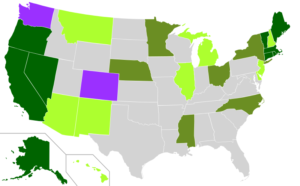
Follow NCIA
Newsletter
Facebook
Twitter
LinkedIn
Instagram
News & Resource Topics
–
This Just In
Committee Blog: Access to Capital in the U.S. Cannabis Market Outlook
Member Blog: The Risks of Removing a Regulated Cannabis Market