Bills in Congress, SAFE Banking, and House and Senate Committees
by Michelle Rutter Friberg, NCIA’s Deputy Director of Government Relations
While it got off to a slow start, the 118th Congress is finally in full swing. Let’s take a look at some of the latest cannabis and government relations news coming out of Washington, D.C.:
Bills are being introduced
When a new Congress begins, all legislation from the last session must be re-introduced and start from scratch again in the legislative process. Over the last few weeks, a couple of cannabis bills have been reintroduced: two from Congressman Greg Steube (R-FL) and one from Congressman Alex Mooney (R-WV).
Rep. Mooney was the first to introduce a cannabis bill for the 118th Congress when he released his Second Amendment Protection Act. Last Congress, a similar bill was filed by the late Rep. Don Young (R-AK) known as the Gun Rights And Marijuana (GRAM) Act. The full text of the new measure is not yet available so it’s unclear what exactly the bill contains, but advocates expect the bill to be similar to the version Mooney introduced in the 116th Congress. Interestingly, although federal law explicitly prohibits all Americans who consume or possess marijuana from purchasing or possessing a firearm, a judge in Oklahoma late last week declared that ban unconstitutional.
Congressman Steube’s two bills were the Veterans Cannabis Use for Safe Healing Act and the Marijuana 1-to-3 Act. The former prohibits the Department of Veterans Affairs (VA) from denying a veteran any VA benefit due to participation in a state-approved marijuana program. For veterans participating in these approved programs, the VA must ensure its healthcare providers both discuss marijuana use with such veterans and adjust treatment plans accordingly and record such use in the veterans’ medical records. The latter bill, the Marijuana 1 to 3 Act, has been introduced by Rep. Steube in past sessions and seeks to do exactly what the title says: reschedule cannabis to Schedule 3 – a reform that would not resolve the federal conflict with the vast majority of state laws with some form of legal cannabis
A SAFE Bet?
The cannabis industry may have been devastated when Congress failed to pass the SAFE Banking Act last Congress, but we’re not giving up yet! Congressional champions have every intention of reintroducing SAFE in both chambers, but don’t expect the bill to look identical to last session.
Last week, Senate Majority Leader Schumer held a closed-door meeting with a number of other Democratic Senators to discuss what’s next for the bill. Reportedly, the Senators discussed changing the text of the bill to reflect some of the “SAFE +” language that was negotiated at the end of 2022, including the HOPE Act. It’s currently unclear if the House’s version will be identical.
Committees Finally Seated
It took Congress longer than usual to seat committees this session – particularly in the House – but we now know which members will have jurisdiction over which issue areas. Our friends at Politico put together an extensive list, but some committees I’ll be keeping my eye on include the House Judiciary Committee, the Senate Banking Committee, and the Appropriations Committees in both chambers.
House Floor Debates, Markups, and Beyond for SAFE Banking and MORE Act
Photo By CannabisCamera.com
By Michelle Rutter Friberg, NCIA’s Deputy Director of Government Relations
Usually, things are somewhat slow when it comes to cannabis policy reform in Washington, D.C., but the last week has been quite the whirlwind! In the span of one week, the SAFE Banking Act was included in (and passed via) the must-pass National Defense Authorization Act (NDAA) and the House Judiciary Committee marked up and subsequently passed the Marijuana Opportunity, Reinvestment, and Expungement (MORE) Act!
Last week, the House passed the language of the SAFE Banking Act for the fifth time via the must-pass NDAA. NCIA and our allies on Capitol Hill are always trying to be creative and come up with new, different avenues to advance our policy priorities, and the NDAA was a great opportunity that we were able to take advantage of! At first, there were some concerns that the language (proposed as an amendment to the larger package) would not be ruled germane, however, we were able to clear that hurdle in the House Rules Committee, allowing the provision to move forward for Floor debate and a vote.
The amendment was then debated for a short period of time on the House floor and for the first time ever, passed via voice vote! This is incredibly exciting and reinforces the strong, bipartisan support that this legislation has.
SAFE’s inclusion in the Senate’s version of the bill is a bit more uncertain. Currently, the Chair and Ranking Member of the Senate Armed Services Committee (which has jurisdiction over the NDAA) have circulated their draft of the package that differs in many ways from the House’s bill. Here at NCIA, we will be working with Senate allies to determine what’s next for the NDAA in that chamber and collaborating with other stakeholders to ensure that the SAFE Banking language is included and passed into law. I’ll be the first to admit that I am not (nor have I ever been) a defense lobbyist, however, I’m definitely getting a crash course now!
Then, less than 24 hours later, the House Judiciary Committee announced that they would be holding a markup on the Marijuana Opportunity, Reinvestment, and Expungement (MORE) Act. You’ll recall that the MORE Act was marked up in that committee in November 2019 (during the last Congress), and passed by a vote of 24-10. Then, after all of the other relevant committees waived their jurisdiction, the MORE Act was brought to the House Floor in December 2020 and passed 228-164.
While the MORE Act passed out of the Judiciary Committee this session by a vote of 26-15, the bill still has a long journey ahead of it. It’s unlikely that committees like Ways and Means and Energy and Commerce will waive their jurisdiction again, and it’s critical to remember that the chamber actually became slightly more conservative following the 2020 election. Additionally, there is no companion legislation in the Senate as of publication.
As always, NCIA will continue to work with our allies and stakeholders on and off Capitol Hill to get these policies enacted into law. Have questions? Find me on NCIA Connect. Want to become more involved with policy at NCIA? Learn more about our new Evergreen Roundtable here.
A (Mostly) Non-COVID-19 Legislative Update
by Michelle Rutter Friberg, NCIA’s Deputy Director of Government Relations
I don’t know about you, but it seems no matter where I look, everything is about COVID-19. And with good reason — many of us are still working from home, helping their families with distance learning, and overall dealing with the effects of the virus. That being said, this week I wanted to take a look at two pieces of cannabis legislation — non-COVID related — and update you on where things stand, since we’re already nearly halfway through 2020!
The SAFE Banking Act
Last September, the SAFE Banking Act became the first piece of cannabis reform legislation to ever pass out of the United States House of Representatives by an astounding bipartisan vote of 321-103. The first iteration of the bill, named the Marijuana Businesses Access to Banking Act, was introduced to the 113th Congress back in 2013 and has made a long journey to get to this point in the legislative process.
Now that the SAFE Banking Act has passed the House, its journey has continued in the more conservative, Republican-controlled Senate. However, just before Christmas, Senate Banking Committee Chairman Mike Crapo (R-ID) issued a press release detailing his opposition to cannabis policy reform — including the SAFE Banking Act as it’s currently written. In the release, Chairman Crapo said,
“I remain firmly opposed to efforts to legalize marijuana on the federal level, and I am opposed to legalization in the State of Idaho. I also do not support the SAFE Banking Act that passed in the House of Representatives. Significant concerns remain that the SAFE Banking Act does not address the high-level potency of marijuana, marketing tactics to children, lack of research on marijuana’s effects, and the need to prevent bad actors and cartels from using the banks to disguise ill-gotten cash to launder money into the financial system.”
Even now with COVID-19, NCIA is virtually lobbying for the SAFE Banking Act, or some of its provisions, to be included in the next coronavirus relief package. Before COVID-19, the all-cash situation cannabis businesses face created an unnecessary public safety risk and undue safety burden on state and local tax and licensing authorities who must receive and process large cash payments. Now, as recent reports show that viruses can live on cash for up to 17 days, the public safety concerns of this cash-only system compound. The lack of access to financial institutions places industry workers, government employees, and the public-at-large at risk as banknotes circulate from consumers and patients to businesses to government.
NCIA is continually working with Sen. Crapo, congressional and committee staff, coalition partners, and the bill’s cosponsors to ensure that all parties have the materials and information that they need in order to solve this pressing public safety– and now, public health– issue and pass the SAFE Banking Act into law!
The MORE Act
In November, by a vote of 24-10, the House Judiciary Committee approved the Marijuana Opportunity Reinvestment and Expungement (MORE) Act of 2019, or H.R. 3884. This bill was introduced by House Judiciary Committee Chairman Jerrold Nadler (D-NY) and currently has 73 cosponsors. This was the first time that a congressional committee held a vote on – let alone approved – a comprehensive bill that would make cannabis legal. Perhaps even more significantly, this bill recognizes and works to address the disproportionate impact prohibition has had on marginalized communities and people of color while helping to increase access and opportunity in the legal cannabis industry.
The bill still has a long way to go, though. While the House Judiciary Committee has passed the legislation, there are still six more congressional committees with jurisdiction over the bill, including the Energy and Commerce, Agriculture, Education and Labor, Ways and Means, Natural Resources, and Oversight and Reform committees. In January, the House Small Business Committee waived its jurisdiction over the MORE Act.
While the MORE Act does not contain an explicit regulatory structure for cannabis after it is descheduled, Chairman Nadler said in a press conference the day before the markup vote that it was possible amendments could be added to the bill as it moves through the House.
All that being said, it’s unclear what Congress’ schedule will look like for the rest of the year. The Senate returned to Washington yesterday, however, the House remains out of session as concerns about legislating in the age of COVID-19 remain. On top of that, 2020 is an election year, which complicates matters (and scheduling) even more. Regardless, I hope you can rest assured knowing that NCIA’s government relations team is working around the clock to advocate for the cannabis industry — whether that be banking reform, ending cannabis criminalization, or allowing for SBA relief. From D.C. to wherever you are, stay healthy!
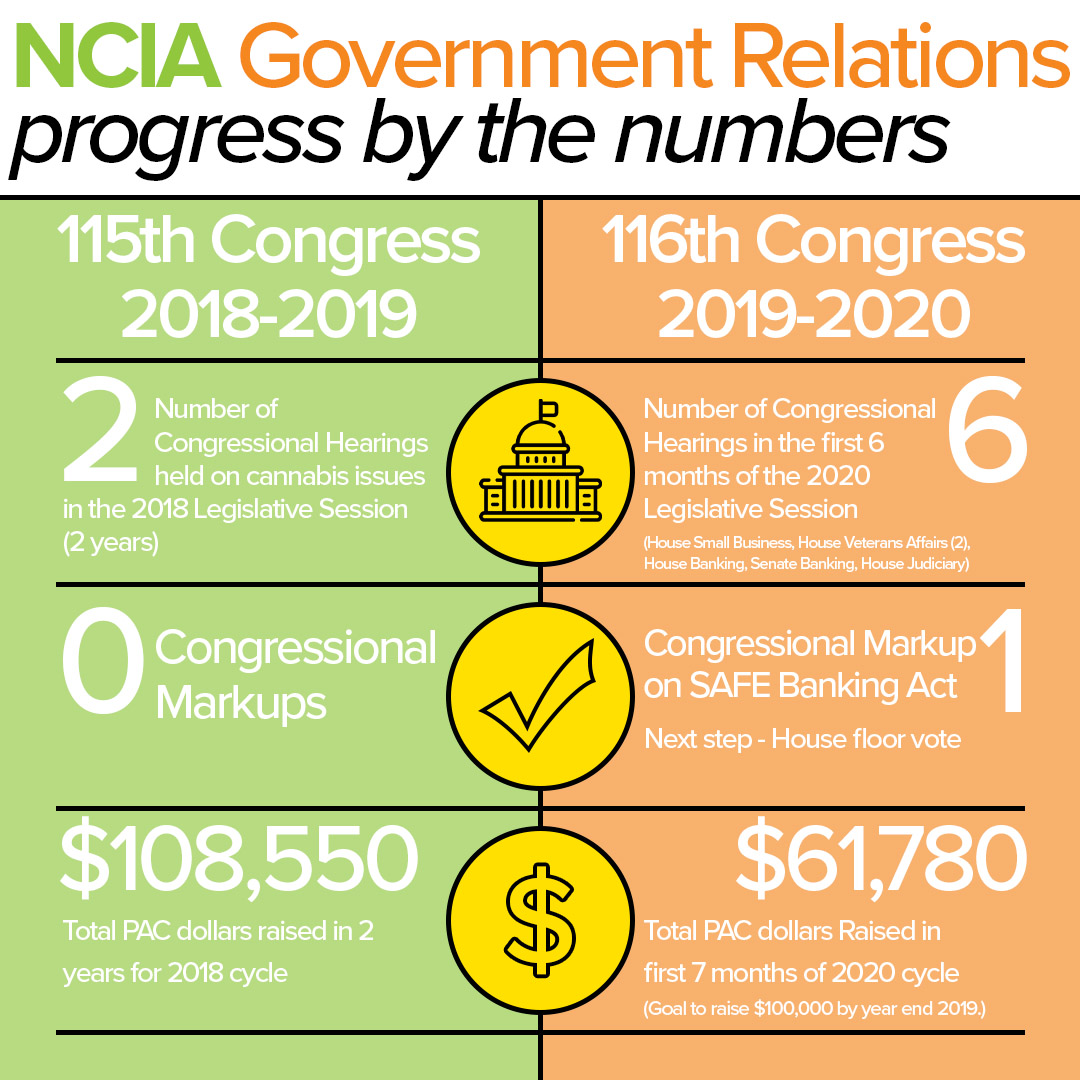
2019 By The Numbers (So Far!)
August recess is winding down, and soon, Members of Congress will return to D.C. for the remainder of the year. This year, however, was a benchmark year for cannabis policy, and we still have four months left to go! Let’s take a look back on how 2018 compared to 2019 (so far!).
2:
Number of Congressional hearings held on cannabis issues in the 115th Congress (2017-2018)
6:
The number of Congressional hearings as of August 2019 in the following committees:
House Small Business Committee House Veterans Affairs Committee (2) House Financial Services Committee Senate Banking Committee House Judiciary Committee
95:
The number of cosponsors the House version of the SAFE Banking Act garnered during the entire 115th Congress.
206:
The number of cosponsors on H.R. 1595, the SAFE Banking Act, just in the first seven months of 2019.
0:
The number of Congressional markups held on a cannabis bill in the 115th Congress.
1:
The number of Congressional markups held on a cannabis bill in the 116th Congress. In March 2018, the House Financial Services Committee marked up H.R. 1595: the SAFE Banking Act. It passed out of Committee by a vote of 45-15.
$108,550:
Total NCIA-PAC dollars raised for the 115th Congress (2017-2018)
$61,780:
Total NCIA-PAC dollars raised in the first 7 months of 2019. Our goal to raise $100,000 by the end of the year, so make sure you learn more about the NCIA-PAC here!
We have been busy this year advocating for pro-cannabis policy reform and will continue pounding the pavement on Capitol Hill. We look forward to all of the successes yet to come in 2019 and beyond!
Re-Cap of House Judiciary Hearing on Marijuana Laws in America
On Wednesday, for the first time ever, lawmakers in the House of Representatives held a hearing to address the disproportionate ways in which marijuana prohibition has negatively impacted people of color and marginalized communities. The hearing, entitled “Marijuana Laws in America: Racial Justice and the Need for Reform,” was called by the House Judiciary Subcommittee on Crime, Terrorism, and Homeland Security and exclusively featured testimony from witnesses in favor of sweeping cannabis policy reforms.
Notably, none of the members of the subcommittee or witnesses advocated for keeping cannabis illegal.
Rep. Tom McClintock (R-CA) participated as acting subcommittee Ranking Member, and began his opening statement by saying, “Marijuana decriminalization may be one of the very few issues upon which bipartisan agreement can still be reached in this session.” He added, “it ought to be crystal clear to everyone that our laws have not accomplished their goals.”
Chairwoman of the subcommittee, Rep. Karen Bass (D-CA), also gave strong opening remarks: “The collateral consequences of even an arrest for marijuana can be devastating. These exclusions create an often permanent second class status for millions of Americans. Like drug war enforcement itself, these consequences fall disproportionately on people of color.”
While there seemed to be a consensus on reforming our outdated cannabis laws, how to reform them was more murky than anything else. Essentially all of the Republicans who spoke during the hearing iterated their support for the Strengthening the Tenth Amendment Through Entrusting States (STATES) Act, while Democrats on the subcommittee stressed the need for reforms that address equity, inclusivity, and diversity — which the STATES Act does not address in any way.
NCIA’s written testimony, submitted at the hearing by Rep. Steve Cohen (D-TN), urges Congress to remove cannabis from the Controlled Substances Act (commonly known as de-scheduling); to enact legislation repairing the damage prohibition has inflicted on communities of color; and to begin the process of regulating cannabis products at the federal level. However, NCIA also recognizes that the STATES Act (and other incremental reforms) deserve the support of the industry, given that it addresses many of the problems plaguing cannabis businesses today.
On behalf of the largest and most-diverse membership base of any cannabis trade association in the U.S., NCIA’s team in D.C. is continuing to work with allies in Congress to end federal prohibition and replace it with federal jurisdiction that benefits an inclusive, diverse, and legal cannabis industry.
NCIA thanks our nearly 2,000 members who have made this progress possible. If your business is not yet a member of NCIA, please join the movement today.
Top Ten Reasons NCIA Supports De-Scheduling Cannabis
Today, the House Judiciary Committee (Subcommittee on Crime, Terrorism and Homeland Security) is holding a hearing on marijuana policy reform proposals and related social equity provisions. While NCIA supports the STATES Act and other incremental approaches to reform, we strongly prefer a longer-term approach that includes de-scheduling cannabis and the inclusion of robust social equity provisions. Let’s get this right the first time around.
Below are the top ten reasons to support de-scheduling:
1. De-scheduling is good public policy because cannabis should not be classified alongside dangerous drugs like heroin and methamphetamines, and cannabis has proven medicinal properties and is safer for adults than alcohol and many over-the-counter medicines.
2. De-scheduling automatically solves the banking problems plaguing the cannabis industry and automatically cures issues related to the unfair tax provisions imposed by 280E.
3. De-scheduling removes many of the roadblocks in the way of creating an industry that prioritizes and promotes social equity and inclusion.
4. De-Scheduling would allow for cannabis to be transported across state lines in accordance with interstate trade compacts, opening opportunities for licensed growers to get their product into more markets and to stabilize supply and demand issues currently facing some state markets.
5. De-scheduling takes regulatory authority away from the DEA and creates opportunities for the federal government to regulate marijuana through FDA and Treasury with regimes that are more appropriate, given the relative harm of cannabis compared to other adult products.
6. De-scheduling immediately makes federal research and grants possible.
7. De-scheduling immediately changes current immigration policy that prohibits people with “bad moral character” from applying for citizenship because of their work in the cannabis industry.
8. De-scheduling allows for the provision of bankruptcy protection for cannabis-related businesses.
9. De-scheduling would allow veterans access to plant-based medicine and retention of VA benefits if they choose to use medicinal marijuana.
10. De-scheduling still allows for state autonomy while simultaneously providing for federal continuity.


Follow NCIA
Newsletter
Facebook
Twitter
LinkedIn
Instagram
News & Resource Topics
–
This Just In
NCIA Applauds Reintroduction of SAFE Banking Following Lobby Days
Beyond Rescheduling: Inside NCIA’s 14th Annual National Cannabis Industry Lobby Days