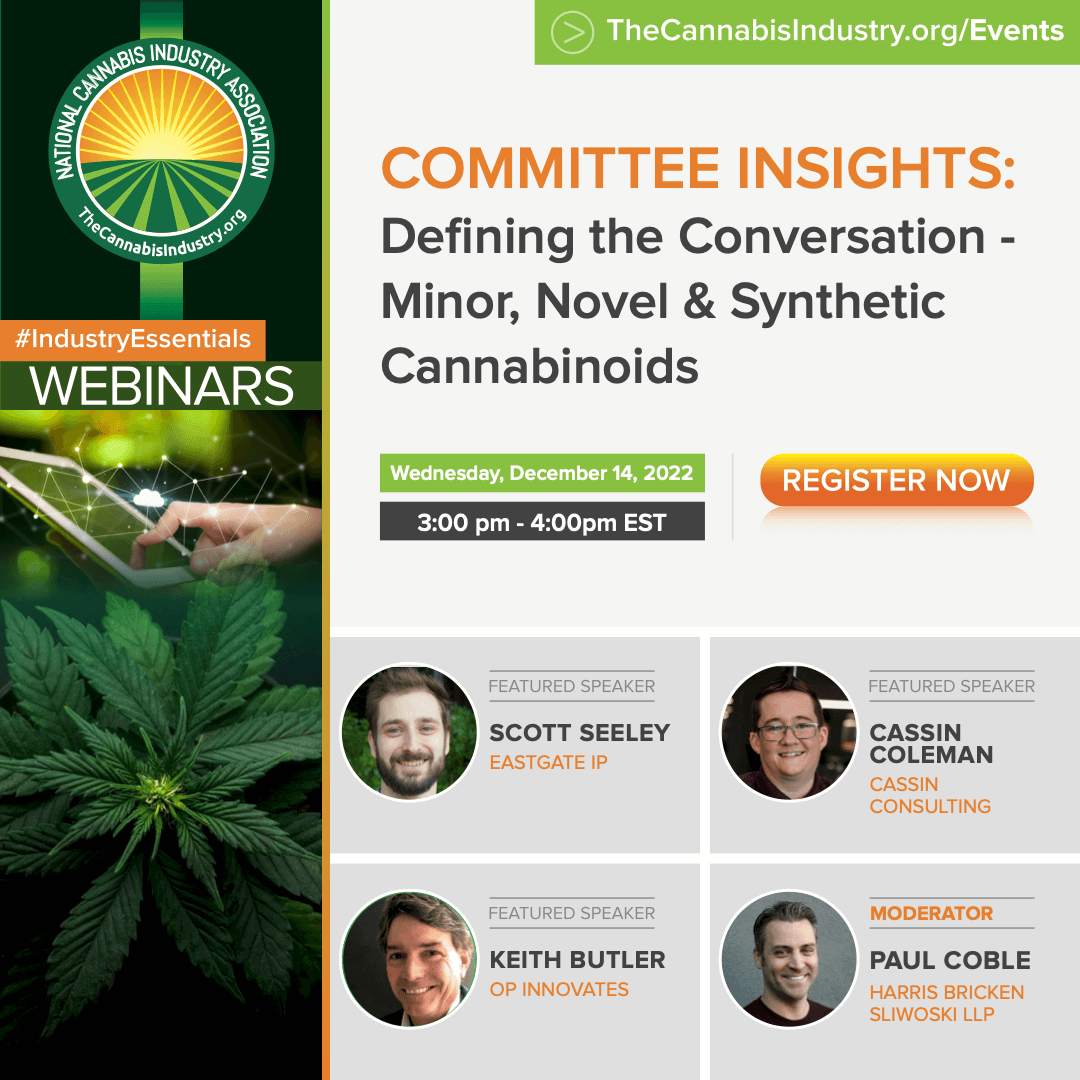
NCIA’s #IndustryEssentials webinar series is our premier digital educational series featuring a variety of interactive programs allowing us to provide you timely, engaging and essential education when you need it most.
In this edition of our NCIA Committee Insights series, originally aired on December 14 and produced in collaboration by NCIA’s Cannabis Manufacturing Committee, Scientific Advisory Committee and Hemp Committee we introduced and framed the myriad regulatory, scientific, linguistic, and ethical issues that come with the rise of minor, novel, and synthetic cannabinoids.
Learning Objectives:
• Understand the role of minor, novel, and synthetic cannabinoids in the cannabis industry and the unique issues relating to their current status.
At the conclusion of the discussion our panel hosted a lengthy moderated Q&A session so our network could get all their burning questions answered by these leading manufacturing, biochemical, and legal professionals from the hemp and cannabis industries.
Panelists:
Scott Seeley
Biochemist and Patent/TM Attorney @Eastgate IP
Cassin Coleman
Founder
Cassin Consulting
Keith Butler
CEO
OP Innovates / Hemp Mellow
Paul Coble
Intellectual Property Attorney
Harris Bricken Sliwoski LLP
There is more to cannabis than THC and CBD. As our understanding (and commercialization) of cannabis evolves, new compounds like CBG, delta-8-THC, THCv, and others are coming onto the scene. These various “minor” cannabinoids, however, bring with them a host of new issues.
Over the next few months this collaboration will continue to explore these issues with various subjects ranging from basic and advanced overviews of these molecules, regulatory recommendations, risk management and compliance concerns all the way to consumer and manufacturer safety. Stay up to date and be the first to know when additional follow-up sessions are scheduled by signing up via the form below.
What would it take for cannabis to become a commodity? To answer this question, we must first understand what a commodity is. Commodities are often raw materials, such as mineral ores, petroleum, sugar, rice, corn, wheat, etc., traded in large quantities, with little restriction, with prices fluctuating based on supply and demand. These commodities are often traded on exchanges to facilitate transactions, as price and availability are the main factors, not product differentiation or branding. Thus, standardization of the commodity and minimum quality standards are essential to commoditization. Currently in the EU and UK, hemp raw materials and finished goods must be compliant with the Novel Food Regime to be sold. To be compliant, manufacturers must apply for Novel Food status which will then be approved by the Food Standards Agency. This is a perfect example of standardization beginning to take place. However, globally, there are ~800 recognized strains of cannabis, although realistically, that number is likely in the thousands. This is in comparison to most commodity markets which usually have less than a dozen different variations. We can break this down into three main sub-sectors: industrial hemp, medical cannabis, and adult-use cannabis, and the challenges to commoditization for each.
Industrial hemp is cultivated primarily for its seeds or fibers to make clothing, paper, biodegradable plastic, building materials, etc. Most CBD extracts also come from industrial hemp, so the hemp farmers can potentially be seen as commodity producers while the buyers, who then use the CBD extracts to produce their differentiated products, are not. However, one major issue is the lack of price stability and transparency for differentiation seen in other commodities. In the United States, prices for high-CBD cannabis biomass declined up to two-thirds in value in 2020 compared to the previous year.
Medical cannabis, which can be over the counter or pharma-grade, has various medical applications, some still yet to be discovered. On the pharma side, GW Pharma has the only cannabis drug that has been approved by the FDA, which treats different types of epilepsy. Cannabis is also being researched for its effectiveness in treating Alzheimer’s, cancer, eating disorders, mental health disorders, seizures, and many more. However, firms focused on medical cannabis often attempt to produce products with specific ratios of THC and CBD through crossbreeding and generating unique terpene profiles. However, for a company to develop pharma-grade products, the product must meet the minimum standards required by its prospective country. These are usually for a particular type of treatment, making commoditization difficult.
Adult-use cannabis has seen tremendous growth and legalization in the past years; however, products differ between producers. While there are thousands of strains of cannabis, even the same strain can vary widely between producers depending on cultivation methods and conditions. Naturally occurring terpenes also allow for differentiation. It can come in a wide range of different potencies, even due to farming techniques, thus making it challenging to produce premium quality cannabis at scale consistently. At the same time, countries are beginning to implement minimum requirements for its products, like the EU and UK’s Novel Food Regime explained above. As countries continue implementing these requirements, the ability to differentiate products will decrease.
As you can see, the most likely to be commoditized would be industrial hemp, as standardization would be a massive obstacle for both recreational and medical cannabis. However, other factors need to be resolved before cannabis can reach commodity status, including price transparency and legalization. There are benchmark prices for commodity products that are easily accessible, and currently, a platform to publish these benchmark prices has not been fully developed yet. Regarding legalization, in the US, cannabis with a THC content over 0.3% remains federally illegal, despite individual states allowing growth, processing, and sale. Multi-state operators cannot transport THC products across state lines, preventing the national distribution of branded products. The problem with interstate commerce would disappear when cannabis becomes federally legal, but it is currently a challenge and simply put, for now, a surplus in California stays in California.
While there are still many hurdles for cannabis to become a commodity, many tailwinds could lead to its successful commoditization. Federal legalization in the U.S. would likely remove restrictions in transactions, allowing for the free trade of cannabis within the country. On a global scale, the real barrier to global trade centers around the United Nations Drug Treaty. In December 2020, the U.N. Commission on Narcotic Drugs transferred cannabis from a Schedule 4 to a Schedule 1 drug. Schedule 1 drugs are still prohibited substances but are seen as having medicinal value. For cannabis to trade freely, the United Nations must move cannabis to a U.N. Schedule II or III drug. This is because countries must be compliant with the 1961 U.N. Convention to import and export cannabis, which requires a narcotic license. Additionally, once regulators such as the FDA come out with specific rules, CBD will begin to act more like a commodity with significant supply and demand. One World Pharma, The Cannabis Mercantile Trading Exchange (CMTREX), Panexchange, and Canxchange have begun developing exchanges for cannabis to trade on, with One World Pharma even beginning to offer limited futures contracts. On the positive side, cannabis has a head start in testing to meet minimum quality standards. Most jurisdictions already require it, although the threshold levels needed to sell the product still vary between locations. The regulations between different countries vary greatly, as countries in South America and places like Canada and Israel are very open to cannabis. However, in others, such as most EU and Asian nations, there is still a lot of stigma surrounding cannabis, which will likely take much longer to gain widespread acceptance. While there are still many hurdles to cross until commoditization, the current Biden administration has shown a willingness to legalize cannabis federally, the first and most crucial step towards cannabis becoming a commodity.
Ms. Della Mora is the Co-founder ofBLC, a financial advisory and investment firm based in Los Angeles with satellite offices in Houston, New York, London, Hong Kong, and Melbourne. During her tenure at BLC, she successfully invested, assisted in the capitalization, and helped business develop small cap oil companies in Kentucky, Texas, Louisiana, Illinois, Colorado, California, Wyoming, North Dakota, and Alaska. She has also structured oil & gas partnerships in several U.S. states, and in Ecuador, Central America. Ms. Della Mora has been involved in many LNG (Liquid to Natural Gas) projects in the U.S., as well as many commodity trades worldwide. She has personally advised also Chinese conglomerates in their U.S. oil & gas investments.
Black Legend Capital is a leading Merger & Acquisition boutique advisory firm based in California with offices worldwide. Black Legend Capital was founded in 2011 by former senior investment bankers from Merrill Lynch and Duff & Phelps. We provide M&A advisory services, structured financing, and valuation services primarily in the cannabis, technology, healthcare, and consumer products industries. Black Legend Capital’s partners have extensive advisory experience in structuring deals across Asia-Pacific, Europe, and North America.
Member Spotlight: Cannabis Basics
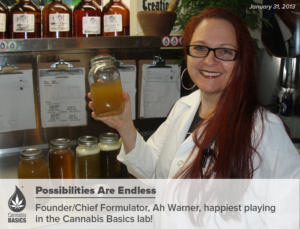
To kick off 2016, we speak with Ah Warner of Cannabis Basics, whose company saw a landmark year in cannabis policies in her state of Washington. She also recently won ‘Best Topical Brand’ at the 2015 Dope Industry Awards in Washington. Many in the industry and movement look up to her involvement in both her community and her direct activism, setting a tone for others looking to create a successful and responsible business in the cannabis industry.
Cannabis Industry Sector:
Cannabis-Infused Products
NCIA Member Since:
February 2013
How do you uniquely serve the cannabis industry?
We are dedicated to true whole genus cannabis topical therapy.
Cannabis Creations, now Cannabis Basics, was founded in 1995. Back in those days, there were many hemp body care manufacturers working with hempseed oil because of its amazing nutritive value for skin care. Today there are a host of cannabis topical producers that focus on cannabinoids from the plant and also CBD-derivatives from hemp that speak to our CB2 receptors. Cannabis Basics is this rare and beautiful place where the essential fatty acids and anti-inflammatory properties of hempseed oil and the multiple cannabinoids and terpenoids from cannabis are blended together with an arsenal of other botanical constituents to provide natural localized therapy for symptoms brought on by a myriad of conditions.
Why should customers seeking cannabis-infused topical products use Cannabis Basics?
We never use animal products, man-made fragrance oils, or chemical preservatives. We buy locally and organically whenever possible. Supporting Cannabis Basics is also activism because it enables us to continue to work for the betterment of our industry and community as a whole.
On August 25th, 2015, the USPTO awarded Cannabis Basics the first federal registration to a brand/logo displaying both the leaf and the word “cannabis” representing an actual product that contains cannabis, not a service or institution. Cannabis Basics has two distinct lines, one that contains cannabis (industrial hempseed oil) that can be sold anywhere in the world, and the other that contains cannabis (I.H. and multiple cannabinoids including THC) sold only in the state of Washington.
It is important to note that the USPTO did not award federal registration based on my cannabinoid line of products. Federal protection was awarded for my cannabis industrial hemp products however, and due to same branding, will by default provide protection to the entire Cannabis Basics family of products.
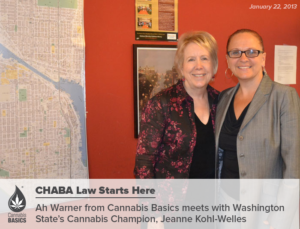
What started out as stand-alone sister bills with bipartisan support actually passed on June 30th as Section 7 of HB 2136, an I-502 tax fixer bill, and was signed into law by Governor Enslee. This law was enacted on July 1st, 2015, and is the first of its kind in the country. The CHABA law defines Cannabis Health and Beauty Aids for the first time in our legal lexicon as “cannabis products for topical use only, non-intoxicating and contains less than .3% THC.” It defines these products as not marijuana and allows for them to be sold to any mainstream retailer in the state of Washington, i.e., any health food stores, salons, or spas. The much larger significance of this new law is that it is the first removal of anything cannabis from the Washington State Controlled Substances Act.
I would be remiss if I did not take this platform to thank all the legislators who played a part in moving CHABA through Olympia, especially Washington State’s Cannabis Champion Senator Jeanne Kohl-Welles and my co-author/policy advisor Kari Boiter. The state of Washington and anyone who uses or produces CHABA are forever in your debt.
Why did you join NCIA?
Our goal at Cannabis Basics is to make Cannabis Health and Beauty Aids accessible to all health-conscious consumers everywhere in the U.S. and to be able to export to any country that is interested in importing these types of products. Being a member of NCIA has given me access to the movers, shakers, and policy-makers so that I may work efficiently at this ultimate goal.


 Ms. Della Mora
Follow NCIA
Newsletter
Facebook
Twitter
LinkedIn
Instagram
News & Resource Topics
–
This Just In
Committee Blog: Budtenders Make or Break Your Business – A No-Nonsense Guide to Cannabis Retail Staffing
Member Blog: Guaranteeing the First Loan