Cannabis, once relegated to the shadows of society, is making a significant push into mainstream America. However, the journey from prohibition to acceptance is faced with many challenges, particularly in the retail world. The stigma surrounding cannabis stems from historical, legal, social, and cultural factors, and lack of education, plays a role in shaping the stigma. In this blog, we’ll explore some of the roots of the stigma on cannabis and how the landscape is gradually changing.
The Historical Backdrop
The roots of cannabis stigma are deeply embedded in history. In the early 20th century, cannabis was criminalized in many parts of the world. The United States’ War on Drugs, which began in the 1970s, heavily penalized cannabis use, linking it to criminal behavior and societal decay. Media reports of cannabis users as lazy, unmotivated, or criminals; these negative stereotypes are what many believe to be true.
However, alongside this negative portrayal, there exists a rich history of cannabis as a medicinal plant. For centuries, cannabis has been used to treat a variety of medical issues. Ancient cultures across Asia, the Middle East, and Africa utilized cannabis for its therapeutic properties, including pain relief and anti-inflammatory benefits.
In more recent times, cannabis has shown promise in helping cancer patients manage symptoms such as nausea, pain, and loss of appetite. Additionally, it has been found to fight inflammation, which is beneficial in treating conditions like arthritis and multiple sclerosis. This positive history of cannabis as a healing plant is often overshadowed by its criminalization and the stigma attached to its recreational use.
Legal and Regulatory Hurdles
One of the most significant barriers to cannabis acceptance in retail is the complex legal landscape. In the United States, for instance, cannabis remains illegal at the federal level, despite being legal in several different states. This legal ambiguity creates uncertainty and fear among businesses, banks, customers as well as B2B consumers.
Moreover, the reluctance of banks and financial institutions to work with cannabis-related businesses due to federal regulations results in limited access to financial services and funding. This financial exclusion makes it difficult for cannabis businesses to operate and expand, perpetuating the stigma. It also makes it challenging for funding purposes for these businesses to continue to operate efficiently.
Social and Cultural Challenges
Public perception plays a crucial role in the acceptance of cannabis. Despite increasing acceptance, many still view cannabis use negatively and as a Schedule 1 drug, influenced by concerns about health impacts, addiction, and moral values. Workplace policies that maintain strict no-drug stances, regardless of legal status, also contribute to this negative perception. Enhancing education on cannabis can help mitigate this stigma within our culture, which in turn will aid in positioning the cannabis industry as a credible sector in the eyes of consumers, banks, and other business sources.
Retail Industry-Specific Issues
In addition, mainstream retailers are often hesitant to carry cannabis products due to fear of backlash from conservative customers or communities, which limits the visibility and availability of these products in the broader spectrum.
Furthermore, stringent marketing and advertising regulations restrict cannabis businesses from effectively reaching new customers and normalizing their products. Social Media advertising is prohibited as well as certain television channels.
Conclusion
Resolving the challenges surrounding the stigma of cannabis in the retail world requires a multifaceted approach. Firstly, education plays a pivotal role: increasing public awareness about the medicinal benefits of cannabis and dispelling myths through targeted campaigns can shift negative perceptions. Secondly, advocating for legislative reform to align federal and state laws can provide clarity and confidence for businesses to operate effectively. Moreover, fostering open dialogue among stakeholders, including policymakers, industry leaders, and the public, can promote understanding and acceptance. Lastly, mainstream retailers can be encouraged to embrace cannabis products through initiatives that demonstrate responsible consumption and highlight regulatory compliance, thereby normalizing its presence in the retail market. By addressing these aspects comprehensively, we can gradually reduce stigma and integrate cannabis as a legitimate and beneficial sector within the retail market.
Member Blog: Pre-Roll Market Industry Trends and Growth Potential
Having the ability to identify trends in the cannabis industry is vital for producers to build a successful brand, and the biggest trend in ther cannabis industry right now is pre-rolls. Growing at 12% YoY in the US and 38% YoY in Canada, pre-rolls are the fastest growing cannabis product in the world of legal cannabis, and it’s not close.
This trend could be chalked up to a sudden rise in popularity and as something that will decline once another hot trend appears; however, we believe that the rise of pre-rolls is more than just a flash in the pan. In fact, after looking over the sales data we received from Headset, we believe that pre-rolls will not only continue their growth, but they will become the bestselling cannabis products by 2030.
Here’s why!
Prices Fall, Sales Rise, Both Stabilize
Over the past few years, the wholesale price of flower has dropped dramatically in mature markets, and cheaper cannabis costs have allowed producers to source higher quality flower for their pre-rolls. Combined with the advances in pre-roll making machinery, quality pre-rolls are now able to be sold at a lower retail price, which has driven strong growth for the category.
As you can see from the graph, pre-roll sales have steadily increased as prices have fallen, but the last two years have seen both sales and prices begin to stabilize. The pre-roll segment that has seen the most growth during this time is infused pre-rolls. Customers love high THC percentages, and producers are happy to finally be able to offer it to them in an affordable pre-roll form.
Pre-Rolls have the Least Amount of Price Compression
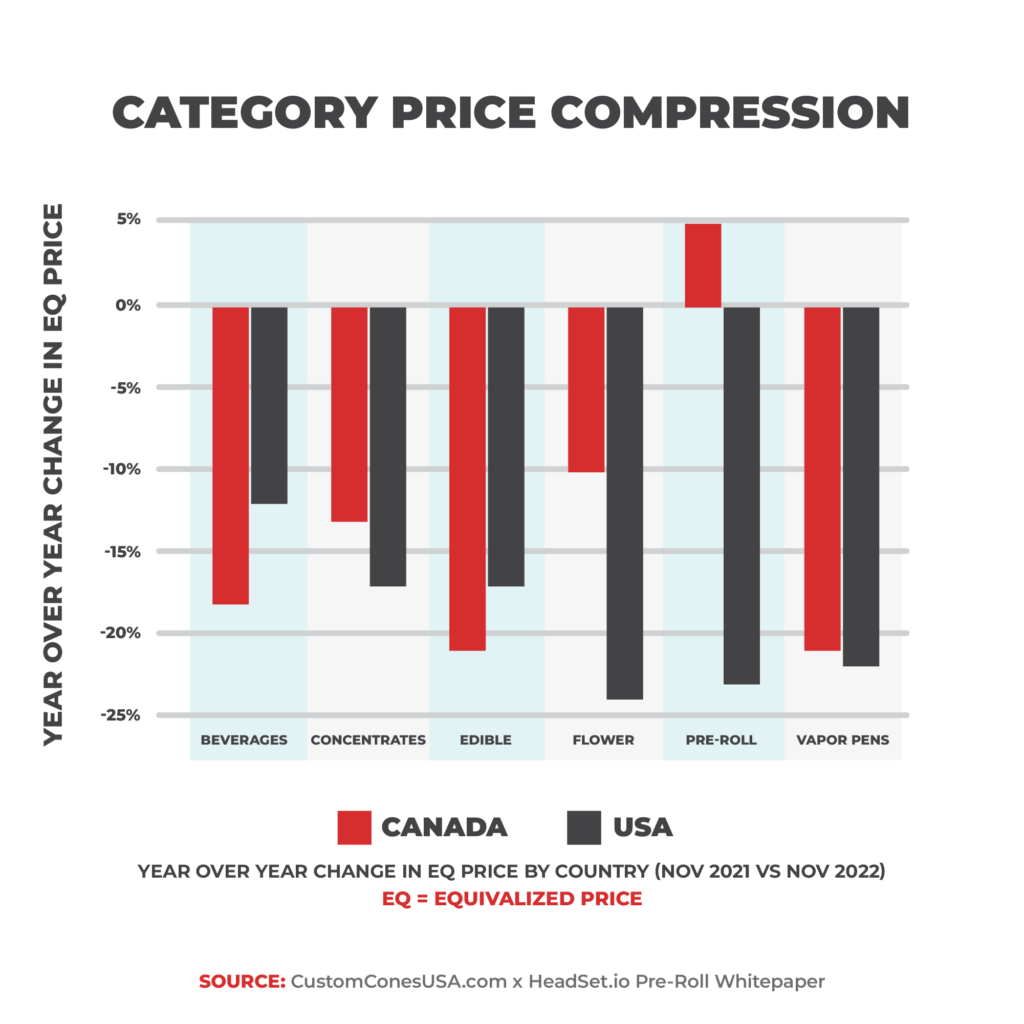
It’s not just pre-roll prices that are falling. Prices are down across the board, but even though prices for all cannabis products declines over time, pre-rolls are showing the least amount of price compression. In other words, if you are in the business of selling cannabis, and you are worried about declining margins, pre-rolls are a category you should be expanding into to maintain and boost profitability.
You can also see from the graph that Canada has actually seen the average price of a pre-roll increase, but there is nuance to this data. This does not mean that pre-rolls are getting more expensive for Canadian consumers. This data shows just how popular infused pre-rolls are becoming. They are becoming so popular that people are choosing to buy them over regular, more affordable pre-rolls, and that change in buying habits has increased the average sales price for pre-rolls.
Pre-Roll Multi-Packs
Another interesting trend we see in the sales data is that pre-roll multi-packs have become extremely popular. In 2018, multi-packs of pre-rolls only made up 27.7% of the market in Oregon, Washington, and Colorado. By 2023, multi-packs make up 47.62% of the market—representing a growth of about 20% over 5 years. Also, Since 2021, we have seen an almost 400% growth in multi-packs that have a volume of 2 or 5 grams as well as steady growth across most other sizes.
Buying pre-rolls by the pack is a lot more convenient for consumers. It means not making a special trip to the dispensary every time a pre-roll is wanted. The rise in their popularity is a sign that consumers are investing in pre-rolls as a staple in their cannabis routine. Because they know they will continue to enjoy pre-rolls, they buy multiples at a time for convenience, and it’s this kind of product loyalty that moves a product from a trend into something more.
Wallet Share by Age
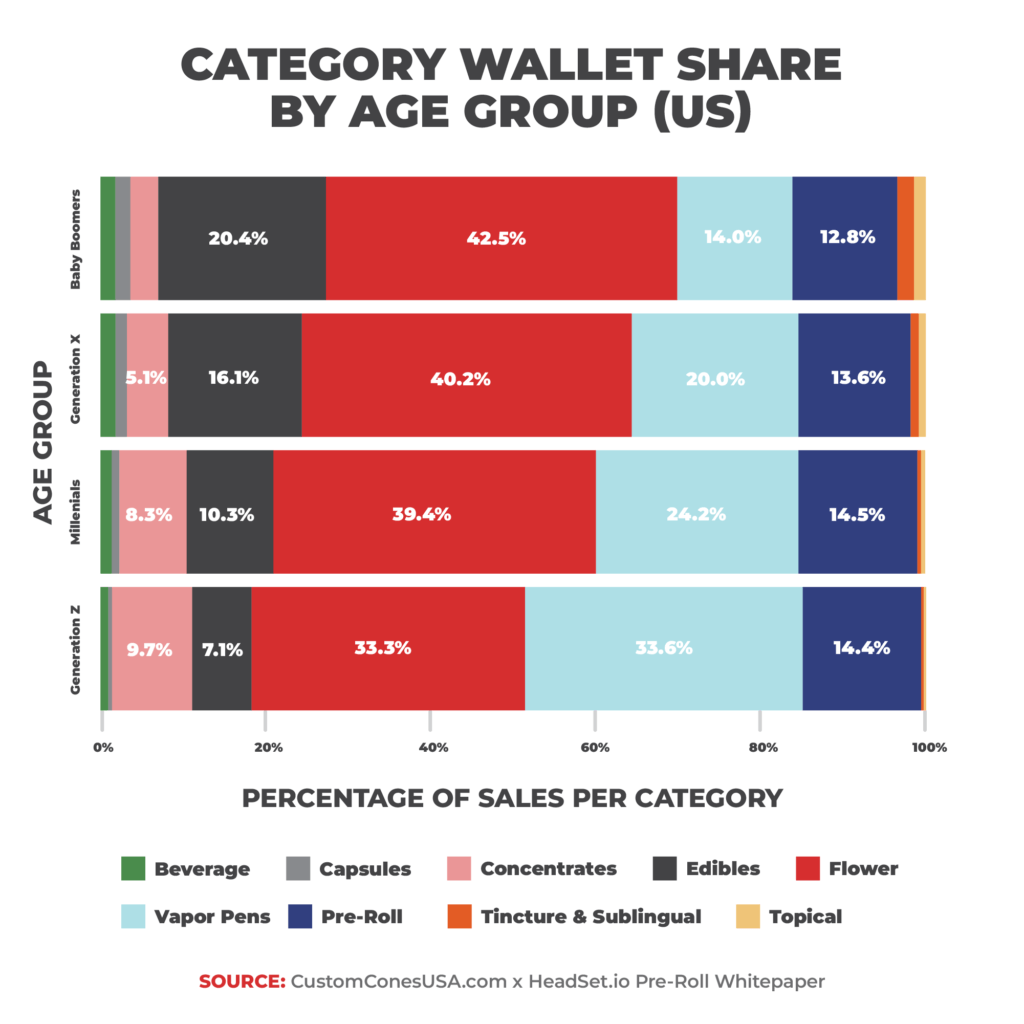
Another interesting thing about pre-rolls is that, when it comes to wallet share, they are the most consistent product segment across all age groups. Other products show a significant increase or decrease in popularity with each new generation; however, pre-rolls steadily hover between 12.8% and 14.5% in each group and even show a slight increase with the younger generations.
It’s also important to note the decline of flower with younger generations. Why this is significant is because, at their core, pre-rolls are a flower product, and they are not following the same decline in sales. They distinguish themselves from loose flower by providing consumers a way to enjoy their flower without extra paraphernalia. In this way, we think pre-rolls could start to eat into the flower market, as they better meet the consumption needs of flower customers.
Pre-Roll Attachment Rates
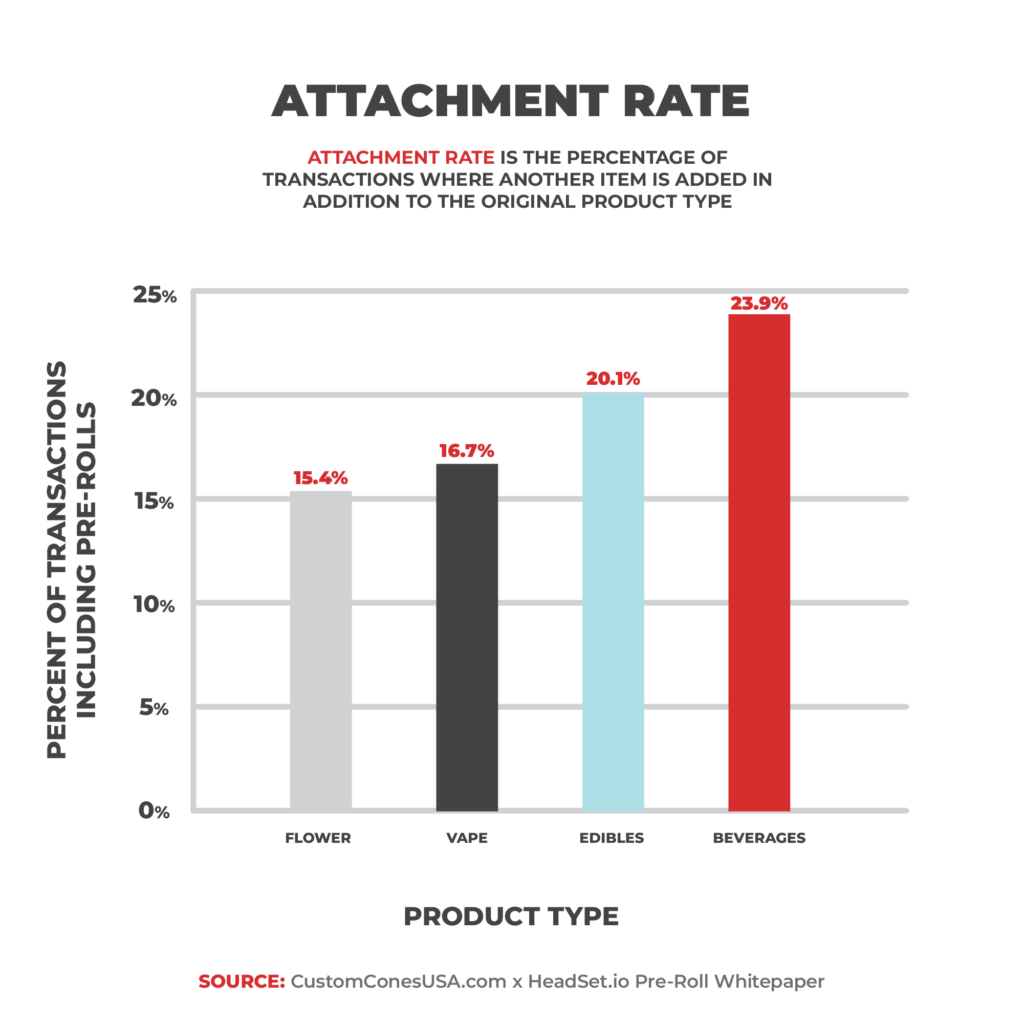
Another big reason why pre-rolls will remain a dominant product segment in the future is that they are the perfect add-on item at the point of sale. The data shows that, when a person walks into a dispensary, they will add-on a pre-roll 15.5% to 23.3% of the time. In fact, in all product segments, pre-rolls either have the highest attachment rate or are within a single percentage point of the leader.
In other words, no matter what a customer is interested in purchasing, it doesn’t take a lot of convincing to get them to add on a pre-roll. They’re reasonably priced, made with quality materials, and incredibly convenient. Whether they want to consume it right away or want to save it for later, pre-rolls have become something flower lovers like to have on-hand for whenever, and that makes it more than a trend. That makes it a staple.
Convenience Impacting Pre-Roll Purchasing
Cannabis is starting to make its way into mainstream culture. You can’t buy it at your local grocery store, like you can buy wine or cigarettes, but it’s out there. The legalization of cannabis has opened the door to innovation in the cannabis industry, and those innovations are starting to have an impact on everything—especially consumption.
Flower needs paraphernalia to be consumed, and, if you are just trying to enjoy cannabis, sometimes you just don’t want the hassle. Pre-Rolls are unique in that they offer the consumer flower as well as a way to consume it, so it’s not too much a leap to think that pre-roll could keep expanding and start eating into flower sales.
In this way, cannabis can be compared to tobacco. Even though people can buy loose tobacco and roll their own cigarettes or use a pipe, most people are buying pre-rolled products. Even though the tobacco quality, smoking experience, and price point can be better when you buy loose tobacco, most people are choosing the convenient option. It shouldn’t surprise us that cannabis starting to fall into this pattern as the market matures.
Final Thoughts on The Pre-Roll Market
The data lets us know that pre-rolls are doing amazing things when it comes to sales, but it is also giving us hints as to trends in consumption methods. Pre-rolls are a flower product, and it’s clear from the data that flower consumers are buying into the convenience of pre-rolls. This is more than just a trend, but a shift in the preferences around flower consumption. Because of this shift, we can see pre-rolls taking on a more prominent role as the cannabis industry continues its expansion.
For a more in-depth look at the pre-roll industry, be sure to check out the State of the Pre-Roll White Paper, and, if you have any questions, feel free to reach out to the Pre-Roll Experts at Custom Cones USA.
Omnibus Leaves Industry Hanging
by Michelle Rutter Friberg, NCIA’s Deputy Director of Government Relations
Photo By CannabisCamera.com
Since 2014, federal funding bills, or appropriations bills, have included provisions restricting the Department of Justice from using tax dollars to prosecute or penalize state-legal medical cannabis businesses and patients. Since then, NCIA and others have worked diligently to expand those protections and enact cannabis reform through the budget, with some efforts being more successful than others. Another issue making matters more complicated: the federal appropriations process requires this provision to be approved by congressional process annually, so introducing, lobbying on, and enacting these provisions has to reoccur every year.
Last week, Congress passed the most recent omnibus appropriations bill, which is increasingly used to group together the budgets of all departments in one year. Keep reading to find out what provisions related to cannabis were included (or weren’t!) and why it matters:
PROTECTIONS
If you’ve been in cannabis for a while, you might remember when medical cannabis protections were first enacted in 2014. Back then, the provision was known as the “Rohrabacher-Farr Amendment,” named for then-Reps. Dana Rohrabacher (R-CA) and Sam Farr (D-CA). This amendment forbids the Department of Justice (DOJ) from spending money to prevent the implementation of state-level medical cannabis programs, in addition to removing funding for federal medical cannabis raids, arrests, and prosecutions in states where medical cannabis is legal. To put it simply: the DoJ can’t use any of its money against state-legal, compliant medical cannabis businesses.
So, the omnibus had some good news and some bad news regarding protections for cannabis businesses from the Department of Justice. Good news? Those protections for medical cannabis businesses, patients, and programs remain in place. Bad news? Congressional leaders declined to expand those protections to include all cannabis businesses, despite the fact that the House has voted twice in the past to do so.
WASHINGTON, D.C.
For decades, Congress has used its power and jurisdiction over Washington, D.C. as a bargaining chip and test subject for various policies, and cannabis is no exception.
Washington, D.C. voted to legalize adult-use cannabis via Initiative 71 in 2014. However, because the Constitution gives Congress jurisdiction over the District of Columbia, Washingtonians have been, and continue to be, unable to implement the taxed and regulated sales of cannabis for adults. (That hasn’t stopped a flourishing gray market, but that’s a topic for another blog!)
One Congressman, in particular, has obstructed D.C’s cannabis market: Andy Harris, the lone Republican in the House from the state of Maryland. The “Harris Amendment,” which prevents legal sales from occurring in D.C., has been included in every appropriations bill since – again, despite the fact that House Democrats have voted to strip the language multiple times.
The inclusion and maintenance of this provision – especially while Democrats control both chambers of Congress – is simply unacceptable and inexcusable. To that end, NCIA recently signed on to a letter urging leadership to remove the language. It’s also critical to point out that Washington, D.C. is one of the places where disparate cannabis arrests occur at an alarming rate, making the need for reform even more dire.
EXPUNGEMENTS
A new appropriations amendment that NCIA supported was also included in the most recent omnibus. The language, championed by Cannabis Caucus Co-Chair Dave Joyce (R-OH), would allow JAG funding to be used for the cost of state and local cannabis expungements and record clearing. This is a small but incredible reform that we hope will be the first step in providing justice to individuals impacted by the War on Drugs.
VAPING
The omnibus also included report language related to cannabis. Report language is non-binding and essentially encourages an agency to do something. In this case, Congress is urging NIDA (the National Institute on Drug Abuse) to conduct interdisciplinary research on the relationship between the vaping of tobacco and marijuana, with an emphasis on risk perceptions, decision-making, and neuroscience.
Interestingly, the appropriations process for FY2023 is beginning to get underway already. NCIA will be working with appropriators and other allies in Washington, D.C. to maintain provisions that protect cannabis businesses and consumers while stripping those that deny opportunity and justice to others. Interested in learning more about appropriations, or working with our team on an amendment? Learn more about our Evergreen Roundtable and committees by visiting our website!






Follow NCIA
Newsletter
Facebook
Twitter
LinkedIn
Instagram
News & Resource Topics
–
This Just In
How THCa Vapes Are Changing Consumer
Announcing NCIA’s 2026-2028 Board of Directors