Equity Member Spotlight: Ontogen Botanicals – Dr. Adrian Adams
NCIA’s editorial department continues the Member Spotlight series by highlighting our Social Equity Scholarship Recipients as part of our Diversity, Equity, and Inclusion Program. Participants are gaining first-hand access to regulators in key markets to get insight on the industry, tips for raising capital, and advice on how to access and utilize data to ensure success in their businesses, along with all the other benefits available to NCIA members.
Tell us a bit about you, your background, and why you launched your company.
Hello, I’m Adrian Adams, EdD. I spent a decade teaching Biology and Chemistry as well as coaching football. I chose to spend several years as a stay-at-home dad (the hardest job by far) and then worked in the pharmaceutical industry. I know many of the physicians in my area. While at dinner one night with a couple of doctors, the conversation revolved around having to combat the misinformation that patients come in with from “Dr. Google.” Minutes later, one doctor asked the others what they were saying to the increasing number of patients who come in asking about cannabis therapy. There was a prolonged silence until another doctor said “I just tell them I don’t know anything about that and to look online.”
Another doctor said, “me too.” The irony within the few-minute span was worthy of a fork drop. The FDA has approved CBD as a medicine. To me, not educating a patient about a legal, safe, and effective treatment option meant they just didn’t have the cannabis knowledge. That also meant more legal, safe, and effective products needed to be made for doctors and their patients. In that moment, Ontogen Botanicals CBD was born.
What unique value does your company offer to the cannabis industry?
We offer reduced costs, which can be a barrier to entry for consumers. And a deep knowledge of the intersection between cannabis and medicine. Physicians are a choke point for the industry that is overlooked. Simply put, doctors are good people. Most of them have simply had zero training on the endocannabinoid system as it was only identified in the 1990s. Ontogen Botanicals believes if they knew better, they’d do better. We offer doctors the information to make an informed decision on the utility of cannabis for their patients. We also offer the ability for doctors to provide legal cannabis products for their patients right in their office as part of a sound treatment plan.
Ontogen provides effective CBD products that are truly full-panel lab tested for safety. We strongly believe in starting at a low dose, which also lowers cost. Using the least medication necessary is part of medical training. Low-dose products work for many people and reduce the cost barrier of entry to try CBD and other cannabis products.
What is your goal for the greater good of cannabis?
We want to increase the healthcare provider and patient knowledge of what this plant can do, as well as provide quality of life-improving products. Now we’re expanding to help the population at large. Medically speaking, cannabis is as good as advertised. The more people use it, the more legitimate the industry becomes.
Cannabis gets a bad rap for being a gateway drug to the opioid crisis. In fact, doctors are beginning to address the pain that often starts and underlies chronic opioid use. You cannot pull opioids and not address the pain that drives many folks back to opioids. Regulated cannabis can reduce pain without the many harmful side effects of opioids – especially unregulated heroin.
With industry growth, and Ontogen Botanicals‘ growth, will come the capital for Ontogen to address the challenges that poverty creates for people who may have much less access to healthcare and prescription drugs to get the medicine they prefer. There is enough money in cannabusiness to use it for social good.
What kind of challenges do you face in the industry and what solutions would you like to see?
A big problem for any small business is finding the right people to do business with. Minority business owners face discrimination and mistrust when trying to do business in general. Now add cannabis to the equation. I’ve been asked for $5K just for the right to open a business checking account.
Groups like NCIA, MCBA, and Minorities for Medical Marijuana help us find each other to do business with as well as bridge the gap between us and traditional business communities like banking for access to capital.
This industry has shown the ability to help remediate the cannabis criminalization harms done to minorities during the war on drugs. Big tobacco and many other industries are already investing and awaiting federal law changes. I fear that once the flood gates open to large companies investing billions of dollars, the feeding frenzy will create an extinction-level event for smaller minority-owned companies. We need federal and state-level legislative dams in place before then to protect minority-owned smaller businesses.
Why did you join NCIA? What’s the best or most important part about being a member through the Social Equity Scholarship Program?
I joined to try to help advocate for social equity and social justice for minorities to have a once-in-a-lifetime chance to start an industry. The best part about the NCIA Social Equity program is that it brings minority entrepreneurs together weekly to support each other. We’ve locked elbows, pick each other up in hard times, and celebrated the good.
Member Blog: Hemp And CBD Consumer Insights – Who, Why, And How
Hemp CBD became the fastest growing CPG product in 2019, following its legalization in the Farm Bill of December 2018. Consumers show great interest in its use for wellness, health & beauty applications and for pets. Its many distribution channels require integrating convenience store and shipment data not required for most dispensary products.
In U.S. Convenience Stores, total sales of CBD have increased 168% in the first half of 2019 while average weekly dollar sales increased by 235%.
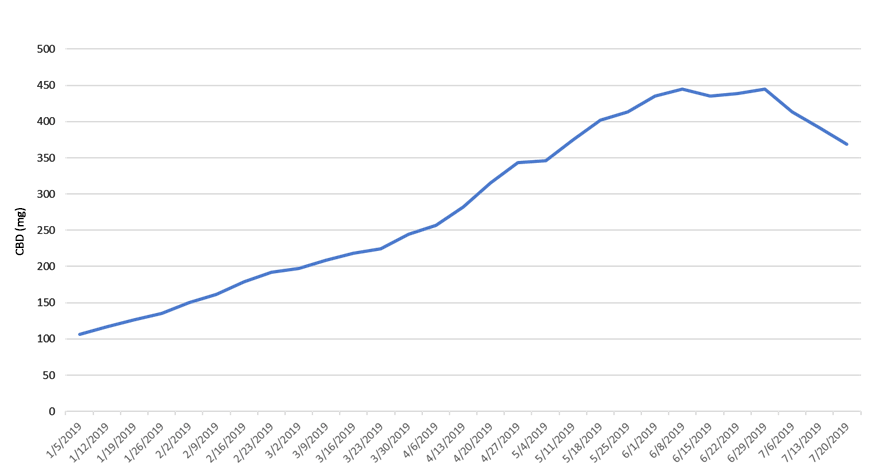
The higher revenue growth accompanied CBD content per package increasing from 100mg on January 5, 2019 steadily to over 350mg on July 20, 2019, after having peaked briefly in June 2019 near 450mg per unit. See graph below.
Mg CBD per SKU at Retail
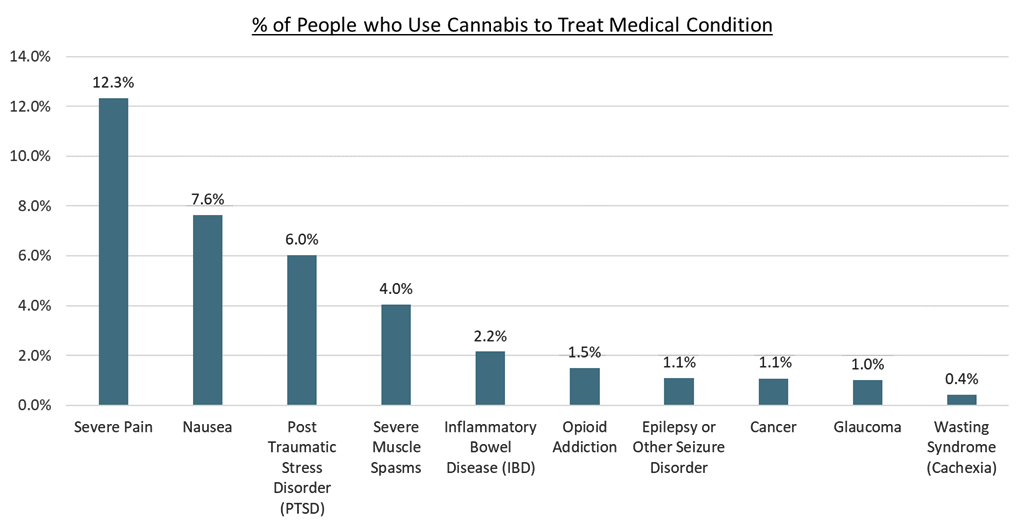
Medical Conditions Treated with Cannabis
Pain relief is the major reason cited as a medical condition for cannabis use, followed by nausea, PTSD, muscle spasms, IBD and opioid addiction as seen in the following table:
Source: Consumer Research Around Cannabis
Cannabis and Opioid Use Disorder
Of particular note is the growing number of consumers using Cannabis to treat Opioid Use Disorder (OUD). As of August 2019, seven states have approved medical cannabis for treating OUD: PA, NY, NJ, NM, MO, IL & CO. Twenty-one studies (2009-19) show the effect of cannabis on helping opioid users to reduce or eliminate the use of opioids to treat pain. NFL professional athletes have withdrawn from using opioids after they retire, with the aid of CBD and/or adult cannabis.
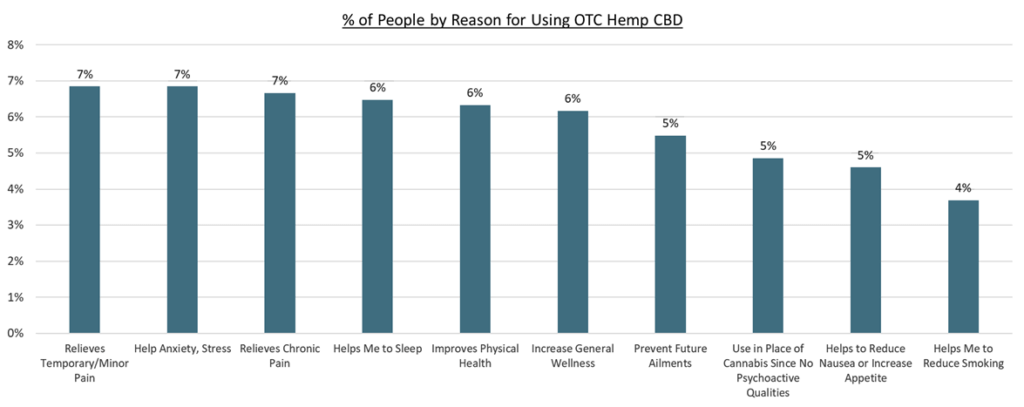
Consumer Purchase Drivers of OTC Hemp CBD
The top consumer drivers of OTC Hemp CBD are pain relief, reducing anxiety and helping sleep, as shown in the following graph.
Cannabis Product Composition and Patient Outcomes
Over the past several years, advances in technology have greatly enhanced the prospects for cannabis growers, processors, and dispensaries to provide medical cannabis products to patients that efficaciously treat the medical conditions and alleviate the incapacitating symptoms that they suffer.
Pre-clinical scientific research is determining the physiological effects of individual cannabinoids and terpenes on specific medical conditions and symptoms. Mobile apps are enabling the systematic querying of patients about the efficacy of specific cannabis strains and products in alleviating symptoms and conditions.
Collectively, these advances and other medical research are creating volumes of evidence to which human and artificial intelligence will be applied to develop insights for use by patients and medical researchers, growers, and processors in formulating products creating newer therapeutic options. Patients are already making informed decisions that improve individualized treatment of medical conditions progressively over time due to CBD being an approved over-the-counter consumer product.
Advanced Consumer and Patient Targeting to Improve Marketing and Medical Outcomes
Consumer attitudes, perceptions, and usage in local markets create richer, more actionable insights from customer segments, creating advanced quality scores and indices for scoring first-party internal data.
Cannabis consumer data is used for strategic and tactical product development, applications including:
Market Architecture: differentiating dimensions of product form and brand choice
Key Reasons for Use and Purchase
Affinity with Media, Channel, and other Product Categories
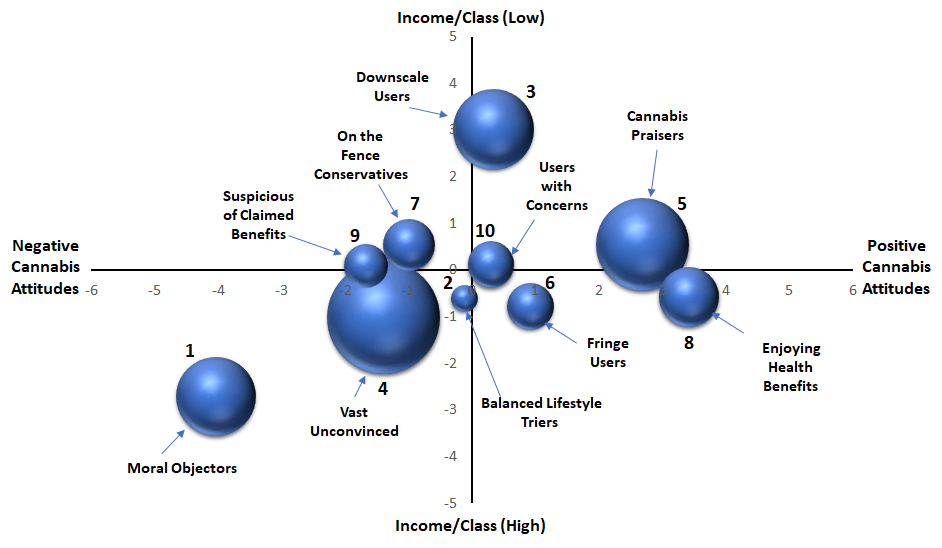
Multiple correspondence analysis of hundreds of consumer survey category questions is used to understand dimensional distinctions and differences between clusters. These key spatial dimensions for segmentation illuminate key differentiators, for use in innovation/new products, brand strategy, marketing execution, and digital media tactics.
Create Target Profiles
Merging cannabis consumer data with general consumer data such as Financial, Healthcare, Restaurants, Grocery/Drug Stores, and Media usage & exposure for each respondent facilitates creation of new consumer segments.
Using zip code identified respondent level data, the above Target Profile clusters can be integrated with other market and first–party data to prioritize personalization, enhance brand positioning, inform messaging, new customer marketing & acquisition efforts, and multi-touch attribution databases.
Mr. Stephen J. Gongaware is Sr. Vice President of Business Development at MSA (Management Science Associates, Inc.), a privately held diverse information technology development and service firm that for over 50 years has provided innovative solutions within its three core competencies of analysis, technology and data management. He has played a major role in developing and managing several MSA businesses in addition to his focus since 2014 on the medical value of cannabis for prospective patients, beginning with CBD and 20 other nonpsychedelic cannabinoids then measured by leading edge test labs. Other businesses he’s created and managed at MSA in the last 20 years includes services to develop/market pharma “rare disease” solutions, and MSA Casino Gaming solutions improving operation of slot floors, player satisfaction and also lead smart phone and sports book innovative projects with 6 of the Top 10 global casino operators and with several major gaming equipment manufacturers.
Prior to joining MSA, Mr. Gongaware was CEO of NetworkNext, an innovative national advertising firm; R&D Director at Cellomics, Inc. where he was awarded US Patent #US6365367; and an Electrical Engineer at Westinghouse Electric Corp. He received his BSEE degree from University of Pittsburgh in 1992 and his MBA from its Katz School of Business in 1995.
MSA is an Analytics firm with Big Data integration capability incorporated in 1963 to focus on improving government and management decisions. MSA has 800+ professionals with expertise in data science & AI, software development, test marketing, data management and management consulting and many of its innovations have become industry-standard solutions. MSA has served over 70 Fortune 500 Customers/Clients in the CPG, Media, Metals, Life Sciences & Pharma, and Casino Gaming & Sports Betting industries. It has been engaged in cannabis research since 2013 with the goal of providing the cannabis industry similar services to what has been now provided to the CPG, Steel, Tobacco, Casino Gaming, and Pharma industries for more than 50 years.
VIDEO: Member Spotlight – Om Of Medicine
In this month’s video member spotlight, get to know Om of Medicine, a cannabis dispensary based in Ann Arbor, Michigan. Learn about their role in fostering a politically engaged and friendly community in their state of the art facility. Om of Medicine also collaborated with the University of Michigan conducting an IRB-approved pain study with hundreds of its patients which displayed a significant decrease in opioid use and an increase in quality of life.
Member Blog: Cannabis Retailers – Help Advance Cannabis Research
by Lisa Conine, Community Outreach Coordinator at Om of Medicine
Medical cannabis retailers are in the unique position of having large amounts of data available to them in the form of medical cannabis patients. Four years ago, Om of Medicine partnered with researchers at the University of Michigan to develop an IRB-approved survey study examining medical cannabis patients and their opioid use. We conducted a survey of 244 medical cannabis patients in Michigan with chronic pain for 3 months. The goal was to collect data to examine if using medical cannabis for chronic pain affected one’s opioid consumption. We saw testimonial evidence of this every day in our consultation rooms and we wanted to quantify that evidence to elevate our patient’s voices and bring them to decision-makers.
The results of that study displayed a 64% reduction in opioid use and a 45% increase in quality of life. The Journal of Pain published this research in their 2016 edition and since, the findings have been used as a tool for engaging with medical professionals and elected officials. Additionally, the results have been cited in publications such as the 2017 edition for the National Academies of Sciences, Engineering, and Medicine’s report: Health Effects of Cannabis and Cannabinoids. Soon after, the results were sited in Representative Earl Blumenauer’s Physicians Guide to Cannabis-Assisted Opioid Reduction. Blumenauer’s office took the initiative to put this document together and circulate it to his colleagues throughout Congress. These findings are intended to be a tool for advancing our advocacy for this movement and the patients we serve. You can find the study here and you are encouraged to use these findings in your lobbying and education efforts!
Currently, Om of Medicine is continually working to increase research around medical cannabis patient’s experiences. We now have launched our third IRB-approved study examining patient’s daily regimens, their knowledge on cannabis, and their relationship to their medical health care team. We are calling on the cannabis industry to help us increase our patient data set by circulating the IRB-approved survey to any networks you have with medical cannabis patients.
The survey is quick to complete and is completely confidential. The published work is intended to be used as a tool for all working in the industry and movement to use it as a piece for engagement with policymakers and doctors.
If you have any questions, you can reach me at lisa@omofmedicine.org. Sending out sincere gratitude to NCIA and participants who take this survey to aid in the advancement of understanding this plant and its revolutionary potential.
Lisa Conine is the Community Outreach Coordinator for the Om of Medicine, a medical cannabis dispensary in downtown Ann Arbor. Lisa works to prioritize relationships with Om’s local community non-profits, businesses, medical professionals, and elected officials. Outreach at Om is based in social justice and forwarding the cannabis movement by uplifting the work of partnering community organizations, providing education on cannabis to the public, and engaging politically, on all levels, to create sensible policy. Lisa is also a member of the newly formed NCIA Retail Committee.

 NCIA’s editorial department continues the Member Spotlight series by highlighting our Social Equity Scholarship Recipients as part of our Diversity, Equity, and Inclusion Program. Participants are gaining first-hand access to regulators in key markets to get insight on the industry, tips for raising capital, and advice on how to access and utilize data to ensure success in their businesses, along with all the other benefits available to NCIA members.
  Hello, I’m Adrian Adams, EdD. I spent a decade teaching Biology and Chemistry as well as coaching football. I chose to spend several years as a stay-at-home dad (the hardest job by far) and then worked in the pharmaceutical industry. I know many of the physicians in my area. While at dinner one night with a couple of doctors, the conversation revolved around having to combat the misinformation that patients come in with from “Dr. Google.” Minutes later, one doctor asked the others what they were saying to the increasing number of patients who come in asking about cannabis therapy. There was a prolonged silence until another doctor said “I just tell them I don’t know anything about that and to look online.”
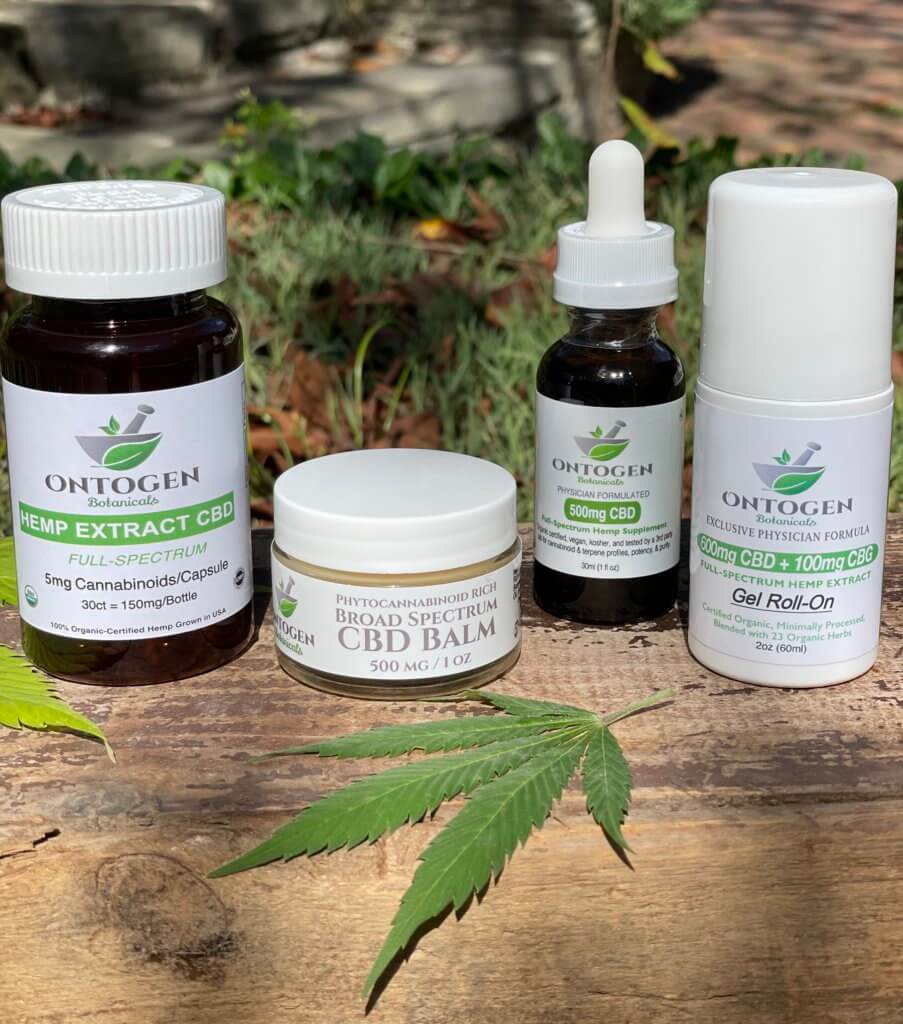 We offer reduced costs, which can be a barrier to entry for consumers. And a deep knowledge of the intersection between cannabis and medicine. Physicians are a choke point for the industry that is overlooked. Simply put, doctors are good people. Most of them have simply had zero training on the endocannabinoid system as it was only identified in the 1990s. Ontogen Botanicals believes if they knew better, they’d do better. We offer doctors the information to make an informed decision on the utility of cannabis for their patients. We also offer the ability for doctors to provide legal cannabis products for their patients right in their office as part of a sound treatment plan.
 A big problem for any small business is finding the right people to do business with. Minority business owners face discrimination and mistrust when trying to do business in general. Now add cannabis to the equation. I’ve been asked for $5K just for the right to open a business checking account.


Follow NCIA
Newsletter
Facebook
Twitter
LinkedIn
Instagram
News & Resource Topics
–
This Just In
How THCa Vapes Are Changing Consumer
Announcing NCIA’s 2026-2028 Board of Directors