Member Blog: Top 6 Pathogens Seen in Cannabis Plants
By Angel Fernandez and Felipe Cisternas, MyFloraDNA
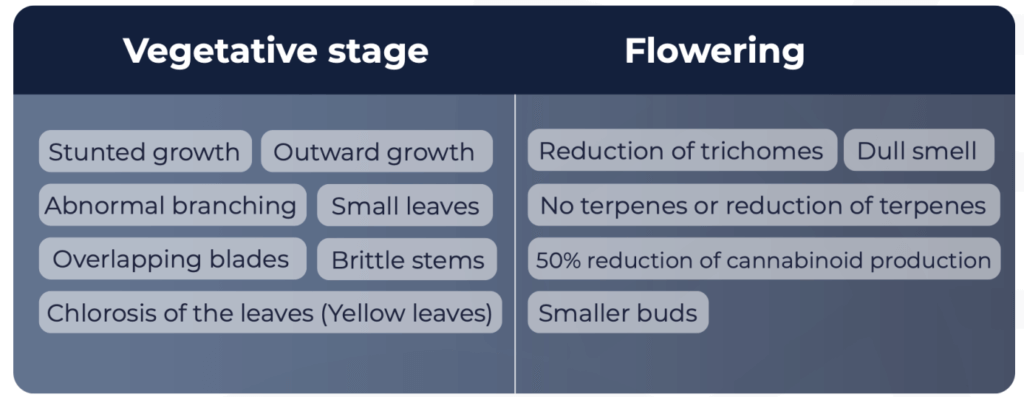
Pathogens cause diseases when looking for a host body to infect. They come in diverse forms: bacteria, fungi, worms, viruses, and also prions. Pathogens are one of the significant threats to cannabis fields. These silent visitors may cause your plants to produce fewer trichomes, small buds, or even death.
Identifying each pathogenwill help to understand how each of them propagates, its symptoms, and its consequences. In this blog, you’ll find everything you need to know about:
Hop Latent Viroid (HLV) is a single-stranded infectious RNA that interferes with cannabis plant growth. Once the Hop Latent Viroid has infected the plant, the obvious sign of infection is dudding, which is when the plant grows smaller, shorter leaves in the process. HLVcan also cause other symptoms, such as yellowing, and necrotic and malformed leaves.
These plants will have fewer traces of trichomes in their structure. Detecting HLV on time is crucial to avoid an existential threat to the entire garden.
Botrytis Cinerea
Botrytis Cinerea, or bud rot, is a fungus that damages the tender parts of plants in areas of high humidity. This necrotrophic fungus will invade damaged tissue. The symptoms include smaller buds, the development of gray mass spores, and brown, water-soaked spots found on leaves. A major consequence of this fungus is that it can kill cannabis plants within a week.
Lettuce Chlorosis Virus
Much like Botrytis Cinerea, Lettuce Chlorosis Virus can potentially destroy an entire garden. Likewise, Lettuce Chlorosis Virus occurs in lettuce grown in southern California. The plants change into a frail yellow color. They will become very brittle and stunted. One way to prevent the virus from spreading is to take a sample of tissue from a cannabis plant and perform qPCR tests to make sure the plant is virus free.
Cannabis Cryptic Virus
Cannabis Cryptic Virus is a double-stranded RNA virus causing subtle symptoms to plants. Some of these symptoms include smaller flower quality and stunted growth. Thus, this virus can affect plants by producing fewer terpenes, cannabinoids, and trichomes, which are three essential components that serve different purposes for cannabis plants.
Alfalfa Mosaic Virus
Another pathogen is Alfalfa Mosaic Virus, the virus starts by killing cells within a plant and this can be a potential problem for groups of plants. Aphids, small insects, will begin to infect one plant after another as they move and transmit the virus instantly. Seed transmission is also a possibility. There’s no known cure so it is best to care for plants to avoid infection from this type of virus. The symptoms are the same as many of the previous viruses and diseases; stunted growth, slower yield, and calico or yellow color is typically seen on leaves. The good thing is that this can be detected on time by performing serological tests, or antigen and antibody tests to help prove immune status.
Beet Curly Top Virus
Lastly, Beet Curly Top Virus is a dangerous plant virus containing a single-stranded DNA that can affect all kinds of plants, especially cannabis plants, giving them a serious infection. Symptoms include showing a yellow color with purple veins, leaves beginning to curl, seedlings dying out, and deformation beginning at the buds. Since this virus contains a protein carrying a unique code that allows for host cell replication if the virus is not detected on time the cannabis plants will die.
Recognizing the danger these pathogens pose to cannabis plants, and acknowledging their potential to prevent cultivation is very important for growth and success.
Author: Angel Fernandez, CEO & Co-Founder at MyFloraDNA. “It is time to fill in the gap between DNA Sciences and Agriculture. MyFloraDNA is willing to show the huge opportunities that exist for modern genetics in agriculture. Now, it is time for another agricultural revolution”
Co-author: Felipe Cisternas, Intern at MyFloraDNA
Editor: Ashlyn East, Intern at MyFloraDNA
About MyFloraDNA: We are a genomic laboratory based in Woodland California, delivering modern genomics for the cannabis industry. MyFloraDNA provides data-driven decisions to help breeders increase their plant yields.
Our services include Trait detection (cannabinoid profile and sex/gender ID), Pathogen Detection, and Genetic Validation Services. We offer breakthrough solutions using the inner power of your plants.
Who asks if you think you have an infection in your garden?
We highly recommend you consult with DNA Laboratories. They will guide you through the process, test your plants, and let you know if they are infected with HLV or not.
Member Blog: Pathogens And Public Health – The Dire Need To Detect Microbes
As a new industry, cannabis has the opportunity to do business the right way. From day one. Many industries have come before ours, making missteps as well as setting best practices. In fact, we have the Harvard Business Review articles to prove it.
That’s why it frustrates me to no end to see industry players short-cut the right path forward. One of those areas is testing. In every consumer product area, testing is vital to ensuring consumer health and safety, but it is even more dire for products that are consumed or inhaled.
The Dire Need to Detect Microbes
Microbial contaminant testing is a critical step in the supply chain for all food and agricultural products, but it becomes ever more important to ensure cannabis products are verified as free of hazardous contaminants as cannabis-derived products become accepted treatments for various medical conditions.
Currently, the regulatory framework for evaluating the safety of cannabis products differs from state to state, with an abundance of clinical cases to back up the reason for testing, and the availability of technology to meet the safety standards to protect immuno-compromised patients and consumers. Conventional methods such as Petri-dish culturing and qPCR methods are not nearly as accurate or sensitive as commercially available, next-generation technology such as DNA microarray testing. Yet, the continued use of these outdated methods opens up the possibility that dangerous and deadly contaminants can enter the supply chain, and get consumed by millions of consumers.
In a recent study released to regulators and labs across the country, it was presented that plate culturing and qPCR testing was unable to detect the presence of a deadly fungal species, Aspergillus, that is presently common in both recreational and medical marijuana. A different technology, the DNA-Microarray tests not only detected Aspergillus, it also identified the exact species of the fungus, a nuance that requires longer testing times and additional testing steps when using petri dishes or qPCR methods.
Technologies such as sequencing and DNA microarrays can test for dozens of different deadly pathogens multiple times simultaneously from the same sample, whereas plate and qPCR methods test for a single or limited number of microbes. What this means is definitive confirmation when using the Microarray technology. This is where the technology is different and better, and also saves on costs, streamlines the entire testing process and reduces any opportunity for operator error.
In addition to being more accurate, DNA microarray testing is also faster. Plate methods require microbials to be cultured before being tested, which takes a minimum of 24 hours and often closer to a week for slower-growing organisms, such as many fungi including Aspergillus. In contrast, DNA Microarray testing yields results in six hours, and reduces harm to lab technicians by not subjecting them to large amounts of live cultures.
The point here is when technology is available that protects consumers and patients to an even greater level, is faster and more economical to process, and better in terms of performance, then why should the cannabis industry walk down the same path other industries have traversed, and one which they have tripped over multiple times? Why not learn from the lessons of these other industries and set a path that ensures greater safety and quality to the product?
History Not Worth Repeating
We’ve seen what happens when industries and governments turn a blind eye to deadly matters. In the pharmaceutical industry, the FDA came under scrutiny after a study found that excess dosages of the Merck drug Vioxx tripled a patient’s risk of cardiac arrest. In front of a Senate Finance Committee, the FDA was asked why danger signals of Vioxx went ignored. Questioning specifically focused on its relationship with the drugmaker, its expedited review process and the timeliness in conducting and stopping clinical trials when potentially adverse information was found that put the public at risk.
And yet, a similarly concerning matter remains ongoing with asbestos makers. The U.S. began regulating asbestos in the 1970s but has yet to ban the mineral, despite it being the number one cause of work-related deaths in the world. In fact, evidence suggests there is no safe level of asbestos exposure.
Similarly, science shows that there are no safe levels of Aspergillus. All it takes is one spore to kill. Sub-par and outdated testing methods not only risk the health of immunocompromised patients, it also puts consumers exposed over a period of time into the line of fire – as well as the credibility of the industry as a whole. Regulators need to demand cannabis is 100 percent contaminant-free by using testing methods that deliver absolutely proven and reliable results.
A number of stakeholders in the industry and beyond have reason to take up the call. In the recent e-vape crisis over 2,000 people have been hospitalized and 50 people have died due to lung infections. The pathogenic strains of the Aspergillus family would exacerbate this crisis further, and so gives the industry reason to ‘tighten’ the regulatory framework even more so not only with trusted testing methods, but ones that definitively protect public health. Even today in certain states that have not mandated testing of Aspergillus, but only mandating testing of Yeast & Mold, those states are allowing their consumers and patients to inhale Aspergillus ultimately fueling a national pandemic in lung infections. Just reference a peer-reviewed scientific paper by Kagan MD et al in the Journal of Allergy Clinical Immunology published in 1983, where the authors concluded that “[t]he use of MJ thus assumes the risks of both fungal exposure and infection, as well as the possible induction of a variety of immune and infectious lung disorders. Given the extraordinary number of individuals estimated to be MJ smokers, the occurrence of these illnesses may well become more commonplace”.
Sometimes the way things have always been done just isn’t good enough anymore. Technology has changed the way we take pictures, listen to music and even hail a ride. Can you do those things the old way? Sure, but they won’t have as much definition or clarity. It won’t be as convenient or cheap. When there is truly a better way, why wouldn’t you change?
And that’s what we ask when it comes to protecting the supply chain, a place where quality and accuracy cannot be compromised. When it comes to which testing method is the best, there is a clear choice – a choice that literally comes down to life and death. In order to safeguard both consumers and the legitimacy of the industry, cannabis stakeholders should demand labs use rigorous testing methods that pinpoint pathogens and protect public health.
Photos by Michael Chansley Photography, www.michaelchansley.com
Mr. Patel leads the strategic vision, financial health and global growth of PathogenDx, a Scottsdale, AZ based company which provides disruptive DNA-based pathogen testing technology and solutions for the cannabis, botanical, food and agricultural industries.
Previously, Mr. Patel spent over 25 years working with large public, small private and entrepreneurial companies in numerous fields from the life sciences, to biotechnology, to government services and the automotive industry. Milan served as COO/CFO of GMSbiotech. He also was CFO of 2020 Company, LLC, a leading premier professional services firm that delivered business and technology solutions to the government, in the areas of health, education and science.
Mr. Patel also worked at Intel Corporation in Sales & Marketing, Finance and Manufacturing. He has extensive experience in corporate finance, mergers and acquisitions, business strategy and planning, infrastructure and organizational development, and controls, compliance and audit and has led several company exits.
Milan earned his BS in Electrical and Electronics Engineering from the University of Detroit Mercy; a MS in Biomedical/Medical Engineering, University of Michigan; and a MBA in Finance and Marketing, University of Detroit Mercy.


 Author: Angel Fernandez, CEO & Co-Founder at MyFloraDNA. “It is time to fill in the gap between DNA Sciences and Agriculture. MyFloraDNA is willing to show the huge opportunities that exist for modern genetics in agriculture. Now, it is time for another agricultural revolution”

Follow NCIA
Newsletter
Facebook
Twitter
LinkedIn
Instagram
News & Resource Topics
–
This Just In
How THCa Vapes Are Changing Consumer
Announcing NCIA’s 2026-2028 Board of Directors