Having the ability to identify trends in the cannabis industry is vital for producers to build a successful brand, and the biggest trend in ther cannabis industry right now is pre-rolls. Growing at 12% YoY in the US and 38% YoY in Canada, pre-rolls are the fastest growing cannabis product in the world of legal cannabis, and it’s not close.
This trend could be chalked up to a sudden rise in popularity and as something that will decline once another hot trend appears; however, we believe that the rise of pre-rolls is more than just a flash in the pan. In fact, after looking over the sales data we received from Headset, we believe that pre-rolls will not only continue their growth, but they will become the bestselling cannabis products by 2030.
Here’s why!
Prices Fall, Sales Rise, Both Stabilize
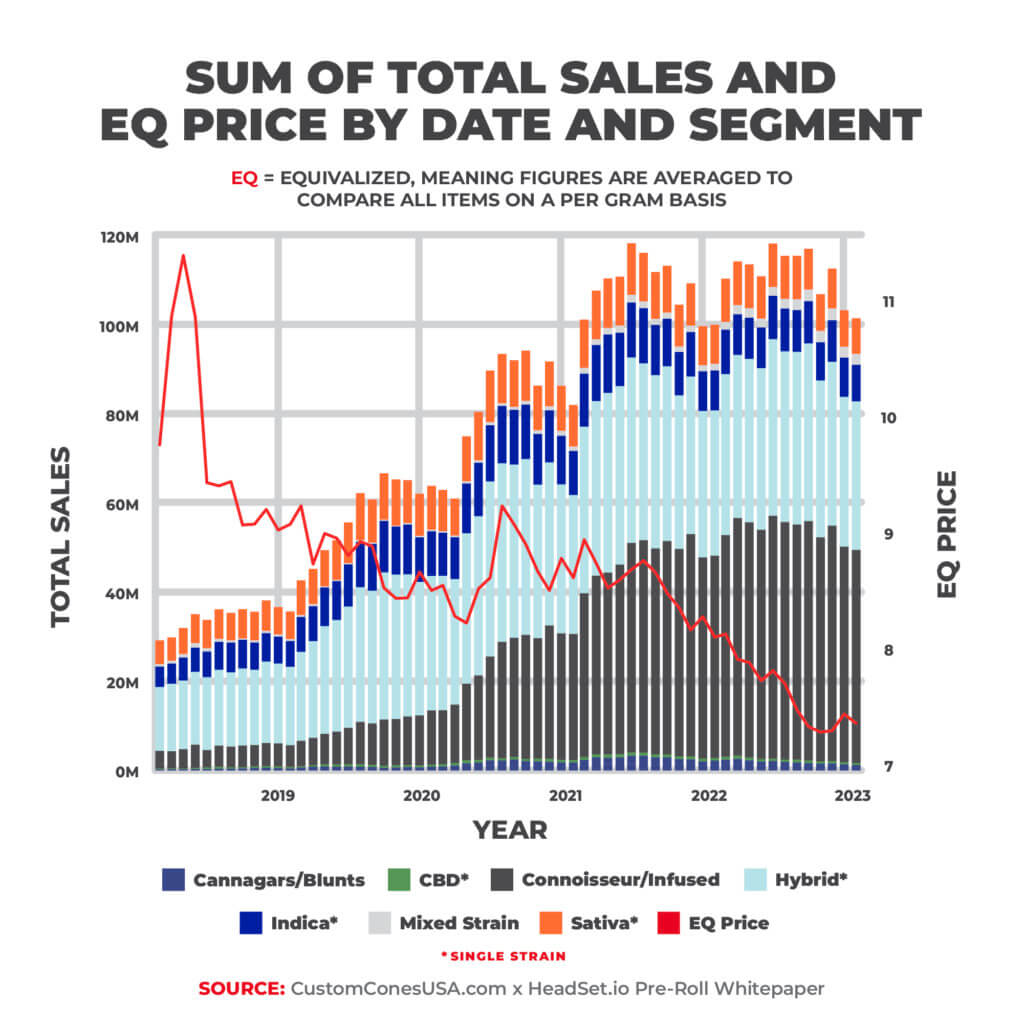
Over the past few years, the wholesale price of flower has dropped dramatically in mature markets, and cheaper cannabis costs have allowed producers to source higher quality flower for their pre-rolls. Combined with the advances in pre-roll making machinery, quality pre-rolls are now able to be sold at a lower retail price, which has driven strong growth for the category.
As you can see from the graph, pre-roll sales have steadily increased as prices have fallen, but the last two years have seen both sales and prices begin to stabilize. The pre-roll segment that has seen the most growth during this time is infused pre-rolls. Customers love high THC percentages, and producers are happy to finally be able to offer it to them in an affordable pre-roll form.
Pre-Rolls have the Least Amount of Price Compression
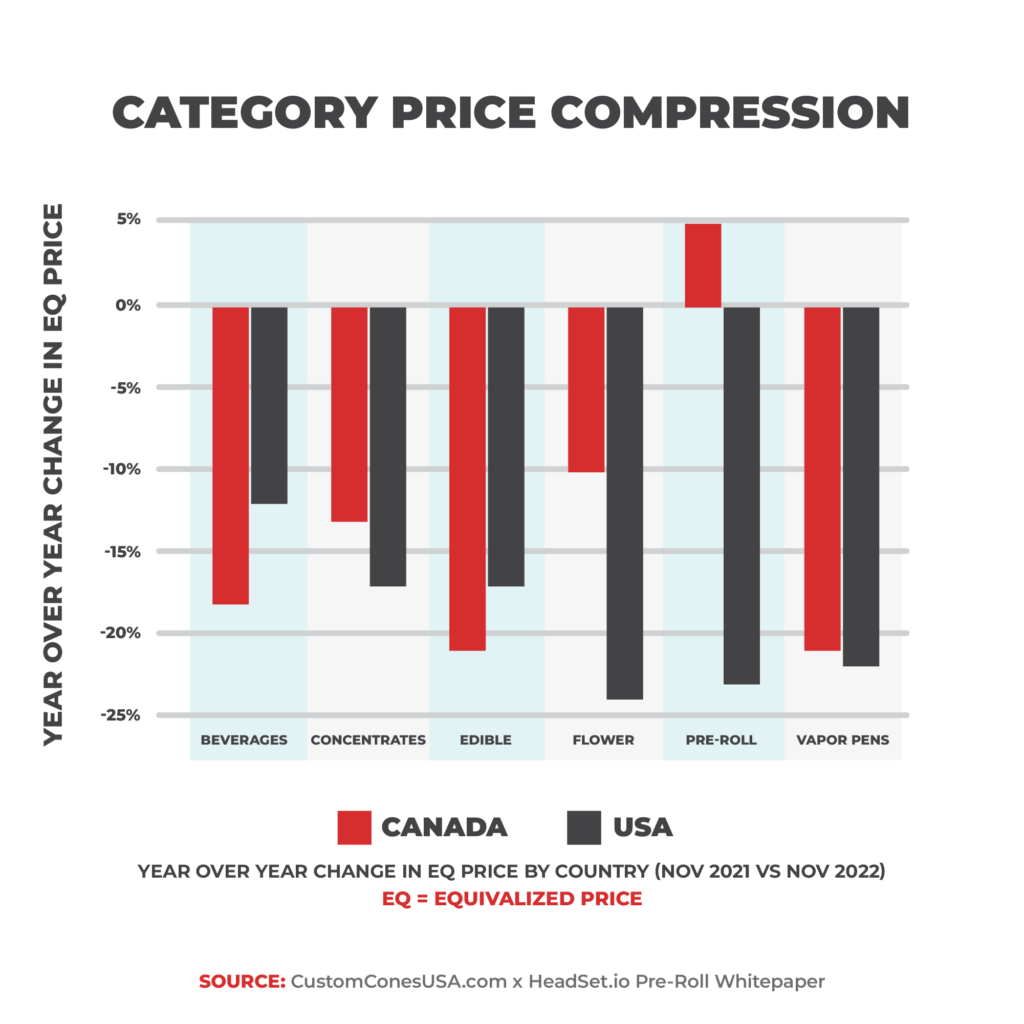
It’s not just pre-roll prices that are falling. Prices are down across the board, but even though prices for all cannabis products declines over time, pre-rolls are showing the least amount of price compression. In other words, if you are in the business of selling cannabis, and you are worried about declining margins, pre-rolls are a category you should be expanding into to maintain and boost profitability.
You can also see from the graph that Canada has actually seen the average price of a pre-roll increase, but there is nuance to this data. This does not mean that pre-rolls are getting more expensive for Canadian consumers. This data shows just how popular infused pre-rolls are becoming. They are becoming so popular that people are choosing to buy them over regular, more affordable pre-rolls, and that change in buying habits has increased the average sales price for pre-rolls.
Pre-Roll Multi-Packs
Another interesting trend we see in the sales data is that pre-roll multi-packs have become extremely popular. In 2018, multi-packs of pre-rolls only made up 27.7% of the market in Oregon, Washington, and Colorado. By 2023, multi-packs make up 47.62% of the market—representing a growth of about 20% over 5 years. Also, Since 2021, we have seen an almost 400% growth in multi-packs that have a volume of 2 or 5 grams as well as steady growth across most other sizes.
Buying pre-rolls by the pack is a lot more convenient for consumers. It means not making a special trip to the dispensary every time a pre-roll is wanted. The rise in their popularity is a sign that consumers are investing in pre-rolls as a staple in their cannabis routine. Because they know they will continue to enjoy pre-rolls, they buy multiples at a time for convenience, and it’s this kind of product loyalty that moves a product from a trend into something more.
Wallet Share by Age
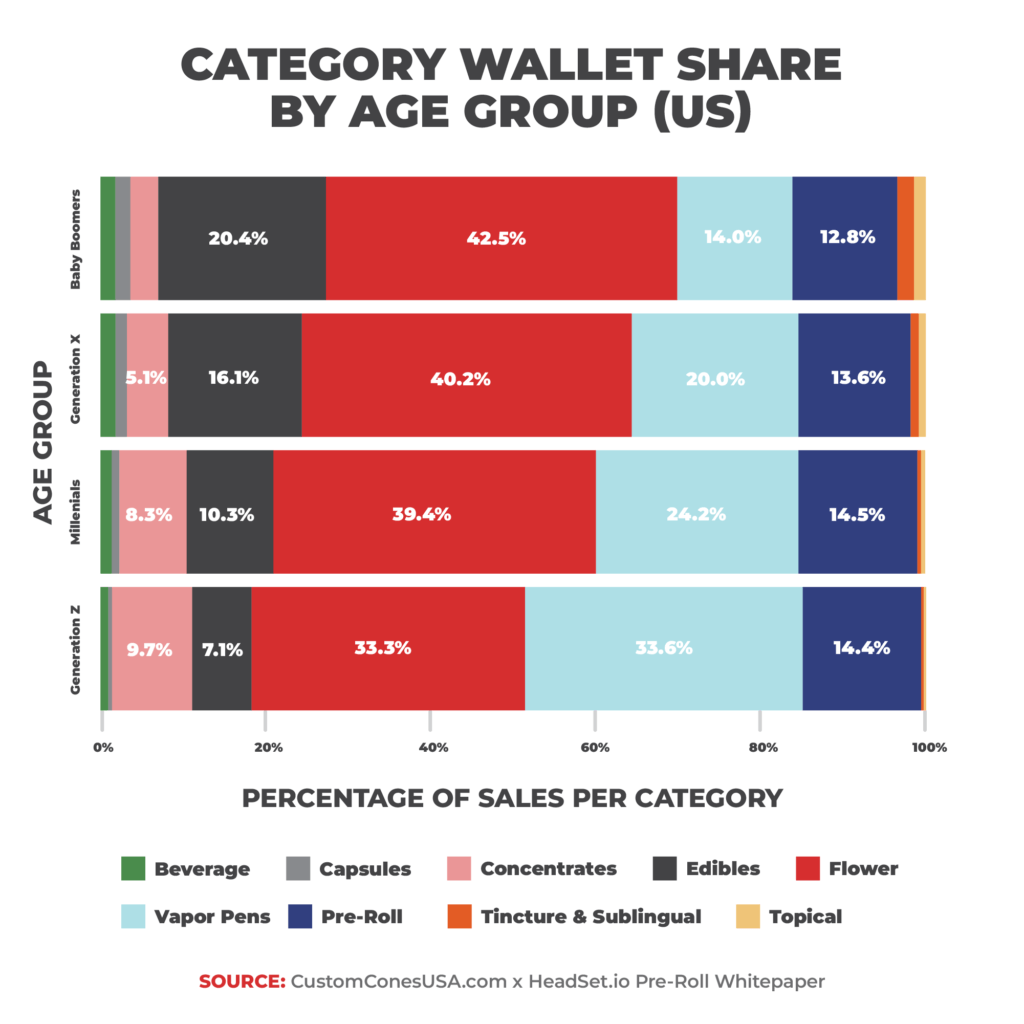
Another interesting thing about pre-rolls is that, when it comes to wallet share, they are the most consistent product segment across all age groups. Other products show a significant increase or decrease in popularity with each new generation; however, pre-rolls steadily hover between 12.8% and 14.5% in each group and even show a slight increase with the younger generations.
It’s also important to note the decline of flower with younger generations. Why this is significant is because, at their core, pre-rolls are a flower product, and they are not following the same decline in sales. They distinguish themselves from loose flower by providing consumers a way to enjoy their flower without extra paraphernalia. In this way, we think pre-rolls could start to eat into the flower market, as they better meet the consumption needs of flower customers.
Pre-Roll Attachment Rates
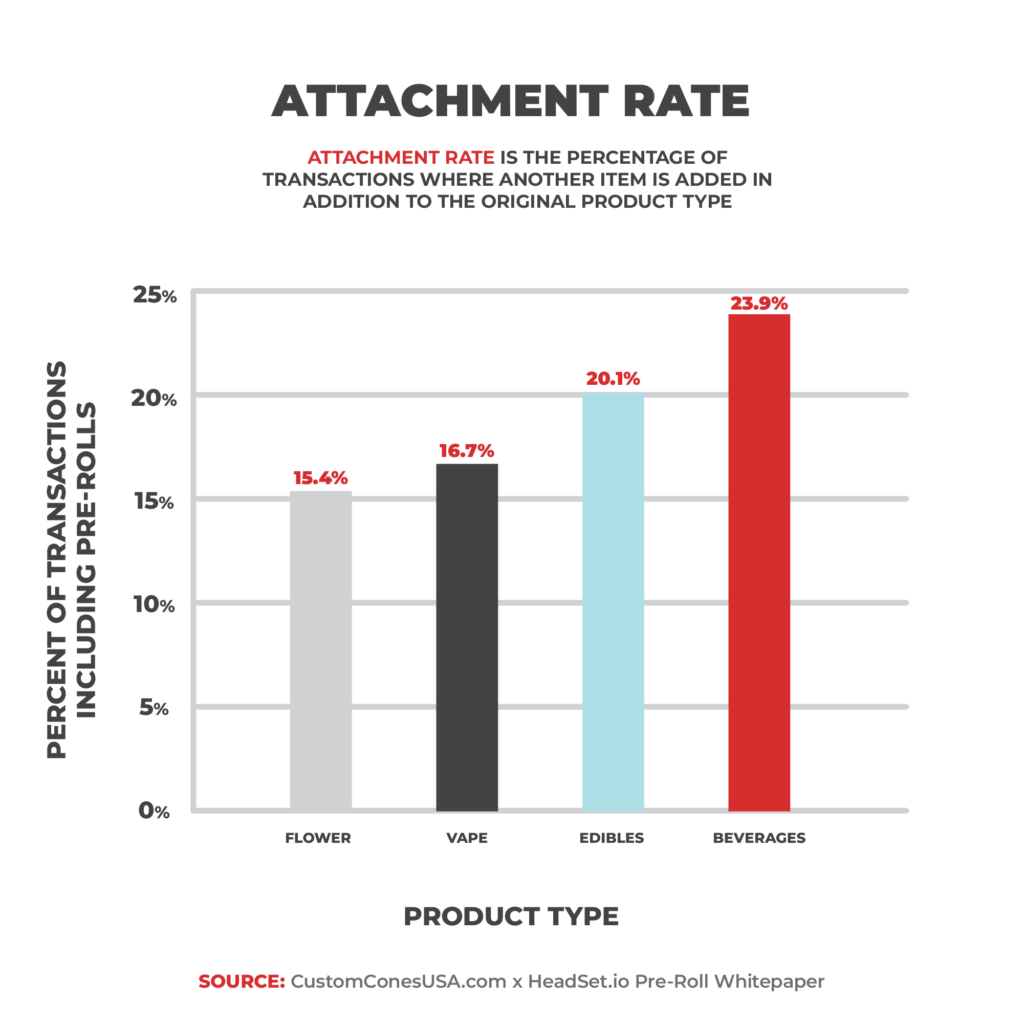
Another big reason why pre-rolls will remain a dominant product segment in the future is that they are the perfect add-on item at the point of sale. The data shows that, when a person walks into a dispensary, they will add-on a pre-roll 15.5% to 23.3% of the time. In fact, in all product segments, pre-rolls either have the highest attachment rate or are within a single percentage point of the leader.
In other words, no matter what a customer is interested in purchasing, it doesn’t take a lot of convincing to get them to add on a pre-roll. They’re reasonably priced, made with quality materials, and incredibly convenient. Whether they want to consume it right away or want to save it for later, pre-rolls have become something flower lovers like to have on-hand for whenever, and that makes it more than a trend. That makes it a staple.
Convenience Impacting Pre-Roll Purchasing
Cannabis is starting to make its way into mainstream culture. You can’t buy it at your local grocery store, like you can buy wine or cigarettes, but it’s out there. The legalization of cannabis has opened the door to innovation in the cannabis industry, and those innovations are starting to have an impact on everything—especially consumption.
Flower needs paraphernalia to be consumed, and, if you are just trying to enjoy cannabis, sometimes you just don’t want the hassle. Pre-Rolls are unique in that they offer the consumer flower as well as a way to consume it, so it’s not too much a leap to think that pre-roll could keep expanding and start eating into flower sales.
In this way, cannabis can be compared to tobacco. Even though people can buy loose tobacco and roll their own cigarettes or use a pipe, most people are buying pre-rolled products. Even though the tobacco quality, smoking experience, and price point can be better when you buy loose tobacco, most people are choosing the convenient option. It shouldn’t surprise us that cannabis starting to fall into this pattern as the market matures.
Final Thoughts on The Pre-Roll Market
The data lets us know that pre-rolls are doing amazing things when it comes to sales, but it is also giving us hints as to trends in consumption methods. Pre-rolls are a flower product, and it’s clear from the data that flower consumers are buying into the convenience of pre-rolls. This is more than just a trend, but a shift in the preferences around flower consumption. Because of this shift, we can see pre-rolls taking on a more prominent role as the cannabis industry continues its expansion.
For a more in-depth look at the pre-roll industry, be sure to check out the State of the Pre-Roll White Paper, and, if you have any questions, feel free to reach out to the Pre-Roll Experts at Custom Cones USA.
Service Solutions: Taking Your Profits Higher – Navigating the Maze of Cannabis Marketing
NCIA’s Service Solutions series is our sponsored content webinar program which allows business owners the opportunity to learn more about premier products, services and industry solutions directly from our network of established suppliers, providers and thought leaders.
In this edition originally aired on Wednesday, July 20, 2022 we were joined by Fox Rothschild LLP whose national cannabis team discussed discussed how agencies and companies can comply when marketing products.
A successful business relies on marketing and advertising to grow and bring in new customers. But what happens when those promotional efforts are heavily regulated or even restricted? These are questions and hurdles cannabis businesses face, but there are ways to navigate this maze.
04:04 – How is marketing & advertising cannabis different than other industries?
07:45 – How is marketing & advertising for cannabis different from state to state?
13:40 – Are these state restrictions for cannabis OK under the First Amendment and do similar state constitutional free speech protections exist or apply here?
15:25 – Virginia State Board of Pharmacy & Thompson Case
16:26 – Central Hudson Case & The Four-Part Test for Commercial Speech
19:57 – Equal Protection Challenges on the Horizon
26:00 – California Cannabis Consumption Event Permitting Process
31:39 – How is marketing & advertising for hemp-based CBD products different than other industries?
37:28 – What is a curative healthcare claim and how can cannabis (or CBD-based) companies develop creative methods to comply while still distinguishing themselves?
41:40 – What trends and challenges do you see on how cannabis products are being advertised and sold?
We are pleased to announce the release of the 2021 Cannabis Compensation Survey Report. This second annual survey aggregates compensation data for cannabis businesses and ancillary services, establishing benchmarks to help those businesses better understand the market and stay competitive, all while following federal compliance regulations that guide the collection and dissemination of compensation survey data and results.
FutureSense and NCIA laid the foundation for the project in 2019 and released results for the inaugural survey at the end of that year. At the onset of the pandemic in early 2020, both parties took a step back to adjust their trajectories looking to enhance the scope and depth of the project. Marijuana Business Daily came on as a primary partner to assist with visibility and distribution. Green Leaf Payroll & Business Solutions came on as a supporting partner, providing the project with anonymized payroll data. NCIA has stayed on as an endorsing partner to promote the shared mutual interest of supporting cannabis businesses and the industry at large.
This year, the survey established benchmarks with reportable data for 98 unique positions, a jump up from the inaugural report, which included 78 positions. The benchmarking process also established more accurate job titles representing both specific job responsibilities as well as representing the scope and breadth of organizational structures within the cannabis industry. These benchmarks include close to 200 unique positions total that will be reported on as the project grows and more cannabis organizations participate and submit data in future years.
The final report also includes recent trends and observations connecting the data to anecdotal insights found through our work and involvement in the cannabis community. The final report also provides information about how to utilize the survey data and a “geo-differential” chart to inform making any adjustments by state. The results are presented as percentiles to show both central tendency and spread. They are meant to be used as ‘guideposts’ to help inform salary and wage decisions, rather than exact numbers to base those decisions on. Many factors can and should be taken into consideration when determining what and how to pay employees, but these results provide an accurate representation of what pay amounts can be.
As the survey evolves and more companies participate, the project plans to also produce results with demographic breakouts such as by region/location, industry sector, and company size; as well as data for benefits, incentives, and equity compensation. These are all very valuable insights but require more participation across the country to produce, per compliance regulations.
The results from the survey can be used across every facet of the cannabis business. Understanding not just how to pay your employees, but also how to attract, motivate, engage, and retain your employees through compensation can be make-or-break in this rapidly evolving industry. 60-70% of companies’ expenses are typically payroll; being even 5% on- or off-the-mark could mean thousands or hundreds of thousands of dollars lost or gained.
The survey’s success is contingent on participation. More and more companies are realizing the value of this information and the importance of transparency through 3rd party surveys. All submissions and their respective data are held in strict confidentiality. Abiding by the Department of Justice regulations, this survey produces anonymous and unbiased results.
The survey accepts organization-wide submissions for companies with ten or more employees at this time. Individual submissions are appreciated as anecdotal insights, but are typically not included in data calculation.
For any questions and/or to sign up for next years’ survey, please email matt@futuresense.com or visit: www.BlueFireCannabis.com
Matt Finkelstein is a consultant with BlueFire Cannabis by FutureSense. He has worked in the management consulting world since 2007 while also pursuing a passion for and career in organic farming. His farming experiences span across the many facets of the cannabis industry, lending itself to unique perspectives supporting his current work bringing FutureSense’s services to the cannabis industry and its community.
BlueFire Cannabis is the cannabis-forward division of FutureSense LLC, a management consulting firm providing holistic people strategies that improve business performance. Our specialties include business strategy, motivation and rewards, executive, employee and sales compensation, organizational and individual assessment, leadership development and coaching, human resources, communications, change and sustainable transformation. For more information, please visit www.BlueFireCannabis.com and www.FutureSense.com
Watch The Webinar: An Insight into Cannabis Attitudes, Uses, and Trends
This informative webinar recording from January 28, 2020, provides insightinto recent market research on state-by-state consumer attitudes, usage, and trends. Cannabis consumer segments and profiles will also be presented along with media consumption and lifestyle attributes, along with preference insights from medical dispensaries and the role of cannabis in the treatment of severe pain and key findings and takeaways from their latest consumer research. Featured speakers include Stephen J. Gongaware and Jennifer Wolfe of Management Science Associates (MSA).
2019 was an incredible year of growth for the cannabis industry; mergers and acquisitions, multi-state expansion, new state licensing, and an explosion of new jobs created. Operationally, more businesses began adopting best practices from the retail and hospitality industries and implemented technology systems to connect all facets of business for stronger insights. There have been focused efforts on hiring, engagement, and training to improve employee retention. Plus, the momentum for widespread acceptance of cannabis legalization is truly unstoppable.
These favorable advancements haven’t come without a variety of challenges, including continued banking access stalls, compliance hurdles, and environmental tragedies. While most legal markets in the nation are struggling to keep up with the demand for qualified talent, select California enterprises laid off an average of 30% of their workforce due to numerous obstacles. Most notably, the vaping crisis shed light on the need forconsistent regulation and testing. Additionally, lack of access to capital has significantly slowed down business growth nationwide.
According to a survey Wurk sent to leading enterprise U.S. cannabis businesses, the largest human resource challenge in 2019 was managing rapid growth and scaling the workforce to meet demand. Managers felt pressure to ensure hiring plans were strategic, yet could meet the constant change of the industry, and many learned that employee turnover was directly related to a lack of training and effective performance management practices.
2019 tested the resiliency, patience, and commitment of many in the industry. As 2020 begins, consider this: this is a passionate community that has the experience, determination and gumption to persevere no matter the roadblocks. As pioneers in cannabis HR, leaders are responsible for providing the right support and resources to the people of the industry, so momentum continues.
In 2020, recognize these 9 trends in cannabis Human Capital Management:
Employee Training & Performance Management
While more than half of the US has some form of cannabis legislation in place, the industry still lacks a standardized education and training program for employees in each vertical. Compliance and risk management programs have been developed by vendors like Cannabis Trainers, and states such as Massachusetts are mandating that operators take part in these sessions. A portion of marijuana businesses have created internal training programs and will invite producers in-house to offer product education to budtenders.
Although there’s been progress in this category, the industry is still a long way away from providing consistent, reliable education to employees. In the coming year, HR leaders will have self-developed or outsourced courses on compliance, at a minimum. More and more operations will expand their employee development to include product and plant specifics, responsible selling best practices, and even positive psychology coaching.
Reducing employee turnover will remain a focus for cannabis HR leaders in 2020. Operators will take a fresh look at how performance management is handled and whether it aligns with company culture. One approach to replace the annual review will be “continuous performance management,” where frequent one-on-ones are scheduled to improve communication, address issues fast, and ensure employees are engaged in the organization. HRIS platforms can support these conversations with people data so managers can combine the human interaction with trending evidence in order to spot at-risk employees before they jump ship.
Employee Experience
People are a business’s largest asset, which means not only can they be the most substantial expense, they are also the biggest revenue generator. The Employee Experience (what people encounter, observe or feel over the course of their employee journey) will begin to be a part of cannabis HR strategy into the new year. By gathering insights about this unique workforce through surveys, interviews, and conversational documentation, cannabis businesses will start to define an Employee Experience that parallels the company’s mission, vision, and values.
Forbes recently included “tending” people as an HR trend to be aware of in 2020. The idea is to cultivate employees and support their growth, rather than manage them. This intentional relationship-building practice evokes a sense of community and wellbeing. Harvard Business Review notes that tending goes a long way in mitigating the “workers as machines” phenomenon. If crucial talent feels they are just a cog in the Multi-State Operator machine or an unseen hourly inventory manager, the likelihood of them voluntarily departing the business will rise.
Standardization vs Customization
Recognition must be given to leadership in 2019 for leaning on other industries for processes to effectively manage a mostly hourly workforce. While cannabis businesses are still in start-up mode, there are labor tasks and procedures that mirror those in the fast food, hospitality, and agricultural segments that can help shape standards. There’s no need to reinvent the wheel, but it’s obvious that the intricacies involved with the seed-to-sale process require customization.
In 2020, HR will balance enforcing best practices and the need for agile, tailored decision-making. When it comes to talent acquisition, for example, a hiring manager may draft a job description that includes vital soft skills, like reliability, communication skills, organization, adaptability, and leadership. In new cannabis markets, following a cookie-cutter model won’t generate the talent pool needed to build a business.
Being innovative with tried and true methods will allow leadership to solve bottlenecks today, not in the future.
Data-Driven Decision Making
According to Deloitte’s 2018 Human Capital Trends report, 85% of companies see people analytics as a high priority, but only 42% believe they are either ‘very ready’ or ‘ready’ to meet expectations. Over the years, cannabis executives have taken action to implement a technology foundation that supports compliance, streamlines processes, and reduces cost. Yet, there is still a lot of runway left to cover.
The focus will shift from technology as a ‘nice to have’ to technology as a major transformational driver in the years to come. Organizations will recognize the benefit of all-in-one solutions that enable better business decisions based on data. Human Resources will remain on budget by comparing actual spend per department, location, and cost center to predicted payroll spend. Managers will rely on people analytics to identify what elements impact turnover and employee engagement. Even in the most fast-paced, ever-changing industry, HR professionals will have the ability to predict future trends for talent, finance, and workforce planning.
Managing Rapid Growth
Massive expansion has created immense pressure for all positions in the cannabis vertical, notably for HR professionals. With most companies growing through M&A activity, not organically, the structure of business is evolving faster than most can realistically manage. This surge will only continue in 2020, demanding the expertise of the HR department to effectively discern new opportunities and build the workforce of the future.
According to the PwC CEO survey, 77% of CEOs believe the biggest threat to their business is the lack of availability of key skills. With CEOs so concerned about talent, cannabis HR managers will shift focus to increasing productivity of their existing workforce as opposed to hiring additional staff. Data will help inform HR professionals on who the top performers are and what conditions are supporting their success.
Outsourced HR Solutions
Employee relationship management should be made a priority for every business, but in-house cannabis human resources may not be an option for all. Small businesses may wait until they reach 40 or even 75 employees before bringing on a full-time HR manager. Constantly evolving labor laws and the risks involved with cannabis payroll will drive some business owners to outsource HR services to cannabis-specific partners.
From employment taxes to employee benefits to the Fair Labor Standards Act (FLSA), there are many aspects of workforce management that owners may not have the resources or experience to maintain. In an industry already strapped for financial support, one mistake in adhering to the work and pay rules for a specific municipality can amount to a hefty fine. The risk involved with managing cannabis people is high and this liability will drive licensees to depend on cannabis-friendly HR and Payroll partners.
Diversity and Inclusion
Key states had strict requirements surrounding diversity initiatives in the cannabis application process in 2019 and this focus will only grow in the decade to come. HR departments will develop stronger D&I plans with innovative ways to recruit, to communicate the importance of unique perspectives and to support peers across the organization.
Sadly, the industry saw a decline in the number of women execs at the end of the decade. Vangst found that of the 38.5% of employees that self-identified as females in the industry, only 17.6% of these women held a “Director” or “Executive” role. This compares to 82.4% for self-identified males.
As momentum gains, the industry will continue to attract like-minded, experienced professionals from mainstream, big box corporations. This past year, KushCo Holdings appointed former Nestle and Cetera Financial Group HR Executive, Rhiana Barr, as their Chief People Officer and Harborside brought on a female HR leader from big pharma. This trend will progress as the industry continues to prove legitimacy through international acceptance and financial opportunity.
Corporate Social Responsibility
Giving back to the community has been a challenging push for cannabis businesses as many non-profit organizations and volunteer programs are still hesitant to partner with plant-touching operations. Thankfully, this trend is taking a turn in a positive direction. Take for example, Cresco Labs, who launched the SEED initiative in 2019 to “ensure that all members of our society have the skills, knowledge and opportunity to work in and own businesses in this industry.” Companies all over the nation are contributing to those most affected by the War on Drugs by donating to non-profits like Last Prisoner Project or collaborating on expungement events.
Human Resources will attract a wider talent pool and increase employee satisfaction in 2020 by providing thoughtful opportunities for employees to be involved in CSR efforts.
Wellness and Benefits Offerings
For years, marijuana businesses have had to worry about basic employee resources, like ensuring they have access to banking and can receive a direct deposit. Although this will remain a hurdle for many, more doors have begun to open for managers to offer benefits, and even 401(k). Insurance and 401(k) brokers that are transparently serving the industry are becoming more and more prevalent into the new year. While Section 280E hinders employers from offering a 401(k) match, some production-focused entities may be able to deduct contributions to their employee benefits plans, where dispensary entities may not be able to—even when they’re owned by the same parent company.
Partnering with cannabis-friendly brokers and financial advisors will only benefit HR professionals as these offerings are still difficult to obtain and execute.
They say a year in cannabis is like 7 dog years… The industry has made it this far, not without flaw and frustration, but certainly with grit and determination. Organizations have the strength to power through 2020 with a solid foundation, the right toolset, and the best people around.
Heather is an experienced marketing professional with a demonstrated history of work in cannabis technology and digital strategy. Skilled in customer relationship management, online marketing, immersive experience design and communications, Heather brings a unique combination of creative ideation and project management. As Director of Marketing for Wurk, the first workforce management company designed specifically for the cannabis industry, Heather develops key messaging to inform the market about effective human resource management and to support the advancement of the industry. With previous experience at MJ Freeway, the leading provider of seed-to-sale software solutions for marijuana businesses, Heather brings a unique understanding of cannabis chain of custody and the various challenges operators face in this highly regulated space. Heather earned a bachelor’s degree in communication design and marketing from Metropolitan State University.
Designed specifically for the cannabis industry, Wurk allows employers to protect and streamline their operations, while providing an environment where people are a priority every step of the way. The intuitive, all-in-one solution automates the most complicated and risk-prone processes associated with hiring, scheduling, and paying employees. Learn more at enjoywurk.com.


 In other words, no matter what a customer is interested in purchasing, it doesn’t take a lot of convincing to get them to add on a pre-roll. They’re reasonably priced, made with quality materials, and incredibly convenient. Whether they want to consume it right away or want to save it for later, pre-rolls have become something flower lovers like to have on-hand for whenever, and that makes it more than a trend. That makes it a staple.


 Matt Finkelstein is a consultant with


Follow NCIA
Newsletter
Facebook
Twitter
LinkedIn
Instagram
News & Resource Topics
–
This Just In
How THCa Vapes Are Changing Consumer
Announcing NCIA’s 2026-2028 Board of Directors