Last week, the hemp and CBD industries took another blow from the Food and Drug Administration when the agency refused to grant a request from prominent CBD producer Charlotte’s Web to regulate the substance as a dietary supplement. This is the latest in a series of delays and setbacks on the part of the FDA when it comes to regulating hemp-derived cannabinoids and products since they became technically legal at the federal level under the 2018 Farm Bill.
Bloombergreports: “The company’s bid to sell its full-spectrum hemp extract with CBD as a dietary supplement won’t be considered because of the FDA’s own prior decision to treat CBD as a drug, according to a letter posted on the agency’s website Wednesday. This shouldn’t disrupt the business of Charlotte’s Web or prevent other companies from continuing to sell such products, which already exist in a gray area without the agency’s oversight. The decision shows the agency’s ongoing hesitancy to regulate cannabidiol, the non-psychoactive ingredient in cannabis plants better known as CBD… The FDA’s objection rested in part on its prior approval of Epidiolex, a CBD drug to reduce seizures, which the agency said precludes it from authorizing CBD for dietary purposes. Even if the drug hadn’t been approved, though, the FDA said in the letter to Charlotte’s Web dated July 23 that it “has concerns about the adequacy of safety evidence” that the company submitted.”
This position is likely to create serious problems for the CBD industry. Without allowing CBD products to be regulated as dietary supplements or food additives, the FDA will be forcing producers to get federal approval for their products under the Investigational New Drug program. This process can often take years and cost applicants millions of dollars.
This casts even more doubt on what the future of the CBD market will look like as producers continue to operate in an uncertain landscape. The legality of CBD combined with the lack of federal regulations has created a lot of opportunities for responsible producers to bring products to market without dealing with the often overly strict state cannabis programs, but it has also opened the door to irresponsible operators who have been accused of actions from making misleading or unsubstantiated health claims to selling mislabeled or adulterated products.
Furthermore, the lack of federal regulations has discouraged many larger retailers from selling CBD or hemp-derived products altogether, drastically limiting the market options for producers. Some industry insiders have theorized that lack of access to those retailers has directly led to some producers desperately searching for ways to unload their excess CBD, including processing it into unregulated Delta 8 THC and flooding the markets in both legal and prohibition states, creating concerns among regulators, lawmakers, licensed cannabis operators, and consumers.
This troubling news follows on the heels of another memo issued by the Farm Credit that suggests that financial institutions that provide financing to hemp businesses should only do so if the company is operating under the auspices of a USDA-approved state hemp program.
“While many states and federally recognized tribes have since submitted those plans, 20 states are still operating under an earlier provision: a hemp pilot program created by the 2014 Farm Bill. That program, which is still valid and would befurther extended under pending legislation that has passed the House and is pending in the Senate, requires less federal oversight than the new USDA-approved programs,” Marijuana Momentreports.
Some in the industry are concerned that the memo will lead to lenders dropping their hemp clients operating under the pilot programs, but others have suggested that it will not have a significant impact on the lenders who are already working with hemp businesses given the amount of reporting that they must already complete for the federal government and the lack of federal prosecutions for doing so historically.
It seems pretty clear by this point that the FDA will not move forward with regulating CBD in a timely and reasonable manner without outside pressure. You can add your voice to the chorus calling for sensible CBD regulations by visiting RegulateCBDNow and urging Congress to take action.
MORE Act House Vote Delayed, NCIA Submits Comments on FDA Guidance
by Morgan Fox, NCIA’s Director of Media Relations
In what House leaders have assured supporters is merely a temporary delay, lawmakers announced that the vote on the MORE Act which was originally scheduled for this week has been postponed until at least after the November election.
This legislation – which would remove cannabis from the Controlled Substances Act (CSA), expunge federal cannabis convictions, and establish programs to promote diversity in the cannabis industry and help communities that have been unfairly targeted by marijuana enforcement – was eagerly awaited as the first bill of its kind to get a floor vote in either chamber of Congress. No other de-scheduling bill, particularly one that contains robust restorative justice provisions, has ever gotten a vote since the original passage of the CSA in 1971, and advocates were confident that it would be approved in the House. In recent months, dozens of additional lawmakers have signed on to co-sponsor the bill, bringing the current total to 113.
Unfortunately, despite recent polling showing majority support for the MORE Act among Republican voters (and its job- and revenue-creating potential), some in the GOP attacked Democratic House leadership for moving forward with the bill before Congress had come to an agreement on a new pandemic relief package.
While this is certainly disappointing, House leadership has promised that the MORE Act will get a vote before the end of the year. That gives us at least another seven weeks to continue building support! In the meantime, attention is turning back to pandemic relief, where we are still pushing for the continued inclusion of SAFE Banking language in the final package if Congress can come to an agreement. There are also a number of cannabis-related provisions in this year’s appropriations bills, including removing barriers to research, protecting universities engaged in cannabis research, and preventing federal interference in state-legal medical and adult-use cannabis programs.
Please contact your members of Congress and urge them to support ALL these measures!
In other federal news…
With the help of our Policy Council, Hemp Committee, and Scientific Advisory Committee, NCIA submitted comments to the Food & Drug Administration this week providing recommendations on a number of issues related to how the agency will classify cannabis and cannabis-derived compounds in the future. You can read the full comments here. While the current comment period is now closed, the FDA has been expressing increased interest in input from a variety of stakeholders, suggesting that they are preparing for a change in policy in the relatively near future. It is very likely that there will be more opportunities to weigh in on their policies that could affect the cannabis industry for years to come.
The DEA and USDA both have open comment periods right now, so be on the lookout for more information about how you can help us influence cannabis and hemp policy at those agencies in the coming weeks!
Member Blog: Cross-Pollination Poised to Prompt Litigation in Light of New USDA Hemp Rules
On October 29, 2019, the USDA released regulations establishing a domestic hemp production program, paving the way for hemp cultivation on an industrial scale in 2020. While the potential benefits of a robust hemp industry in California are exciting, large scale industrial hemp cultivation increases the risk of cross-pollination for hemp and cannabis growers, which may significantly impact the value of both crops.
Cannabis sativa, the plant used in both hemp and cannabis production, is a dioecious species, meaning that male and female flowers are borne on separate plants. Cannabinoids, including THC and CBD, are more concentrated in the female flower than in the male flower. Therefore, cannabis or hemp growers who desire a crop with a high yield and potency of either THC or CBD will typically use feminized seeds or clones and will weed out male plants if they appear. Growers of industrial hemp produced for seed or for fiber, however, are not concerned with producing potent cannabinoids and therefore will generally grow both male and female plants.
Cross-pollination between female and male plants can cause problems, such as seed production, lower crop yields, and altered THC or CBD content of the flowers that are produced. This can devastate the value of crops grown for their THC or CBD content. Moreover, if hemp exceeds the 0.3% THC concentration threshold allowed under the federal regulations, it must be destroyed.
Unfortunately, cannabis pollination can occur over large distances depending on the concentration of plants and weather conditions. Industry experts recommend a minimum distance of ten miles between outdoor growing operations, but research shows it is possible for cannabis pollen to travel much further. Therefore, cross-pollination is possible even if a neighboring farm is miles away. This dynamic poses a huge problem to the young industry.
At this point, there are few regulations in California designed to prevent cross-pollination. Several counties enacted temporary moratoriums on the production of hemp, primarily based on the USDA’s inaction. In those counties, cross-pollination has not been a problem since cultivation was not allowed in the first place. Now that the USDA has issued regulations governing the hemp industry generally, counties will likely lift these temporary moratoriums. But since the USDA regulations are silent as to the distance between hemp and cannabis operations, cross-pollination will almost certainly occur and will likely result in litigation in the near future. Indeed, cross-pollination has already caused litigation in other states. For example, lawsuits related to cross-pollination have already commenced in Oregon. In Jack Hempcine LLC v. Leo Mulkey Inc., et. al., a hemp grower alleges that cross-pollination by male plants on the property of several nearby growing operations raised the THC levels of the Plaintiff’s female plants, rendering his entire crop unmarketable. The grower who brought that action alleges damages exceeding $8,000,000 in lost crop value.
There are several legal theories available to growers seeking to recover damages caused by cross-pollination of their crop by a nearby hemp or cannabis operation, including negligence, trespass, nuisance, strict liability, and interference with prospective economic advantage. If your crop is or was negatively affected by cross-pollination or another grower alleged that you have damaged their crops via cross-pollination, you should contact counsel as soon as possible.
Ryan McGuire is an attorney at HK Cannabis Law, a practice group of Huguenin Kahn LLP, a full-service law firm representing clients throughout California and beyond. Ryan has years of experience litigating a broad range of legal actions, including personal injury, employment, contractual disputes, and construction defect claims. Ryan also has deep ties to California’s agricultural community, and has successfully represented growers, packers, and distributors. Ryan’s knowledge and experience are valuable assets for clients involved all aspects of cannabis production from seed to sale. Established to provide legal representation and counsel in the emerging field of cannabis law, HK Cannabis Law stands ready to serve clients at every stage of the cannabis business cycle, from business entity formation, real estate acquisition, land use, contracts, business transactions, regulatory compliance, licensing and permitting, enforcement defense and, should it ever be necessary, legal representation in both civil and criminal trials and appeals.
Webinar Recording: NCIA’s Official Response To USDA’s Hemp Rules
Watch this recording if you missed the live webinar on December 10 about NCIA’s official response to the USDA’s hemp rules.
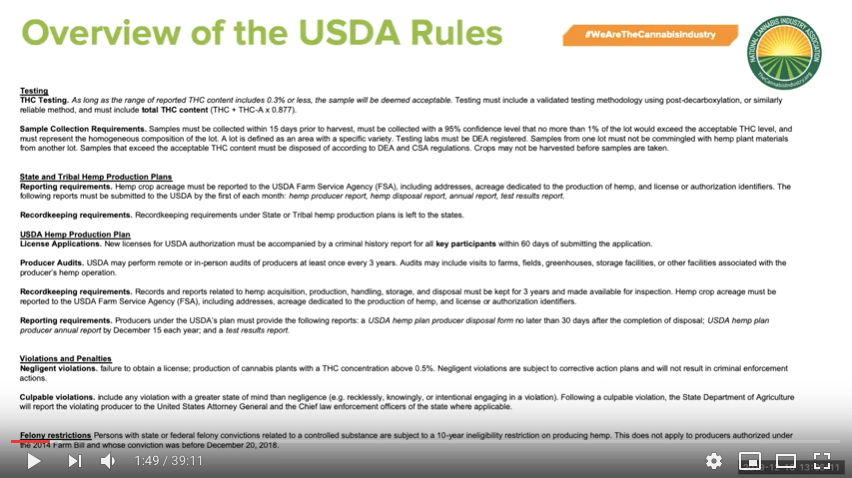
On October 31, 2019, the USDA released its Final Interim Rule governing the domestic production of hemp within the United States. The USDA is currently accepting public comments to its hemp rules through December 30, 2019. There are many rules that need to be changed or clarified to make the program viable, including sampling, required DEA registration for labs, a fifteen-day harvest window, and a definition of “commingling” among other potential issues. Please join Cindy Sovine and Alex Buscher to discuss the NCIA’s public comments and steps you can take to help shape the final USDA hemp rules.
Former FDA Commissioner Calls For Descheduling And Federal Regulation
by Andrew Kline, NCIA’s Director of Public Policy
With uncertainty about the proximate cause of the vaping crisis continuing to roil state regulators, and state governors trying to determine the right short-term solution to protect the public health, the former Commissioner of the FDA has a longer-term plan. Former Commissioner Scott Gottlieb is rightly calling for descheduling and federal regulation in an op-ed in the Wall Street Journal. NCIA made the same argument in our Policy Council’s recent white paperon regulating cannabis post-legalization and in our public responses to the vaping crisis.
While no one yet knows for certain what has been causing these injuries and deaths, it is readily apparent that unregulated and untested products are extremely dangerous and continue to infiltrate the market. Just last week, a mother and her two sons were arrested for allegedly illegally filling over 30,000 vape cartridges in Wisconsin from their home. That burgeoning illicit and untested market poses real risks to American consumers. And the best way to eliminate the illicit market is to create opportunities for consumers to purchase products from legal dispensaries and market awareness of the benefits of purchasing from those regulated markets.
For example, if consumers know that legal dispensaries are selling regulated products that have been tested to improve consumer safety, then they will be more inclined to stop purchasing from the illicit market. People already know that when they step foot into a grocery store, the foods they eat and the drugs and dietary supplements they take are part of a supply chain designed to improve safety. That is because they have placed trust in the USDA and FDA. And no better way to build consumer confidence, than to make sure that trusted federal agencies are in charge of promoting public health in the cannabis industry.
We can’t continue to leave the cannabis industry in a state of uncertainty. It’s time to deschedule, regulate at the federal level, and require mandatory lab testing. We must displace the illegal, unregulated and untested illicit market. There is no plan B.
Andrew Kline is Director of Public Policy for NCIA and Chair of NCIA’s Safe Vaping Task Force
 by Morgan Fox, NCIA’s Director of Media Relations

Follow NCIA
Newsletter
Facebook
Twitter
LinkedIn
Instagram
News & Resource Topics
–
This Just In
NCIA Applauds Reintroduction of SAFE Banking Following Lobby Days
Beyond Rescheduling: Inside NCIA’s 14th Annual National Cannabis Industry Lobby Days