The word “advocacy” is a loaded term. It evokes different emotions in different people. However, in the cannabis industry, it’s a case of goose and gander, as a win for advocacy is a win for operators as well — with policy wins ultimately translating into financial benefits for operators. Thus, it would stand to reason that whenever possible, operators should lend their support to the side of advocacy. In this article, we’ll explore how the two can work together to their mutual benefit.
From Bill Passage to Bank Balance
Due to its quasi-legal status, every positive legislative change can be a massive boon for the cannabis industry. As many are aware, the industry can often operate on a cash-only basis due to federal restrictions. Thus, something like theSAFER Banking Act, which advocates have been pushing for, can be highly beneficial to the industry. To recap: this act would help provide federal protection to financial institutions, including preventing the depository institution from being penalized for providing banking services to a state-sanctioned cannabis business. Further, the Act prohibits a federal banking service from requesting or requiring a depository institution to cancel a deposit account.
While this act isstill waiting to be passed by the Senate, it could represent a significant step forward for the industry by offering essential banking services such as loans, credit lines, and cash management services, such as armored deposit services.
Another big issue for cannabis advocacy isrescheduling. Going from a Schedule I narcotic to a Schedule III narcotic would also open many doors for the industry. One of the most significant advantages of this shift would be the elimination of IRC 280E, which restricts what operators can deduct under the tax code. Unshackled from this prohibitive tax code, operators would have a wealth of items they could deduct, such as wages, rent, utilities, insurance, marketing, and administrative costs.
The benefits of rescheduling wouldn’t stop there. This shift could also herald more research and development opportunities for cannabis, as there would be a greater legal recognition of the plant’s medicinal value.
TL;DR: Advocacy could help operators in many ways; here are but a few examples:
The SAFER Banking Act would provide federal protections, allowing banks to safely offer essential services, such as checking accounts, loans, and cash management, to state-legal cannabis businesses. This would reduce cash-only risks and improve industry stability.
Rescheduling cannabis to Schedule III would eliminate the restrictive tax code 280E, enabling cannabis businesses to deduct regular business expenses and promoting more research, development, and legal recognition of cannabis’s medical value.
Now, let’s discuss how the industry is already working together to be most effective for everyone.
Coalition Building
Fortunately for the cannabis industry, supporters are passionate and proactive. We can examine several examples of how the industry has leveraged partnerships across different segments to the benefit of everyone.
The oldest chapter of NORML, established in 1972, the National Organization for the Reform of Marijuana Laws — California chapter continues its legacy from the Compassionate Use Act of 1996 to the recent passage of AB 564, a tax-reducing policy. California NORML unites the cannabis industry by coordinating lobbying, publishing resources, and building a business directory — acting as a bridge between consumers, legislators, and cannabis businesses to promote equitable laws and industry cohesion.
Favoring a grassroots approach, the MCBA seeks, in their words:
“To create equal access for cannabis businesses and economically empower communities of color through policy, programming, and outreach initiatives to achieve equity for the communities most impacted by the War on Drugs.”
Through advocacy and events, the MCBA creates partnerships through many industry segments (retail, cultivation, etc.) for maximum impact.
Besides working together, let’s explore how we can utilize onestate’swin as a model for others.
NCIA brings together various players in the cannabis industry by providing national advocacy, policy coordination, education, networking, and a member directory across all verticals — ensuring businesses and stakeholders speak with one informed, powerful voice.
Scaling Local Success
We can look to states such as California, Oregon, and Washington as (limited) success stories. These states have passed legislation enabling their governors to enter into interstate agreements, allowing border-transversing sales of cannabis between states where it is legal. This enables operators to reach far-flung markets beyond their home state. We see how these states follow each other’s lead while also working collaboratively to secure the best return on investment, although full-scale interstate commerce remains limited pending federal changes.
We can also turn back the clock nearly thirty years from today to when California passed the Compassionate Use Act of 1996. Other states would follow California’s model, and by 2023, 37 states had medical marijuana laws.
Or we can turn to Colorado and Washington, rewinding the clock not quite as far to 2012, when the states legalized recreational cannabis use. This would also serve as a model for other states, and by 2023, 19 states had followed Colorado’s example.
It goes without saying that when one state makes progress for cannabis reform and has quantifiable results, other states are likely to follow suit.
Conclusion
There is no cannabis industry without advocacy. Every step advocacy makes, operators are in lockstep with it. Fortunately, as competitive as the industry is, groups like the National Cannabis Industry Association are arduously working for legislative changes that benefit many in the industry. At the same time, we have other organizations like the Minority Cannabis Business Association toiling to help specific groups that have been historically disadvantaged. However, when these minority groups benefit, everyone benefits — as these social equity initiatives support whole communities by providing jobs and using tax revenue for mental health support, legal services, and other community reinvestment programs.
And speaking of tax revenue, when one state’s cannabis laws are effective — whether medical or recreational — it’s easier to get the ball rolling on similar laws in other states.
Committee Blog: The Digital Dollar Dilemma – How a U.S. CBDC Could Reshape Cannabis Banking
A potential U.S. Central Bank Digital Currency (CBDC) represents one of the most disruptive technologies on the horizon for the financial world, with profound implications for the cannabis industry. While a “digital dollar” could theoretically solve the industry’s payment rail issues overnight, it also introduces significant threats related to privacy, data security, and direct federal oversight, creating a high-stakes dilemma for cannabis businesses and the institutions that bank them. However, recent developments have fundamentally altered this landscape, particularly the January 2025 Executive Order 14178 halting U.S. CBDC development and ongoing progress with cannabis banking legislation.
Current State Analysis
The conversation around a U.S. CBDC has evolved dramatically from academic theory to active research, most notably through the Federal Reserve’s collaboration with MIT on “Project Hamilton,” which completed its Phase 1 research in February 2022. However, in January 2025, President Trump issued Executive Order 14178, explicitly prohibiting federal agencies from “undertaking any action to establish, issue, or promote a CBDC” and revoking previous digital asset policies. This makes the United States the only major economy to halt CBDC development through executive action. Despite this policy shift, understanding the potential impacts of CBDCs remains relevant, as policy positions can change with administrations, and other countries continue rapid CBDC development that could influence global financial systems. For the cannabis industry, banking challenges persist despite the executive order. The core issue remains the industry’s reliance on private-sector workarounds. Fintechs and banks have invested heavily in BSA/AML programs to manage the risks of handling cash deposits.
Legislative Developments
Simultaneously, significant progress has occurred with cannabis banking legislation. The SAFE Banking Act evolved into the SAFER Banking Act (S.2860), which passed the Senate Banking Committee with a bipartisan 14-9 vote and awaits a Senate floor vote. This legislation would provide safe harbor protections to financial institutions serving state-legal cannabis businesses, potentially resolving many banking challenges independent of any CBDC considerations. Additionally, cannabis rescheduling efforts at the federal level could fundamentally alter banking access. While rescheduling alone wouldn’t resolve all banking issues, it would reduce regulatory burden and risk perception for financial institutions considering cannabis banking services.
Regulatory Landscape
The introduction of a CBDC, if policy were to reverse, would create a direct and unavoidable conflict with the Controlled Substances Act (CSA). Every transaction involving a CBDC would be recorded on a central ledger managed by the Federal Reserve, raising critical policy questions about privacy versus surveillance. The Federal Reserve’s previous white papers presented various models, from anonymous, token-based systems (similar to cash) to account-based systems that would link every transaction to a verified identity. If the U.S. were to adopt an identity-based CBDC in the future, the federal government would have a real- time, unalterable record of every dollar spent at every state-licensed dispensary in the country.
Alternative Pathways
With CBDC development currently halted, the cannabis industry must focus on alternative pathways to banking normalization:
1. Legislative Solutions: Continued advocacy for the SAFER Banking Act and similar legislation that would enable traditional banking services.
2. Existing Compliance Frameworks: Further investment in robust compliance programs under current FinCEN guidance, which remains relevant despite policy shifts.
3. Private Sector Innovation: Development of alternative payment solutions that can operate within current regulatory frameworks.
4. State-Level Banking Solutions: Some states are exploring state-chartered banking options specifically for cannabis businesses.
Key Takeaways
• The January 2025 Executive Order significantly altered the U.S. CBDC landscape but hasn’t resolved cannabis banking challenges
• The SAFER Banking Act represents the most immediate potential solution for cannabis banking issues
• Banks should continue investing in current compliance technologies rather than waiting for CBDC or legislative solutions
• The cannabis industry must actively engage with multiple parallel policy debates that impact banking access
• Privacy concerns remain central to any digital payment solution for the cannabis industry, whether government or privately issued
• Cannabis rescheduling efforts represent another potential pathway to improved banking access independent of payment technology development
How to Make the Most Out of Lobby Days
Dr. Amanda Reiman in conversation with Jeremy Marsh, from the Office of Congresswoman Dina Titus
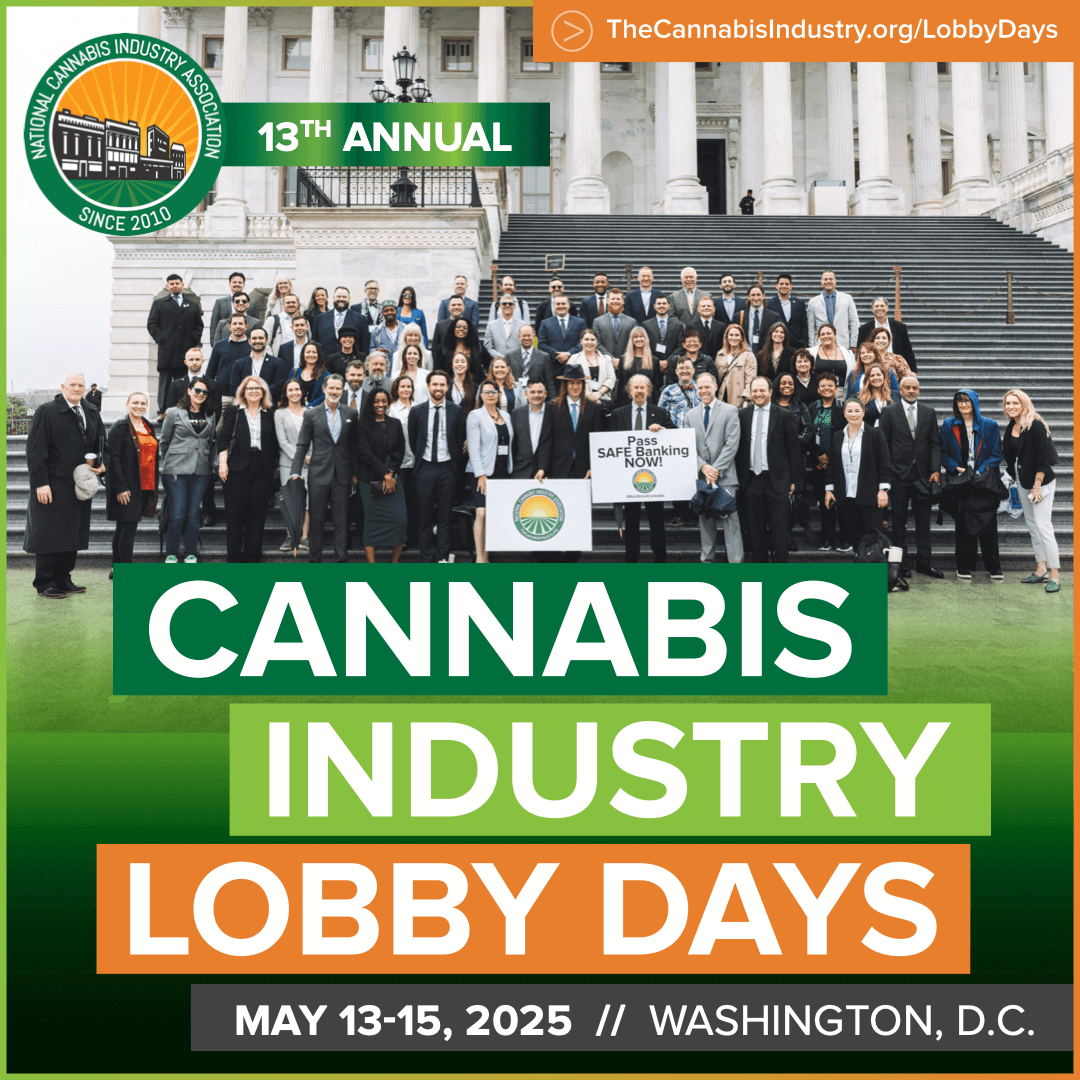
NCIA’s 13th annual Cannabis Industry Lobby Days is rapidly approaching and new and seasoned attendees alike may be wondering how to make the most out of the precious time with electeds’ offices. Meeting with allies and skeptics both present unique challenges and opportunities. To provide advice on how to make the most out of Lobby Days, I reached out to Congresswoman Dina Titus’ office and spoke with Legislative Assistant Jeremy Marsh. Following his advice will help you walk away from Lobby Days feeling accomplished and confident that your message got through.
Stories from the community matter
White papers and data points are fine, but what really moves the needle are stories from the community and the front lines. Tailoring stories to the district/state of the office you are meeting with shows how constituents and local businesses are impacted by policy. These stories are great tools for supportive legislators to take to the floor and their committees. And, when meeting with a legislative office that has supported cannabis in the past, be sure to thank them! Standing up for cannabis is still a risk and those willing to take it should be acknowledged.
Rescheduling and hemp are still areas of confusion
Elected officials are more cannabis savvy now than ever before, but there are still some issues where education is needed. Don’t assume that elected officials, even supporters of cannabis are experts in all of the hot button issues being discussed in the industry. Mr. Marsh explains that rescheduling/descheduling and hemp regulation are two areas where confusion persists. Explain the issue before asking for support, and have some fact sheets ready with background information, as well be willing to answer questions and give context to these issues. Be sure you yourself can clearly explain the issues you are bringing into your Lobby Days visits.
Be early and be flexible
If you’re early you’re on time, if you’re on time, you’re late. This adage was drilled into my head by my Dad (thanks Dad!) and it is a great rule of thumb for Lobby Days. Try to be at least 5 minutes early to each meeting. Time is precious and being early shows that you are taking the process seriously. It also gives you time to collect your thoughts and your breath before heading into a meeting. Lines to get into the Capitol can be long, so keep this in mind before your first meeting of the day. If you are going to be late to a meeting, call the office and let them know. At the same time, be flexible. Schedules are constantly shifting for elected officials, so don’t take it personally if you are meeting with a staffer, or in the hallway outside the office. ALL communication is important, and many vital conversations happen outside the office doors (just watch Veep!).
The economy and public safety are selling points for opponents
Many would argue that meeting with opponents is just as, if not more, valuable than meeting with allies. And although cannabis has gained support from both sides of the aisle over the years, many are still skeptical of changing the laws around cannabis. If you meet with someone who has not traditionally been supportive, discussing the economic and public safety benefits of legalization is a good focus. Cannabis tax revenue has been used to support schools, roads, substance abuse programs, job placement and more. And, research shows that, after legalization, fewer teens are using cannabis, and fewer people are using opiates. You don’t have to be a fan of cannabis to be a fan of legalization.
NCIA’s 13th annual Cannabis Industry Lobby Days is a chance to bring the cannabis issue front and center with lawmakers. Once a source of snickers and jokes, the cannabis movement has become a major political force. Even so, assumptions about those involved in cannabis persist. Being prepared, professional and well versed on the issues will make an impression. And being a part of shedding a positive light on this industry and the people who work in it feels really great.
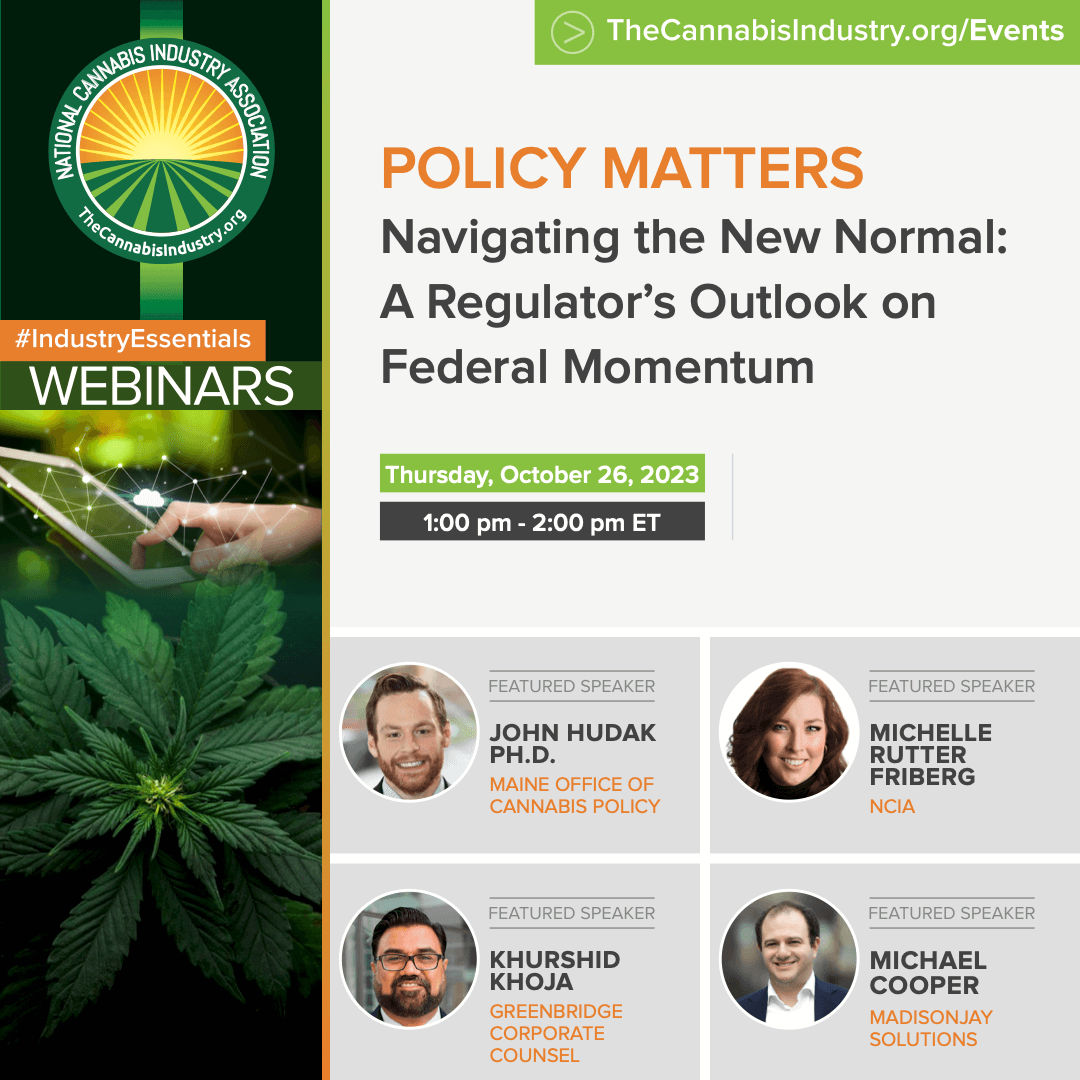
Navigating the New Normal: A Regulator’s Outlook on Federal Momentum | 10.26.23 | Policy Matters
Welcome to the second edition of our new Policy Matters series, dedicated to unraveling the intricate world of regulatory and policy dynamics within the cannabis industry. In the previous edition of Policy Matters, we had the privilege of hosting Will Tilburg from the Maryland Cannabis Administration, who shared his perspectives into the strategic aspects of designing a thriving cannabis market while meeting regulatory standards. This month, we continue our exploration into the world of cannabis policy, focusing on the potential implications of federal cannabis reform and recommended preparations for various stakeholders, including regulators, industry players, and the public.
In this #IndustryEssentials webinar series, we aim to provide Main Street cannabis operators valuable insights from regulators, industry experts, and advocates to keep you informed about the latest developments and challenges in the ever-evolving cannabis landscape. This article provides a comprehensive summary of the discussions, speaker highlights, and key takeaways from the event, continue reading and view the full recording below.
John Hudak: A Transition from Academia to Public Service
Our guest speaker for October’s edition of “Policy Matters”, John Hudak, serves as the Director of the Office of Cannabis Policy in Maine, a role he took on after serving as a senior fellow at the Brookings Institution. His background is an interesting blend of academic expertise and hands-on experience in state government and he touched on how this transition reflects his strong commitment to public service and his desire to implement real-world policies.
Hudak emphasized the challenges of engaging with industry stakeholders and regulators, even from a state perspective. He highlighted the importance of good public policy that not only benefits the cannabis industry but also safeguards the well-being of the people of Maine. His insights underscored the need for a balanced approach in crafting cannabis policies that are in the best interest of all stakeholders.
The Significance of Cannabis Rescheduling
The recent rescheduling recommendations of cannabis was discussed as great momentum in the right direction on the path to federal cannabis reform. While it wasn’t expected to lead to full descheduling, rescheduling still represents a positive step forward. This shift in classification may offer some much-needed tax relief for an industry that has faced considerable financial challenges, especially for smaller businesses.
The change in cannabis classification may also prompt a reevaluation of state-level business deductions, aligning them more closely with federal tax codes. Additionally, it was noted that the optics of President Biden initiating the rescheduling process were noteworthy, given his history on drug policy. However, it was emphasized that federal legalization should only occur when the government is well-prepared to manage the potential repercussions to avoid any undesirable outcomes.
Congressional Challenges to Federal Cannabis Reform
Michelle Rutter Friberg, NCIA’s Director of Government Relations, joined the discussion this month, shedding light on the challenges related to congressional action or inaction in the context of federal cannabis reform. She raised concerns that Congress might view its work as done if rescheduling takes place and that the historical difficulty in reaching a consensus on various issues within Congress poses a potential threat to further federal cannabis reform.
Years of congressional inaction have led to market consolidation, impacting small businesses and creating disparities within the industry. These insights highlighted the inherently political nature of the current reform process. Michelle also mentioned President Biden’s campaign promise to reform cannabis policies, which continues to influence the ongoing debate.
Balancing Politics and Cannabis Policy
Khurshid Khoja, NCIA’s Policy Co-Chair & Co-Host of Policy Matters, contributed his perspective to the discussion, recognizing that rescheduling is indeed a positive step as it acknowledges the medical uses of cannabis. He emphasized that the cannabis industry would welcome any form of tax relief that may come with rescheduling. The speakers collectively explored the fears and expectations related to rescheduling and its potential impact on the industry. They also discussed the importance of cautious regulation and research-backed medical claims while stressing the importance of protecting small businesses and ensuring they are not left behind during the reform process.
John Hudak shared further insights into the importance of collaboration between federal and state regulators with the challenges of shared jurisdiction between federal and state authorities being highlighted, particularly concerning public health and safety. Hudak emphasized the need for guidance or regulations from the Food and Drug Administration (FDA) to provide clarity for both regulators and the industry. The benefits of standardization in labeling and packaging across states were also discussed, with an emphasis on reducing burdens for small cannabis businesses.
Hudak’s approach to preparing Maine for federal legalization differs from how other states might approach it. Rather than rushing to issue new rules or guidance based on assumptions, he emphasized the importance of crafting contingency plans. Such plans would allow states to be ready for various scenarios post-federal legalization, rather than being caught flat-footed. He explained that they are considering unknown, known, and nearly guaranteed aspects of federal legalization to ensure they are well-prepared.
Hudak cited the importance of labeling standards, as these are among the regulatory aspects that are likely to be implemented. Drawing from past experiences with federal reforms, such as the Affordable Care Act and HIPAA, he illustrated the significance of state preparation and the impact it has on successful implementation.
Audience Question and Opportunities for Industry Engagement
An audience question by Tucker Holland (principal of Blooming Member Entourage Cannabis, an Oregon infused product manufacturer) raised the necessity of federal descheduling leading to federal re-regulation. The question emphasized that states already regulate their individual markets, and there was interest in exploring a pathway where federal responsibility might be pushed to the states.
In response, the speakers discussed the complexities of the issue and the need for effective collaboration between state and federal regulators. While the specifics of such collaboration remain a work in progress, the role of state regulators remains pivotal in shaping the future of cannabis regulation.
Conclusion
In conclusion, the insights shared during this Policy Matters webinar shed light on the complexities and challenges associated with federal cannabis reform. From the significance of rescheduling to the impact of taxation and market consolidation, the conversations between the panelists highlighted the need for cautious and well-informed policies. The discussions also underscored the importance of industry engagement and active participation in shaping federal regulations. This is a pivotal moment for the cannabis industry, and it is clear that industry stakeholders have a role to play in influencing the path forward.
The journey towards federal cannabis reform is an ongoing process, and it’s imperative that industry stakeholders, advocates, and regulators work together to navigate the challenges and opportunities that lie ahead. With your commitment to informed and balanced policies, we can continue to move forward, fostering an environment that benefits all members of the cannabis community. Join NCIA today to be a part of this influential movement.
Watch the Full Discussion on YouTube
If you’re eager to dive deeper into this insightful conversation, we encourage you to watch the full webinar on NCIA’s official YouTube channel. This video provides an opportunity to absorb every detail, gain a comprehensive understanding of the issues discussed, and explore the valuable insights offered by our panel of experts.
The Path Forward
As the cannabis industry continues to evolve and adapt, staying informed and engaged remains crucial. Opportunities like the NCIA’s committee applications, industry events, and educational sessions provide avenues for individuals and businesses to get involved and make their voices heard.
Last month, we had the opportunity to gain valuable insights from Will Tilburg of the Maryland Cannabis Administration, shedding light on the challenges and successes of of launching an adult-use cannabis market in record time. This month, we’ve explored the critical topic of preparing for federal cannabis reform, its potential implications for various industry stakeholders and the nuanced aspects surrounding it.
Stay tuned for future editions of Policy Matters, where we’ll continue to tackle the most pertinent issues in the cannabis industry, providing you with valuable insights and fostering dialogue on the policies that shape the future of cannabis in the United States. Your voice in the development of common sense policy matters, and together, we can make a difference.
Member Blog: Adult-Use Cannabis Now Legal in Maryland – A Look at the New Law
In the heart of the East Coast, Maryland stands as a state rich in history and diversity. But now, it’s making headlines for quite a different reason.
In a significant move, the state has crossed one of the biggest milestones of its legislative journey- adult-use cannabis is now officially legal.
Of course, the decision comes after much debate, consideration, and reflection on the impact this will have on society. However, this law is sure to change the way cannabis is viewed, controlled, and used within the state.
The following article explores the details of this landmark law, what it means for Maryland’s future, and how customers can get their hands on adult-use cannabis.
Let’s cut to the chase!
The New Cannabis Law In Maryland: Explained
The journey of legalizing cannabis for adult-use began in the 2022 General Election. During these elections, voters gave a nod in favor of allowing adults aged 21 and older to use cannabis. This came into effect on July 1, 2023.
But what did this mean for the state?
Well, during the 2023 legislative session, lawmakers got to work. They passed a law called House Bill 556/Senate 516, describing the rules for legal sales of cannabis, including how to license sellers and how to tax them.
This change was sealed when the Cannabis Reform Act got the Governor’s signature on May 3, 2023. This Act was like a green signal for licensed shops to sell both medical and adult-use sales. So, by July 1, there was an official marketplace for adult-use cannabis.
But that’s not all! The Act gave more powers to the Maryland Cannabis Administration. They were tasked with issuing more licenses to those growing, processing, and selling cannabis. There was also something new – the incubator licenses. All these licenses were set to be released in two phases.
Highlights of The New Law:
Adults aged 21 and over can legally possess, consume, and grow marijuana for personal use.
The legal limit to possess cannabis is:
Up to 1.5 ounces of flower
Up to 12 grams of concentrated cannabis
The product contains up to 750 milligrams of delta-9-THC.
Public consumption remains illegal.
Driving under the influence of marijuana is still a criminal offense.
Expungement of certain marijuana-related convictions, giving thousands of individuals a fresh start.
Under federal law, cannabis is still prohibited; that’s why transporting or carrying it across state borders is not allowed.
How Can Someone Buy Cannabis Products For Adult-Use?
Purchasing cannabis products for “non-medical” use is pretty easy now. If you or someone you know wish to get their hands on these products, follow this simple guide:
You need to be 21 years old or older. That’s the legal age for buying cannabis products for adult-use in Maryland. Remember to carry a valid photo ID to confirm your age when visiting a dispensary.
Dispensaries or stores have a variety of options to choose from. So, whether you’re interested in edibles, flowers, tinctures, or topicals, it’s essential to check them out to find the product that suits your preferences. You can even ask questions to make a well-informed decision.
Though you don’t require a medical card to buy cannabis, you do have to keep the maximum limit of possession in mind and follow all the state regulations. It will help avoid potential penalties or legal troubles at the federal level.
That’s all! Now, you can enjoy the benefits of this popular herb from the comfort of your home.
What Would Be The Implications Of This Law in Maryland?
Well, just like any law amendment and law regulation, this milestone has also brought along a few implications that include:
Economic Implication
The legalization of adult-use cannabis in Maryland is set to have significant economic implications. Tax revenues from cannabis sales are estimated to bolster state funds, allowing for investment in various public services like education, healthcare, and infrastructure.
The growth of the cannabis industry will likely create new jobs, supporting the local economy and providing opportunities for entrepreneurs and workers alike. Proper regulation can further ensure that the economic benefits are widespread and sustainable.
Social Implications
The state has taken a significant step, and this is because people’s feelings and opinions about cannabis are changing. This is reducing the age-old stigma related to its consumption and other uses.
In addition to this, the new law allows for expungement of prior convictions related to its possession and use. This is a step for righting past wrongs, positively impacting countless lives, and offering them a second chance to build their lives.
Educational Initiatives
Education is one of the key components of Maryland’s approach to cannabis legalization. Basically, the plan is to implement public education campaigns aimed at informing residents about responsible use, potential health risks, and legal boundaries.
These educational initiatives are vital for ensuring that people, especially young ones, understand the new law’s nuances and potential health implications. Such awareness is crucial in preventing misuse and fostering a responsible approach to adult-use cannabis.
Moreover, this will make regulation of the law much easier, transparent, and responsible. In fact, law enforcement agencies have also provided clear guidelines on the legal use of cannabis, emphasizing the continued illegality of driving under the influence, underage possession, and other related offenses.
Key Takeaways: A Historical Moment for Maryland
The decision to legalize adult-use cannabis in Maryland isn’t a minor tweak in legislation. It’s a significant moment, marking the state’s progressive stance in acknowledging changing societal views and personal freedoms.
In fact, it’s about dollars and cents too. With regulated sales and businesses springing up, the state stands to gain from additional tax revenue and job creation. The state has shown foresight. The legalization comes with robust educational initiatives and strict safety regulations.
From ensuring quality control of products to launching public education campaigns, the state is determined to prevent misuse and ensure responsible consumption. Ultimately, it’s a multifaceted approach shaped by careful deliberation, public interest, and a vision for a better future.
Come Meet Congress – 11th Annual Cannabis Industry Lobby Days
by Madeline Grant, NCIA’s Government Relations Manager
Will you join us as a united front in Washington, D.C. this year?
Hundreds of cannabis industry professionals from all over the country will descend on Capitol Hill this month for the 11th year for NCIA’s Annual Lobby Days. It’s more important than ever before to make your voice heard and advocate for the federal reforms our industry needs to truly thrive.
Whether it’s access to banking for your business, much-needed federal tax reforms, or some of the many other struggles faced by our industry that could be remedied by congressional action, we need you to tell your stories on Capitol Hill with us on May 16-18.
Here’s our top four reasons for you to register today to join us for this exciting and impactful event this year:
New members of Congress
Last November, we saw midterm elections bring in a new class of freshman members of Congress. Many of these new faces replaced the old guard of those with long-standing prohibitionist views toward cannabis. Many of them lean more progressive, which means they are more likely to be friendly toward our issues. This infusion of new blood, new minds, and new perspectives in the halls of Congress can work in our favor.
NCIA’s Lobby Days is the best way to get direct access to some of these offices so we can get off on the right foot with them on our issues. Joining us in D.C. means you will inform and educate these new members of Congress on the struggles we face like tax reform, veterans’ medical access, social equity, and of course, the SAFE Banking Act specifically. How many new co-signers can we get on this bill? Let’s find out together.
Discuss incremental and comprehensive reform
With new members of Congress come new staffers that need to be educated on cannabis policy reform. In an environment where there are hundreds of issues, it’s important we reach every Hill office. When we descend on Capitol Hill, NCIA members will have the ability to discuss their personal stories in the cannabis space. The government relations team is constantly on Capitol Hill meeting with offices; however, hearing directly from businesses is something special.
As we are at the beginning of the 118th Congress, cannabis legislation will continue to be introduced and this is our opportunity to get members of Congress on board. It’s all about baby steps; as we educate congressional offices they now have the ability to reach out to NCIA for resources and information. Over the past ten lobby days, NCIA sees a significant increase in co-sponsorship for cannabis legislation.
When we go into meetings the government relations team will provide talking points covering incremental reform; such as SAFE banking and 280E reform. Further, we have the opportunity to gather intel regarding their view on comprehensive reform. We’ve seen bills, such as the Cannabis Administration and Opportunity Act and the States Reform Act. Although these bills have not had any legislative success, it’s important for Hill offices to understand the importance of state and federal conflict for the cannabis industry.
Meeting 200+ other politically active industry professionals
It’s not a conference — it’s different. There’s no expo floor or panel discussions, just people. And it happens to be some of the most politically engaged leaders of our industry who attend Lobby Days. You’ll rub shoulders and team up with cannabis industry pioneers who have been in the game for years. You’ll learn the “ins and outs” of the Beltway from lobby day veterans who join us every year to advocate for our industry. Hear about it for yourself by watching this re-cap video from last year’s 10th Annual Lobby Days:
Learn how to lobby and take those lessons home
This isn’t our first rodeo, but it might be yours, and that’s okay. Even if you’ve never done citizen lobbying before, NCIA’s government relations team makes it easy by offering training before the event, as well as on-site. We’ll give you materials to help you tell your stories including descriptions of our priority legislation, and background information on the offices you’ll be speaking with. And you won’t have to go it alone! We will team you up with a small group of your fellow cannabis industry peers to navigate the halls of Congress together.
Lobby Days with NCIA will empower you to go back to your home state to advocate on the industry’s behalf. You’ll know what to say, how to say it, and what to expect.
Together, we can make a real difference and push our industry past the tipping point. Hundreds of NCIA members have already registered for this event, so what are you waiting for? Register today, schedule your flight, and book your hotel. We can’t wait to see you there.




 by Madeline Grant, NCIA’s Government Relations Manager
Follow NCIA
Newsletter
Facebook
Twitter
LinkedIn
Instagram
News & Resource Topics
–
This Just In
How THCa Vapes Are Changing Consumer
Announcing NCIA’s 2026-2028 Board of Directors