The word “advocacy” is a loaded term. It evokes different emotions in different people. However, in the cannabis industry, it’s a case of goose and gander, as a win for advocacy is a win for operators as well — with policy wins ultimately translating into financial benefits for operators. Thus, it would stand to reason that whenever possible, operators should lend their support to the side of advocacy. In this article, we’ll explore how the two can work together to their mutual benefit.
From Bill Passage to Bank Balance
Due to its quasi-legal status, every positive legislative change can be a massive boon for the cannabis industry. As many are aware, the industry can often operate on a cash-only basis due to federal restrictions. Thus, something like theSAFER Banking Act, which advocates have been pushing for, can be highly beneficial to the industry. To recap: this act would help provide federal protection to financial institutions, including preventing the depository institution from being penalized for providing banking services to a state-sanctioned cannabis business. Further, the Act prohibits a federal banking service from requesting or requiring a depository institution to cancel a deposit account.
While this act isstill waiting to be passed by the Senate, it could represent a significant step forward for the industry by offering essential banking services such as loans, credit lines, and cash management services, such as armored deposit services.
Another big issue for cannabis advocacy isrescheduling. Going from a Schedule I narcotic to a Schedule III narcotic would also open many doors for the industry. One of the most significant advantages of this shift would be the elimination of IRC 280E, which restricts what operators can deduct under the tax code. Unshackled from this prohibitive tax code, operators would have a wealth of items they could deduct, such as wages, rent, utilities, insurance, marketing, and administrative costs.
The benefits of rescheduling wouldn’t stop there. This shift could also herald more research and development opportunities for cannabis, as there would be a greater legal recognition of the plant’s medicinal value.
TL;DR: Advocacy could help operators in many ways; here are but a few examples:
The SAFER Banking Act would provide federal protections, allowing banks to safely offer essential services, such as checking accounts, loans, and cash management, to state-legal cannabis businesses. This would reduce cash-only risks and improve industry stability.
Rescheduling cannabis to Schedule III would eliminate the restrictive tax code 280E, enabling cannabis businesses to deduct regular business expenses and promoting more research, development, and legal recognition of cannabis’s medical value.
Now, let’s discuss how the industry is already working together to be most effective for everyone.
Coalition Building
Fortunately for the cannabis industry, supporters are passionate and proactive. We can examine several examples of how the industry has leveraged partnerships across different segments to the benefit of everyone.
The oldest chapter of NORML, established in 1972, the National Organization for the Reform of Marijuana Laws — California chapter continues its legacy from the Compassionate Use Act of 1996 to the recent passage of AB 564, a tax-reducing policy. California NORML unites the cannabis industry by coordinating lobbying, publishing resources, and building a business directory — acting as a bridge between consumers, legislators, and cannabis businesses to promote equitable laws and industry cohesion.
Favoring a grassroots approach, the MCBA seeks, in their words:
“To create equal access for cannabis businesses and economically empower communities of color through policy, programming, and outreach initiatives to achieve equity for the communities most impacted by the War on Drugs.”
Through advocacy and events, the MCBA creates partnerships through many industry segments (retail, cultivation, etc.) for maximum impact.
Besides working together, let’s explore how we can utilize onestate’swin as a model for others.
NCIA brings together various players in the cannabis industry by providing national advocacy, policy coordination, education, networking, and a member directory across all verticals — ensuring businesses and stakeholders speak with one informed, powerful voice.
Scaling Local Success
We can look to states such as California, Oregon, and Washington as (limited) success stories. These states have passed legislation enabling their governors to enter into interstate agreements, allowing border-transversing sales of cannabis between states where it is legal. This enables operators to reach far-flung markets beyond their home state. We see how these states follow each other’s lead while also working collaboratively to secure the best return on investment, although full-scale interstate commerce remains limited pending federal changes.
We can also turn back the clock nearly thirty years from today to when California passed the Compassionate Use Act of 1996. Other states would follow California’s model, and by 2023, 37 states had medical marijuana laws.
Or we can turn to Colorado and Washington, rewinding the clock not quite as far to 2012, when the states legalized recreational cannabis use. This would also serve as a model for other states, and by 2023, 19 states had followed Colorado’s example.
It goes without saying that when one state makes progress for cannabis reform and has quantifiable results, other states are likely to follow suit.
Conclusion
There is no cannabis industry without advocacy. Every step advocacy makes, operators are in lockstep with it. Fortunately, as competitive as the industry is, groups like the National Cannabis Industry Association are arduously working for legislative changes that benefit many in the industry. At the same time, we have other organizations like the Minority Cannabis Business Association toiling to help specific groups that have been historically disadvantaged. However, when these minority groups benefit, everyone benefits — as these social equity initiatives support whole communities by providing jobs and using tax revenue for mental health support, legal services, and other community reinvestment programs.
And speaking of tax revenue, when one state’s cannabis laws are effective — whether medical or recreational — it’s easier to get the ball rolling on similar laws in other states.
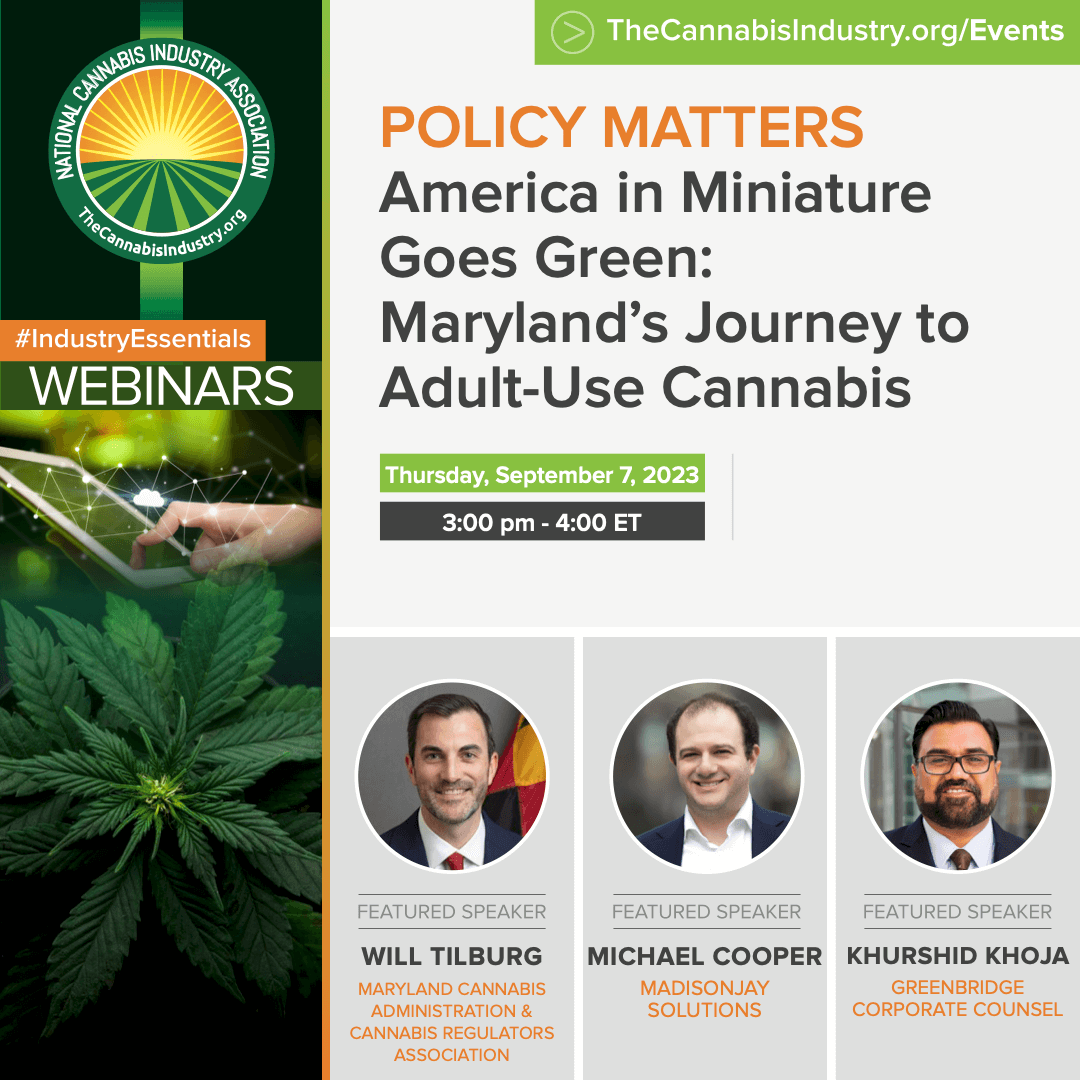
America in Miniature Goes Green: Maryland’s Journey to Adult-Use Cannabis | 9.7.23 | Policy Matters
Introducing “Policy Matters” – an insightful new #IndustryEssentials webinar series dedicated to unraveling the intricate world of regulatory and policy dynamics within the cannabis industry. As the cannabis landscape continues to evolve, staying informed about the latest regulations and policies impacting Main Street cannabis operators is crucial for success. Join us for a series of engaging discussions where regional regulators, industry leaders, legal experts, and policy influencers come together with NCIA leadership to shed light on the most pressing issues facing cannabis professionals.
Are you curious about the intricacies of launching an adult-use cannabis market in record time? In the debut episode of our new Policy Matters webinar series we delved into the strategic aspects of designing a thriving cannabis market while meeting regulatory standards. In this exclusive session, NCIA Policy Co-Chairs Khurshid Khoja and Michael Cooper were joined by Will Tilburg, Director of the Maryland Cannabis Administration and President of the Cannabis Regulators Association, to explore invaluable insights into the objectives that drive cannabis regulators and the pitfalls they strive to avoid. Discover the pressing enforcement challenges that are top of mind for cannabis regulators in 2023 and gain a clear understanding of the evolving landscape.
Don’t miss this opportunity to gain an understanding of how policy matters in the fast-paced cannabis sector. Stay informed, stay ahead, and be part of the conversation that’s shaping the future of cannabis policy. Tune in today and empower yourself with the knowledge to thrive in this dynamic industry.
03:40 – Launching an Adult Use Market in 2023 | Were there lessons from the existing medical market and others around the nation that you identified as important, both success stories and pitfalls to avoid?
07:23 – Launching an Adult Use Market in 2023 | What allowed you to move so efficiently and what lessons would you highlight for industry and regulators in new markets rolling-out in the future?
12:48 – Launching an Adult Use Market in 2023 | What are some priorities you have for the months ahead?
16:55 – Launching an Adult Use Market in 2023 | What advice would you give to future regulators on building relationships within the executive branch to prioritize these issues?
22:20 – Social Equity | Can you talk about reserving the first round of adult-use cannabis licenses exclusively for social equity applicants and other recent milestones or developments working with the Office of Social Equity?
28:56 – Social Equity | How has Maryland worked to make its medical cannabis industry more equitable and ensure these goals aren’t undercut as they have been with similar licensing preferences in other states?
34:04 – Enforcement | How did the state set up its enforcement plan? How do you strike a balance in a new market between a complete absence of enforcement and protecting public health?
37:34 – Enforcement | What are some key enforcement priorities for you looking ahead?
41:40 – CANNRA | Can you talk about the Cannabis Regulators Association (CANNRA) purpose, membership, and goals?
44:39 – CANNRA | What are the priorities or goals for your tenure as CANNRA president?
47:20 – Federal Reform & Regulation | What is Maryland doing to address the hemp-derived cannabinoids issue as it relates to protecting public health and unfair competition with adult-use cannabis licensees?
52:10 – Federal Reform & Regulation | As a state regulator, how did you receive the recent HHS recommendation for rescheduling of cannabis to Schedule III?
56:34 – Federal Reform & Regulation | What is the optimal division of labor between state and federal government if cannabis is completely descheduled in the future?
Before we dive into what to watch this Congress, we’d like to acknowledge the totally unacceptable and disgusting violence that besieged the Capitol recently. You can read NCIA’s statement on the insurrectionhere.
by Michelle Rutter Friberg, NCIA’s Deputy Director of Government Relations
Photo By CannabisCamera.com
We’re barely halfway through January, and it already feels like so much has happened in 2021! We at NCIA anxiously watched along with the rest of the country to see who would be victorious in the Georgia Senate races and, subsequently, which party would control the U.S. Senate. Both of the Democrats, Rev. Raphael Warnock and Jon Ossoff defeated their Republican opponents and won their races —- ensuring that the Senate will be split 50-50 with Vice President-elect Harris being the tiebreaker.
The 117th Congress has barely begun, but after Inauguration Day on January 20th, things will really take off here in the nation’s capital. Keep reading to see my answers to FAQ’s for the new Congress:
Whatever happened to the SAFE Banking Act?
During the 116th Congress, the SAFE Banking Act (H.R. 1595/S. 1200) became the first cannabis-related bill to be passed by a chamber of Congress. In September of 2019, SAFE came to the House Floor under a suspension of the rules and passed by a whopping 321-103. While the bill had a hearing in the Senate Banking Committee back in the summer of 2019, it never received a markup or moved further than that. In addition to the bill itself, the SAFE Banking Act was also included in not one, but two COVID-19 relief packages passed by the House, colloquially known as HEROES I & II.
This session, the SAFE Banking Act will be back, and with even better chances to pass! The bill will be reintroduced in both the House and Senate in the next 1-2 months and we expect little to no changes to the text. Additionally, we’re also continuing to work with our Hill champions on this issue to see if we can get the language included in the next COVID-19 relief package — something that both President-elect Biden and Democratic leadership has said is pretty much priority number one.
In the meantime, keep an eye out for reintroduction and for how many cosponsors the bill has when it’s dropped — when the 116th Congress ended, SAFE had already passed the House as but also had 33 Senate cosponsors — that’s one-third of the entire chamber!
What’s next for the MORE Act and comprehensive cannabis reform? Is legalization on the horizon?
Cannabis policy ended the year on a high note (no pun intended!) when the Marijuana Opportunity, Reinvestment, and Expungement Act (H.R. 3884), commonly known as the MORE Act, passed out of the House of Representatives by a vote of 228-164.
As I mentioned earlier, all eyes were on the Georgia Senate races as we strategized over what could be possible for the 117th Congress depending on the outcome. With the results in, we now have a better idea about what’s possible with comprehensive reform, but there’s still a lot of unknowns. We know that the MORE Act will be reintroduced sometime in the coming months in both the House and Senate. In the Senate, the lead sponsor was Kamala Harris, who is now Vice President-elect, which means another Senator will have to pick up the torch. I can’t share with you who it’s going to be just yet, but trust me when I say they will be a wonderful lead and are a true champion for cannabis reform!
A reintroduced MORE Act will likely have a good number of edits and changes, but the underlying intent of the bill will be the same: to remove cannabis from the Controlled Substances Act and help repair the harms the war on drugs has done — specifically to communities of color.
We also know that comprehensive reform, in general, has a better chance of advancing given that Democrats now control the Senate. Sen. Schumer (D-NY) was quoted in October as saying if he’s reinstalled as Majority Leader he “will put this bill in play,” and “I think we’ll have a good chance to pass it”, talking about his own bill, the Marijuana Freedom and Opportunity Act (S. 1552).
All of that being said, legalization, or the passage of comprehensive reform is far from a done deal. Legislation requires 60 votes for passage in the Senate, and we have a lot of hard work to do to get to that level of support in the upper chamber. In the House, Democrats have an even slimmer majority now than during the 116th Congress, so we also have to make sure we don’t lose support there.
What about appropriations?
You’ve been involved in cannabis for a long time if you remember when the appropriations process was the only way to get Congress to talk about this issue. But now, with Democrats controlling both chambers, you may be hearing more about these amendments again.
Appropriations bills are legislation in Congress that “appropriates,” or sets aside, federal funds to be divided between specific federal government departments, agencies, and programs. Read more about this process and why it matters for cannabishere.
Over the last few years, the House has continued to pass marijuana-related amendments but were unable to get through the Senate due to Republican control and a “gentleman’s agreement” between the Chair and Ranking Member of the Senate Appropriations Committee. But now, all of that will change.
In the past, appropriations amendments have been introduced that touch on a multitude of issues: research, veterans, medical and adult-use cannabis, hemp, banking… the list goes on! In this session, expect to see cannabis-related amendments included in the final budget. Just remember that budget bills must be passed annually, so anything that comes into law this way must be renewed again next year!
What’s going to happen at the committee level?
If you’re following cannabis policy at the federal level, definitely keep your eyes on what’s happening in various congressional committees. Given who controls both chambers, all of the committees will now be chaired by Democrats, which means you’re going to see a lot of cannabis-related bills come up for hearings and markups. Some I’ll be keeping my eye on, including both chambers’ appropriations, financial services, tax, and judiciary committees.
The opportunities for reforming our outdated cannabis laws have never been brighter than they are right now as we begin the 117th Congress. Bills are going to begin dropping left and right — and that’s because there’s a ton of excitement, enthusiasm, and optimism about what we can accomplish over the next two years.
Want to learn more about what’s possible? Make sure your company is an active member of NCIA and register for our next members-only webinar with our government relations team on Wednesday, January 27, or, if you can’t make it, hop on over to NCIA Connect to chat with us and learn more about what we’re working on in D.C.!
Committee Blog: Interstate Cannabis Commerce Will Benefit Public Safety, Consumer Choice, and Patient Access (Part 2)
By Sean Donahoe, Founder and CEO, Sungrown Developments Inc. Member of NCIA’s State Regulations Committee
In Northern California’s legendary cannabis growing region of Mendocino, the elected county sheriff was recently a competitor at a homebrew festival, jovially pouring samples of his “Pretty Sour Powerful Sider” (jokingly referring to the “Public Safety Power Shutoffs” recently implemented by the electricity utility PG&E to prevent wildfires.) While this relaxed scene of neighbors bonding in the wake of shared inconveniences was not exceptional in itself, here, Sheriff Allman was posing for selfies with licensed (but possibly a few unlicensed) cannabis cultivators sharing the liquid bounties of harvest for the benefit of a local nonprofit.
For nearly a decade, the elected officials and staff of Mendocino county have worked together to normalize the local cannabis farmers by providing a pathway for medical cannabis cultivation permits, long before the state established a licensing system. This public policy process brought once-outlaw cannabis growers into conformance with every regulation of modern life: from building code standards to streambed alteration regulations to the quantification of gross receipts for tax collection. Bringing regulators onto these farms has curtailed previous practices that may have threatened consumer safety: pesticide and other chemicals are now tracked and regulated, while every gram can now be tracked back to its very plot of origin (in case of a safety recall or other concerns post-harvest.) This has been unquestionably difficult for and disruptive to many heritage and small farmers, but it has also allowed in these regions for simple scenes of social bonding and neighbors trusting neighbors again, as participants in the illicit sector were normalized into first their local county’s community then into a system of state license and next (hopefully soon) into a web of regulated interstate commerce. The process of bringing every farm into the regulated supply chain is far from complete, of course, and there are still illicit operators producing for consumers in urban areas in the state and beyond.
Rather than dwell on the incomplete success of California’s ongoing efforts to bring order to the world’s largest cannabis marketplace, it is essential to focus on the quality of life benefits from every cannabis operation successfully brought over from the traditional market to the regulated sector. Each licensed operation makes for one more safe workplace, one more source for lab-tested products for consumers and patients, and one more farm abiding by environmental regulations while providing stable employment and economic sustainability in rural communities. Under the previous medical cannabis paradigm, while there was certainly an abundance of responsible operators, there was virtually zero guidance from the state on matters of workplace safety, manufacturing standards, or environmental compliance. We are now several years into a robust legislative and administrative rulemaking process that has established a (mostly) clear set of rules of the road for commercial cannabis activities. It has unquestionably been a bumpy road for many of the legacy farmers to comply with new regulatory standards, but we are nonetheless able to say that there are now thousands of well-regulated cannabis farms in California (and southern Oregon) eager to sell their clean and craft quality products in a hopeful system of interstate commerce.
Has every cannabis farm in California transitioned? Of course not, but neither have the illicit cannabis economies been entirely supplanted by adult-use cannabis retailers in Colorado and Washington. Sensible and sustainable cannabis policy reform is a process, not a simple flipping of a switch from “illegal” to “legal,” and Americans should be realistic about the progressive and iterative nature of this process. This process, like most evolutionary processes, has already experienced several inflection points, transformative moments that noticeably shifted public opinion or opened up new frontiers in policy reform. While the earlier era of medical cannabis state laws certainly created a base of public opinion and laws, it was questionably the passage of adult-use ballot measures in Colorado and Washington which brought onto the global stage and accelerated the awareness that adult consumers could buy cannabis in clean, responsible retail locations rather than furtive or even dangerous transactions in the illicit marketplace
Throughout this policy process, we have established that licensed retail options can be scaled without negatively affecting public safety and are highly efficient competitive enterprises, offering consumers ample product selection and low prices. In both Colorado and Washington states (but also in later states) we have seen imbalances for some time as market forces, regulatory factors and new cultivation capacity coming online have all helped to create price fluctuations, product shortages, and other supply disruptions. These disruptions were not unique to these early states and will likely continue in every market as new in-state regulated options come online in fits and starts (but when interstate commerce becomes possible we should expect significant price fluctuations unlike any seen to date.) During these fiscally trying periods, we have often seen cannabis operators attempt to cut corners on compliance to make ends meet, which can lead to compromised consumer safety and public safety. The goals of consumer availability and cost competitiveness should be foremost in the minds of policymakers crafting cannabis policy reform nationwide, most notably in the anticipated markets of the Northeast. As these next anticipated adult-use states are designing the framework of their retail and distribution systems, strong consideration should be taken on the potential benefits of quickly and effectively scaling their programs by incorporating interstate commerce as soon as (politically) possible.
The Interstate Commerce Conversation
As the serious policy conversations about compliant interstate cannabis commerce begin, it is helpful to study how in our proverbial laboratories of democracy we can see that decreasing retail friction and shifting consumers from the illicit marketplace benefits crime reduction efforts and improves overall public safety. We should also note that retail cannabis sales have continued to grow in Colorado and Washington, even after the initial novelty and the surge of tourism waned, while legal sales have supplanted illicit sales. These early-adopting states have created models that are addressing consumer demand as national interest in cannabis for wellness and adult-use purposes are soaring and the cultural normalizing continues to occur on a global scale. Interest is high, consumer demand is real, and evidence shows that our drug reform policies should be crafted to bring every cannabis consumer transaction into the regulated supply chain in order to fulfill the demand while benefiting from increases in public safety.Interstate commerce could provide not only safer products but also a greater variety of quality and highly competitive offerings. For medical patients and wellness-oriented consumers, interstate commerce may be the only viable means of access for certain formulated cannabis products or cultivars, especially in smaller state markets.
In addition to the above benefits, regulated interstate cannabis commerce system could provide a more robust and differentiated production and distribution network combined with the ability to rapidly scale retail sales and address insufficient cultivation capacity in new adult-use markets.Cannabis consumers are price sensitive and illicit market retail options continue to entice consumers in states with functional adult-use programs such as California (or Canada), where there is an insufficient amount of licensed retail options to address total consumer demand. With the beginning of adult-use sales in Illinois and larger adult-use states yet to come, it is frankly a bit difficult to envision how total consumer demand will be able to be fulfilled in any near term by relying on licensed cannabis cultivated in-state alone.
The Safe Vaping Discussion
While moving to allow interstate commerce will best position licensed operators to compete with the prices available to consumers in the illicit sector, moving towards a borderless system of production and distribution will also increase safety and access for patients and consumers. Most prominent is the recent nationwide discussion on vaping and vaping-related issues, where tainted products and resultant injuries have been found in the unregulated, illicit sector (or in a very few instances from licensed but arguably under-regulated sources.)Notably, NCIA’s Policy Council established a Safe Vaping Task Force to work on these issues and has released a more comprehensive document advocating for the expansion of a regulatory approach for the safe manufacturing and distribution of cannabis products, whether vape cartridges or otherwise.
The issue of vaping extends to broader issues of product safety including educational campaigns, quality assurance, and testing programs, supply chain integrity, track and trace, and other reporting systems, and (when all else fails) a capable and sophisticated product safety recall system and these are all necessary components of a well-regulated marketplace. These consumer safety programs have already been carefully designed and stress-tested in Colorado and California and the insights from these systems and those in other states should be incorporated into the crafting of interstate cannabis policy (which will require significant harmonization of Certificates of Analysis and testing standards, packaging and labeling standards, etc., again all of which will benefit patients and consumers by offering greater predictability and reliability of their preferred products.)
Multi-State Coordination
In various forums, we have begun to see state regulators liaise with each other and we hope to see more coordination in the future and potentially an earnestness in harmonizing standards where statutorily possible. This multi-state coordination on product safety standards would be accelerated as part of the regulatory coordination efforts that are likely necessary for interstate commerce and, again, consumers and patients will benefit from safer cannabis and cannabis products, and we see NCIA as the critical player in this coming national conversation. In conclusion, moving to a system of regulated interstate cannabis commerce will have tangible benefits for the general public, for consumers and patients and I encourage forward-thinking members of the industry to participate and help manifest a system of interstate cannabis commerce with NCIA, its Allied Associations and other industry groups.
After studying Russian affairs and working as a political consultant, Sean Donahoe co-founded the California Cannabis Industry Association. He served as its Deputy Director through 2014 when he transitioned to consulting for investors and operators, communicating with public stakeholders, serving on local government committees, and advising industry trade groups. He holds an MSc in Government from the London School of Economics and is CEO of Sungrown Developments Inc., an advisory firm and holding company in Oakland, California.


 After studying Russian affairs and working as a political consultant, Sean Donahoe co-founded the California Cannabis Industry Association. He served as its Deputy Director through 2014 when he transitioned to consulting for investors and operators, communicating with public stakeholders, serving on local government committees, and advising industry trade groups. He holds an MSc in Government from the London School of Economics and is CEO of Sungrown Developments Inc., an advisory firm and holding company in Oakland, California.
Follow NCIA
Newsletter
Facebook
Twitter
LinkedIn
Instagram
News & Resource Topics
–
This Just In
Committee Blog: Access to Capital in the U.S. Cannabis Market Outlook
Member Blog: The Risks of Removing a Regulated Cannabis Market