Member Blog: 5 Things You Need to Do Before You Launch Your Cannabusiness in New York
Cannabis was legalized in New York in 2021, and now the market is starting to fully open up for all types of cannabusinesses across the state. Despite a rocky start to rolling out new licenses, it’s almost time for the general public to dip their toes in and start their own dispensaries.
New York’s legal cannabis market is projected to be worth $4.2 billion by 2027, making it the country’s second-largest recreational cannabis state. It won’t be long before cannabis businesses have hundreds of locations across New York.
Curious about how to open a New York dispensary? Here are five things you need to do to get ready for your blossoming cannabusiness.
Conduct Market Research & Choose a Location
Since many cannabusinesses will be opening up in New York in the next few years, you need to ensure that yours is set up for success from the start. The best way to secure success is by selecting a high-demand area with minimal competition. You can identify lucrative locations by exploring different neighborhoods and conducting market research.
Visit prospective spots in person, instead of just looking at them on a map. You’ll get a much better sense of the feel of the area, the type of people walking through, the surrounding businesses, and more. And if feasible, talking to residents and local business owners will help you to really understand the market.
It is also important to be mindful of the New York zoning laws before securing a location. According to statewide zoning restrictions, a cannabis dispensary can’t be on the same road or within 500 feet of a school and 200 feet from a house of worship. Cities may have additional restrictions to limit the number of cannabis dispensaries in a certain location. Do your research before you get married to a location that won’t work out for logistical reasons.
Apply for a License
You’ll need a license to open a cannabusiness in the state of New York. However, as of October 2023, the path to applying and receiving a cannabis license in the state is a little up in the air.
When applications for the first licenses opened up, New York legislators wanted to ensure that people who were negatively impacted by the state’s previous criminalization of cannabis could apply first. This included people who were convicted of a cannabis offense in New York or were affected by a loved one’s conviction.
Now, starting on October 4, 2023, New York will start accepting license applications from a much broader pool of entrepreneurs. Applications are open to everyone over the age of 21 who does not already have three licenses. This is exciting news for many aspiring cannabusiness owners who were not eligible the first time around.
However, these licenses may not be issued as soon as prospective owners hope. When the state legalized cannabis, its goal was to award half of the retail licenses to people with previous cannabis convictions, racial minorities, women, and veterans disabled during service. Several veterans have filed a lawsuit stating that veterans were unfairly passed over for the early licenses. The judge in the case ordered that the state wait to award any new dispensary licenses until the case continues.
Opening a dispensary in New York will be expensive. While profits will likely be high once you open, you need to find a way to secure the funding needed to get your cannabusiness operational — which experts say could cost between $500,000 to $2 million.
This figure accounts for a variety of expenses for your cannabusiness, including:
Licensing and application fees
Lawyers and consultants
Real estate
Dispensary design and construction
Staffing
Business equipment
Surveillance and security system
Marketing and advertising
Products and inventory
Many cannabis entrepreneurs take out loans to cover these up-front costs, either from credit unions or cannabis-friendly banks. Some are able to partner with others or enlist investors to start their businesses. However, you should do your due diligence and research before taking on a loan or going into business with an investor. Unfortunately, there has been some predatory lending occurring in the market because of the inability to lend from large banks. Make sure that you do this research before you get too far in the process of creating your cannabusiness.
Understand Cannabis Laws & Regulations in New York
There are hundreds of laws and regulations that apply to cannabusinesses in New York. While this can feel overwhelming, it’s important to follow them carefully, especially when you’re setting up your dispensary.
There are some regulations that apply to your customers that you’ll need to adhere to, including:
Customers must be over the age of 21
Customers can only buy 3 ounces of cannabis flower per day
Customers can only buy 24 grams of cannabis concentrates per day
Others regulations apply to your business location, including:
Installing a 24-hour commercial-grade security system
Installing a perimeter alarm
Conducting video surveillance in every part of the store with cannabis products
Products cannot be visible from outside of the store
Maintaining minimum staffing levels (depends on business plan submitted with application)
Training staff on local ordinances, laws, and cannabis safety
It’s vital to take these rules seriously from the beginning. Neglecting even a single law could result in your dispensary getting shut down. You can consult an extensive overview of the New York cannabis laws and regulations here.
Invest in the Right Team
You need to hire a team of high-quality employees who will help your business succeed from the very first day. Your budtenders can make or break your entire business model, so you need to vet them carefully and train them well.
Your budtenders will be interacting directly with clients. They’ll answer their questions, suggest products, and upsell items. Hire these employees carefully, and make sure they’re happy in their positions by offering great pay and benefits.
To streamline training, create training manuals and SOPs (standard operating procedures) so that every employee is trained in the same way. This will limit mistakes and increase efficiency and customer satisfaction.
Final Thoughts on Launching Your New York Cannabusiness
Cannabis is expected to become a booming industry in New York. If you’ve always dreamed of opening a cannabusiness, now’s your chance to get in as early as possible and make your impact on the market!
Service Solutions | 10.26.22 | Show Me the Money – The Current State of Cannabis Lending
NCIA’s Service Solutions series is our sponsored content webinar program which allows business owners the opportunity to learn more about premier products, services and industry solutions directly from our network of established suppliers, providers and thought leaders.
In this edition originally aired on Wednesday, October 26, 2022 we were joined by the experts from cannabis-focused financial institutions FundCanna, Safe Harbor Financial, and AVANA Companies to dive deep into the current state of cannabis lending with leading industry journalist John Schroyer of Green Market Report.
A decade after California and Colorado became the first adult use states, the regulated U.S. cannabis market encompasses over 70,000 cannabis-related businesses. Shockingly, most of those businesses still lack easy access to debt and other forms of growth and operating capital. From federal prohibitions and the impact of IRS regulation 280e, to state and local taxation issues, the costs of operating a regulated cannabis company continue to remain nearly unendurable.
Learn what may change in the coming six to 12 months so you’ll know how to access debt capital most cost-effectively in this ever evolving environment. No matter your place in the industry or the supply chain from cultivators, manufacturers, vendors, suppliers, distributors and retailers this conversation will provide the insights to meet your financial needs.
At the conclusion of the discussion our panel hosted a moderated Q&A session to provide NCIA members an opportunity to interact with leading minds from the financial services space, join today to contribute to future conversations!
Panelists:
Adam Stettner
Founder & CEO
FundCanna
Sundie Seefried
Founder and CEO
Safe Harbor Financial
02:13 – Equity vs. Debt: With equity dried up, should cannabis companies be looking at debt financing to grow now?
07:28 – Equity vs. Debt: What do borrowers need to do before approaching a debt provider (vs. an equity provider)?
13:25 – Equity vs. Debt: What can cannabis companies or entrepreneurs do to improve their overall credit worthiness prior to seeking capital?
17:16 – How has the interest rate increases by the Federal Reserve impacted capital markets (and the industry at large) in 2022?
26:07 – Audience Q&A: “If there’s “no reason not to have banking” for your cannabis business how can I easily (and inexpensively) establish and maintain a compliant bank account?”
28:56 – Lending: What significant lending challenges are your clients currently facing within the industry?
33:56 – Lending: What advice can you provide business owners for evaluating lenders that you should (or shouldn’t) work with and tips for avoiding predatory lending practices?
39:05 – Cannabis Reform: What impact do you expect President Biden’s recent announcement will have on the industry?
49:32 – Audience Q&A: “Are your financial institutions planning to offer lending and banking services in New York, New Jersey and other new markets?”
51:42 – Audience Q&A: “With the mindset of “Investors are betting on the Jockey not the Horse.” What type of CEO or founding team would be a red flag or not a viable investment?”
55:19 – Audience Q&A: “How can I start to shift my retail company from being primarily a cash-only business?”
1:05:03 – NCIA Member Appreciation Credit Sequence
Sponsored By:
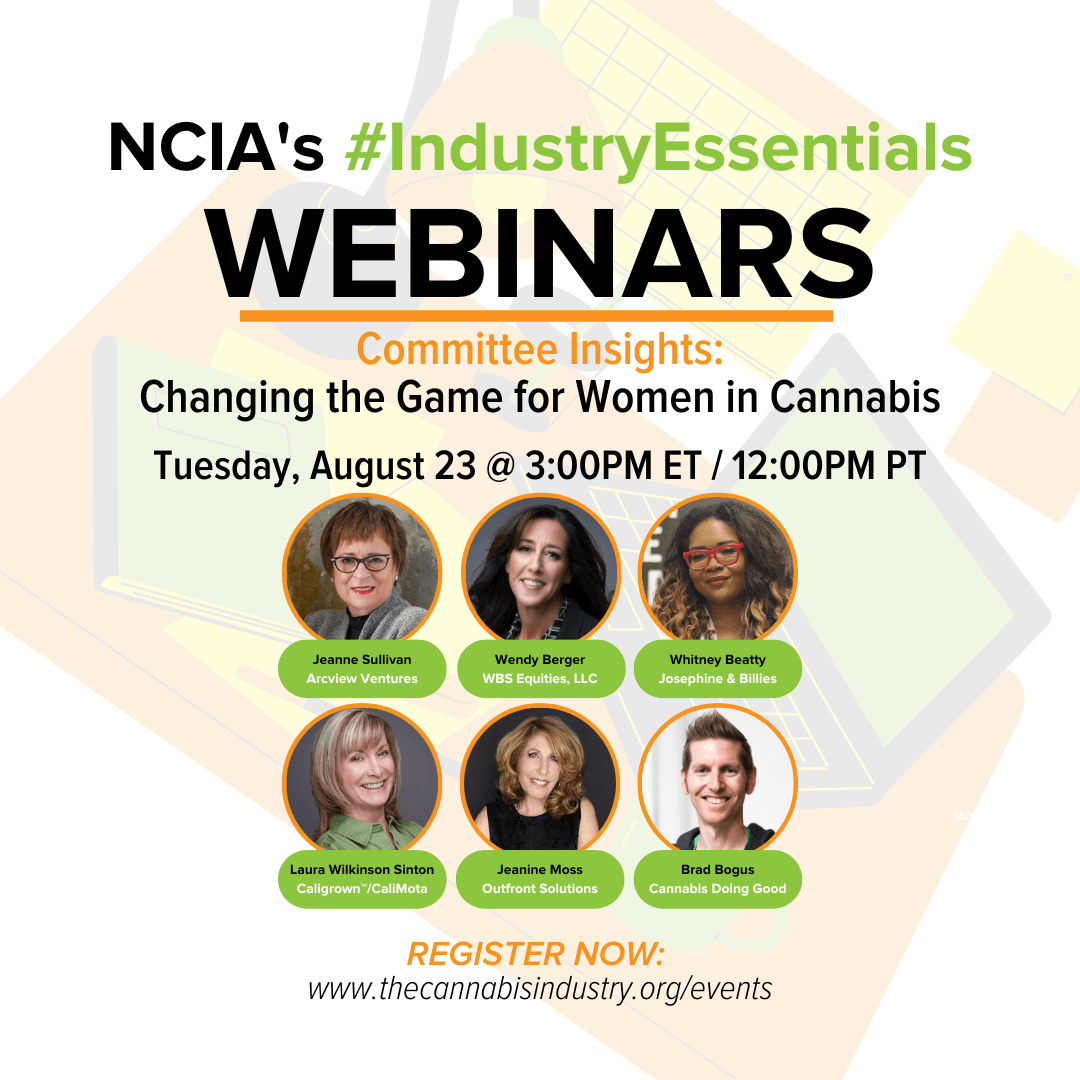
Committee Insights | 8.23.22 | Changing the Game for Women in Cannabis
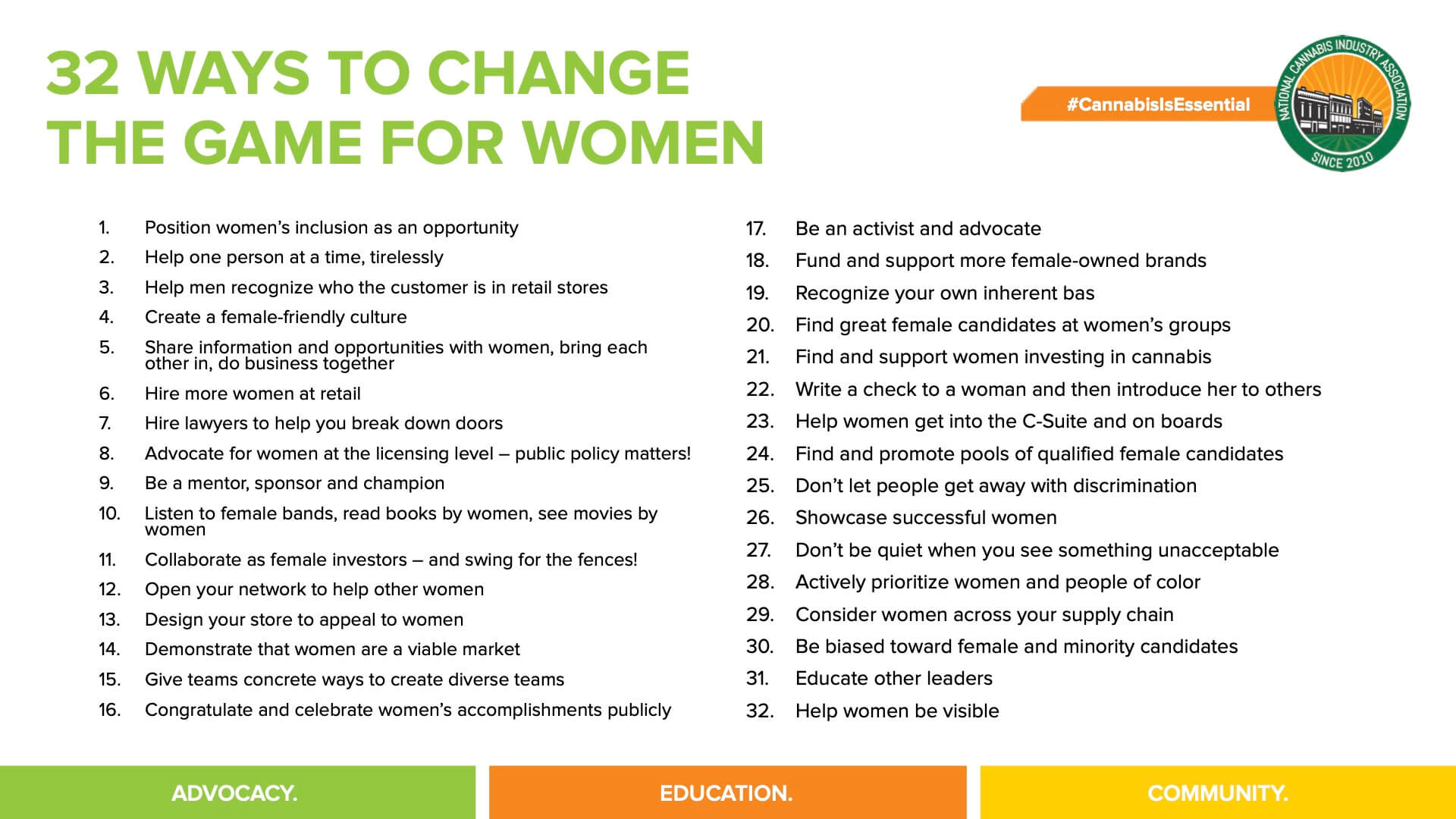
In this edition of our NCIA Committee Insights series originally aired on Tuesday, August 23, 2022 members of NCIA’s Retail Committee convened an all-star panel of leading investors, entrepreneurs and C-Suite executives alongside retail and marketing experts to discuss how the time to “move the needle” for women in cannabis is gone… It’s time to change the game.
Female executive representation in cannabis has shrunk to 22% in 2021 from 36% in 2019 (below the average 30% in mainstream businesses). Learn how to advance women and tap into the single greatest market opportunity for legalization and sales. Tune in now to get actionable solutions to implement today and get your business and our industry back on track.
Learning Objectives:
• Discover the definition of a female-friendly cannabis retail experience
• Get a suite of actionable solutions to increase success and profitability
• Learn the best career paths in cannabis for female candidates
• Learn where male dispensary buyers are missing the mark
• Identify opportunities across the supply chain to attract women
Committee Blog: Fundraising Basics in the Cannabis Industry — Part 3
By Deborah Johnson, MCA Accounting Solutions & James Whatmore, MAB Investments NCIA’s Banking & Financial Services Committee Part 3 of a 3-part series
In our first two blogs we took you from early concept, legal formation and early efforts through the early angel rounds. You have production in place with some equipment financing, getting you to early-stage revenues. Hopefully a smart angel investor is available to you for questions or direction. In the final part of this blog on funding your business, we will present some formal round structures, how you can best prepare for those finance rounds, and some ways to bring your friendsalong for the ride.
Everything you have done to date is going to be considered in a Series A round. What you have done and who you have surrounded yourself with will be looked at by potential investors. You have put in the work and built strong social capital. You have a diverse and strong team with expertise in your sector. The next level of investor will want to see how you tie it all together. These factors will be considered in light of your Total Addressable Market (TAM), valuation, use of funds, jurisdiction, and many other metrics. At this level a solid accounting team can produce Canna-GAAP (Generally Accepted Accounting Principles) financials to build a credible financial model. Having this current as you move through funding will give investors some level of comfort. As we have discussed, preparation is particularly important.
Alain Bankier, an active Angel investor, points out, “If you have brought on the right group of Angel investors, they are a prime source of excellent feedback, as you prepare your deck, your financials, and your pitch for the next round. Angel investors have seen 100’s if not 1000’s of company pitches and they can help you craft the most compelling presentation and they are your natural allies, as they have already invested and are motivated for you and the company to succeed!”
Long-term planning will help you define the total amount of funding you will need for certain milestones of development. A series of capital raises has some advantages over a single funding event. Each milestone you pass signals a value add to the company, and each subsequent round will be less dilutive. And the investor may see the project as de-risked, increasing their commitment through the follow-on rounds.
For each round there are several types of funding instruments: SAFE agreements, convertible debt, and preferred equity to name a few. Simple Agreement for Future Equity (SAFE) may be an option early in the funding plan. A SAFE note is a convertible security that allows the investor to buy shares at a future priced round. It has no maturity date and no interest rate. As such they are not debt and therefore do not accrue interest. But it also requires C-Corp status as the note goes on the cap table just like stock options. A convertible note is a common way to kick off a formal funding cycle and is dependent on future rounds as a trigger event. As a note it has a term of maturity and an interest rate; often there will be a cap on conversion value and a discount on valuation below that threshold. Once triggered, both of these may convert into shares of the company (or units of an LLC); what those shares are is described in the offering documents, usually summarized in a term sheet outline. These shares can have any number of rights or preferences attached to them. The fact that these are triggered by further rounds makes them a good part of an overall funding strategy.
The alphabet soup of rounds starts after the convertible note. The first equity Around will essentially sell some of the company to your investor; there will be a price, your valuation, and terms. As long as you are executing on the vision you have communicated to investors, each additional round will reflect your progress with a higher valuation and less attractive rights. The business put forth by you and your PowerPoint pals from the first blog in the series was worth a couple thousand dollars. Now you can apply many metrics on your sales, balance sheet, or milestone for a multimillion-dollar value.
Convertible debt and equity rounds are part of your long-term funding plan; so are new target investors. As you hit milestones and rise in valuation, the company becomes attractive to new investor classes. Certain funds have a minimum milestone they need to see before considering an investment. Pre-revenue, post-revenue, cash flow positive, market share, and total sales all have relevant hurdles for certain groups. Seed and angel investors may participate in a convertible note getting you to revenues, while an investment fund will only lead the A round with those revenues in place. If all is right, they will participate in B and C rounds as well; with larger and more sophisticated investors looking at the milestones you are currently achieving. The investors who value your milestone wins will take notice and start to circle.
As the investment in your company grows, the pool of investors shrinks. Although this may change in the near future, the traditional investment landscape is limited in cannabis; fortunately, there are several new and non-traditional sources of funding. Crowdfunding is a trend that has not escaped cannabis; however, the stigma has limited the platforms those in the industry have access to. Crowdfunding via Reg CF is the use of small amounts of capital from a large number of individuals. It is legal to be part of a cannabis business by investing up to $2,000 in exchange for ownership of a portion of the company. Through this method, a company can raise up to $5 million. Sites such as Fundanna, CannaFundr, Start Engine, Kickstarter, Crunchbase, Mazakali, Useed, Indiegogo, and SeedInvest provide platforms to market opportunities. There are various hurdles encountered here as well. Platforms can have banking issues as well. For example, 420fundme was shut down after their bank decided not to work with them. Also, some require the business to be in a U.S. state where cannabis is legal, or they only promote those businesses that impress them. So be sure to understand the sites’ rules and stay on top of regulations.
The REG A(+) is crowdfunding’s big sibling. This is an investment vehicle that is exempt from registration with the SEC that allows the general public and not just accredited investors to join the round up to $50 million in a 12-month period. GAGE, a Michigan vertical, successfully funded their recent expansion with a Reg-A. If you are talking to investment banking firms, this could be a good late-stage option to secure a large round of capital.
As you prepare to fundraise and have a clear understanding of where your business is in its lifecycle, you can put together the best capital raise for your project. Cannabis is a relatively new industry, and its murky legality means that roadblocks are likely. Be prepared to exercise all of your financing options. When raising funds for equity, all of the investors are looking for a liquidity event. So, whether your company eventually goes public or there is a merger or acquisition, they are not looking to invest in a so-called “lifestyle” company. As legality is resolved, many companies that are now on the sidelines looking in will be looking for opportunities to acquire and appear “established”. This is your window of opportunity to build a great brand, gain traction and be ready for when that happens.
Committee Blog: Fundraising Basics in the Cannabis Industry – Part 2
by Deborah Johnson, MCA Accounting Solutions & James Whatmore, MAB Investments NCIA’s Banking & Financial Services Committee Part 2 of a 3-part series
In our first part of this blog, we discussed the very beginnings of a company; an idea, gathering a team around you, self-funding, opening a bank account and forming an LLC or incorporating. Now you are ready to take a big step, bring on some more people, purchase more equipment and explore partnerships. You have a path with real milestones. This is the time to plan a funding strategy.
If you are not plant-touching, or you are directly ancillary, you might be able to secure a bank loan or an SBA loan. As the SAFE Banking Act is being considered in Congress (at time of writing) the reality of greater access to cannabis banking services may be getting brighter. However, traditional banking sources may still be an issue. These challenges have blended into some ancillary activities. There are a few other debt instruments including venture debt, an accounts receivable (AR) line, or an asset loan. Some of these instruments can be originated with specialty firms or other investment sources.
“While debt has traditionally been scarce in our industry, the relatively recent arrival of lenders has fortunately changed the construct of cannabis company balance sheets. Industry normalization, low rates, relatively high equity capital costs and supply-demand imbalances have attracted capital pools into credit and provided companies with the ability to further normalize their blended cost of capital,” said Sumit Mehta, founder and CEO of Mazakali and chairperson of NCIA’s Banking & Financial Services Committee.
Recently Harborside Inc. (CSE:HBOR) (OTCQX:HBORF) in California landed a historic $12 million revolving line of credit with a bank, marking the first time a cannabis touching company has secured this kind of access. Granted it is secured, but it is a commercial loan from a traditional lender. If you have real estate involved many investors will do a sale leaseback on the property to provide some liquidity. Equipment may also secure a loan; this is often a choice to outfit a capital-intensive production. When evaluating your debt options consider what is happening at this point in your life cycle. For an early-stage company, a revolver may not be the right fit; however, having the right equipment getting you to revenues might be worth investigating.
There are also grants available. Especially with COVID-19, many local jurisdictions are providing small business grants, or you might find one aligned with your demographic or target market niche. Many startups find an accelerator or incubator to help both fund and scale the company. In cannabis, the accelerators have historically been targeted to the ancillary market. Several exist, including Canopy Boulder, Momentum, Gateway, Hood Incubator, The Initiative, Cannabiziac, and even traditional market accelerators such as Y Combinator are addressing the needs of the cannabis market. Accelerators will invest in the companies they are providing guidance to and are generally hosted over a short period of time like 3-4 months, whereas an incubator provides resources, networks, and services over an 18+ month time and might charge a fee to participate. This early mentoring is a great resource for social and personal capital as well. If you have participated in an accelerator or incubator environment you should be exposed to early-stage investors; if you haven’t been exposed to them, this is the time for a solid PowerPoint deck and to polish your presentation.
Next on the list are angel investors. Angels are those individual investors that provide early-stage funding for a startup usually in exchange for convertible debt or ownership equity but are not locked into a funding structure. Banks make loans, angels can do as they please. They can be sophisticated or unsophisticated as they technically just need to qualify as an accredited investor. Most are drawn to investing in something familiar, so either they have a direct professional background in your industry or have felt the pain point you are addressing personally. Some want to roll up their sleeves and be engaged in helping your company grow, others just want to diversify their investment portfolio and take a more passive role. They can invest in the idea and direction of the company and a good angel will understand the timing of the investment. This means that early-stage investors like angels and funds should understand that this is a long-term investment that might take 5-8 years to see liquidity.
The greatest challenge to an entrepreneur is where to find them. Sometimes it’s as easy as looking around your network. With some work you can attract attention to your business idea by either presenting/speaking or pitching at a conference. Over the years, many opportunities to do so have developed. NCIA hosts CannaVest and Cannabis Business Summit, one of the longest running is The Arcview Group, Benzinga, IC3 by IMN, CWCBExpo and many cut their teeth at MJ Biz. Angels are individuals, but often belong to a group of angels to assist with deal sourcing and due diligence. With the normalization of cannabis, you can find many groups via the Angel Capital Association. We’d suggest reviewing market transactions and see who is announcing that they secured funds and with whom. You can find this information through keywords and press releases, consolidating sites such as New Cannabis Ventures or Viridian Capital Advisors, or even Pitchbook. This is the hard part of fundraising: connecting with the right investors.
You can also gain exposure to investors by sharing your expertise. Whether it’s articles on LinkedIn or podcasts and panels, exposing your knowledge of your niche is critical to gaining their confidence in your ability to execute. The conferences above may host your presentation as well furthering your investor engagement. One word of caution, there is a new platform being used by millions – even though it’s still in beta – called Clubhouse. There have been many people that are running pitch rooms on that platform and they are running up against the SEC and rules for fundraising. We encourage an extra dose of caution when pitching where you don’t understand who your audience is and if they adhere to qualifying factors. Many times, the later investors (Series B or C rounds) have to do a lot of work to clean up the cap table from earlier investment rounds. That can be a hurdle that an investor might walk away from. So, the more you can do to assure you are running a clean and efficient fundraising round, the better.
Given that we are in the cannabis industry, it is of particular importance to be an advocate. Access to this plant is still restricted for many, people are still going to jail or are still in jail, and businesses have a disadvantage to all other industries given the repercussions of federal illegality. So being an advocate, aligning and engaging with advocates like the National Cannabis Industry Association (NCIA),Marijuana Policy Project (MPP),Students for Sensible Drug Policy (SSDP) and others, can also expose you to investors who recognize your understanding that there is much work to be done to assure fair access. Expertise, Advocacy, and Engagement will build your social capital. The early rounds can hinge on these factors. While you will need a proforma, other financials and a solid plan, an angel is investing in you as much as in your current project. With enough social capital, your relationship with the early angel investor will survive major setbacks.
Once past these early rounds, your focus will turn to more formal investment groups and businesses in private equity, venture capital and then the public market. Currently those companies touching the plant are able to be hosted on the OTC (over-the-counter) market or the CSE (Canadian Stock Exchange) with a growing number of ancillary companies listing on the traditional exchanges. Here there will be a deep dive into the numbers and execution, pre/post revenues with a clear runway to real revenue. This requires an adaptive corporate culture with some loss of control expected.
In our final piece of the series, we will review crowdfunding, tips on angel and fund investors, and types of funding.
Member Blog: Four Innovative Tips for Funding Your Marijuana Dispensary
It can be tricky enough to find funding for a new business in any industry, but marijuana businesses are at that much more of a disadvantage. Strict regulations, less-than-favorable taxation laws, and straight-up illegality of federal funding stack up against those looking for their starting dollar in the industry.
Without having this backing, dispensary owners need to be creative and resourceful and draw upon the support of private investors to fund their dispensary goals.
Financial planning and sourcing of funds should be a large component of the business plan. Demonstrating an understanding of the scope of start-up costs for a dispensary includes:
Licensing/application costs
Working capital requirements
Cost of inventory (e.g. initial flower, edibles, accessories)
Technology costs (e.g. Point-of-sale system, server costs)
Real estate (e.g. mortgage payments or rent)
Staff training and compensation
Marketing and advertising
While budding cannabis entrepreneurs do have a limited number of funding options, there is still hope. You just have to know where to look.
Self-Funding
Many marijuana start-ups have invested a lot of their own savings into their businesses, recognizing their funding limitations. Speed in the industry is essential, but you may need to take a little extra time to raise your own capital before you turn the “Open” sign on.
Friends & Family
Crowdfunding is becoming increasingly popular for a variety of causes, and reaching out to like-minded individuals in the community who support your vision, and are willing to give you a boost in funds, is not at all unheard of. While there may be limitations in the ways you can publicly crowd-fund, you may be able to hold private events to raise money from your friends and family, as well as those in the community.
Partnerships
The “green rush” that marijuana legalization has caused makes finding potential partners, with similar goals and larger bank accounts, easier to find. There are so many facets to success in the industry, and valuable partnerships can take some of the strain off your own venture. After all, two heads are often better than one!
Cannabis-Specific Investment Groups
A great indicator of progress for the legal cannabis industry is the number of cannabis-specific investment groups that have cropped up across the country, giving entrepreneurs a helpful resource. In fact, last year, these groups provided 18% of marijuana funding.
Learn How to Fund Your Marijuana Business: While the situation for marijuana startup funding may seem grim, more and more investors are beginning to recognize the marijuana industry is thriving with opportunity.
Covasoft has put together a helpful resource to understand the various strategies in the marijuana business. Download our eBook today to learn about willing investors, ready to make a change in the legal marijuana market.
In a career that encompassed a dozen start-ups, Gary Cohen has held leadership roles with Verizon and AT&T, has managed technology-oriented research practices for Nielsen, Milestone Group and ITG/MScience, and led software/internet ventures Shoptok, Birdstep and Handmade Mobile. He has also been on the boards of several tech start-ups, including Onavo (acquired by Facebook), OpenSignal, Cenoplex and Adello. Gary has a Bachelor of Science in Finance and a Master of Science in Marketing.
Cova enhances the cannabis retail experience for both consumers and dispensaries through an integrated solutions platform (POS, ERP, CRM, eCommerce, Digital Signage and Dropship). Over 19,000 retailers with complex retail environments currently run Cova’s solutions in North America. Cova’s solution built for the legal marijuana industry focuses on compliance, UI, UX, reporting and a much better dispensary experience. Cova is headquartered in Denver, CO.






 By Deborah Johnson, MCA Accounting Solutions & James Whatmore, MAB Investments


Follow NCIA
Newsletter
Facebook
Twitter
LinkedIn
Instagram
News & Resource Topics
–
This Just In
NCIA Applauds Reintroduction of SAFE Banking Following Lobby Days
Beyond Rescheduling: Inside NCIA’s 14th Annual National Cannabis Industry Lobby Days