It’s that time of year again, the busy fall harvest season. While indoor growers can harvest year-round, the fall can create significant workforce challenges, especially for outdoor producers and processors. Here are three tips to make sure you are ready to go for the fall harvest!
Plan ahead! If you have not already thought through your fall harvest plan, you will want to figure this out immediately. Most cannabis companies need additional workers during harvest season, unless their grow schedule is structured where they are harvesting on a regular basis, depending mostly – if not entirely – on their permanent employees for harvesting, de-leafing, trimming, etc. However, given the increased demand for workers by outdoor growers, even in a normal year, the demand for labor often exceeds the supply, placing added pressure on anyone competing for this talent.
Every fall we receive a rash of calls from producers, who failed to plan ahead, requesting workers that same week, if not the same day. Unfortunately, by this time, nearly all the available labor, especially those with experience and skill, have already been scheduled and committed elsewhere. In rare cases, staffing companies might be able to provide workers if they had another client in the area back out, at the last minute due to a heavily damaged crop or not being ready for harvest at the time they originally projected, however, cannabis growers shouldn’t count on this. A good rule of thumb is to provide at least 2-3 weeks’ notice, minimum, to request your harvest crews during the fall, and the further in advance the better. Many cannabis companies that have struggled in the past with worker shortages during the fall have started locking in their fall staffing as early as spring.
COVID-19 has created an even more significant labor shortage. Before 2020, we saw thousands of workers coming into the United States from other countries to take their ‘vacations’ working on unregulated market farms doing harvest work and trimming and getting paid cash. Due to COVID-19 travel restrictions keeping much of this seasonal labor out of the U.S., the regulated and unregulated market were increasingly forced to compete for the same domestic talent with the unregulated market often winning this battle as they were paying tax-free cash at higher wages, given their relatively lower costs compared to the regulated market. Thus, many cannabis companies ran into situations last year where, unless they were able to pay premium rates for harvest workers, their in-house staff were forced to work a ton of overtime to make up for the shortfall. We hope that in 2021 this won’t be the case, however with COVID-19 numbers rising again, this is something that cannabis companies should plan and budget for just in case.
If your cannabis operations are relatively remote or not within an easily commutable distance from a large population center, you may need to go the extra mile to make it easier for workers and staffing companies to assist you. If nothing else it is essential to take an inventory of nearby resources and be prepared to communicate them easily. For example, if you can’t provide lodging to your seasonal workers, you will want to create a list of local hotels/motels, RV Parks, and campgrounds that offer services. Many of these workers are accustomed to traveling from site to site in RV’s, camping, etc. Create a list of grocery stores, gas stations, and other retail establishments the crews may need to access. If there aren’t any lodging options close to your farm, and you have the means, you might want to consider buying some land nearby and building some basic lodging. We have even seen some cannabis companies open a cafe or restaurant close to their farm when there weren’t any good or healthy options in the area so that workers would have a place to go on their lunch breaks or after work. The more of a positive experience you can provide to these workers, even though they are seasonal, the better. Production will typically be quicker, you may gain a customer and even an ambassador for your product, and that worker may be excited to return for years to come, which will keep you from having to deal with some of the labor shortage issues other producers struggle with.
Have a contingency plan. Many of you already know this, but you should always have a plan B and plan C, maybe even a plan D. 2020 and 21 have definitely been years of fires, hot temperatures, and floods. If air quality is deemed especially poor in your area, due to smoke, many harvest workers won’t be able to work outdoors as worker’s compensation policies won’t cover workers laboring in such conditions and few people will want to. We’ve also noticed an uptick in state governments coming out with restrictions and safety guidelines during times of poor air quality or extreme heat. If you’re in an area that has a fire season, you’ll want to have a plan for workers during this time. Perhaps you will need to have them work indoors when the air quality is poor, focusing on things like bucking, trimming, and packaging; then back outside to continue the harvest when conditions allow.
Given the increase in COVID-19 cases, you’ll definitely want to have SOPs and contingency plans in place in the event your crew is exposed to COVID-19. To be proactive, you should also take precautions to protect workers from exposure before it occurs including having masks and hand sanitizer supplies on hand in abundance. Contingency plans could include having a partnership with a staffing firm to provide workers for your fall harvest or offering overtime and bonus incentives for your regular workers to pick up the slack, if necessary. If you’re working with a staffing company, most crews of harvest workers will have a team lead who is there to assist with any HR-related issues that might come up (i.e., sick workers, injury, etc.). However, if for some reason there is not a team lead assigned for your crew, you’ll want to make sure that the workers have a point of contact at your company for any HR-related issues that come up.
Last but not least, if you’re looking for great, experienced harvest talent, especially when it comes to trimming, you will need to budget for the kind of talent you want. With the most talented crews, you’ll likely need to pay some form of a retainer upfront as many of them have trimmed more seasons than adult-use has been around and have not always been paid for their work. Last year, we typically saw trimmers making $15-$25/hour. This was before bonuses. Companies who want to incentivize things like speed and quality increasingly offer bonuses for the quantity and quality of output. This has resulted in the best workers making nearly $50/hour!
The Godmother of Cannabis Industry Recruiting, Kara Bradford, MBA, MM, is Co-Founder & CEO of Viridian Staffing. Founded in 2013 as the first professional, full-service staffing, recruiting & HR consulting firm in the Cannabis industry, Viridian Staffing has led the way in providing temporary, temp to hire, direct placement & HR outsourcing services. Kara has been an HR professional, specializing in Talent Acquisition, Talent Management, Workforce Planning, Employer Branding, Compliance, Federal/State Employment Laws, and Organizational Design for over 15 years. Her career has spanned multiple Fortune 100 companies & start-ups in a wide variety of industries. More importantly, she has more experience recruiting in the cannabis industry than any other Recruiter globally. Kara has an MBA in Human Resources & Organizational Behavior and is LinkedIn Recruiter Certified. Kara is active in many organizations, including NCIA, The Cannabis Alliance, Women of Weed, etc., and was the Founding Chair of the NCIA’s Human Resources Committee.
Committee Insights | 8.31.21 | Taking Human Resources Higher as a Strategic Partner
In this edition of our NCIA Committee Insights series originally aired on Tuesday, August 31, 2021 we were joined by members of our Human Resources Committee for a discussion on how to create a healthy workplace, a positive employee experience and an effective relationship with your leadership team to make the right decisions for your company’s success.
Human resources is the hub of the workplace, the employee experience and leadership decisions with the cannabis industry being no different. Join our panel of human resource experts as they equip you with the skills needed to create positive employee experiences and influence change with other strategic leaders within their organization by effectively utilizing data.
Panelists:
Shawnee Williams (Moderator)
Recruiter & Account Manager
Illinois Equity Staffing
Nichole McIntyre
Director of Human Resources
urban-gro
Dan Walter
Managing Consultant
FutureSense LLC
Committee Blog: The Cure-All for Impostor Syndrome = Mentors
by Kimley Svendsen, Drive Talent on behalf of the Human Resources Committee
My dream as a child was to become a fashion designer. But there were many voices telling me this was not realistic, if I wanted to drive a nice car and live in a nice house. Step in line! While some people are able to ignore these messages and walk to the beat of their own drum come what may, I wanted to please those around me and continue the family tradition of academic achievement. The eventual result was being admitted to one of my dream schools as a graduate student.
Enter the Impostor Syndrome. According to the Oxford Dictionary, this is “the persistent inability to believe that one’s success is deserved or has been legitimately achieved as a result of one’s own efforts or skills.” I believe Impostor Syndrome can result from following someone else’s path versus your own, and/or achieving a position in life you believe you don’t deserve. By my mid-20’s, I had achieved an Olympic level of comparing myself to others, and feeling as if I were “playing the part” of a graduate student. I had the sneaking suspicion that an administrator in tweed would show up in class and say a mistake had been made (this didn’t happen by the way).
Re-enter Impostor Syndrome after 20+ years of twists and turns which bring me to today as the Founder of Drive Talent, a cannabis recruitment services business, for the past 5+ years. The tweed-clad administrator has been replaced with my peers and those I admire within cannabis. I don’t want to let them down, let my team down, or let myself down. Most days I can fight off the doubts that pop up, but the whisper is still there – “you don’t deserve this, someone else is faster/smarter/better than you, and you should hang it up my friend.”
Running a business is hard. Running a business within cannabis is REALLY hard! I imagine many of you out there entered the cannabis ecosystem for a variety of reasons – you worked within the space pre-state legalization, personally witnessed the plant’s benefits, desired an influence on unjust laws, wanted to be a part of a trailblazing industry, and/or saw the opportunity to profit. Most of these are true for me, albeit not quite the dream of designing for the runway. Still worth it!
Whether you are a founder, member of senior leadership or at the beginning of your career within cannabis, my best piece of advice to combat the Impostor Syndrome is to GET A MENTOR! Mentor #1 for me was my Grandfather who advocated for women to have access to the highest degree of education. Mentor #2 was a fellow graduate student who gave me rides to and from school in her beat-up Saab, and challenged me to have a creative vision for myself. Mentor #3 is my mentor today who encourages me to dream big. I have learned from him that I am not having a unique experience with Impostor Syndrome, I am not alone as a business owner, and my work can align with my dream of positively influencing the cannabis ecosystem. This is like medicine and reinforces my confidence and belief in myself on a daily basis.
There are formal and informal mentors, and those whose words of encouragement have stuck. Who are these people for you, and in what way have you served this role for someone else? Make this a priority and don’t be afraid to ask. The Mentor/Mentee relationship is beneficial for both parties, and can serve as a conduit to identify/reinforce your passion, capability, and confident following of your dreams.
Kimley Svendsen is the founder and CEO ofDrive Talent, a leading recruiting company that connects their clients with diverse talent within cannabis and other industries, and is a member of NCIA’s Human Resources Committee.
Committee Blog: Employee Privacy Guidelines In A Time Of COVID-19
By NCIA’s Human Resources Committee
Privacy Guidelines
As employers across the country bring back their employees, coronavirus risks remain top of mind. These concerns are important to ensure both the safety of their employees and the ability of their businesses to remain open. No one wants their employees to experience a spike in infections, or to subsequently close down as a result. However, protecting employees and businesses from COVID-19 is not as simple as asking an employee if they are sick. Federal and state laws restrict the type of medical information an employer can require an employee to share, even during the pandemic.
Under the Federal Americans with Disabilities Act (“ADA”) and the California Fair Employment and Housing Act (“FEHA”), medical inquiries are generally not allowed unless they are job-related and consistent with business necessity. Under this standard, medical inquiries are allowed if the employee poses a “direct threat” to him/herself or others because of a medical condition. FEHA regulations provide that factors to be considered when determining the merits of the direct threat defense include, but are not limited to:
the duration of the risk;
the nature and severity of the potential harm;
the likelihood that potential harm will occur; and
the imminence of the potential harm.
FEHA regulations say that the analysis of these factors should be “based on a reasonable medical judgment that relies on the most current medical knowledge and/or on the best available objective evidence.”
Unfortunately, this leaves the answer to whether employers may make medical inquiries or take temperatures “it depends.” Ultimately it becomes a business/risk tolerance decision. Asking employees questions about their medical condition and taking their temperatures may be more defensible if there has been documented exposure to COVID-19 in the workplace or a high rate of contagion in the community.
The answer will also depend on what the Centers for Disease Control (“CDC”) determines. If the CDC makes a determination that COVID-19 is significantly more severe than the seasonal flu, it could pose a “direct threat.” Under the ADA, a direct threat is “a significant risk of substantial harm to the health or safety of the individual or others that cannot be eliminated or reduced by reasonable accommodation.” When the CDC advises testing, employers will have better standing to require it. CDC guidance is available here.
The Equal Employment Opportunity Commission has also issued specific COVID-19 guidance. The EEOC has advised employers that they may ask all employees who physically enter the workplace if they: (i) have COVID-19; (ii) have been tested for COVID-19; or (iii) are experiencing symptoms associated with COVID-19. Employers may also check the temperatures of employees entering the workplace. If an employee refuses to answer or refuses to submit to a temperature check, the employer may refuse to permit him or her to enter the workplace. However, employers should reassure refusing employees that the questions are simply designed to ensure workplace safety.
Employers may then single out individual employees for temperature checks or questioning only if the employer has a reasonable belief, based on objective evidence, that the employee has COVID-19 or symptoms associated with COVID-19. Employers may also ask employees if they have had contact with anyone who has been diagnosed with COVID-19 or who has symptoms of COVID-19.
If a manager learns that an employee has COVID-19 or symptoms associated with COVID-19, the manager may disclose this information to which employees are necessary to take action consistent with CDC guidance. As a general rule, employers should try to limit the number of necessary employees” who know the employee’s identity. Everyone informed of the employee’s identity should be told to keep the information confidential. This includes telling others that an employee may be absent or working from home, but not explaining why.
If employers do decide to take temps, there are multiple additional issues to consider: who will do the testing? What training? Will nonexempt employees be paid for their time undergoing testing? What will the employer do if the employee refuses? What information is recorded? All of these questions should be addressed in advance, and the answers should err on the side of caution. Tests should be simple, as non-invasive as possible, and as little data should be recorded as possible. Data for each employee should be recorded separately; an employer should not compile a single list of employees and their temperatures. An employer could, however, maintain a record of a single employees’ temperature of time. In other words, a single piece of paper could track an individual employee’s temperature history, but not the entire workforce’s temperature history.
In summary, employers must be careful to ensure their employees’ privacy rights remain respected and protected as they return to work. Employers may take reasonable precautions to ensure infected and at-risk individuals do not work, but must be careful in the questions they ask and the manner in which they record and keep the information. If a diagnosis is confirmed, employers must also be careful about who that information is shared with. Everyone wants a safe workplace; employers must simply keep in mind that a safe workplace is one that ensures an employee’s physical safety as well as their privacy.
NCIA’s Human Resources Committee is comprised of human resource practitioners devoted to bringing best practices to the cannabis industry. Their focus is educating and bringing awareness to misclassification of employees, promoting guidelines for employee safety, clarification on wage and hour issues in the industry and creating checklists to being a legitimate employer.
NCIA’s Human Resources Committee hopes that you and all your employees are healthy during this outbreak. Many states continue considering cannabis-related business as ‘essential,’ so the HR Committee met to discuss ways NCIA member companies could navigate the impact of the COVID-19 outbreak on our cannabis businesses to help ensure you and employees minimize your risk of spreading and contracting the virus in the workplace.
We are confident that our fellow member companies strive to create a safe and healthy work environment for their employees, but we have brainstormed a few extra precautions cannabis companies may want to consider during this outbreak.
One of the best resources we have seen thus far are the WHO guidelines put in place for workforces.
Some additional best practices we have seen from dispensaries, processing facilities, and cultivation sites are as follows:
Time Login/Logout
Consider using an app so employees can login/logout on their own phones versus signing in/out, using a time punch system, or everyone logging in/out on the same computer system.
Cash Handling
We know that cash handling & computers being used by multiple people is a concern for many employees. Consider purchasing gloves for employees to use. If gloves aren’t available due to medical personnel needing these supplies at this time, offer additional breaks so employees can wash their hands between each transaction with a customer.
Product Packaging Handling
If you’re in a state where customers are allowed to touch the product packaging or sample containers, consider also having gloves available for customers to use. You should also have some form of cleaning wipes available to wipe down packaging, sample containers, etc. after each customer has touched them, along with wiping down cabinet tops between each customer. Seeing as these supplies are sometimes not available at this time, consider putting up a notice stating that in order to keep customers safe during these times, only Store Employees will be handling product packaging.
Safe Distancing
For retail stores, you may want to even consider installing plastic/glass barriers (think similar to what we had back in the medical days or you see at banks) in order to keep employees/customers safe. For Producer/Processer cannabis companies, you should try to keep employees at the 6-foot minimum distance. If you’re not already operating in multiple shifts, you may want to consider doing this as well so you can continue regular production but space out workers so they feel safer in this environment.
Hand Washing
Add additional hand sanitizer stations and consider hiring additional staff and/or appointing one of your current staff members to wipe down all surfaces every 30 minutes.
Thermometers
Consider purchasing thermometers for each employee so they can check their temperature multiple times/day.
Curbside Pickup or Appointment-Based Purchasing
Consider adding to your website a mechanism for customers to pre-order online with curbside pickup, or to schedule an appointment to visit your store. This can help to keep the number of customers in your store at any given time relatively low, while maintaining consistent business throughout the day.
Encourage Delivery
While not all states have delivery available, those that do should try to encourage its use. This will help limit contact between your workers and customers.
We are sure our fellow members will have plenty of other valuable suggestions, so we encourage you to share your best ideas in the comments section of this blog post, on NCIA’s Facebook page, so we can all work together to keep our cannabis community safe during these times.
Committee Blog: What The Recent Layoffs in the Cannabis Industry Mean
Many in our industry have heard about the recent layoffs announced by cannabis companies, including some of NCIA’s members, in the U.S. NCIA’s Human Resources Committee views the layoffs as an unfortunate but sometimes necessary part of business, and overall remain optimistic about the industry as a whole.
On the face of it, the recent headlines regarding cannabis industry layoffs appear grim. One of California’s best-known cannabis brands announced a reduction of 20% of its labor force. Another grower is reported to have had a similarly sized cut. Listening to the news coverage, one might have the impression that the industry as a whole is going through a massive negative upheaval. This could not be further from the truth.
At the same time, we have seen hiring trends in 2019 that are overwhelmingly positive. According to an article in Forbes earlier this year, the cannabis industry added almost 65,000 jobs in 2018, with a substantially greater amount expected for this year. Clearly, cannabis is a significant growth engine for employment across the U.S. Add in Illinois, Massachusetts, and other states legalizing cannabis for medical or adult-use, and the numbers continue to grow. The state of the cannabis industry is strong!
Since its founding nearly a decade ago, NCIA has dedicated itself to promoting the growth of a responsible and legitimate cannabis industry. During this time, the industry workforce has swelled to over 200,000 people, and new people are joining us daily from coast to coast. NCIA’s HR Committee, which is comprised of human resource practitioners devoted to bringing best practices to the cannabis industry, carefully monitors hiring trends and other people-related developments.
NCIA’s Human Resources Committee regrets any job losses for their impact on the lives of employees and their families. History has shown that layoffs often happen in high growth industries. These reductions in force occur when companies who have over-invested ahead of anticipated growth must adjust their labor counts to rapidly shifting business dynamics. While painful in the short term for employer and employee alike, this represents a chance for other companies to acquire top talent, and for that top talent to secure new and exciting opportunities.
NCIA’s HR Committee is unwavering in its faith that the cannabis industry will continue to grow as an economic force in this country for many decades to come, and that these short-term changes will make the industry better, stronger and more resilient in the long run.
There are many ways you can get involved and help. Attend NCIA’s national trade shows and regional networking events to get your foot in the door of our dynamic industry. Start a business. Educate yourself on the latest issues, and contact your congressperson. Whatever road you choose to take, we look forward to welcoming you as our partner on this amazing journey!
by NCIA’s Human Resource Committee: Kara Bradford of Viridian Staffing, Kerry Arnold of Canndescent, Heidi Quan of Murchison & Cumming LLP, Nichole McIntyre of Urban-Gro, Michelle Whitmore of H2 Talent, and Mark Hackett of Emerge Law Group.
Maybe you’re just getting your business started. Perhaps you’ve already been rolling full steam ahead. Either way, people are crucial to your business. The NCIA Human Resource Committee formed this past year. The committee, headed by Kara Bradford of Viridian Staffing, includes experienced HR Practitioners, Recruiters and Employment Attorneys, who have all brought their collective “best practices” together in an effort to assist NCIA members to navigate the often complex world of employment.
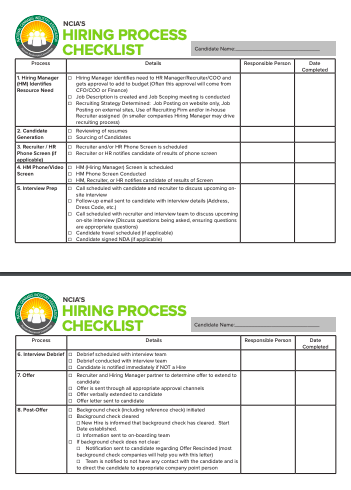
The HR Committee is starting off by releasing a series of checklists to provide some essential guidelines for your firm during the hiring, on-boarding and termination phases of employment. Without further ado…
Welcome to the first installment of the NCIA Human Resources Committee Employer Checklist Series! Today, we begin where every employer begins – the hiring process – and present the Hiring Process Checklist. Although laws may vary from state to state and each employer’s approach to hiring may differ, the Hiring Process Checklist provides a framework to assure your hiring process includes basic best practices, so you can attract and hire the best candidates.
Why is it important to have a well thought out hiring process? In this era of full employment, you just need to hire warm bodies before your competitors, right? Wrong! There are at least three critical reasons to make sure you put a good hiring process in place.
First, your hiring process must comply with the law. Are your job postings nondiscriminatory? Does your job application request potentially illegal information, such as criminal background, salary history or prior workers’ compensation claims? Are interviewers only asking applicants appropriate questions? Are you storing applications and other information about applicants for the required length of time? A good hiring process greatly reduces your risk of legal problems.
Second, hiring the wrong applicant is expensive. According to a study by SHRM (The Society for Human Resource Management), the average cost of hiring an employee is just over $4,100. This does not include the cost of training a new employee, a new employee’s lower productivity and greater likelihood of making mistakes or the stress on your other employees who must pick up the slack while the new employee ramps up. A good hiring process can improve your bottom line by significantly increasing the likelihood that you hire the right employee the first time.
The third and perhaps most important reason to lock down your hiring process: you are introducing potential employees to your company for the very first time. From the time they read your job posting until you inform them of your hiring decision, the applicant is assessing and judging your company. In this competitive job market, you need to quickly give that applicant a reason to want to work for you, rather than all the other hungry employers vying for their services.
An unstructured, haphazard hiring process sends all the wrong messages. Right or wrong, it tells an applicant that the company is not serious about hiring the best employees. It tells the applicant that you don’t value their time. Would you want to work at that company?
You only get to make one first impression, so make it a good one! Be upfront and clear with the applicant about the hiring process and your timeline and stick to them. Keep the interview process on schedule and make sure interviewers are well-prepared. If you tell an applicant you will get back to them by a certain date, get back to them by that date. If the timeline changes, let the applicant know. Treat every applicant with respect at every stage of the hiring process.
Once you establish your hiring process, the hard part begins – putting the plan into action. Even the best hiring process is useless if your staff doesn’t understand it. Clearly explain the hiring process to staff who will implement or supervise it. Provide them with the training and tools they need. Finally, periodically review the success of the hiring process and make improvements, so you continue to attract high-quality job applicants.
We hope you find the Hiring Process Checklist a useful tool as you develop your company’s hiring process, but it is not the only tool available. Take advantage of the many resources available to you in books and magazines, on the internet, and through the services of an HR professional or attorney.
Happy hiring!
The HR Committee needs and values your feedback. We exist to serve NCIA members, so please tell us how we can serve your needs by emailing us at HRC@TheCannabisIndustry.org. Thank you.

 By Kara Bradford, Viridian Staffing
 The Godmother of Cannabis Industry Recruiting, Kara Bradford, MBA, MM, is Co-Founder & CEO of Viridian Staffing. Founded in 2013 as the first professional, full-service staffing, recruiting & HR consulting firm in the Cannabis industry, Viridian Staffing has led the way in providing temporary, temp to hire, direct placement & HR outsourcing services. Kara has been an HR professional, specializing in Talent Acquisition, Talent Management, Workforce Planning, Employer Branding, Compliance, Federal/State Employment Laws, and Organizational Design for over 15 years. Her career has spanned multiple Fortune 100 companies & start-ups in a wide variety of industries. More importantly, she has more experience recruiting in the cannabis industry than any other Recruiter globally. Kara has an MBA in Human Resources & Organizational Behavior and is LinkedIn Recruiter Certified. Kara is active in many organizations, including NCIA, The Cannabis Alliance, Women of Weed, etc., and was the Founding Chair of the NCIA’s Human Resources Committee.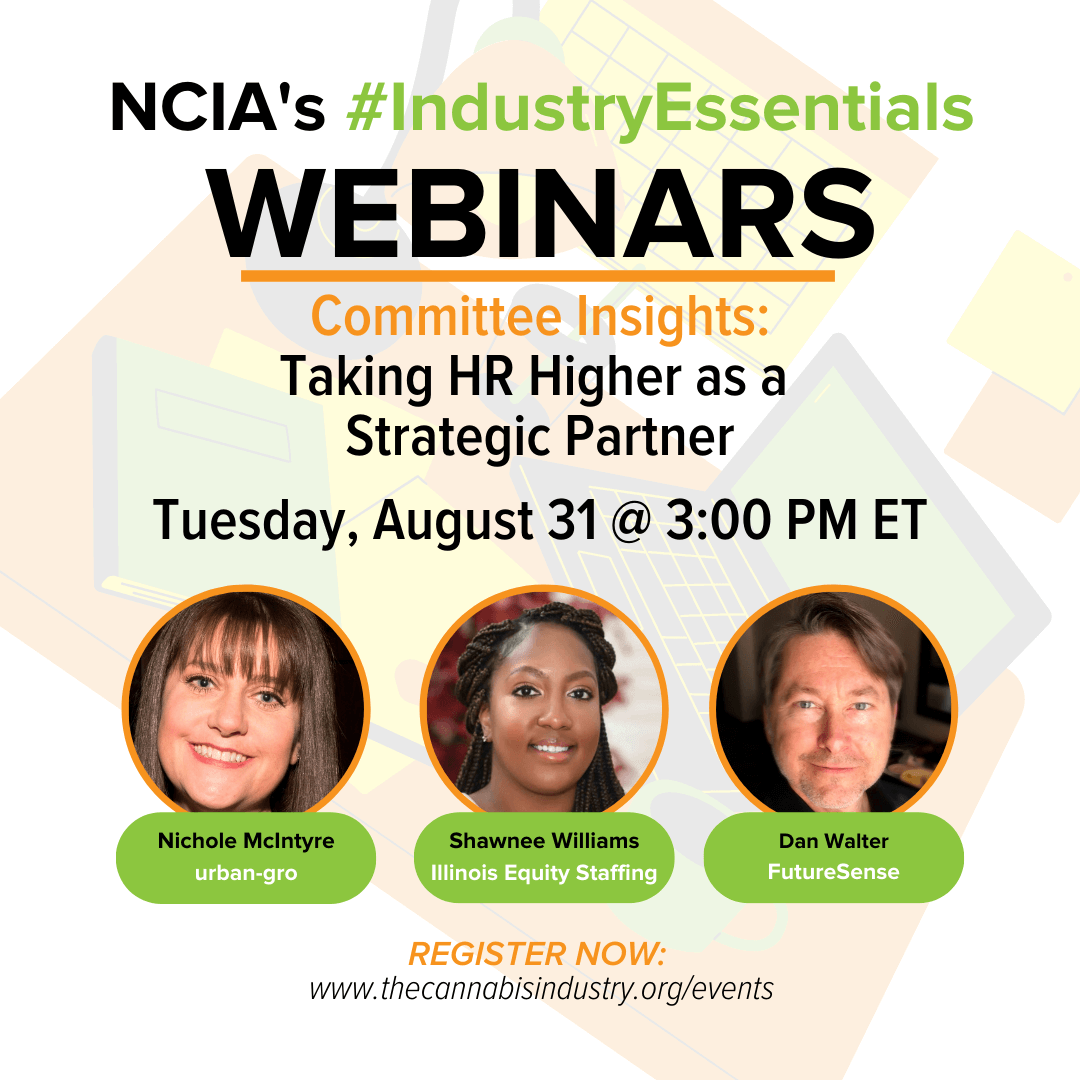

 Kimley Svendsen is the founder and CEO of


Follow NCIA
Newsletter
Facebook
Twitter
LinkedIn
Instagram
News & Resource Topics
–
This Just In
Member Blog: The Evolving Cannabis Legal & Regulatory Landscape in 2026
How THCa Vapes Are Changing Consumer