Service Solutions | 9.27.22 | The Devil is in the Details: Claiming Your Employee Retention Credit as a Cannabis Business
NCIA’s Service Solutions series is our sponsored content webinar program which allows business owners the opportunity to learn more about premier products, services and industry solutions directly from our network of established suppliers, providers and thought leaders.
In this edition originally aired on Tuesday, September 27, 2022 we were joined by the experts from ERT Credit for an exclusive webinar outlining how cannabis businesses can take advantage of The Employee Tax Credit (or ERC) which has currently only been claimed by a small fraction of cannabis businesses, and most importantly, as a payroll tax credit is not subject to Section 280E.
Think your cannabis-related business does not qualify for COVID-19 relief funds worth up to $26,000 per employee.? You’ll leave the session with a roadmap for next steps to determine eligibility and maximize your claim so you don’t miss out on a potentially guaranteed refund worth hundreds of thousands of dollars and in some cases millions.
At the conclusion of the discussion our panel hosted a moderated Q&A session to provide NCIA members an opportunity to interact with leading minds from the cannabis accounting and technology space, join today to contribute to future conversations!
40:46 – Audience Q&A (If your business is still operating – what are the taxes due on the tax credit?)
42:04 – Audience Q&A (I was told that ERC money is not available for the cannabis industry due to 280e. How are you navigating that compared to others trying to provide the same services?)
44:31 – Audience Q&A (Does this apply to cultivation facilities also?)
46:42 – Audience Q&A (What if we apply and don’t receive our money or we are denied the credit?)
48:09 – Audience Q&A (What if my accountant/lawyer says I don’t qualify?)
49:41 – Audience Q&A (How can I find more details on how to navigate the 280e concerns?)
50:58 – Audience Q&A (So if you went out of business before or soon after getting the tax credit you would not have any (or minimal) tax impact from taking the tax credit?)
53:24 – Audience Q&A (Do I have to spend the money on my payroll? Or can I use it towards my other business expenses? Any other restrictions?) 54:26 – Audience Q&A (So is this a credit for my company towards next year or do I get an actual check like a refund?)
As a member of the NCIA, you probably already know how difficult so many of the aspects of business are due to the nature of the industry. Unfortunately, sometimes it seems like the laws and regulations are never-ending, and frankly, it can cause quite the impact on the way operations are handled.
As much as we hate to be the bearer of bad news, it is likely a good idea to be wary of these things, especially regarding compliance regulations.
Cannabis Compliance Regulations
While numerous states have legalized cannabis, it remains federally illegal under Schedule I of the Federal Controlled Substances Act. While the hope is that cannabis will soon be federally legalized and decriminalized, we haven’t quite gotten there yet.
Because of the state of our society and often the stigma associated with cannabis, not to mention the astronomical fines associated with being involved in the legal industry incorrectly, many financial institutions refuse to touch cannabis businesses. Yes, even when a client does everything correctly.
Cannabis companies constantly have to get creative with how they handle revenue –– which is enough to make any business owner pretty uneasy. Without banks, stores are often forced to take payment in cash and invest in ATMs for their shops while they’re at it. Holding so much cash means armored vehicles to collect the money and tremendous crime risk. Yikes, talk about a debacle.
In an attempt to make things easier, some companies have opted to funnel cash through shell companies, but as you can imagine, that puts a big target on their backs. “It can start to look a lot like money laundering,” says businessman Tim Cullen. Despite complaints from states that collecting hundreds of thousands of dollars in cash for taxes is troublesome (to say the least), little has been done to rectify the problem.
A Cautionary Tale
A Massachusetts company running three cannabis dispensaries has found itself in quite the mess despite believing they were following protocol properly. After an eight-month investigation, the company has been ordered to pay $300,000 in restitution and penalties.
This situation has resulted from unintentionally neglecting a state law requiring businesses to pay 1.2 times the regular hourly wage on Sundays and Holidays. The company has admitted that these errors have stemmed from difficulty in hiring a traditional payroll service provider.
Avoiding Compliance Related Repercussions
One way many owners are attempting to get around payroll and tax issues is to misclassify their employees as 1099 contractors to avoid many of the tedious payroll-associated hurdles. Sounds too good to be true? It is! The Department of Labor does not take this kind of infraction lightly, and if you think $300,000 for missing Sundays and a few holidays is a steep fine, buckle up, and fast. If the DOL suspects the misclassification was intentional, you can expect up to $1,000 in criminal penalties per employee and even jail time. So for some legal options……
A Promising IRS Initiative
The IRS has recently launched a program titled “Cannabis/Marijuana Initiative” with the hopes of implementing a strategy to increase voluntary compliance. This is fantastic news for the industry because, as was the case for the dispensary above, often, the breeches are simply a result of misinformation. Hopefully, with an initiative such as this one put in place, small business owners can grasp tax regulations before any compliance issues arise with the guidance of the IRS on the industry’s side.
A Helpful Hand
Another great option is investing in a software solution that supports the cannabis industry and won’t leave you hanging. With payroll support and full-service banking, HCM software can prevent issues that may arise by automating the systems that cannabis businesses spend a great deal of time on in avoiding any missteps. You must find a company that won’t leave you hanging with an unreliable banking service.
Conclusion
While more and more of America seems to be coming around to the idea of legal cannabis businesses being a legitimate industry, we still have some ways to go. In the meantime, covering all your bases and ensuring compliance is the best bet to ensure you don’t end up between a rock and a hard place — and as a result, spending a small fortune in fines and fees. Be sure to keep up with changing laws and consider your options for the best shot at easy and secure payroll and tax keeping.
PeopleGuru develops and supports cloud-based Human Capital Management (HCM) software to help mid-market organizations in the Cannabis Industry attract, retain, and recognize their people and streamline back-office HR and Payroll functions.
PeopleGuru HCM is a highly configurable, true single solution residing on one database that efficiently manages every stage of the employee lifecycle. Behind PeopleGuru’s best-in-class technology, is a team of Gurus who are passionate about helping clients meet their desired business goals by ensuring that they always have the tools and support they need to deliver on their strategic HR objectives, maintain tax & legislative compliance, and boost people productivity.
Alexa is the Assistant Marketer at PeopleGuru. With a B.A. in Advertising and currently pursuing an M.A. in digital strategy, Alexa has a passion for writing, content creation and branding strategy. Specializing in copywriting and unique niche positioning, the world of HCM Software is her latest and greatest challenge.
Committee Blog: Re-thinking Cannabis Track and Trace Models — A Sustainable and Scalable Approach
by NCIA’s State Regulations Committee Contributing authors Jennifer Gallerani, Tim Gunther, Elise Serbaroli, and Erin Fay
The COVID-19 pandemic and subsequent recession powerfully demonstrated that the cannabis industry is providing essential medicine and products to countless Americans, as well as creating jobs and tax revenue. Retail sales of medical and adult-use cannabis in the United States were on pace to eclipse $15 billion by the end of 2020, and if you include ancillary products and services, the industry is estimated to reach $68.4 billion in 2021. The U.S. cannabis industry is experiencing rapid job growth, boasting an estimated 300,000 full-time jobs in 2020. Those numbers are expected to almost double by 2024. Over the next four years, the industry is expected to add nearly 250,000 full-time equivalent positions. By comparison, roughly 271,000 people currently hold beverage manufacturing jobs. These numbers demonstrate with sureness that the U.S. cannabis industry is on a high-growth trajectory, which makes it imperative that the market operate under a practical regulatory framework that benefits both regulators and operators.
Most states that have approved some form of legal cannabis sales (medical and/or adult-use) have also selected a single, mandated technology platform that all operators must use to track and trace their cannabis seeds, plants, and end products. Some iterations of the current track and trace model — which is primarily centralized approach — sets businesses, employees, and regulators up to fail. Of course, it also further limits the competitiveness of the regulated market with the unregulated market, and the ability for policymakers to be confident that cannabis consumers in their states are obtaining taxed, tested, and regulated products.
Local governments are missing out on tax revenue, and businesses (both large and small) are forced to spend unnecessary resources on a system that is fundamentally flawed. The centralized model, contracting with one specific software provider, and mandating operators to use that software provider in order to stay compliant, is wreaking havoc on the entire U.S. cannabis industry and is not sustainable for a federally-legal and global supply chain.
As a team, the National Cannabis Industry Association’s State Regulations Committee’s Technology and Compliance Subcommittee has spoken to regulators, operators, and international technology providers in the interest of presenting a practical track and trace solution to benefit the industry as a whole. This is the first blog in a series that will highlight the issues that cannabis operators and regulators are facing because of the current centralized state-mandated track and trace model. We propose that the U.S. cannabis industry operate under a more practical framework that has a higher probability of success for regulators and cannabis businesses through slight changes and improvements based on proven best practices.
The History of Track and Trace in the U.S. Cannabis Industry
Track and trace systems serialize assets to identify where assets are (track) and to identify where assets have been (trace). Track and trace is not something new. It is the globally acknowledged standard for product movement and reconciliation in both the Pharmaceuticals and Consumer Packaged Goods (CPG) industries. A secure track and trace system combines material security and information security elements to confirm assets are legitimately produced and sourced, following a pre-defined and auditable path.
As the regulated cannabis markets started to take shape and mature in 2012, one of the driving factors that shaped the need for a track and trace system was the 2013 U.S. Department of Justice Cole Memorandum (Cole Memo). The Cole Memo indicated for the first time that the federal government would only intervene in states that failed to prevent criminal involvement in the market, sales to youths, and illegal diversion to other states.
The first four states to legalize adult-use cannabis were Colorado, Oregon, Washington, and Alaska. All four of these states instituted a market-based licensing system to regulate the commercial activity of cannabis sales. The intentions of the newly instituted policies were two-fold: protect consumer health and minimize diversion, both of which align with the core principles of the Cole Memo. To meet these intentions, the states instituted procedures for inventory control and tracking documentation using a state-mandated centralized model, in an effort to create a transparent and controlled system of oversight within the cannabis industry.
As the industry has developed over the years, most states that have approved some form of legal cannabis sales have selected a single mandated technology platform that all operators must use to track and trace their cannabis seeds, plants, and cannabis products. As shown in Figure 1, the majority of legalized states have chosen METRC as their exclusive contractor of track and trace services.
A Scalable and Sustainable Track and Trace Solution
The legal cannabis market has changed significantly since 1996 and it is important for the industry to re-evaluate the intention and implementation of track and trace. Regulatory bodies contracting with one track and trace technology provider and mandating operators to use that specific provider in order to stay compliant is problematic for many reasons. Time has shown that the current centralized model is fiscally irresponsible and ultimately counterproductive, with significant negative externalities, including ethical concerns such as anti-trust issues. Most recently, an Oklahoma cannabis operator (seeking class-action status) initiated litigation against the state’s Medical Marijuana Authority (OMMA), alleging that the state exceeded its authority by requiring licensees to pay for a state-mandated track and trace program, and that the state’s contract with METRC creates an unlawful monopoly, among other claims.
To provide an analogy, let’s think about how businesses are required to report taxes. The IRS sets out certain rules and every business must report their income and assets according to that framework. Technology providers (such as TurboTax, Tax Slayer, H&R Block, etc.) have built scalable products to support businesses in reporting their taxes. The IRS does not mandate that businesses use one single specified software in order to report their taxes. Doing so would kill competition, introduce a monopoly, and eliminate any incentive for the technology providers to improve their product. By the IRS allowing free competition over the realm of tax preparation and processing software, the public benefits from the technology companies being incentivized to update and improve their software features and benefits.
The centralized model is crippling the entire industry as system failures are occurring on a more frequent basis, and its after-effects are causing a more detrimental and wide-ranging impact as the industry grows at an exponential rate. Most recently, METRC’s integration functionality (how third-party business operations software communicates to the state’s system) was down for more than fourteen days in California, causing significant problems in the nation’s largest cannabis market. One software provider and its tag-producing partners are benefitting, while setting industry regulators and operators up to fail. One software provider cannot meet the current or future needs of regulators and operators, especially not on a national level. Meanwhile, there are many excellent software providers that specialize in track and trace. The free market should determine the most efficient and user-friendly approach to allow businesses to stay compliant and accurately report to the appropriate regulatory authorities.
By leveraging the knowledge and experience the industry has gained over the last 20 years, we can incorporate best practices from other industries’ and other markets’ track and trace systems, and set regulators and operators up for success.
Join us as we dive deeper into the issues surrounding compliance and track and trace in the cannabis industry. Our multi-part blog series provides an in-depth look into the technical shortcomings of the current centralized approach and provides a roadmap for implementing a distributed model approach. Some of the disadvantages we will cover in the subsequent posts include:
Impact of System Failure: The current centralized model provides a single point of failure: if the system goes down, all licensee operations must stop operating entirely. In some cases, operators may manually record activity during a system failure, and then manually enter the activity when the system resumes. This introduces a high risk of human error. No backup system or alternative means of recording through the use of technology exists since the state relies on only one system.
Challenges with Scalability: The history of performance with centralized track and trace systems demonstrates that there are significant challenges in scalability because of multiple system failures and shutdowns. The system would benefit from a more advanced track and trace capability, specifically with its API (Application Programming Interface). Many times it is not the technology of the licensee system, but the technology design of the state-mandated systems.
Fiscal and Environmental Impacts: Licensees are required to purchase plant and product tags from the single state-mandated vendor, which creates a fixed price system that is typically not in favor of a licensee. It is also creating a sustainability issue in the industry, as the plant and product tags are single-use. More operators are speaking up about the waste it is generating in our cannabis industry.
Interested in joining us in establishing an effective and scalable track and trace framework for regulators and operators in the legal cannabis space? Click here to stay updated on the State Regulations Committee, and the efforts that it’s Technology and Compliance Subcommittee are taking to improve and advance track and trace nationally. Let’s close the informational gap between operators and regulators, and help the entire industry move forward together.
Stay tuned for the next two blog posts in our multi-part series!
Webinar Recording: 280E Mitigation – What You Need To Know
Watch this webinar recording in case you missed the live presentation from December 17.
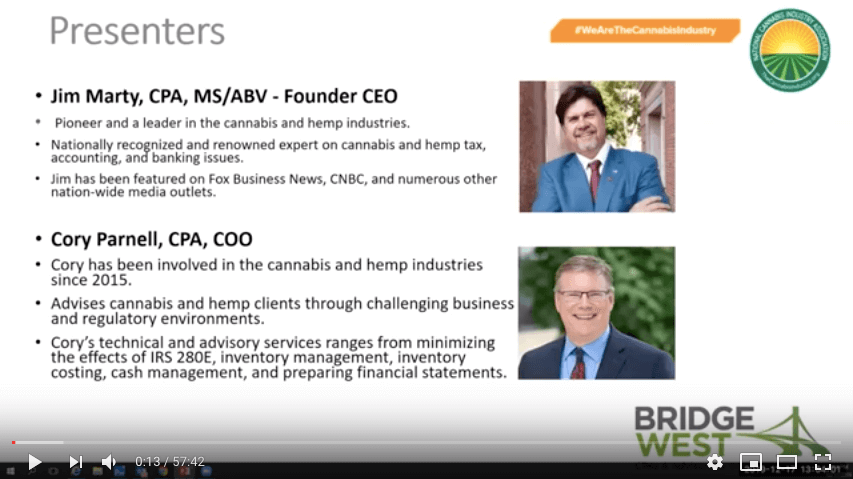
Legal cannabis has been spreading across the United States for over 10 years now. How has the industry been viewed in the eyes of the IRS? The cannabis industry has consistently lost in tax court against the IRS. Can these businesses be profitable on an after-tax basis? Do management companies help with profitability? Jim Marty and Cory Parnell of Bridge West LLC, CPAs and Consultants to the cannabis industry will explore these questions in light of recent tax cases.
Learning Objectives:
1. The session will help attendees understand the implications of recent Tax Court decisions that involve IRS Code Section 280E.
2. Learn how to avoid double taxation with related party management companies.
3. Explore the Eighth Amendment to the U.S. Constitution regarding excessive fines and penalties. Hear the arguments that conflict with 280E.
4. In light of the above, learn how C-Corporations can help protect again personal liability for dispensary income taxes.
Member Blog: Cannabis Industry Banking Predictions In The U.S.
There is little doubt that lack of access to banking is one of the most immense challenges facing cannabis retailers. Legally-operating cannabis businesses are at a significant disadvantage, as well as the communities they operate in. Luckily, there are positive signs that a new day is quickly approaching and cannabis banking laws in the United States are about to go through a major change.
What’s Going on with Cannabis Banking Laws?
Recently and for the first time, the U.S. Congress held hearings on the all-cash nature of the cannabis business. The bill at the center of these monumental hearings: the Secure and Fair Enforcement (SAFE) Banking Act, originally introduced in 2006 and has been stuck in a holding pattern, as have similar bills, ever since.
The committee heard testimony from cannabis industry stakeholders, police departments, and banking executives. These witnesses painted a robust picture of the cannabis banking problem, from the danger it poses to communities in the form of increased risk of armed robbery, to the burden it places on legal dispensary owners who have to find alternative cash management solutions, to the lack of accountability cash creates from a tax perspective.
The bill has yet to come up for a vote. While there are elected officials who reject the concept outright, there is an ever growing coalition in both houses of Congress pushing for a cannabis industry banking solution. More than ever, it seems the U.S. could finally see a loosening on federal restrictions to banking legal cannabis business.
4 Reasons why the U.S. will Loosen Cannabis Banking Regulations Soon
There is more political will for the legal cannabis industry than ever before.
While one hearing is far from passing the law, it is a sign that times are changing. Ten states have legalized recreational cannabis and 33 more have some form of medical cannabis laws in place; this is a drastic increase in the last decade. Shockingly in a time of so much partisan rancor, 62% of Americans favor legalizing marijuana. That is more than double the approval rating cannabis enjoyed in 2000 (31%).
The cannabis banking law being discussed is relatively innocuous. It does not legalize or reclassify cannabis at all, just allows banks to offer services to state-legal cannabis businesses. All in all, considering the strong support across party lines and the success of state industries, passing this law would be an easy win for Democrats, Republicans, and President Trump in a time when political wins are a rarity.
Current banking solutions are prohibitively expensive and states want to see their prosperous legal cannabis industry grow.
Credit unions and banks that currently offer cannabis industry banking charge prohibitively expensive fees, up to $2,000 a month for a simple business checking account. This is a problem for state elected officials.
Recreational and medicinal cannabis states seem, generally speaking, to enjoy the tax revenue they receive from this robust and rapidly growing industry. It is in the best interest of the state for legal cannabis businesses to thrive. If cannabis business owners can’t afford the currently available banking services, it hinders their ability to build upon their business. Even worse, these prohibitive fees keep dispensaries operating on an all cash basis, creating a much higher risk of robbery and violence in the community.
California’s behemoth market is drastically tipping the scales.
It is hard to overstate just how massive California’s legal cannabis market is. Expected to rake in over $50 billion by 2026, the influence this one state industry has is profound and its cash management problem will significantly magnify the problem.
The industry will continue to grow and mature, pushing out the gray market over time. As more cash comes flowing into the legal cannabis industry, it will begin to strain the cash supply and law enforcement to such a degree that action, more than it already is, will be imperative.
Money talks; state and federal governments want their tax revenue.
More than anything else, what will ultimately carry a cannabis banking law across the finish line is money. Cash-only businesses are fertile for tax fraud, simply pocket a little cash here and there and then never report it to the IRS. If there is one thing that can motivate an otherwise slow-moving government, it is tax revenue being left on the table. Allowing cannabis industry banking is a clear way to increases transparency and ensure the state and federal government get their share of the profits.
Access to banking will allow the rapidly growing cannabis industry to advance even faster. Will you be ready? Subscribe to our blog to stay up to date on the latest cannabis news, industry trends, and best practices for running your cannabis dispensary!
Gary Cohen leads Cova’s charge into the legal cannabis space by guiding the vision, strategic development, ‘go to market’ plans and culture.
Before joining Cova, Gary was a principal in over a dozen tech start-ups in the mobile communications industry ranging from small VC funded companies to Fortune 100 firms, including Onavo, which was later acquired by Facebook. In those companies he led sales, marketing, business analytics and market expansions. He has also held a multitude of leadership roles with Verizon and AT&T.
Gary holds a degree in finance with a master’s in marketing from the University of Colorado.






 by NCIA’s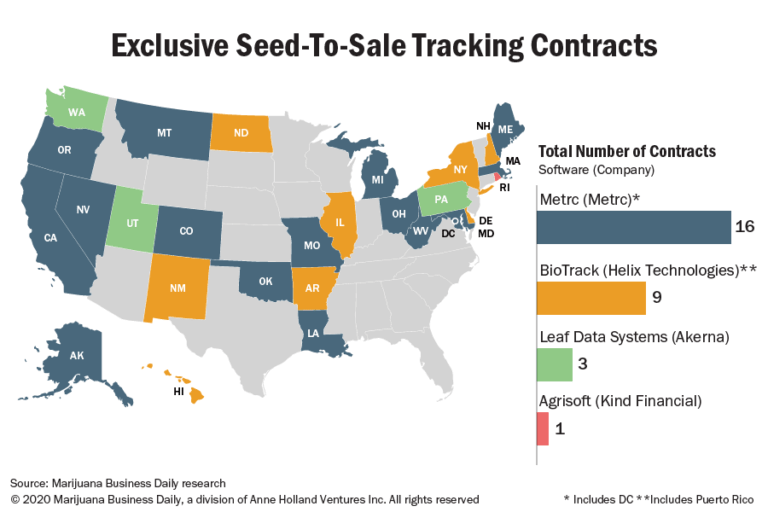


Follow NCIA
Newsletter
Facebook
Twitter
LinkedIn
Instagram
News & Resource Topics
–
This Just In
Member Blog: The Evolving Cannabis Legal & Regulatory Landscape in 2026
How THCa Vapes Are Changing Consumer