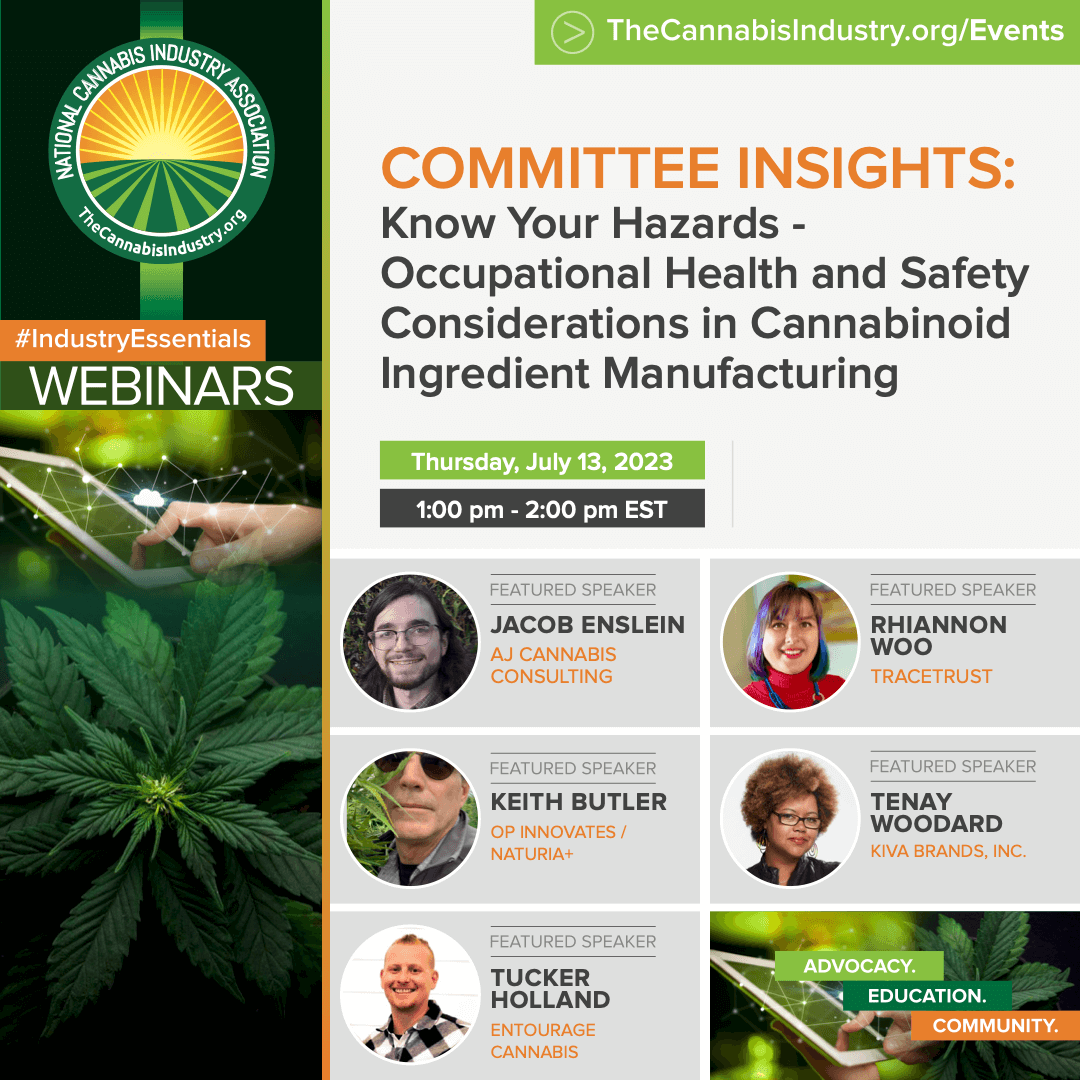
Committee Insights | 7.13.23 | Know Your Hazards – Occupational Health and Safety Considerations in Cannabinoid Ingredient Manufacturing
NCIA’s #IndustryEssentials webinar series is our premier digital educational platform featuring a variety of interactive programs allowing us to provide you timely, engaging and essential education when you need it most.
In this edition of our NCIA Committee Insights series, originally aired on July 13, we were joined by members of NCIA’s Cannabis Manufacturing, Scientific Advisory and Hemp Committees for an in-depth discussion highlighting the occupational health and safety considerations to make during the manufacture of cannabinoids and provide recommendations for mitigating risk.
There is no mistaking that manufacturing cannabinoids is here to stay. It is more and more prevalent to see historically plant/naturally derived bulk ingredients being manufactured in a controlled environment in the lab or through innovative processes like precision fermentation. It is likely that bulk ingredient manufacturing of cannabinoids will go this route too.
For cannabinoids like HHC, that do not exist naturally in the plant or in high enough quantities to be commercially viable for extraction, it is most certainly the case that manufacture of these compounds will occur in the lab. To produce these compounds safely, we can luckily look toward existing regulations and occupational health and safety guidelines for producing novel ingredients for use in foods and non-foods.
Learning Objectives:
• Recognizing common occupational safety hazards associated with manufacturing cannabinoids and recommendation to mitigate these hazards
• Learning the different occupational safety considerations between isolation and purification of naturally occurring cannabinoids and the manufacture (synthesis) of cannabinoids in the lab
• Understanding the special safety considerations that processes like hydrogenation and others have and why these are critical to mitigating liability for your business
Safeguarding Consumers in the Cannabinoid Product Landscape (Part III):
Know Your Hazards – Occupational Health and Safety Considerations in Cannabinoid Ingredient Manufacturing (Part IV): https://bit.ly/3rEUeKP
Concepts for Regulatory Consideration – Shifting the Conversation from “Cannabis vs. Hemp” to “The Cannabinoids” (Part V): https://bit.ly/3P3r5AW
Member Blog: Exactly How – and When – Does Glove Contamination Occur?
Justine Charneau, Head of Cannabis Industry Sales, Eagle Protect
Cannabis workers who regularly wear disposable gloves have every right to be surprised – shocked even – that the products they’re pulling from an unopened box may be contaminated with any number of harmful pathogens and chemicals, yeast species, or a variety of distinct genera of fungi – all of which are capable of leading to costly product recalls. After all, these gloves just came out of a brand new box, completely unused. But that’s precisely what a multi-year metagenomic testing and analysis study recently uncovered about contamination threats on the interior and exterior surfaces of nitrile gloves.
The threats were present because the gloves were contaminated prior to packing and shipping them to your supplier. contamination occurs during the manufacturing stage due to glove manufacturers operating in sub-standard facilities, compounded by their efforts to cut corners and save costs during the production process. Below, we trace the arc of surface pathogen transmission – from its primary source to the end user.
Polluted Water Sources
How does contamination first enter the manufacturing supply chain? In both a figurative and literal sense – the biggest threat comes from upstream. Many overseas glove manufacturers aren’t operating with clean water sources, using putrid water which can be polluted with agricultural fertilizers and pesticides, as well as industrial wastewater and both human and animal sewage. Glove manufacturing uses an abundance of hot water in several phases of production, so polluted water sources contribute to contamination.
Inferior Raw Materials
Contamination can be introduced with poor quality raw materials. While it saves money, gloves produced with cheap materials can include toxic chemical compounds and other unsafe filler ingredients. Chemical contamination in gloves caused a recent cannabis recall. Inferior raw materials can also greatly decrease the durability and performance of the glove and can easily cause skin irritations for the glove user.
Former Cleaning & Drying
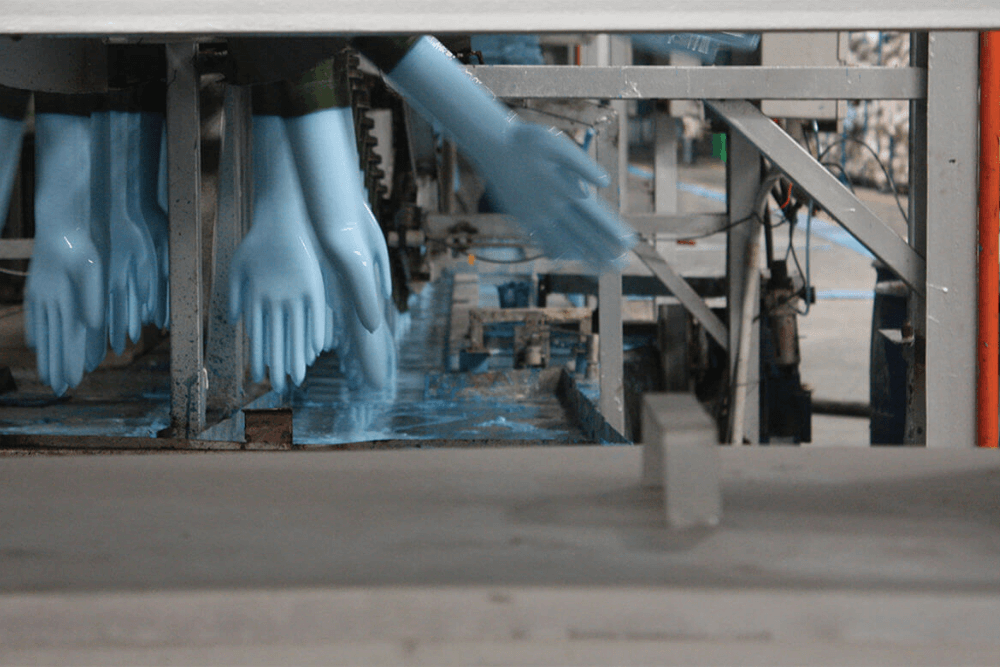
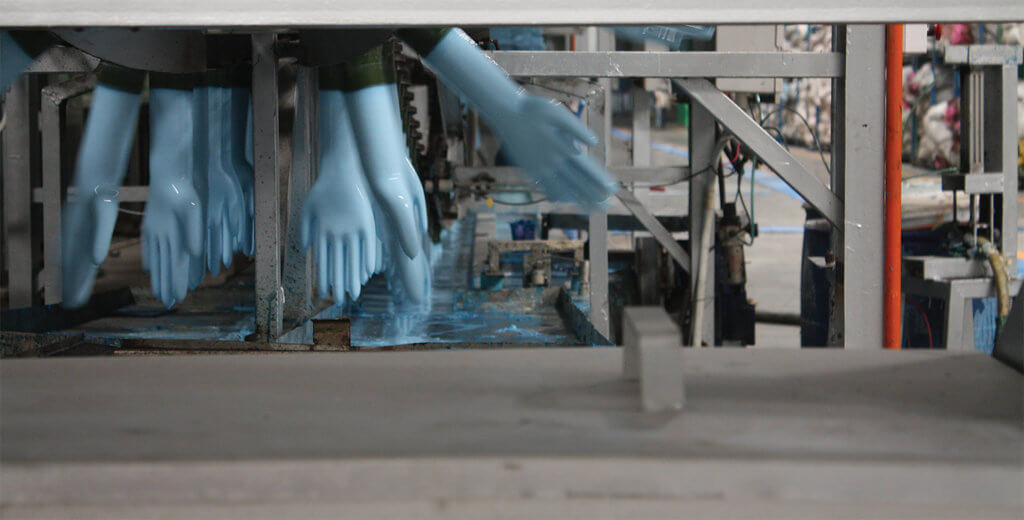
The threat of contamination is further compounded when manufacturers fail to raise the water tank temperatures high enough to kill microbes. Formers, the ceramic, hand-shaped molds used in glove manufacturing, undergo cleaning processes involving hot water and bleach. When the water temperature and chlorine concentration aren’t high enough, or, if the wash water and brushes are not thoroughly cleaned between production stages, microbial contamination can occur.
Inadequate Drying Procedures
Following the former cleaning and drying stage, gloves are vulcanized (heat-treated) in ovens to both strengthen and elasticize them. Gloves are then subjected to the drying process in large industrial ovens that also require routine cleaning. But for some glove manufacturers , simply shortening the drying cycle in tumblers that aren’t routinely cleaned can slash utility costs. The result? These inadequate drying procedures leave products damp, where they’re much more susceptible to airborne microbial contamination.
The Packing Room
After the drying stage, gloves are boxed. New tech manufacturing does this automatically, however, gloves can also be packaged in unhygienic or unsanitary open-air packing rooms where human skin contaminants, including fecal matter, can contaminate gloves. These unsanitary conditions can further expose gloves to contamination, right before they’re packed into boxes.
As you can see, each of the production stages in the glove manufacturing process comes with its own set of contamination risks. If you’re inclined to think that government and industry regulations, oversight, and compliance requirements are designed to prevent such contamination risks, you’re going to be sorely disappointed. But that’s a topic for the next blog in our contamination series, so stay tuned.
Follow NCIA
Newsletter
Facebook
Twitter
LinkedIn
Instagram
News & Resource Topics
–
This Just In
Committee Blog: Budtenders Make or Break Your Business – A No-Nonsense Guide to Cannabis Retail Staffing
Member Blog: Guaranteeing the First Loan