Member Blog: Novel Foods Applications Stalled?

The UK CBD market had an estimated value of £300 million in 2020 and by the end of 2022 estimates had doubled that figure. This goes to show that CBD being deemed a “novel” food in January 2019 has had little impact on market growth and if predictions are right will exceed £1 billion by 2025. With the FSA’s March 2021 deadline long behind us and having made submissions by the deadline, many companies will be feeling comfortable. However, it’s worth remembering that the authorization process is still on-going, so while products that are part of a validated application are allowed to remain on the market they are still not authorized as novel foods. And now with the FSA conducting market research to aid in their risk assessment of consumer CBD products, some concerning data has been published.
The FSA commissioned Fera Science Ltd to carry out a survey to obtain a brief overview of current CBD products on sale in England and Wales in order to help FSA’s risk assessment of CBD products. The products selected covered, oils, sprays and edibles (including drinks). The study collected various data on the products. This included testing for CBD content, cannabinoid profiles, heavy metals, pesticides, residual solvents, Polycyclic Aromatic Hydrocarbons (PAHs) & mycotoxins. A summary of the results are shown below:
- Heavy metals (cadmium, mercury & lead) and arsenic were not detected in the majority of samples, meaning levels were below the limits of quantification of the method. Seven samples contained lead, four samples arsenic and two samples contained cadmium. Mercury was not found in any sample. A definitive statement as to whether products exceed maximum levels cannot be made due to uncertainty as to whether products would be classified as a food (i.e. oil) or a food supplement.
- A low incidence of low levels of mycotoxins, with Fusarium mycotoxins found more frequently than aflatoxins and ochratoxin A, mostly at the methods reporting limit. Three samples were found to contain ochratoxin A at the methods reporting limit.
- A total of seven pesticide residues were found across all of the products (each product was tested for over 400 pesticides). There are no specific Maximum Residue Limits (MRL) for CBD products.
- One oil product was found to have PAHs above the regulated levels, if classed as a product for direct consumption. If classed as a food supplement the PAHs were within regulated levels.
- Three samples contained residual solvents. One product was over the MRL.
- Most products contained CBD close to the declared value. Two oils had substantially different levels than that declared (one higher and one lower). CBD was not detected in one of the drink products. These are potentially non-compliant with compositional and standards requirements.
- Delta 9-THC was detected in 87 % (26) of the samples analysed. Of these 40% (12) were found to have THC+ (the total sum of illicit cannabinoids in the product) above the 1mg threshold.
Although Fera only tested a small number of products, the fact that such a large percentage of products were found to have issues is concerning to say the least. It throws into question how many other products currently on the market that are part of a validated NF application, but aren’t up to spec.
The next question is, are you 100% sure that your current market offerings meet their product specifications? If not then there’s no time like the present to take a closer look at your products and their manufacturing process. It’s also important to remember that if you do need to make changes then these changes need to be updated in your current regulatory filings.
If you would like to discuss this further, please reach out to us at info@arcuscompliance.com.
Member Blog: Pre-Roll Market Industry Trends and Growth Potential

By Harrison Bard, Co-Founder and CEO, Custom Cones USA
Pre-Rolls More than a Trend
Having the ability to identify trends in the cannabis industry is vital for producers to build a successful brand, and the biggest trend in ther cannabis industry right now is pre-rolls. Growing at 12% YoY in the US and 38% YoY in Canada, pre-rolls are the fastest growing cannabis product in the world of legal cannabis, and it’s not close.
This trend could be chalked up to a sudden rise in popularity and as something that will decline once another hot trend appears; however, we believe that the rise of pre-rolls is more than just a flash in the pan. In fact, after looking over the sales data we received from Headset, we believe that pre-rolls will not only continue their growth, but they will become the bestselling cannabis products by 2030.
Here’s why!
Prices Fall, Sales Rise, Both Stabilize
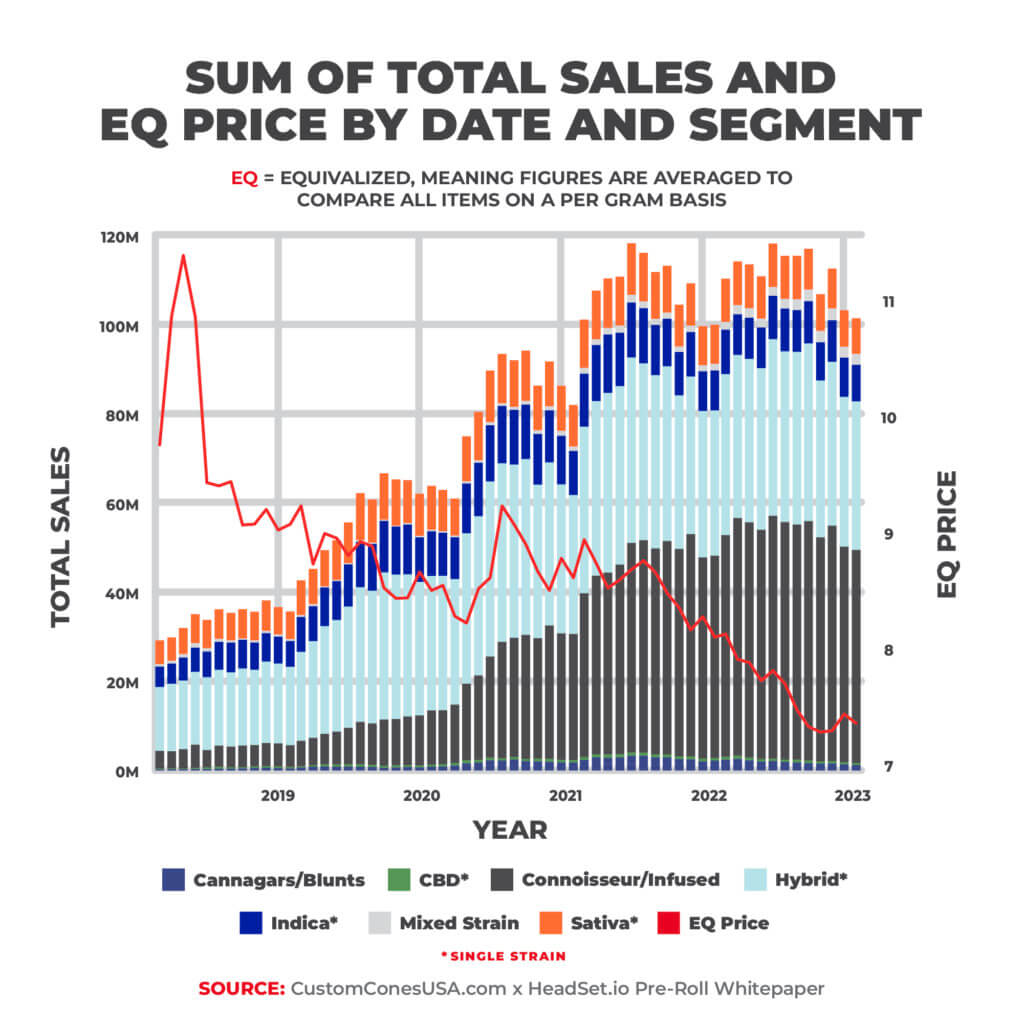
Over the past few years, the wholesale price of flower has dropped dramatically in mature markets, and cheaper cannabis costs have allowed producers to source higher quality flower for their pre-rolls. Combined with the advances in pre-roll making machinery, quality pre-rolls are now able to be sold at a lower retail price, which has driven strong growth for the category.
As you can see from the graph, pre-roll sales have steadily increased as prices have fallen, but the last two years have seen both sales and prices begin to stabilize. The pre-roll segment that has seen the most growth during this time is infused pre-rolls. Customers love high THC percentages, and producers are happy to finally be able to offer it to them in an affordable pre-roll form.
Pre-Rolls have the Least Amount of Price Compression
It’s not just pre-roll prices that are falling. Prices are down across the board, but even though prices for all cannabis products declines over time, pre-rolls are showing the least amount of price compression. In other words, if you are in the business of selling cannabis, and you are worried about declining margins, pre-rolls are a category you should be expanding into to maintain and boost profitability.
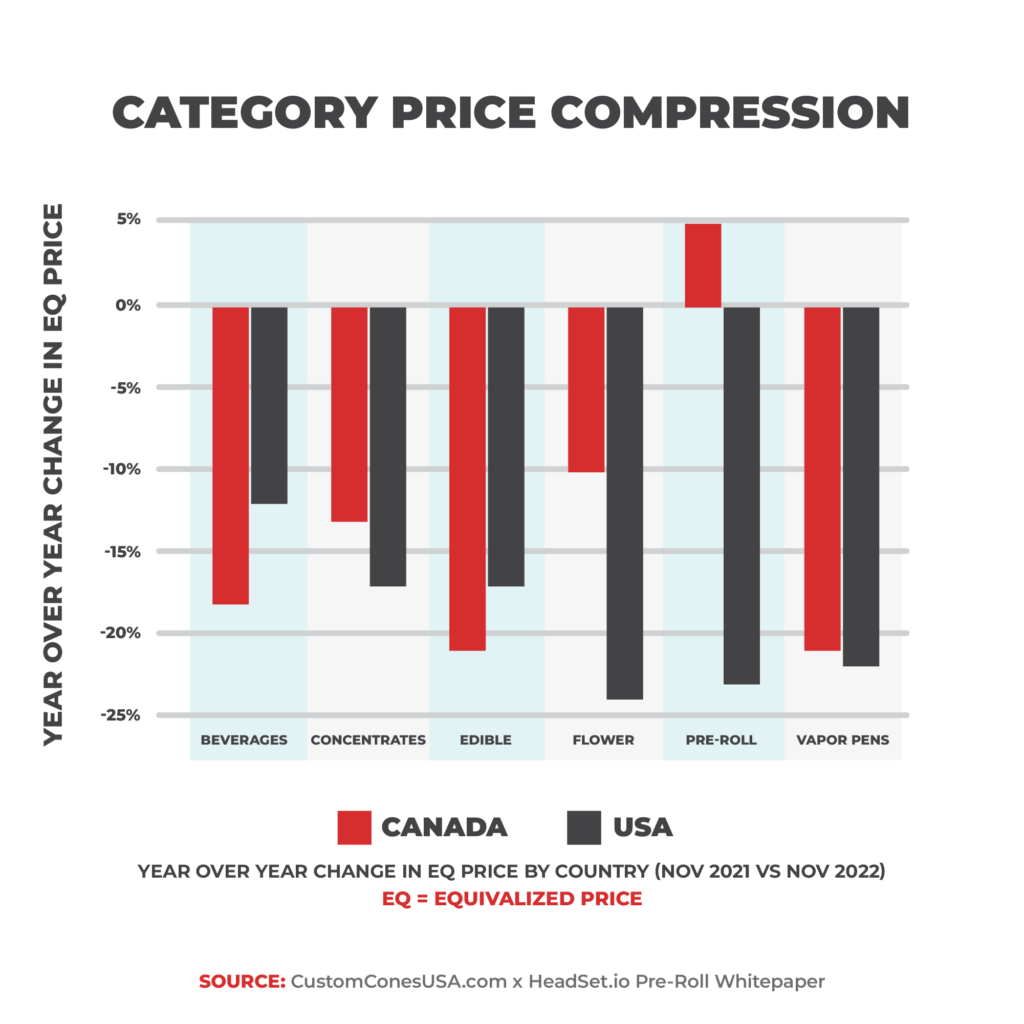
You can also see from the graph that Canada has actually seen the average price of a pre-roll increase, but there is nuance to this data. This does not mean that pre-rolls are getting more expensive for Canadian consumers. This data shows just how popular infused pre-rolls are becoming. They are becoming so popular that people are choosing to buy them over regular, more affordable pre-rolls, and that change in buying habits has increased the average sales price for pre-rolls.
Pre-Roll Multi-Packs
Another interesting trend we see in the sales data is that pre-roll multi-packs have become extremely popular. In 2018, multi-packs of pre-rolls only made up 27.7% of the market in Oregon, Washington, and Colorado. By 2023, multi-packs make up 47.62% of the market—representing a growth of about 20% over 5 years. Also, Since 2021, we have seen an almost 400% growth in multi-packs that have a volume of 2 or 5 grams as well as steady growth across most other sizes.
Buying pre-rolls by the pack is a lot more convenient for consumers. It means not making a special trip to the dispensary every time a pre-roll is wanted. The rise in their popularity is a sign that consumers are investing in pre-rolls as a staple in their cannabis routine. Because they know they will continue to enjoy pre-rolls, they buy multiples at a time for convenience, and it’s this kind of product loyalty that moves a product from a trend into something more.
Wallet Share by Age
Another interesting thing about pre-rolls is that, when it comes to wallet share, they are the most consistent product segment across all age groups. Other products show a significant increase or decrease in popularity with each new generation; however, pre-rolls steadily hover between 12.8% and 14.5% in each group and even show a slight increase with the younger generations.
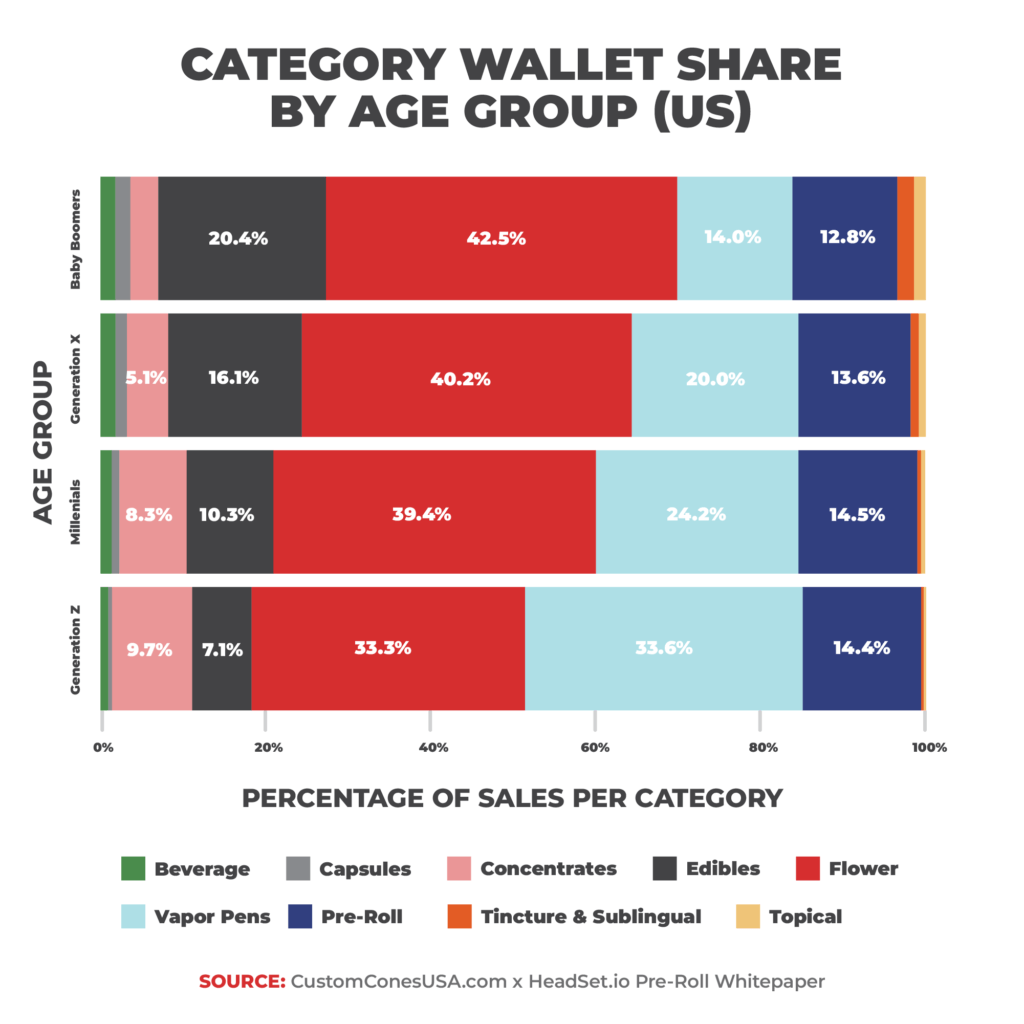
It’s also important to note the decline of flower with younger generations. Why this is significant is because, at their core, pre-rolls are a flower product, and they are not following the same decline in sales. They distinguish themselves from loose flower by providing consumers a way to enjoy their flower without extra paraphernalia. In this way, we think pre-rolls could start to eat into the flower market, as they better meet the consumption needs of flower customers.
Pre-Roll Attachment Rates
Another big reason why pre-rolls will remain a dominant product segment in the future is that they are the perfect add-on item at the point of sale. The data shows that, when a person walks into a dispensary, they will add-on a pre-roll 15.5% to 23.3% of the time. In fact, in all product segments, pre-rolls either have the highest attachment rate or are within a single percentage point of the leader.
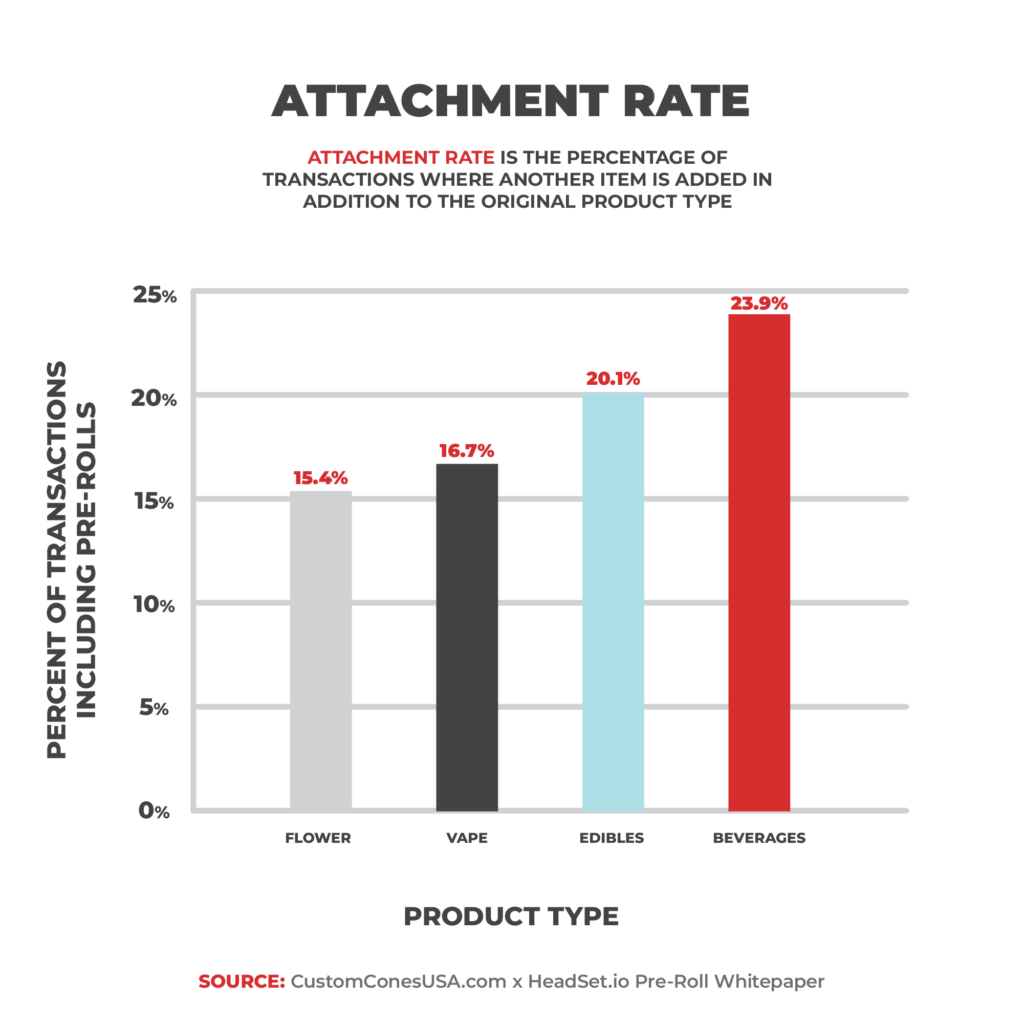 In other words, no matter what a customer is interested in purchasing, it doesn’t take a lot of convincing to get them to add on a pre-roll. They’re reasonably priced, made with quality materials, and incredibly convenient. Whether they want to consume it right away or want to save it for later, pre-rolls have become something flower lovers like to have on-hand for whenever, and that makes it more than a trend. That makes it a staple.
Convenience Impacting Pre-Roll Purchasing
Cannabis is starting to make its way into mainstream culture. You can’t buy it at your local grocery store, like you can buy wine or cigarettes, but it’s out there. The legalization of cannabis has opened the door to innovation in the cannabis industry, and those innovations are starting to have an impact on everything—especially consumption.
Flower needs paraphernalia to be consumed, and, if you are just trying to enjoy cannabis, sometimes you just don’t want the hassle. Pre-Rolls are unique in that they offer the consumer flower as well as a way to consume it, so it’s not too much a leap to think that pre-roll could keep expanding and start eating into flower sales.
In this way, cannabis can be compared to tobacco. Even though people can buy loose tobacco and roll their own cigarettes or use a pipe, most people are buying pre-rolled products. Even though the tobacco quality, smoking experience, and price point can be better when you buy loose tobacco, most people are choosing the convenient option. It shouldn’t surprise us that cannabis starting to fall into this pattern as the market matures.
Final Thoughts on The Pre-Roll Market
The data lets us know that pre-rolls are doing amazing things when it comes to sales, but it is also giving us hints as to trends in consumption methods. Pre-rolls are a flower product, and it’s clear from the data that flower consumers are buying into the convenience of pre-rolls. This is more than just a trend, but a shift in the preferences around flower consumption. Because of this shift, we can see pre-rolls taking on a more prominent role as the cannabis industry continues its expansion.
For a more in-depth look at the pre-roll industry, be sure to check out the State of the Pre-Roll White Paper, and, if you have any questions, feel free to reach out to the Pre-Roll Experts at Custom Cones USA.

Follow NCIA
Newsletter
Facebook
Twitter
LinkedIn
Instagram
News & Resource Topics
–
This Just In
Member Blog: What Consumers Really Want in a Pre-Roll
Member Blog: The Evolving Cannabis Legal & Regulatory Landscape in 2026