Member Blog: What I Learned from Serving as an NCIA Committee Officer
The National Cannabis Industry Association (NCIA) is a business-member organization of professionals from every sector of the legal cannabis industry, from seed to sale. I finished my tenure as Chair of the NCIA Education Committee (EC) in December 2023. I joined the EC in October of 2019 as a committee member and sequentially served as committee Organizer, Vice Chair, and Chair. I now have colleagues and friends in the cannabis industry due to networking through the EC, NCIA’s other 13 committees, and my participation in NCIA conferences, regional events, and Lobby Days.
People in the cannabis industry have a passion for their work that is unlike any other I have seen. NCIA members are professionals in their field, working as medical doctors, Ph.D.s, accountants, lawyers, insurance agents, and marketing gurus, among others. Among these professionals, I felt seen and supported.
As a committee, the members were encouraged by the NCIA staff to pursue our interests and direction for the committee. There was no NCIA agenda for our work. As NCIA members, we were free to choose our path for committee projects.
As an officer, I had access to the other NCIA committee officers in our monthly all-committee call. Each committee reported their work-in-progress and announced finished projects in the form of webinars, blog posts, or white papers. The content of the website is driven by the members, and much of the content is publicly available. It takes an army to deliver cannabis products to consumers, and that army forms at NCIA.
I have listened in awe to NCIA members articulate their knowledge, and others have written beautifully. NCIA has a strong voice in Washington for the mission of federal legalization of cannabis. NCIA members write talking points on their areas of expertise and freely share cannabis knowledge for the betterment of the industry. Members have an opportunity to shape policy at the state, federal, and international levels.
Before NCIA, I was not aware of the reality of the steps for passing legislation in Washington. I have learned about the long process and have been encouraged to use my own voice, from contacting my state and federal legislators to participating in lobbying organized by NCIA at their annual Lobby Days in Washington. I walked from congressional to senate office to office with a team to talk with staffers. I found the staffers open to the conversation about legalizing cannabis, and I learned from a few of them. Approaching a lawmaker as a member of NCIA carries more weight than being a lone concerned citizen.
The cannabis industry has businesses struggling to remain afloat, and membership revenue has declined. If your company is not an NCIA member, ask yourself if you are willing to lose your opportunity to shape the future of the cannabis industry. Then, sign up for membership and make a difference.
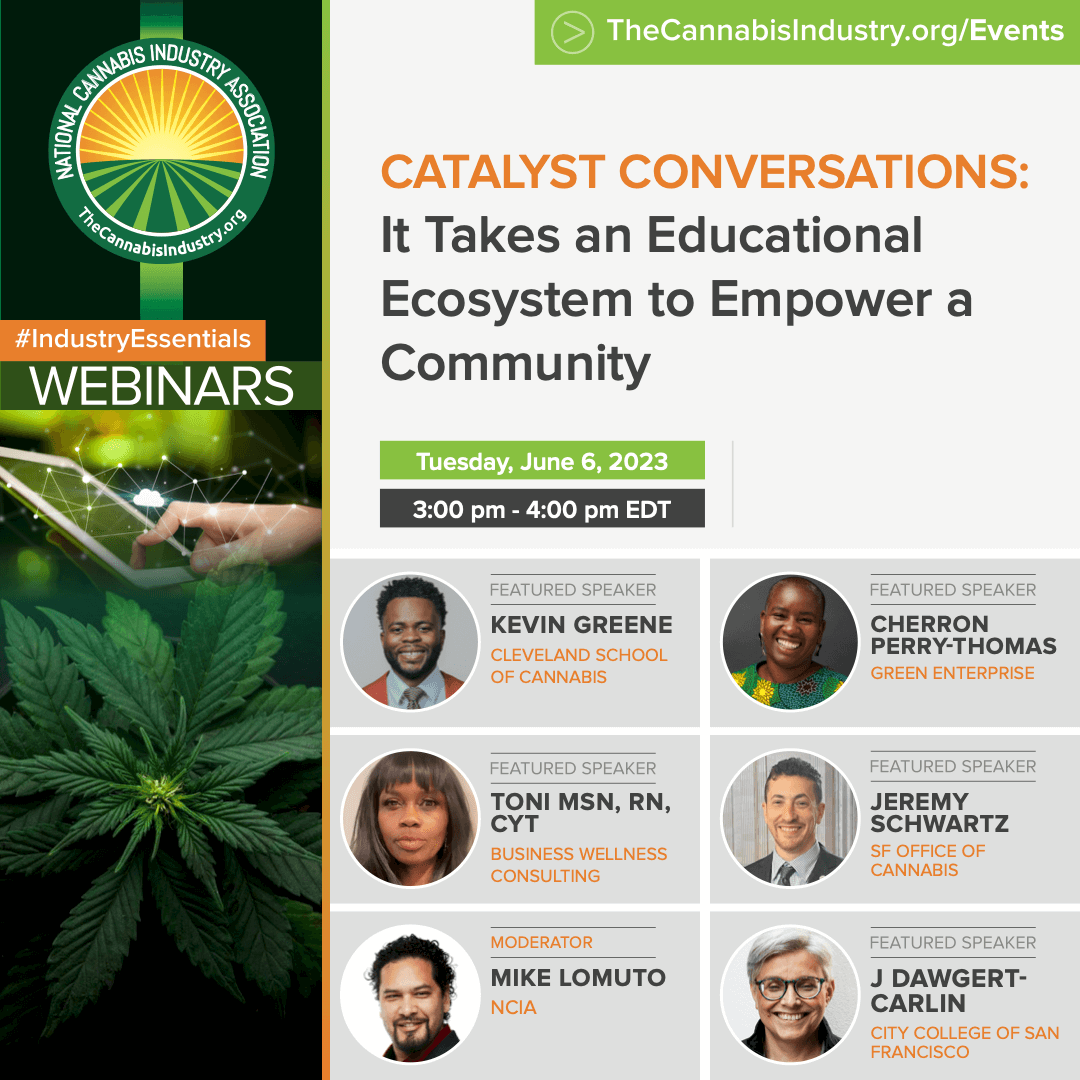
Catalyst Conversations | 06.06.23 | It Takes an Educational Ecosystem to Empower a Community
NCIA’s #IndustryEssentials webinar series is our premier digital educational platform featuring a variety of interactive programs allowing us to provide you timely, engaging and essential education when you need it most. NCIA’s Catalyst Conversations series is an advanced webinar series curated to give enrollees in our Social Equity Scholarship program the opportunity to network and gain access to valuable knowledge that will help them excel in the cannabis industry.
Looking for ways to empower your community? Trying to figure out a way to build an impactful business in cannabis? It’s going to take dynamic and intentional ecosystems to get the most out of the generational opportunities cannabis is opening up.
In this edition of our Catalyst Conversations series originally aired on Wednesday, June 6, members of NCIA’s Education Committee and Health Equity Working Group were joined by San Francisco’s Office of Cannabis, City College of San Francisco, and Green Enterprise’s HBCU College to Careers Tour.
The institutions shared their experiences, lessons learned, best practices, and perhaps most importantly demonstrated the importance of collaboration to create truly holistic educational ecosystems that will create both long and short term impact, particularly in communities harmed by the War on Drugs.
Learning Objectives
• Gain insights into how educational institutions, government agencies, the business community, and the private sector are collaborating to foster Equity in cannabis and the community at large
• Understand the obstacles and how to navigate them when creating a college to careers pipeline for greater DEI in cannabis
• Learn about what types of educational programming exists for people interested in entering the cannabis industry
Panelists:
Toni MSN, RN, CYT
Founder
Toni – Consulting and Wellness
Cherron Perry-Thomas
Director of Social Impact | Founder
Diasporic Alliance for Cannabis Opportunities (DACO) | Black Cannabis Week
Jeremy Schwartz
Deputy Director
Office of Cannabis for the City and County of San Francisco
J Dawgert Carlin (they/them)
Dean of the School of Social Sciences, Behavioral Sciences, Ethnic Studies, and Social Justice
City College of San Francisco
Kevin Greene
Vice President
Cleveland School of Cannabis
Mike Lomuto (Moderator)
Diversity, Equity & Inclusion Manager
NCIA
Committee Blog: Hop Latent Viroid (HLV) – Overview of Pathogen Biology, Spread, Control, and Testing
by Sarah Taylor-Laine (NCIA Education Committee, NCIA Cultivation Committee)
Hop Latent Viroid (HLV/HpLV), sometimes referred to as “dudding” or “stunting”, is one of the most pressing biological threats facing the cannabisindustryworldwide. In the United States, HLV was first detected in California in 2017. Subsequent research by Dark Heart Nursery indicated that 90% of Californian facilities tested at the time were positive for the pathogen. The Dark Heart Nursery research team estimated that an HLV epidemic could result in up to US$4 billion in losses to the cannabis industry annually. To add insult to injury, HLV-infected cannabis may be linked to cannabis hyperemesissyndrome (CHS), which affects both adults and children.
Viroids are subviral pathogenic RNA molecules which replicate within host plants and are only approximately 1/50th the size of the smallest viruses. Specifically, HLV is a circular RNA molecule of approximately 256 nucleotides in length, which can assume a rod-shaped secondary structure. In hops, HLV has been shown to interact with other viruses and alter the gene expression patterns of host plants. HLV has been found to not only infect hops and cannabis, but also Dianthus deltoides, Chenopodiastrum murale, Dysphania pseudomultiflora, cowpea (Vigna unguiculata), common bean (Phaseolus vulgaris), and stinging nettle (Urtica dioica). Notably, by subjecting hop plants to heat stress, researchers have been able to induce “thermomutant” HLV variants which could then infect both tomato (Solanum lycopersicum) and Nicotiana benthamiana, opening up the possibility that HLV could spread to new plant species under climate change-induced warming scenarios.
HLV often does not produce obvious symptoms in hops, and where they do occur there may be a long latency period, making control difficult. In hops, HLV is often detected early in the season at the plant base, where it gradually spreads up the plant and can be detected in all aerial tissues by mid-season during the flowering period. In cannabis, HLV causes brittle stems, a horizontal growth habit, and the destruction of flowers and trichomes. In both hops and cannabis, HLV may cause pathology in host plants through RNA interference (RNAi). HLV infection is reported to reduce THC content by 50-70%, which is not surprising as glandular trichomes are the source of THC in cannabis. In hops, HLV infection has been shown to reducethecontentof terpenes and other secondary metabolites in susceptible varieties. It is currently unknown whether HLV infection decreases the terpene content in cannabis, but it is very likely.
In hops, HLV is not readily transferred byseeds, but may be transferred in uninucleate pollen. However, activating pollen nuclease HBN1 was shown to eliminate HLV in mature pollen. “Real world” transmission of HLV appears to primarily occur through the use of contaminatedcutting tools, the use of infected plant materials, or from plant-to-plant. However, as an obligate pathogen, HLV requires living host tissue in order to survive and propagate. HLV has been confirmed to be transmitted between hop plants by potato aphid (Macrosiphum euphorbiae), green peach aphid (Myzus persicae), and hop aphid (Phorodonhumuli), and may also be transferred by other herbivorous insects. Planting cannabis on sites previously planted with infected host plants is likely to be a source of infection, although this has not been experimentally verified.
In hops, chillingplants at 2-4 °C (approximately 35-40 °F) for 8-21 months prior to harvesting meristem tips for propagation has been shown to reduce or eliminate the spread of HLV, although the effect may be variety-specific. In addition, subjecting hop mericlones to heat treatment cycles (25-35 °C/77-95 °F for two weeks) has been shown to reduce HLV incidence by 70-90%. In terms of waste management, anaerobic fermentation at 70 °C (158 °F) causes HLV degradation, although standard ensiling does not appear to be effective. As with most viral and viroid diseases, there is currently no cure available to disinfect mature host plants. However, researchers are currently studying whether RNAi may have utility in cannabis crop protection against viral and viroid infections. Therefore, it is currently recommended to test all stock plants to confirm that they are pathogen free and to destroy all infected materials.
Plant materials can be tested for HLV infection using several molecular techniques, including DNA barcoding, RNA sequencing (RNA-seq), recombinase polymerase amplification (RPA), quantitative real-time polymerase chain reaction (qRT-PCR), reverse transcription PCR (RT-PCR), dot-blot hybridization, tissue print hybridization, in situ hybridization, and enzyme-linked immunosorbent assay (ELISA).
It is unknown how many, and which, lessons learned in hops will be transferable to cannabis. Both susceptibility and control of HLV in cannabis is likely to be variety-specific. To enable the breeding of HLV-resistant cannabis varieties, future research should focus on characterizing the molecular mechanism underlying HLV pathogenicity and host susceptibility. However, the situation remains that HLV is likely endemic in many cannabis growing regions and cultivators should focus on targeted biosanitation efforts to thwart HLV infection in their crops. These efforts should include testing all propagation materials for infection, destroying infected materials, sanitizing cutting tools and work surfaces, and limiting herbivory by sap-sucking insects such as aphids.
Sarah Taylor-Laine is a plant science polymath. Sarah has taught and developed college-level courses related to general biology, plant biology, and cannabis sciences at several institutions, most recently at Beal University. She has also worked across many industries including agriculture, horticulture, and arboriculture, performing diverse work in research, quality control, product development, regulatory affairs, scientific communication, and field-based consulting.


Follow NCIA
Newsletter
Facebook
Twitter
LinkedIn
Instagram
News & Resource Topics
–
This Just In
How THCa Vapes Are Changing Consumer
Announcing NCIA’s 2026-2028 Board of Directors