Member Blog: Cannabis Strain, Cultivar, or Variety? What Is the Correct Term?
In cannabis cultivation, one often comes across the terms ‘strain,’ ‘cultivar,’ and, more commonly, ‘variety’ to describe the multiple variantsof this versatile plant. While these terms are sometimes used interchangeably, it is crucial to acknowledge that each carries a unique significance. Accurate communication is truly important in this dynamic field, and gaining a comprehensive understanding of these differences is essential. In this article, we embark on a journey to unravel the dissimilarities among strain, cultivar, and variety in cannabis cultivation, shedding light on the nuances that shape this captivating community.
Strain
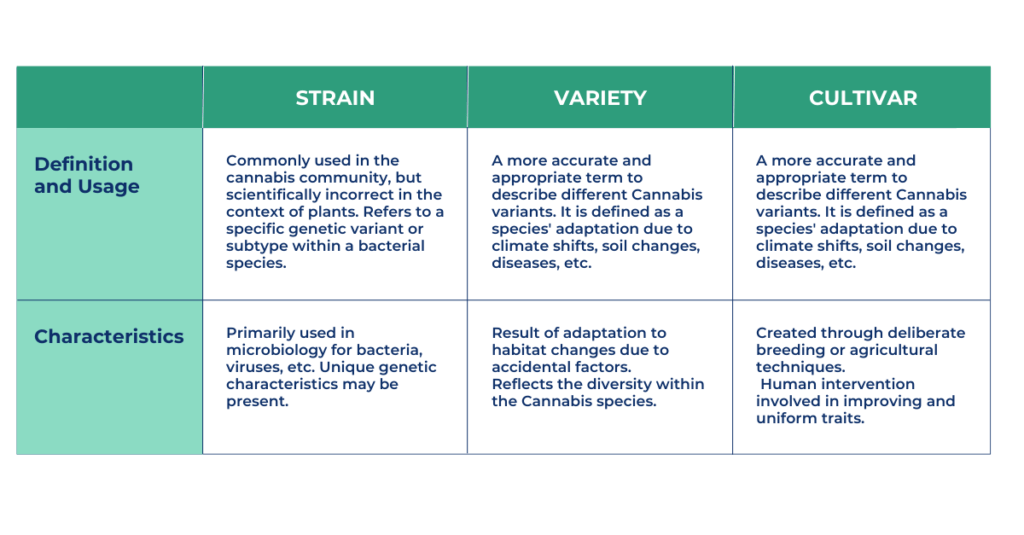
Commonly used in the cannabis community, the term “strain” is not entirely accurate when referring to variants of the Cannabis species. In scientific contexts, “strain” is primarily used in microbiology to discuss bacteria, viruses, and fungi (Russo, 2019). For example, in bacteriology, a “strain” refers to a specific genetic variant or subtype within a bacterial species. Each strain may have unique genetic characteristics, such as the presence of specific genes (Dijkshoorn et al, 2000).
However, when it comes to plants like Cannabis and plants in general, the use of the term “strain” is not appropriate, as it is a word reserved for the realm of microbiology. Therefore, we should avoid using it when referring to different variants of Cannabis species.
Variety
The term “variety,” on the other hand, provides a more accurate and appropriate way to describe different cannabis variants. The term “variety” is defined as a species’ adaptation resulting from changes in its habitat due to accidental factors such as climate shifts, soil changes, the presence of diseases, insect attacks, nematodes, and other similar influences (Arévalo et al., 2006). Therefore, when discussing different types of cannabis, “variety” is the most accurate term to use.
Cultivar
To avoid confusion with the botanical term “variety,” the term “cultivar” was coined. It is a combination of “cultivated variety,” shortened to “cultivar” (Arévalo et al, 2006). Unlike varieties, cultivars are not products of natural evolutionary processes. Instead, they are created through deliberate breeding or agricultural techniques to have improved and uniform traits (Tooker et al, 2012). This distinction is crucial, as it highlights the human intervention involved in developing specific plant traits and characteristics.
But, how important is it to distinguish between cultivar and variety in Cannabis? In the context of Cannabis, differentiating between cultivars and varieties is essential. Varieties refer to naturally occurring adaptations of the plant due to environmental factors, while cultivars encompass those that have been intentionally bred and developed by humans. For example, a landrace variant found growing naturally in its native region would be considered a variety, whereas a hybrid variant carefully created through crossbreeding different varieties would be classified as a cultivar.
Finally, why should we care about using the correct terminology? Understanding the distinctions between “strain,” “variety,” and “cultivar” is more than just semantic pedantry; it has practical implications for various stakeholders:
Scientific accuracy→ Employing correct terminology helps maintain scientific integrity and clear communication among researchers, botanists, growers, nurseries, and enthusiasts. All must adhere to precise terminology to communicate effectively, exchange knowledge, and avoid misunderstandings.
Consistency→ Consistent use of the terms “variety” and “cultivar” promotes a unified understanding within the cannabis community and the broader horticultural and botanical fields. Standardizing the usage of these terms will aid in streamlining scientific research, regulatory practices, and consumer education within the cannabis industry.
Preservation of biodiversity→ Understanding and distinguishing between natural varieties and cultivated cultivars contribute to the preservation of Cannabis biodiversity.
In summary, although the terms “strain,” “cultivar,” and “variety” are frequently used interchangeably in the cannabis community, they hold distinct meanings. Recognizing the proper usage of each term is essential to enhance clarity and ensure accurate communication. By understanding the differences between these terms, we can better appreciate the diverse and captivating world of cannabis, as well as the diligent efforts invested in developing unique and desirable cultivars.
References
Arévalo, R. A., Bertoncini, E. I., Guirado, N., & Chaila S.. “Los términos cultivar o variedad de caña de azúcar (Saccharum spp.).” REVISTA CHAPINGO SERIE HORTICULTURA, vol. 12, no. 1, 2006, pp.5-9. Redalyc, https://www.redalyc.org/articulo.oa?id=60912102
Dijkshoorn, L., B. M. Ursing, and J. B. Ursing. “Strain, clone and species: comments on three basic concepts of bacteriology.” Journal of medical microbiology 49.5, 2000, p. 397-401. https://doi.org/10.1099/0022-1317-49-5-397
Mostafaei Dehnavi, Mahboubeh, et al. “THC and CBD Fingerprinting of an Elite Cannabis Collection from Iran: Quantifying Diversity to Underpin Future Cannabis Breeding.” Plants, vol. 11, no. 1, 2022, p. 129, https://doi.org/10.3390/plants11010129
Russo, Ethan. “The Case for the Entourage Effect and Conventional Breeding of Clinical Cannabis: No “Strain,” No Gain.” Frontiers in Plant Science, vol. 9, 2019, p. 434025, https://doi.org/10.3389/fpls.2018.01969
Tooker, John, and Frank, Steven. “Genotypically Diverse Cultivar Mixtures for Insect PestManagement and Increased Crop Yields.” Journal of Applied Ecology,vol. 49, no. 5, 2012,pp. 974-985, https://doi.org/10.1111/j.1365-2664.2012.02173.x
Video: NCIA Today – Thursday, February 9, 2023
NCIA Director of Communications Bethany Moore checks in with what’s going on across the country with the National Cannabis Industry Association’s membership, board, allies, and staff. Join us every other Thursday on LinkedIN for NCIA Today Live.
Member Blog: Genetics Validation – Certified Growers and Cultivar Identification
by María Zuccarelli and María Belén de Catarina, MyFloraDNA
It’s pretty easy to differentiate humans from one another, except for twins, that’s a more tricky situation.
With plants, it is not that easy. It takes time and a lot of expertise to differentiate each species. Imagine the difficulty to distinguish with 100% precision one cultivar from another within the same species!
Cannabis breeders, nurseries, and growers face this challenge from the beginning of their journey, cultivating and developing new cultivars.
It’s a fact that nowadays people do not know exactly which cultivar (miss-called strain) is growing, much less what they are actually consuming.
You can find out which cultivar you are growing by determining physical attributes such as smell, color, leaf shape, etc.
“Online databases such as Leafly (2018) and Wikileaf (2018), for example, provide consumers with information about strains but lack scientific merit for the cannabis industry to regulate the consistency of strains.” affirms Schwabe and McGlaughlin (2019).
Over time, cannabis growers and geneticists realized the importance of finding an efficient way to determine the genotype of a plant accurately.
Other industries use DNA Fingerprinting to differentiate cultivars and effectively categorize and relate them. They’ve realized that this solution works identically to physical fingerprints, so it can be used to identify cultivars or genes among generations. But, how can we use genomic images for the cannabis business?
Identification of cannabis cultivars using their unique genetic profile
Identification of plant species, varieties, clones, individuals, and even plant products
Guarantee genetic quality and ownership
Authenticate the nature and origin of the plant
Validate the genetic inventory and stockage
Register and protect new cannabis cultivars
Construction of evolutionary and phylogenetic trees
The main goal of this application is to protect the breeders and provide recognition to the creators of the new plant cultivars. Also, this analysis can lead to conscious consumption in this industry and highlight the positive effects that cannabis can have on society.
“Currently, the Cannabis industry has no way to verify strains. Consequently, suppliers are unable to provide confirmation of strains, and consumers have to trust the printed name on a label matches the product inside the package,” says Schwabe and McGlaughlin (2019).
It is important to move towards responsible cannabis production, where growers and consumers know what effect our products will cause. Recognizing precisely what cultivar growers and nurseries are growing and selling is our responsibility.
For this, the DNA fingerprint is a very useful tool. It allows the cannabis industry to build a responsible and conscious production system. Let’s Imagine the power to know in advance which cultivars have to cross to obtain a new one that enhances/improves the final effects and experiences patients and recreational users will have. This is possible if we effectively characterize, define, and categorize each cultivar.
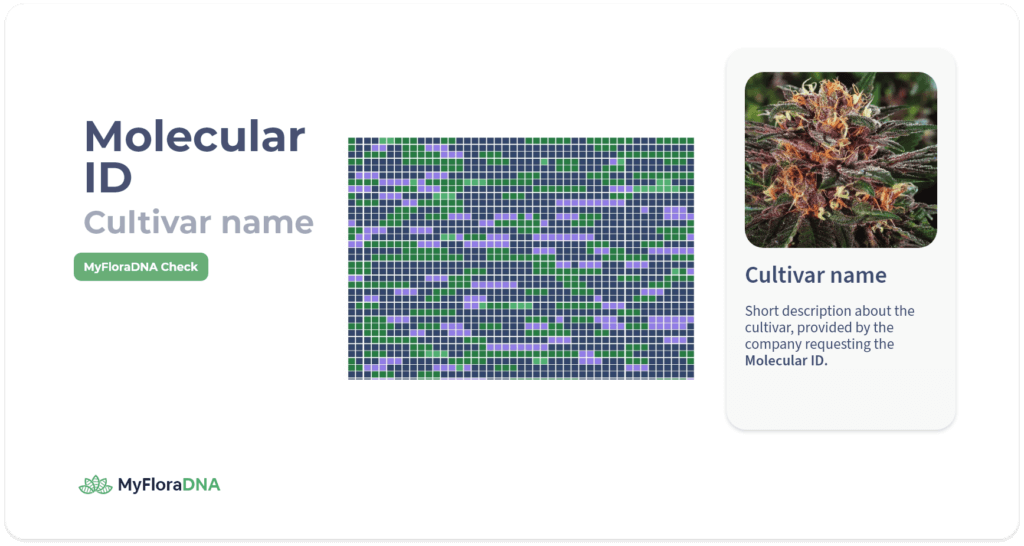
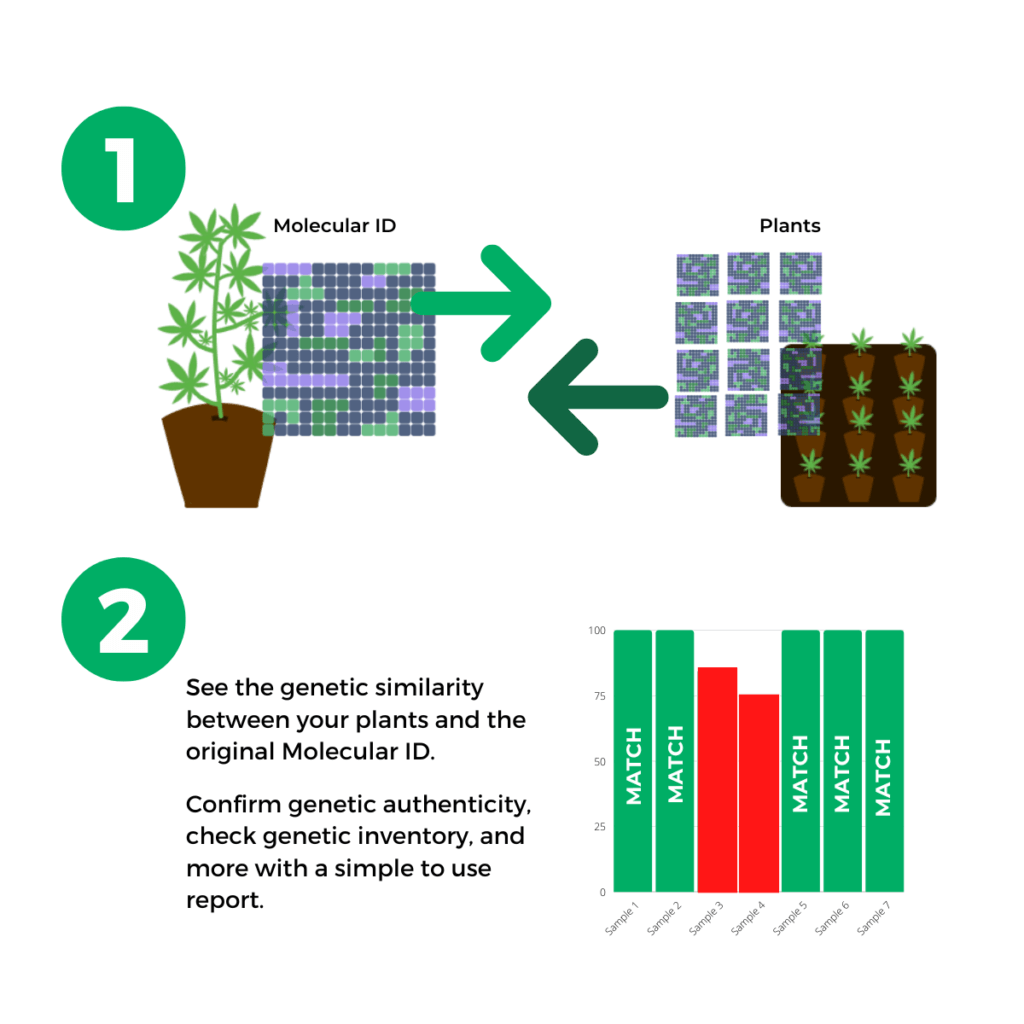
Dr. Angel Fernandez, a plant scientist from UC Berkeley and Co-Founder of MyFloraDNA, discovered and patented a process based on DNA fingerprinting that enables him to build a genetic image representing a cannabis cultivar’s simplified genome. He calls it “Molecular ID.” Every single cultivar already has its own genomic and unique logo inside them, this solution enables us to see it.
In the image, each square represents a molecular DNA marker and the whole combination of squares are unique to every cultivar. Two different cultivars with the same Molecular ID do not exist, that’s what makes it interesting.
Angel discovered that this particular code could be used in more than one way, bringing the cannabis industry new ideas and solutions. It is a universal code that serves to compare and differentiate cannabis cultivars.
Using the Molecular ID, breeders will be able to capture their plants’ genomic logo, using it as a reference, ID, or even a comparison method. The most important thing about this new technique is that everybody will be able to use it as a standardized genomic procedure for their genetics.
Example about one application of Molecular ID
Like everything in the cannabis industry, nothing is possible without the collaboration of all different players. Let’s continue building a conscious and more efficient and sustainable industry.
If you’re curious and would like to know more about this new solution, download our free ebook to read more about how to use genomic information to take your cannabis business to the next level by clicking here.
What do you think about this new genomic solution? Is it going to be even more confusing or helpful?
We’re delighted to read your opinions
About MyFloraDNA:We are a genomic laboratory based in Woodland California, delivering modern genomics for the Cannabis Industry. \
Our servicesinclude Trait detection (cannabinoid profile and sex/gender ID), Pathogen Detection, and Genetic Validation Services. We offer breakthrough solutions using the inner power of your plants.
Marketing expert, with a portfolio of innovative and successful projects around the world. Native leader, resolutive and efficient. She brings creativity and proactivity to MyFloraDNA’s Marketing Department.

 Strain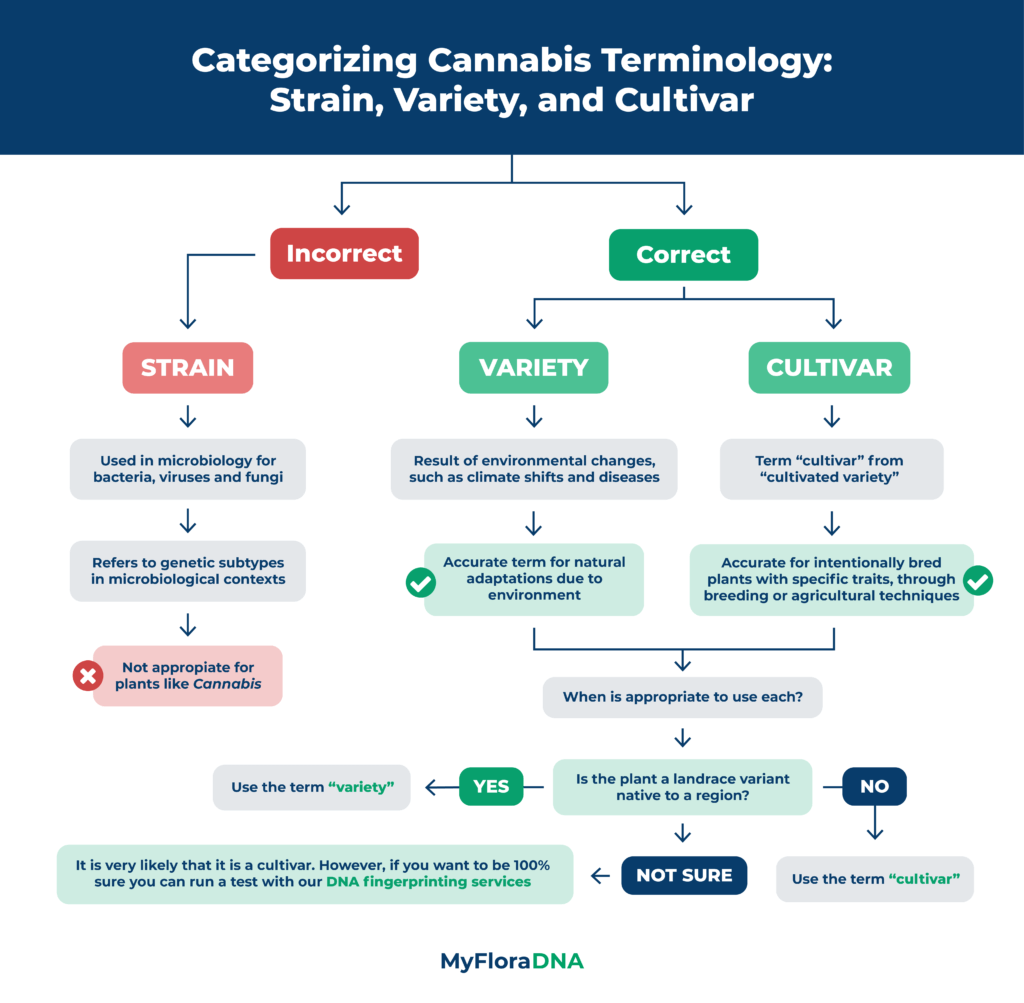



 About
About
Follow NCIA
Newsletter
Facebook
Twitter
LinkedIn
Instagram
News & Resource Topics
–
This Just In
NCIA Applauds Reintroduction of SAFE Banking Following Lobby Days
Beyond Rescheduling: Inside NCIA’s 14th Annual National Cannabis Industry Lobby Days