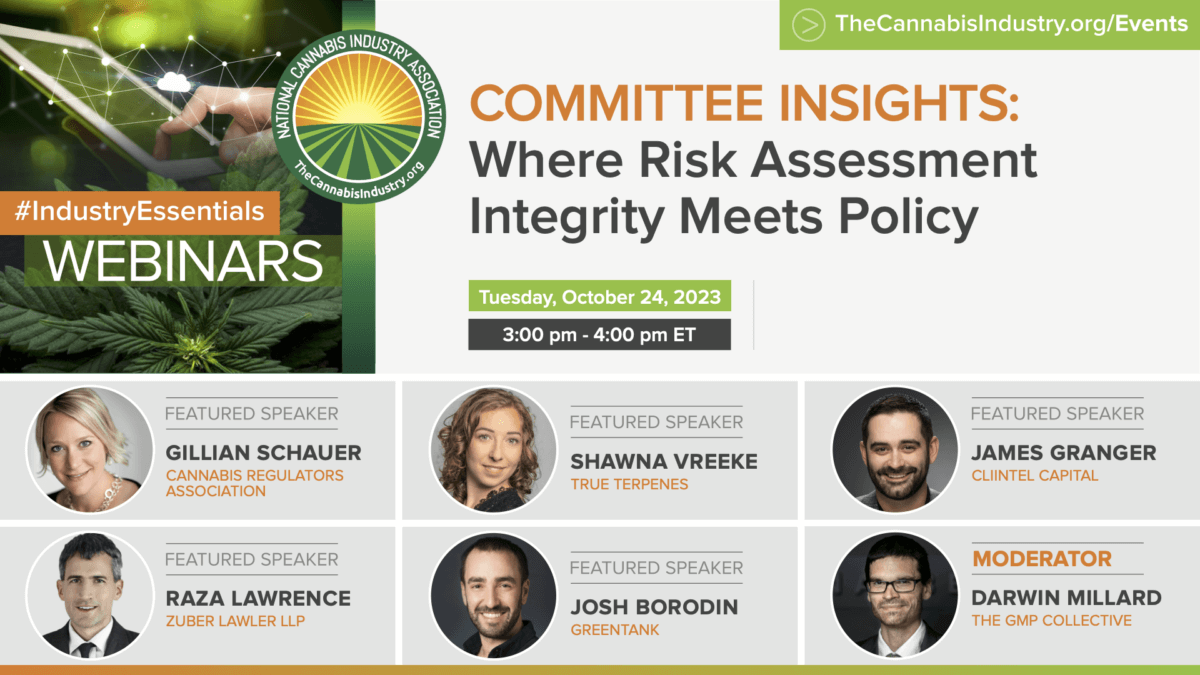
Welcome to the National Cannabis Industry Association’s (NCIA) insightful webinar recording, “Committee Insights: Where Risk Assessment Integrity Meets Policy.” Hosted by NCIA’s Cannabis Manufacturing Committee and originally broadcast on Tuesday, October 24th, 2023, this session provided a deep dive into the complex but critical intersection of cannabis industry risk assessment and policy development. This blog post will highlight key discussions and insights from the panel, offering a condensed overview of the critical issues explored during the webinar, continue reading and view the full recording below.
Comprehensive Risk Assessment for Vape Product Manufacturers
The panelists underscored the importance of thorough risk assessments for vape product manufacturers, especially in the highly regulated cannabis and hemp sectors. The conversation centered on essential areas of concern, including the potential for fraud, liability, and the significance of ingredient selection, particularly terpenes. Material of construction and employee safety were also key factors that were addressed.
Hardware Risks and Due Diligence
The webinar uncovered the risks associated with hardware components and vendors. It shed light on the due diligence required when introducing new vape products, which includes vetting hardware suppliers and partners. Addressing concerns related to shrinkage and theft was another significant aspect of risk management. Additionally, the panel stressed the importance of setting safety guidelines based on industry standards such as ASTM.
Safety Standards and Ingredient Considerations
The discussion dived into the implications of safety standards, especially ASTM, and their role in determining acceptable safety levels within the industry. The panel emphasized the importance of ingredient considerations, particularly in preventing E-cigarette or Vaping Product Use-Associated Lung Injury (EVALI). Risk assessment for ingredients was a major focus, as it plays a critical role in product safety and integrity.
Implications of Fraud and Counterfeit Products
A crucial point discussed was the far-reaching implications of fraud, counterfeit products, and negligence within the cannabis and hemp industry. The panelists delved into the legal considerations when unknowingly selling dangerous products. They also highlighted the industry’s ongoing struggle with counterfeiting and the need for robust prevention measures to protect consumers.
Regulatory Challenges and Industry Growth
The webinar touched upon the challenges of navigating regulatory environments for both regulators and operators. The panelists emphasized the need for striking a balance between regulation and innovation to ensure the industry’s growth while maintaining product safety. The conversation also addressed the evolving landscape of marketing and advertising regulations, emphasizing the need for clear guidance in these areas.
Essential Insights from Industry Experts
Learn more about our distinguished panel of NCIA member experts including hardware & product manufacturers, toxicologists, legal professionals and regulators each of which brought their unique perspective and insights to our comprehensive exploration.
This is the third of five in a multi-part series of #IndustryEssentials webinars. You can watch Parts I & II plus register Part IV & V at the links below.
Episode I – Committee Insights: Mapping the Vape Landscape: Where are We and Where Do We Go from Here?” – [Watch Here]
Episode II – Committee Insights: Cannabis Vaping – Avoid Being an Easy Target – [Watch Here]
Episode IV: Committee Insights: Cannabis Vaping – Beyond the Pen – [Date & Time TBD]
Episode V: Committee Insights: Dabinar Special Edition – Dabbing 101 – [Date & Time TBD]
For access to our full webinar recording archive, featuring 100+ episodes from five separate recurring series, head here.
Join NCIA and Be Part of Future Speaking Opportunities
If you’re eager to share your expertise and insights with our dynamic cannabis community, we encourage you to consider becoming a member of the National Cannabis Industry Association (NCIA). Our member-led committees, such as the Cannabis Manufacturing Committee, offer numerous opportunities to participate in our webinars and events as a speaker. By joining NCIA, you’ll be well-positioned to become a part of our expert panelists in the future. Don’t miss the chance to contribute to meaningful discussions that help shape the cannabis industry.
Learn more about NCIA membership and the benefits it offers here.
Explore Sponsorship Opportunities
For those interested in sponsoring future webinars and events to reach a broad and engaged audience within the cannabis industry, we invite you to fill out our sponsorship inquiry form. Our team will be happy to provide you with more details on how you can collaborate with NCIA to promote your brand and engage with our community.
Your involvement with NCIA opens doors to a wealth of opportunities in the ever-evolving cannabis industry. We look forward to having you as part of our vibrant community!
A Valuable Resource for Industry Professionals
NCIA’s “Committee Insights” series serves as a comprehensive resource for cannabis and hemp industry professionals and this episode offers valuable insights into the critical role of risk assessment and policy development in shaping the future of cannabis operations. By exploring our full recording, you’ll gain invaluable insights and stay informed about the latest developments in the ever-evolving cannabis industry.
Stay Connected with NCIA
Thank you for being a part of our dynamic cannabis community. NCIA’s #IndustryEssentials webinar series is our premier digital educational platform, offering timely and essential insights precisely when you need them. This session is part of our Committee Insights series, produced in collaboration with our member-led committees. Sign up today to receive more industry insights and updates to stay ahead in the evolving cannabis and hemp sectors.
Member Blog: The Days Of Breaking Bad Are Over… Sort Of
With the expanding decriminalization of marijuana and hemp and increasing market demand for cannabis concentrates, more people are assuming the role of pseudo-chemists or lab technicians without formal training. People no longer need to ‘break bad’ by extracting and processing cannabis in their garages, kitchens, or old RVs. Commercial laboratory spaces are becoming more common. Unfortunately, without formal laboratory training, appropriate laboratory safety habits are often not established. The ‘whatever-it-takes’ mentality plus some questionable lab techniques add up to be quite dangerous in a pursuit for the ‘good stuff.’
Solvents used for extraction, though often odorous, are clear and colorless and therefore invisible in vapor form. They are often handled in the lab like water. For those manufacturing cannabis concentrates for retail, the focus has been on possible regulations set by the FDA, but these new, small businesses are also under the jurisdiction of OSHA. While studying industrial hygiene standards written by OSHA, most safety practices seem like common sense, but only after the chemical hazards are recognized.
For more in-depth safety standards and fire codes for non-glassware or non-laboratory-scale (read: industrial-scale) extraction and processing equipment, ANSI/CAN/ UL/ULC 1389 or NFPA 1 Chapter 38 are great starting points.
Most of What We Breathe Is Invisible
As mentioned above, the solvents used to extract and process cannabis are either gases compressed into their liquid form or clear, colorless organic liquids. [Note: here ‘Organic’ means a substance that contains carbon, not the label you find at your grocery store]. These solvents include ethanol, propane, butane, pentane, hexane, isopropyl alcohol, methanol, acetonitrile, and other less common ones.
The danger of these solvents is that even when they are cold they vaporize easily enough for inhalation, some without harsh odors as a warning. Opening containers, glassware, or vessels without proper ventilation or PPE (personal protective equipment) exposes laboratory workers over a short time and many times a day. This exposure can occur during simple acts of pouring, transferring, heating, drying, mixing, or weighing on a balance. While many of the solvents used have a GRAS designation (generally regarded as safe) by the FDA, this label is used for food additives with the intention of ingestion, not inhalation. There are a few research studies on the toxicological effects of breathing in these VOCs (volatile organic compounds) in a short period of time. However, chronic studies of consistent exposure for years are rare. NIOSH, or the National Institute for Occupational Safety and Health, provides a decent summary of worker exposure studies for common industrial chemicals. Some of which can cause respiratory effects that evolve into allergies or even neurological damage. Unfortunately, most of the toxicological literature available can be decades old.
Yet laboratory technicians are not the only ones exposing themselves to a potential hazard. Working onlarge-scale extraction equipment, workers come into contact with large plums of high concentrated VOC when opening extraction tanks and vessels. This process happens many times a day when workers reach in to load and unload bags of cannabis biomass. Exposure also occurs through skin contact, as many of these solvents absorb into uncovered skin.
Gases under pressure are yet another non-chemical hazard. Compressed gas tank cylinders need to be transported and stored safely to keep them from falling over and crushing limbs. If a cylinder valve breaks off, they turn into a projectile missile, or they become damaged enough to rupture and release thousands of liters of suffocating gas within minutes or seconds.
Carbon dioxide solid in the form of ‘dry ice’ is often used in large amounts for cold traps in cannabis oil processing. Dry ice easily sublimes, where the solid form converts directly into a gas. Gaseous carbon dioxide is much heavier than general air and can easily displace oxygen in closed-off storage areas. Oxygen sensors, proper ventilation, and limited exposure help to avoid hazardous side-effects of oxygen deprivation.
The Tools to Keep Everyone Safe Are Out There
Any workplace that handles or stores chemicals should have the corresponding Safety Data Sheets (SDS) of the chemical. These are usually obtained from the manufacturer of the chemical, but there are also free databases online for easy access. All SDS’s should be available for easy access to workers who handle or are in an environment that uses chemicals.
OSHA also provides its own chemical database system that lists the physical properties of chemicals as well as their permissible exposure limits (PELs) and short-term exposure limits (STELs). These limits are used for compliance purposes, but in short, they provide a rough guide for how dangerous it is to breathe in some of these chemicals. Note that OSHA’s exposure limit guidelines may be outdated as many have been written 50 years ago when OSHA had been founded! For the latest guidelines visit NIOSH and ACGIH. These organizations/agencies keep up with current toxicological research and provide more up-to-date exposure limits that are sometimes significantly lower. Air sampling of your workers can always be done through an AIHA-accredited laboratory that will send out certified industrial hygienist to sample during a work shift.
Any industrial hygienist will tell you that the use of PPE is the last line of defense against chemical hazards and exposure. Engineering controls like proper room ventilation and local ventilation, including fume hoods, exhaust hoods, and elephant hoses, are some of the best ways to avoid exposure through inhalation. Fume hoods are almost always found in laboratory spaces; however, it’s easy to form bad habits when using them. For example, storing large objects and numerous chemical bottles inside the hood significantly blocks the proper airflow that needs to occur to make sure any vapor is properly ventilated. The sash (or glass door) should always be kept as low as possible and especially below the chin of the person working at the hood. Newer models of fume hoods have airflow monitoring devices and alarms systems to make sure the face velocity of the hood is between 80 and 120 fpm (feet/min).
Finally, PPE that fits comfortably, doesn’t interfere with the flow of work, and is rated properly for the hazards of the chemicals used, is a definite requirement when working with chemicals even when other controls are in place.
When effective local ventilation is not available for situations where a large plume of solvent vapor is expected (e.g., opening an extraction vessel to remove biomass bags), a full-face or half-face respirator is the best option to prevent exposure.
Respirators have specific cartridges that stop the inhalation of certain hazards. VOC cartridges are required to keep out the organic solvents most used. However, respirators will only protect as they meant to be if they are fit-tested, and properly cleaned and stored.
Last, eye protection via safety glasses is an obvious and thankfully well-practiced habit even in workplaces without chemicals. Unfortunately, the commonsense practice of making sure workers are wearing long pants, shirts with sleeves or lab coats, and closed-toe shoes (preferably non-absorbent) is more difficult to enforce if the location is in warmer climates.
All that said, for those who are dabbling in the new, exciting world of cannabis extraction, let’s hope they are following Walter White’s lead and suit up before they get to work.
With more than 15 years of experience working and teaching in chemistry laboratories, Meghan McCormick, Ph.D. is the Senior Chemist and a part of the Herban Legends team at Spektrum Cannabis Technologies, an innovative, fit-for-purpose engineering services company. Meghan serves as the resident expert in the chemical processes that occur during cannabis extraction and post-processing and has helped design and test the Spektrum industrial-scale cannabis processing modules. Meghan worked as a Senior Chemist for the OSHA Salt Lake Technical Center for 3 years. She received her Ph.D. in Inorganic Chemistry at Indiana University studying organometallic electrocatalysis and anti-cancer prodrug activation mechanisms.

 With more than 15 years of experience working and teaching in chemistry laboratories, Meghan McCormick, Ph.D. is the Senior Chemist and a part of the Herban Legends team at
Follow NCIA
Newsletter
Facebook
Twitter
LinkedIn
Instagram
News & Resource Topics
–
This Just In
Committee Blog: Budtenders Make or Break Your Business – A No-Nonsense Guide to Cannabis Retail Staffing
Member Blog: Guaranteeing the First Loan