Member Blog: Future Of FDIC Easing for Cannabis Banking After Biden Decriminalizes Marijuana

by Joshua Gilstrap, e2b teknologies
Over the years, the simple possession or use of cannabis has seen many lives upended by arrests and criminal convictions. Unfairly, racial disparities have determined that black and brown individuals suffer most of these convictions, arrests, and prosecutions, even though white individuals use and possess cannabis at similar rates. The resulting criminal records lead to individuals being denied fundamental rights to employment, housing, and education opportunities.
However, on October 6, 2022, President Biden made an announcement that could change the cannabis and criminal clemency conversation. The president asserted he would:
- grant pardons to individuals with prior low-level federal cannabis possession offenses
- change federal cannabis laws by reviewing the cannabis Schedule I rule.
The federal government’s classification of cannabis as a Schedule I substance puts it in the same category as more lethal drugs like heroin and LSD while drugs like fentanyl are not considered less severe than marijuana since it falls under Schedule II.
As more states legalize the sale and use of cannabis, the classification of Schedule I no longer makes sense. Additionally, more direct research on the proper utilization of marijuana can develop suitable restrictive and preventative measures to protect against harmful outcomes of cannabis use.
The Biden initiative is crucial because it can begin to remove the burden of employment, education, and housing limitations often experienced by individuals with simple cannabis possession convictions. Besides, if marijuana is rescheduled to Schedule II, or as many advocates champion for a complete descheduling, it could mean the end of cannabis prohibition altogether.
Widespread Support for this Initiative
Nearly 70% of Americans support the President’s pardon proclamation. Publicly, two in three Americans support Biden’s plan for cannabis reforms, and three in four support the removal of cannabis from Schedule I of the Controlled Substances Act.
Bipartisan support for this move is also high, with 74% of Independents, 84% of Democrats, and 58% of Republicans backing the proposal. At the state level, 68% of respondents support governors that want to issue pardons for people with low-level cannabis possession convictions.
Why This is Important
The expeditious review process requested by President Biden has the potential to open the cannabis industry to further changes, like the easing of banking restrictions for cannabis businesses. For instance, the call for action by governors is already inspiring many to rethink state and local relief for marijuana users. Kentucky, Colorado, and Kansas are three states already actively considering enacting the Biden pardons and drafting new reform bills for marijuana cases.
The Colorado governor is pushing Congress to pass a bipartisan banking bill on marijuana.
“The lack of safe banking and financial services for the cannabis industry in the State of Colorado has become a dire public safety issue for highly regulated cannabis businesses operating in compliance with state law,” Gov. Jared Polis’ office wrote to House and Senate leaders.
“Further, the lack of safe banking exacerbates the uneven playing field faced by small and minority-owned cannabis businesses, despite their serving the same communities and being subject to the same increased state regulation as other cannabis businesses in the State,” the letter said.
It’s true – over the years, the cannabis industry has dealt with a lack of financial and banking services because of the strict regulations and criminalization associated with marijuana. Consequently, this has resulted in severe public safety issues, even for cannabis businesses that operate within the compliance mandates of the state law.
Additionally, operators are disadvantaged because they lack funding or banking systems that support cannabis business processes. But following Biden’s pardon, many hope that Congress’ marijuana reform will pass the Secure and Fair Enforcement (SAFE) Banking Act for the industry.
If passed, the protection against armed robbery will increase. Also, the SAFE Banking Act will support the minority, veterans, and women who own small cannabis businesses. This, in turn, is expected to improve public safety amid the growing use of cannabis and cannabis products while simultaneously creating jobs within states.
Ushering in the Era of Cannabis Banking and FDIC
Even though the SAFE Banking Act has been in the House of Congress seven times, federally insured banking services and modern digital banking solutions like electronic payment processing are still inaccessible to the cannabis industry.
The Act lags in the senate under Democratic and Republican control. However, the senate is said to be preparing to enact the reform for the SAFE Banking Act as part of the Biden marijuana proposals. And why not? There is significant support for the SAFE Banking Act.
For instance, National Association of State Treasures members have voiced their support for the SAFE Banking Act. Public policy also demands the immediate relief the ACT will provide cannabis businesses. Therefore, the expectation that leaders in the government will push for banking reforms for cannabis businesses is prevalent.
The SAFE Banking Act is an Advocate for the War on Drugs
Many believe that the baking legislation would advocate for the war on drugs because it would offer protection against the risk of robbery and violence. By denying cash-based cannabis businesses access to the traditional financial system, the state and local governments provide an invitation threat that has seen many victims working in cannabis businesses lose their lives or livelihoods.
On the other hand, the right to payment solutions, like credit cards, protects against armed robbery. Nonetheless, for the banking legislation to work, it requires the support of criminal reforms. This is where initiatives like predicant Biden’s pardon and marijuana schedule reform come in.
The SAFE Banking Act will solve the injustice associated with financial inequality, thus, providing public safety that protects customers, employees, and businesses in the cannabis industry. And with reduced invitations for armed robberies working in tandem with the use of mandated cannabis products, the war on drugs will ensue.
Cannabis Businesses Contribute Equally to the Economy
As such, it is only fair to provide them with the same rights and protections that other businesses, whether big or small, enjoy. Therefore, starting with the push to decriminalize and legalize marijuana, not just at the federal level but at the state level, is a solid place to start.
Following this pardon with an advocacy of the SAFE Banking Act will additionally provide cannabis businesses with the capability to carry out operations securely and optimally. But attention must be paid to the details pertinent to these reforms to ensure thousands of convicts get a better chance at life and cannabis businesses get opportunities to continue contributing to the economy.
FAQs
What does President Biden’s pardon for marijuana possession entail?
President Biden’s cannabis reform initiatives are set to accomplish three things:
- Pardon convicts with low-level marijuana possession offenses, thus, allowing them to get housing, education, and employment without prejudice
- Reduce the marijuana Schedule level on the Controlled Substances Act from Schedule I to Schedule II, which lessens the seriousness of marijuana possession
- Inspire governors to offer the same pardons at the state and local levels where most marijuana convictions are carried out
Is there support for President Biden’s announcement?
Yes. There is ample support from the public and bipartisan control for Biden’s pardon and advocacy for the marijuana schedule change in the Controlled Substances Act.
What would the pardon mean for cannabis banking?
The de-scheduling of the marijuana Controlled Substances Act would remove the many legal hurdles and fears of the financial institutions that keep them from supporting cannabis businesses. This would reduce the discriminatory risks associated with banking or financing cannabis businesses.
 Joshua Gilstrap is the Marketing Manager for e2b teknologies, in addition to his marketing responsibilities Joshua leads business development for e2b teknologies emerging Canna Suite product line. A business graduate with a focus in marketing from Miami University in Oxford, Ohio, he joined the e2b team in the Fall of 2019. Josh brought with him a wide array of business and practical experience in planning and execution. Since coming aboard he has led multiple projects including website hosting and theme standardization company wide, marketing automation streamlining the efficiency of the customer journey, and sales automation where he is changing the conversation from promotion to education, from pitching to catching, and from push to pull in order to keep up with the shifting tides of a digital transformation.
Member Blog: Payment Processing In The Cannabis Space

by Todd Glider, MobiusPay, Inc
There is a lot of confusion about payment processing in the cannabis space because payment processing is somewhat confusing to begin with, and because, in the cannabis space, ambiguity is a way of life.
The title of this very blog post could, realistically, seem misleading to some.
So, to be clear, when I say, “Cannabis Space,” I mean the entire industry — from plant-touchers (CBD included) to the ancillary businesses built up around it.
The passage of the 2018 Farm Bill marked an exciting new chapter for the industry. Suddenly, CBD, or, more specifically, any ingestible cannabis product containing .3% THC or less by volume, was classified as hemp. And since it is marijuana, and not hemp, that is defined as a Schedule I substance under the United States Controlled Substance Act, the Farm Bill, technically, made products like CBD as legal as cow milk — federally, anyway.
The upshot of this new classification is that now, at least some players in the cannabis space can market their products to a national base of consumers and clients, and they can do so by accepting credit cards as payment.
However, the myriad Acquiring Banks across the United States have not exactly jumped for joy at the prospect of providing credit card processing in the form of merchant accounts to CBD retailers. Reticence rules. CBD is considered high risk, and four years on, only a handful of them have thrown their hat in the ring.
Jargon Alert I: Acquiring Banks and Issuing Banks
In merchant processing parlance, banks fall into two categories: Acquiring Banks and Issuing Banks. Acquiring Banks, or, Acquirers, provide merchant processing accounts to businesses wishing to accept credit card transactions. Issuing Banks, short for Card Issuing Banks, are banks that offer branded payment cards directly to consumers. For example, if your bank has ever offered you a Visa card, it is an Issuing Bank (not that it couldn’t also be an Acquiring Bank, too).
Jargon Alert II: CBD is ‘High Risk’
CBD is deemed high risk by the card associations (i.e., Visa, MasterCard, American Express), and when the card associations deem a product or industry high risk, most Acquiring Banks tap out. This is because financial institutions are, by nature, risk averse (subprime mortgage crisis notwithstanding).
So let’s talk for a minute about risk. High risk, that compound term, is a truncation of a longer phrase: ‘Higher risk of fraud or chargebacks.’
Why are CBD products at higher risk of fraud? It’s impossible to say for sure since the Visas and MasterCards of the world are publicly traded companies with their own trade secrets and IP, but there are several characteristics unique to CBD, or any cannabis product now federally legal, that likely figured into that decision.
Those FDA disclaimers that CBD retailers must print or paste on all product packaging and webpages are as good a place as any to start. They are mandatory because none of the benefits assigned to CBD have been clinically proven. There just isn’t enough data or testing at this point, and no big story there. That’s what happens when you demonize a plant for 100 years.
Consequently, from the perspective of the FDA, and the card associations, by extension, consumers are making CBD purchases with baked-in expectations based, exclusively, on word-of-mouth advice and anecdotal data. That’s a recipe for dissatisfied customers. And dissatisfied customers tend to charge back transactions.
The card associations, and the banks who provide merchant accounts, worry incessantly about fraud and chargebacks.
Too Close for Comfort
Dissatisfied customers aside, there are onerous legal nuances that make the prospect of boarding cannabis merchants, even those selling products that are federally legal, daunting for banks.
Selling a product with .31% THC across state lines is felonious. It is a federal offense. Violating a law like that could get a bank’s charter revoked, or, at a minimum, result in massive fines.
On the other hand, selling a product with .30% THC across state lines is 100% federally legal. As stated above, safe as milk, federally.
That is a heck of a distinction. If any product contains more than .3% THC by volume, it is ‘marijuana’ in the eyes of the federal government. From the perspective of the banks, that’s a little close for comfort. Furthermore, banks don’t operate laboratories. They must rely on testing data presented to them in the form of third-party lab reports — Certificates of Analysis or COAs for short — to verify that the products being sold are federally legal.
The last thing an Acquiring Bank wants to do is violate a federal law EVER. It could result in a loss of their charter, lawsuits, and massive fines. And it’s important to keep in mind that the Acquiring Banks out there offering merchant accounts to CBD retailers are not giant, publicly traded institutions like Bank of America or Wells Fargo. They tend to be much smaller, and therefore, have infinitely smaller war chests for court cases.
Still, separating the federally legal Tier I cannabis product from the federally illegal Tier I cannabis product should be pretty cut-and-dry. If the product you’re selling is .3% THC by volume or less, it is exempt from the Controlled Substance Act (CSA). If that threshold is documented in the product’s Certificates of Analysis (COA), you ought to be able to sell it.
Unfortunately, it’s not that simple. When bank underwriters look at percentages of Delta 8, Delta 9, and Delta 10 on the COAs that cross their desks, they’re frequently at sixes and sevens trying to figure the whole thing out.
From the perspective of the 2018 Farm Bill, a cannabis product is hemp if it contains .3% Delta-9 THC or less by volume, but what everybody says is “.3% THC or less by volume.” Consequently, when the compliance officer at the bank is performing her due diligence by inspecting the COAs corresponding to each product, she may encounter a lot of crooked numbers, and she may blanch at the results.
Those results, often, look something like the following:
00.195% D9-THC
52.475% d8-THC.
Federally, the Delta-9 threshold is the only threshold that matters. The 2018 Farm Bill says as much, and the 9th Circuit Court of Appeals in California affirmed it in a ruling this past May. Therefore, in the example above, the Delta-9 threshold has not been crossed. It’s not even close. It is textbook HEMP, even if the Delta-8 threshold is off the charts.
However, if the compliance officer was provided the remit, “.3% or lower,” he’s likely to look at this and say, “Fail,” without realizing that the Delta-8 THC information is irrelevant as far as federal law goes.
Complicating the underwriting further is the fact that there is, to date, no standard template for COA reports. Every lab presents them differently. Bank compliance officers rarely moonlight as scientists. Like most of us, these CBD COAs are probably the first lab reports they’ve looked at since high school chemistry.
Furthermore, the banks can set their own rules. They don’t have to board CBD merchants. Few do, and those few that do have their own standards and practices.
 Todd Glider has been an e-Commerce leader since the start of the Internet age. He has an MFA in Creative Writing from the University of Miami, and has served as CEO for small and medium-sized technology companies in Spain, Austria and the United States. As our Chief Business Development Officer, Todd introduces MobiusPay’s suite of award-winning financial services to new industries, and implements the development strategies and key partnerships needed to bring value to new customers.
MobiusPay, Inc. is a U.S.-based global financial services organization that is committed to empowering individuals and businesses. For more than a dozen years, MobiusPay has leveraged state-of-the-art secure billing technology, long-standing relationships with financial institutions and award-winning customer support to provide merchant processing and payment solutions to brick and mortar and digital businesses around the world.
Member Blog: Is 2021 the Year that Brings Normalcy to Cannabis?
by Jimmy Young, founder of Pro Cannabis Media
Thanks to Democracy and the grassroots efforts of cannabis advocates from coast to coast, there are now 15 holes in the cannabis prohibition wall (legal states), and 36 cracks (medicinal programs). So when will that wall come down and how fast? More importantly, what will the industry look like when the dust settles?
Over the past few weeks, cannabis media pundits from all over the world have chimed in with their predictions for 2021. (Some even pontificated before knowing the results of the Georgia State runoffs in the Senate.)
With President Joe Biden now in the White House and the Democrats controlling both houses of Congress, cannabis advocates are wondering when, and if, we will see federal legalization of cannabis in 2021. Will it succeed or will our dutifully elected politicians do something that will derail the will of the people during this Green Wave of reform?
Already, a Republican congressman from Florida, Greg Steube, decided to file the first draft of reform to a committee that will move cannabis from schedule 1 to schedule 3 on the Department of Justice list of “controlled substances.”
But for many, this does not go far enough. I recently interviewed the Media Relations Director of NCIA, Morgan Fox, who told me, “It’s not something the NCIA or other Cannabis advocacy groups is going to support….we are all focused on de-scheduling, (this draft) it just doesn’t go far enough.”
So what position are lobbyists in Washington, D.C. taking now that their arguments for reform may find a more supportive group to talk to? What is the best thing for the industry? What’s the right thing to do?
I also interviewed Michael Correia, the Director of Government Relations for NCIA, who explained that the target should be for full legalization, but that at the heart of the issue, there is something more important that needs to be dealt with – racism. In my interview with him, he said, “…let’s just stop arresting people for this. Stop arresting people in this war on drugs so no one’s lives are ruined because they’re consuming a natural plant, that 30 plus states have said, Hey, we’re okay with this. There shouldn’t be these differences. So just stopping, arresting these people, and then worrying about what’s the next step?”
Why does he feel so strongly about this? The evidence is overwhelming that law enforcement has used simple possession as a profiling tool to fill our privately run prisons with black and brown people over mere cannabis possession. “The vast majority of these arrests (92%) were for simple possession of the drug. 500,395 of [the 545,602] arrested for cannabis [crimes] were simply found [to be] in possession of cannabis.”
So are you convinced now that cannabis, a plant, is not illegal because it is considered a drug, but rather because of a racist system and the fact it can be used as a means to profile and jail black and brown people? Do you want more evidence of the racial bias in cannabis arrests? Check out this 2020 report on the racial makeup of those simple possession “crimes.”
“A recent report from the ACLU looked at data from 2018 and found that black people were 3.6 times more likely to be arrested for cannabis possession than white people.
This is despite both groups use cannabis at similar rates.
Even in western states with recreational cannabis laws, black people were 1.5-1.8% more likely to be arrested for having cannabis.” Emily Earlenbaugh, Forbes
So what’s the 2021 plan for lobbyists, policymakers, and elected officials? What exactly does this industry look like if one of the following changes happens in the next year or two?
- Cole Memo reinstated
- SAFE Banking
- Rescheduling
- De-scheduling
- The MORE Act
- Science and Research Grants
Each one of those changes is not only positive for this young industry but will have a ripple effect that will impact other industries. The trickle-down effect for any of these changes being implemented will impact the private prison system, banking, and financial markets, big alcohol, big pharma, social equity, expungement of past convictions, interstate commerce, and the international markets.
The cannabis lobbyists know that with Democrats in charge of the direction of the Congress over the next two years, this is their opportunity for serious reform. After all, the House passed a legalization bill, the MORE Act, in December of 2020. In 2019, the previous year, the SAFE Banking Act was also approved by the House, but neither even got to the floor of the Senate because of the then-Majority Leader Mitch McConnell’s anti-marijuana stance.
2021 is now upon us, and “grown-ups are now back in charge in D.C.” However, many advocates I’ve talked with are understandably wary and skeptical about the Federal Government dictating governance of this industry if cannabis is federally legalized and falls under the control of the alcohol and Beverage Commission.
Most cannabis advocates can at least agree that cannabis should be removed from the schedule that was created by the Controlled Substances Act in 1971. This change alone would allow banks to do business with the cannabis industry and allow for the removal of the restrictive 280E tax code that has limited the profit margins of already existing businesses.
Here are some links to other predictions from leading media sources about what cannabis reform democratic control of Congress may lead to:
Marijuana Moment: What The New Democratic-Controlled Senate Means For Federal Marijuana Legalization In 2021
Politico: Democratic-led Senate could clear a path to marijuana legalization
Forbes: Democrats Win The Senate: The Impact On Marijuana Policy
So after reading all this information, here’s what I think will happen over the next four years.
First Year: Cannabis gets removed from the Controlled Substances Act schedule
Second Year: Decriminalization and expungement of cannabis possession crimes with banking reform
Third Year: Interstate commerce
Fourth Year: Full Federal legalization, international export markets open
It’s 2021, the year of the cannabis plant as a political issue is here and reform is as pungent as the odor of this amazing plant. Stay tuned, this will be an ongoing theme in D.C. politics this year as we all hopefully witness another chapter in the historic end to prohibition.
 Jimmy Young is the founder of Pro Cannabis Media. An Emmy Award-winning talk show host from New England, and a resident of Massachusetts who holds a medical card after 4 major surgeries in 22 years.
The founder of Pro Cannabis Media is the current host of In The Weeds with Jimmy Young, a weekly podcast distributed over the CLNSMedia.com, site, iTunes, Spotify, Googlecast among others. In July of 2019, he teamed up with the founder of Cannabis.net, Curt Dalton, to host a two hour live monthly Weed Talk Show where the two Massachusetts natives have interviewed some of the biggest names in Cannabis, like Steve DeAngelo, Bruce Linton, and Tommy Chong. Locally local cannabis advocates and representatives from the medical establishment in the Bay State have all appeared on that show that is now being distributed nationwide. Young also produces a weekly news video, called News Dabs, highlighting and commenting on the biggest stories around the world in the emerging cannabis universe.
Guest Post: Waiver Program Could Clear Path for State Legalization
(AS WITH ALL GUEST POSTS ON NCIA’S WEBSITE, THIS POST SOLELY REPRESENTS THE VIEWS AND OPINIONS OF ITS AUTHOR AND DOES NOT REPRESENT AN NCIA ENDORSEMENT OR OFFICIAL POSITION. ~ EDS.)
by Aaron G. Biros, Editor-In-Chief at Cannabis Industry Journal
Congress is considering a potential waiver program where states will be given an exemption to federal prohibition of cannabis.
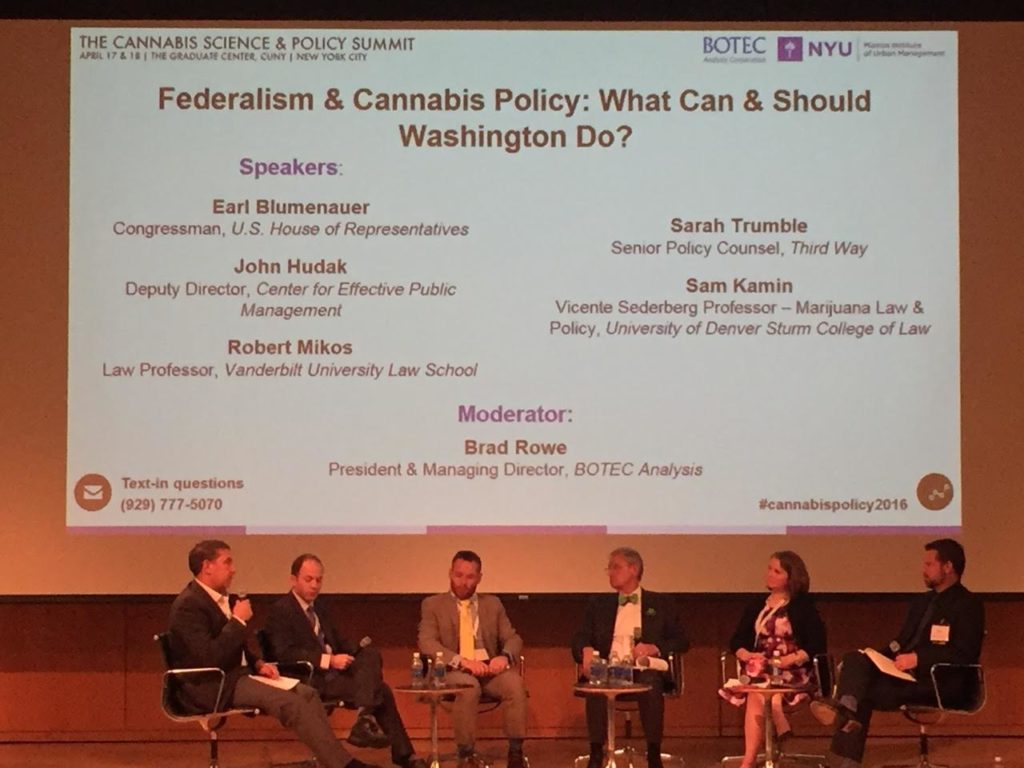
On April 17 and 18, NYU hosted the Cannabis Science & Policy Summit where a panel discussion took place titled “Federalism & Cannabis Policy: What Can & Should Washington Do?” The panel consisted of experts in law and drug policy, including Congressman Earl Blumenauer (D-OR) and Sarah Trumble, senior policy counsel at Third Way, a public policy think tank based in Washington, D.C. The panel discussion delved into the restrictions of the DEA’s power to reschedule cannabis by Congress and appropriate policy alternatives to clearing the path for state-by-state cannabis legalization.
 According to Cody Stiffler, vice president of Government Affairs at BioTrackTHC, who was also present at the panel discussion, Congress has placed so many restrictions on the ability and powers of the DEA, that they can only reschedule cannabis to a Schedule II status. He believes there is almost no possible way that the DEA can de-schedule cannabis. The panel discussed Congress’s consideration of a waiver program for states with legalized cannabis in some form or another. “They [Congress] plan to give the U.S. Attorney General powers to offer waivers to state governments, exempting that state from federal law regarding cannabis, allowing banks and other institutions to take part in the industry without fear of federal backlash under the Controlled Substances Act,” says Stiffler. The waivers would have a duration of a number of years and a reporting and review process would follow the expiration of each waiver. “If the Attorney General decides that states are following the directives of the Cole Memo, then they will be able to continue, but if the data collected proves otherwise, those waivers would then be suspended or revoked,” adds Stiffler. It is important to note that the bill gives states the opportunity to correct any failures before those waivers are revoked.
According to Sarah Trumble, public opinion favors a policy move towards allowing states with cannabis legislation to operate freely. A poll conducted by Third Way found that 67% of voters would support Congress passing a bill giving states freedom from federal intervention with respect to cannabis policy as long as there is a robust regulatory framework in place. In October of last year, Congresswoman Suzan DelBene (D-WA) introduced the bill, H.R. 3746, The State Marihuana [sic] And Regulatory Tolerance (SMART) Enforcement Act. The bill outlines the waiver plan and would exempt states from the prohibition of cannabis as a result of The Controlled Substances Act. It also has measures in place to help prevent diversion of cannabis into the black market, protecting consumer safety and public health, eliminating criminal enterprise involvement and more.
A ccording to Trumble, the SMART Enforcement Act would resolve many of the conflicts between federal law and state legalization measures. “It is the bridge that gets us from the broken system we have now to a future date when public opinion and Members’ positions may have shifted, while in the meantime fixing the problems people are experiencing on the ground,” says Trumble. She believes the bill provides for the protection of consumer safety through logical regulatory systems while eliminating federal prohibition of cannabis. “Every three years, a state will have to re-apply for the waiver and submit data showing that their regulations are working to keep Americans safe.” This would allow states to have the space they need to implement a sound regulatory framework.
One can speculate on a broad range of possible effects this bill could have. “It would allow banks to open accounts for and offer services to legal cannabis businesses so they no longer have to operate on an all-cash basis,” adds Trumble. Perhaps the most significant effect this bill could have on the cannabis industry is knocking down the burden of the 280E tax code on cannabis businesses primarily because it would exempt states from The Controlled Substances Act. “It would protect businesses owners and employees—as well as customers and patients—from federal prosecution and arbitrary DEA crackdowns, now or in the future,” says Trumble. This bill has the potential to be a panacea for so many ailments facing the cannabis industry. Participants in the cannabis marketplace should let their representatives know that they support this bill and show up at the polls in November to elect representatives that support this piece of legislation.
 Aaron G. Biros is the editor-in-chief of CannabisIndustryjournal.com, an online trade journal focused on regulatory compliance, quality and safety in the cannabis industry. He joined Innovative Publishing, LLC full-time after graduating from Tulane University. Graduating with a B.A. in Environmental Studies, his coursework involved environmental sustainability, conservation policy, design thinking in collaboration, social innovation & entrepreneurship, food production & health, and environmental & health risk assessments. He has two years of experience working on staff as an associate editor for FoodSafetyTech.com, writing a series of articles focused on the intersection of food safety and environmental sustainability. Aaron is now the editor and publisher of CannabisIndustryJournal.com, a B2B digital trade publication that seeks to educate the global cannabis industry on everything seed-to-sale in both recreational and medical markets. CannabisIndustryJournal.com covers news, business trends, technology, regulatory compliance and other important areas, aiding in the advancement of a well-informed and safe market. Cannabis Industry Journal became a member of NCIA in May 2016.
Follow NCIA
Newsletter
Facebook
Twitter
LinkedIn
Instagram
News & Resource Topics
–
This Just In
Member Blog: What Consumers Really Want in a Pre-Roll
Member Blog: The Evolving Cannabis Legal & Regulatory Landscape in 2026