Leveling the Playing Field: The Case for §280E Reform and Retroactive Relief
Download NCIA’s new white paper and join the movement to protect the future of the cannabis industry.
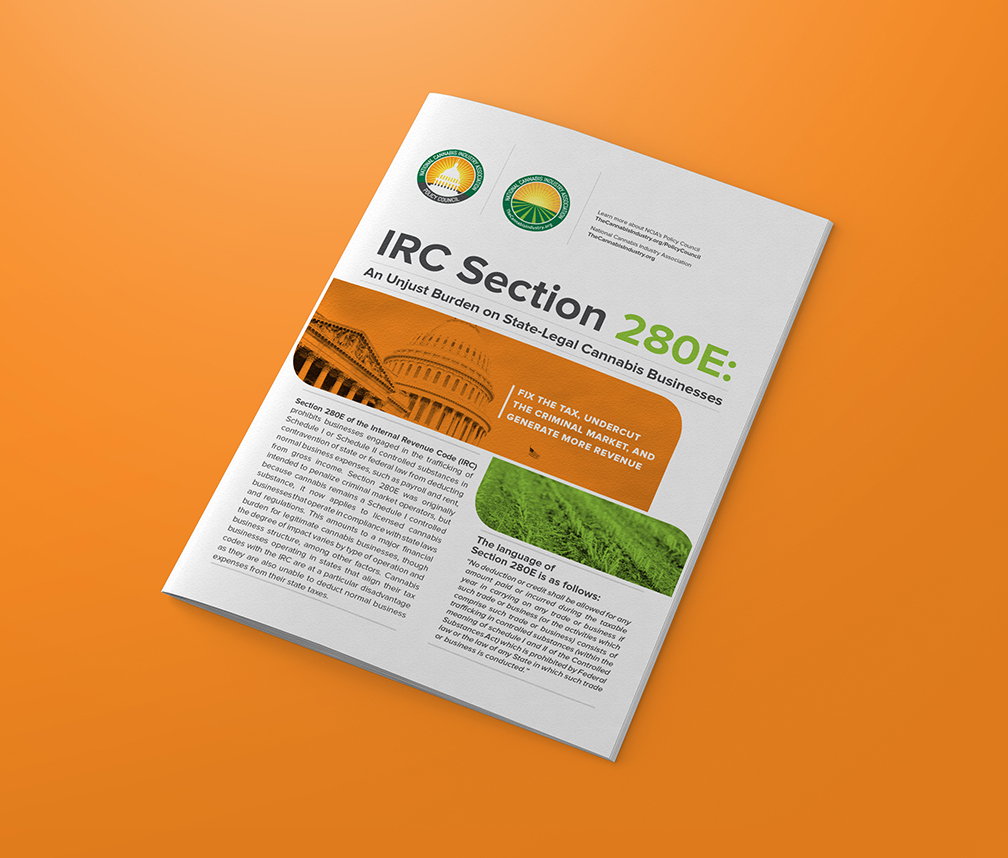
For decades, cannabis operators have shouldered an impossible burden: paying taxes on terms no other industry faces. Section 280E strips away the ability to deduct ordinary business expenses, forcing compliant operators to pay effective tax rates that can exceed 70%. This inequity doesn’t just stifle growth—it threatens the very survival of the businesses that built the legal market.
NCIA’s latest white paper breaks down the urgency of reform and the path forward. Inside, you’ll find:
-
The origins of §280E and why today’s licensed operators were never its intended target
-
The economic impact of inflated tax burdens on growth, investment, and competition with the illicit market
-
Why retroactive relief is essential to keep early operators, equity licensees, and small businesses alive
-
NCIA’s solution: a straightforward fix that delivers fairness, stability, and opportunity to the industry
This is more than a policy paper—it’s a blueprint for survival and growth. By understanding the issue, you’re better positioned to protect your business and strengthen the regulated market.
Download your copy today and be part of the collective push to end 280E’s stranglehold on our industry.
NCIA Public Comment on Proposed Rule to Reclassify Marijuana to Schedule III

After nearly two years of administrative processes, the Department of Justice (DOJ) recently proposed a rule to reschedule marijuana from Schedule I to Schedule III of the Controlled Substances Act (CSA). The rescheduling of a controlled substance follows a formal rulemaking procedure that requires notice to the public, an opportunity for comment, and an administrative hearing.
In response to the proposed rule, NCIA has submitted comments to the DOJ. Key takeaways include:
- Rescheduling marijuana to Schedule III is a positive and historic first step in reforming our outdated cannabis laws, however, it would be more appropriate for marijuana to be completely removed from the CSA.
- Such a move should be accompanied by timely guidance from DOJ and applicable departments to other federal agencies, state governments, regulators, and businesses. Any guidance must not upend the successful regulatory systems now in place in 38 states.
- Legalizing and regulating marijuana has had clear, positive impacts on public health and safety across the nation.
- Moving marijuana to Schedule III would provide clear, profound, and increased economic benefits to the tens of thousands of businesses operating legally under state laws and to the communities which rely upon the tax revenue and jobs they provide.
Navigating the Future of Cannabinoid Regulation: Balancing Safety, Innovation, and Consumer Access Position Paper

The National Cannabis Industry Association (NCIA) invites industry owners, operators, regulators, and elected officials to download our latest position paper on cannabinoid regulation. With over 100 different cannabinoids found in cannabis, nuanced and thoughtful policy considerations are crucial for shaping a safe and thriving industry.
Our position paper delves into the complexities of cannabinoid production, differentiating between plant-extracted and synthesized cannabinoids. It addresses the challenges posed by the current regulatory landscape and advocates for a common-sense federal framework that emphasizes safety, consistency, and quality across all cannabis-derived products.
Key insights include:
- The distinction between intoxicating and non-intoxicating cannabinoids.
- The economic impact of cannabinoids, evidenced by the billions spent annually on CBD products.
- The importance of balancing regulation to support both consumer safety and industry growth.
- Recommendations for federal reform, including modifications to the Farm Bill and the FDCA.
NCIA’s comprehensive approach ensures that safe, regulated cannabinoid products can meet consumer demand while fostering industry innovation and protecting public health.
Download our position paper today to stay informed and contribute to the future of cannabinoid policy.
Three Things Regulators and Policymakers Can Do to Undercut Criminal Markets and Support Legal Main Street Cannabis Businesses
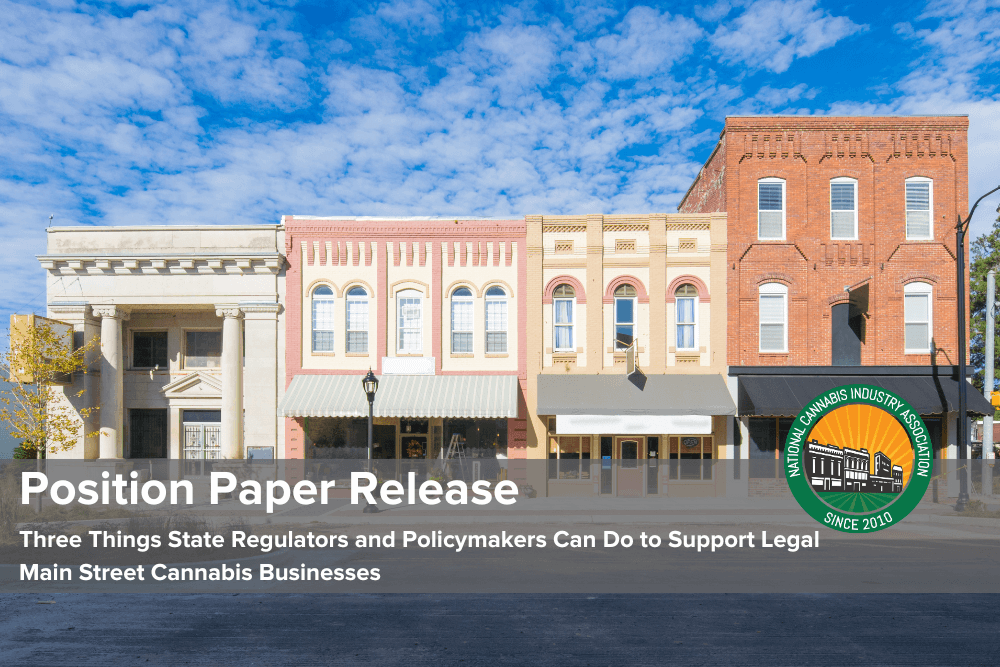
The simple truth is that regulated cannabis markets are not working for the vast majority of small businesses, including equity businesses.
Regulators increasingly understand that these businesses are struggling, but face the daunting challenge of knowing where to start with the many, many, many voices calling for attention. Of course, regulators are also wary of accepting a rescue plan for Main Street businesses from lobbyists exclusively paid for by the handful of large Wall Street backed businesses that can afford such slick-talking representatives.
Providing a credible voice for those Main Street businesses is at the core of NCIA’s mission.
As a result, our Policy Co-Chairs Khurshid Khoja and Michael Cooper recently traveled to the annual external stakeholders meeting of the Cannabis Regulators Association (better known as CANNRA), where they were invited back to address state and local cannabis regulators from across the country. Michael and Khurshid spoke on issues of crucial importance to the future of the industry, including the challenges facing small businesses, the successes and failures of social equity programs, the potential pitfalls of rescheduling without addressing FDA oversight in advance, and establishing a level playing field between state-licensed cannabis businesses that provide highly regulated delta-9 THC marijuana products, and unregulated actors that provide equivalent products with equally potent, psychotropic and/or chemically analogous cannabinoids derived from hemp.
Regulators were clear at the meeting that they need more credible, tangible solutions for the challenges facing these markets, and they wanted to hear directly from the nation’s oldest, largest and still most representative non-profit trade association for the regulated cannabis industry.
Today, NCIA is proud to offer the first of a series of policy papers that offer specific steps that regulators and policymakers across the nation can take to help these struggling markets.
Want to help NCIA fix the challenges you’re facing? Existing members are encouraged to contact us at Membership@thecannabisindustry.org to provide feedback or learn how you can get involved with this project. Not a member? No problem. Sign up here, and roll up your sleeves to join the fight.
NCIA Response to Senate Discussion Draft of Cannabis Administration and Opportunity Act (CAOA)

On July 14, 2021 Senate Majority Leader Chuck Schumer (D-NY), Senate Finance Committee Chair Ron Wyden (D-OR), and Senator Cory Booker released a discussion draft of the Cannabis Administration and Opportunity Act (CAOA), proposed language that would remove cannabis from the federal list of controlled substances and empower states to implement their own cannabis laws. In addition, these Senate offices solicited public comment on this language to “spur a robust discussion among stakeholders in order to inform Sponsoring Offices as they work to craft a final legislative proposal.”
We applaud these three Senate pioneers for their courage and leadership on this important issue. The future of the CAOA will mark the moment when cannabis reform at the federal level took its next great leap; creating the next great American industry while also providing restorative justice to those most harmed by the racist war on drugs.
Environmental Sustainability in the Cannabis Industry: Impacts, Best Management Practices, and Policy Considerations
 The NCIA environmental committee was formed to write a technical report on “Environmental Impacts, Best Management Practices and Policies for the Cannabis Industry” necessary to position the cannabis industry as a leader in environmental sustainability at the local, state, and national levels and to help inform environmental policy.
In this report, we provide a review of the impacts cannabis has on soils and land use, water, energy generation and consumption, air quality, and the challenges associated with waste. Each respective section explores current and emerging best management practices and their corresponding policy considerations. In many cases, existing policies can be broadened or modified to include the cannabis industry. However, the cannabis industry is as unique as the plant itself, and particular growing, processing, and packaging practices may benefit from cannabis-specific policies outlined herein. Legalization of cannabis is an unprecedented opportunity for environmentally sustainable practices to be adopted as the national industry standard from the outset, positioning the cannabis industry to emerge as a leader in environmental sustainability.
NCIA suggests that forward-thinking standard-setting bodies, self-regulatory organizations, and government regulators take note and create workable standards with supporting resources to set the cannabis industry apart as a leader in environmental sustainability. Any such standards should take cost into account, as we don’t want to further encourage illicit market actors by creating unfunded mandates for state-legal operators.
Comments to the Drug Enforcement Administration – Rescind Interim Final Rule “Implementation of the Agriculture Improvement Act of 2018”
In October 2020, NCIA submitted comments to the Drug Enforcement Administration (DEA) urging the agency to rescind an interim final rule (IFR) that is in conflict with the hemp provisions of the 2018 Farm Bill and would cause confusion and widespread harm in the burgeoning legal hemp industry in the United States.
Letter to Sen. Crapo from Businesses regarding SAFE Banking
Letter to Sen. Crapo from Associations regarding SAFE Banking
Testimony of Aaron Smith, Executive Director, NCIA, Before The U.S. House of Representatives Committee on the Judiciary Subcommittee on Crime, Terrorism, and Homeland Security
The cannabis industry has evolved into a national commercial enterprise generating significant tax revenue, generating hundreds of thousands of jobs, and providing people access to plant-based medicines that work to alleviate pain and treat symptoms of myriad diseases. State laws that have replaced the criminal markets with systems that provide for tightly regulated production and sale of cannabis to patients and adults over 21 are improving public safety. But, the unnecessary burdens caused by outdated federal policies must be resolved to benefit our communities’ entrepreneurs.
National Cannabis Industry Association’s Response to the U.S. Food and Drug Administration’s Request for Public Comments on Scientific Data and Information About Products Containing Cannabis or Cannabis-Derived Compounds
On behalf of the National Cannabis Industry Association (NCIA), and in response to the U.S. Food and Drug Administration (FDA) request for comments on Scientific Data and Information About Products Containing Cannabis or Cannabis-Derived Compounds, published in the April 3, 2019 edition of the Federal Register, we hereby submit public comments.
Given the substantial interest in this topic and the need for regulations and standardization throughout the industry, NCIA and this coalition are providing specific insight into all facets the FDA would like to examine, including health and safety risks, manufacturing and product quality, and marketing, labeling, and sales.
Hemp-derived CBD is in high demand by consumers, and the industry is eagerly awaiting the FDA’s regulatory framework for these products. Our industry coalition firmly believes that by working in partnership with the FDA to inform rulemaking, we can develop an appropriate regulatory framework to ensure the safety and efficacy of these important products.
State Cannabis Laws: A Progress Report (2019 Update)
This 2nd edition comprehensive report provides an overview of the successful state programs that have replaced marijuana prohibition with a tightly regulated market as well as the challenges those programs face due to outdated federal laws. (May 2019)
Cannabis Packaging And Labeling: Recommendations For Sensible And Consistent Regulations Across States And Nations (February 2019)
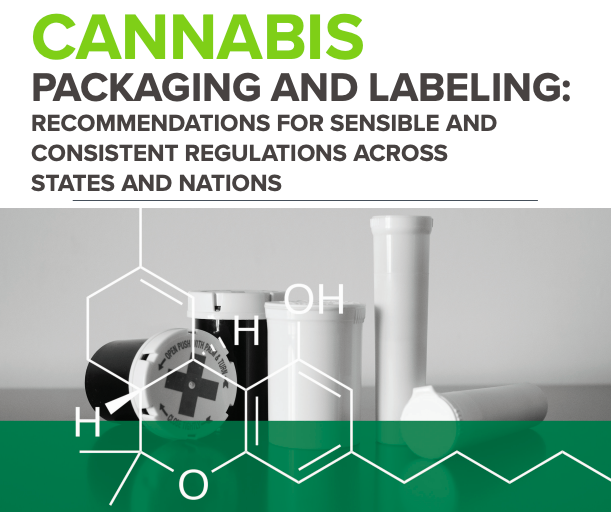
An update of a paper that was previously released by the Policy Council on Responsible Cannabis Regulation and produced in collaboration with the National Cannabis Industry Association. This paper presents regulatory recommendations and model regulations that emerged from a critical assessment of sub-optimal and inconsistent state regulations in one specific area: cannabis packaging and labeling. The overarching goal is to encourage greater consistency and judiciousness in cannabis rulemaking by providing state regulators with model packaging and labeling regulations supported by in-depth research, analysis, and input from diverse stakeholders and experts.
Cannabis Industry Policy Priorities: 116th Session of Congress (2019-2020)
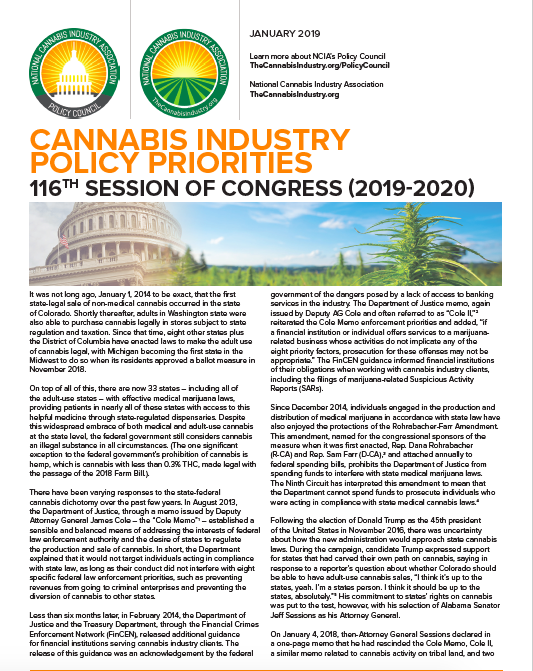
NCIA’s “Cannabis Industry Policy Priorities: 116th Session of Congress (2019-2020)” focuses on how given the pace of change at the state level and the support for cannabis policy reform at the highest level of the federal government, it seems clear that we are at a critical juncture in the history of federal cannabis policy. This paper details NCIA’s stance on how key federal policy priorities should change in this 116th session of Congress.
The New Politics of Marijuana: A Winning Opportunity for Either Party
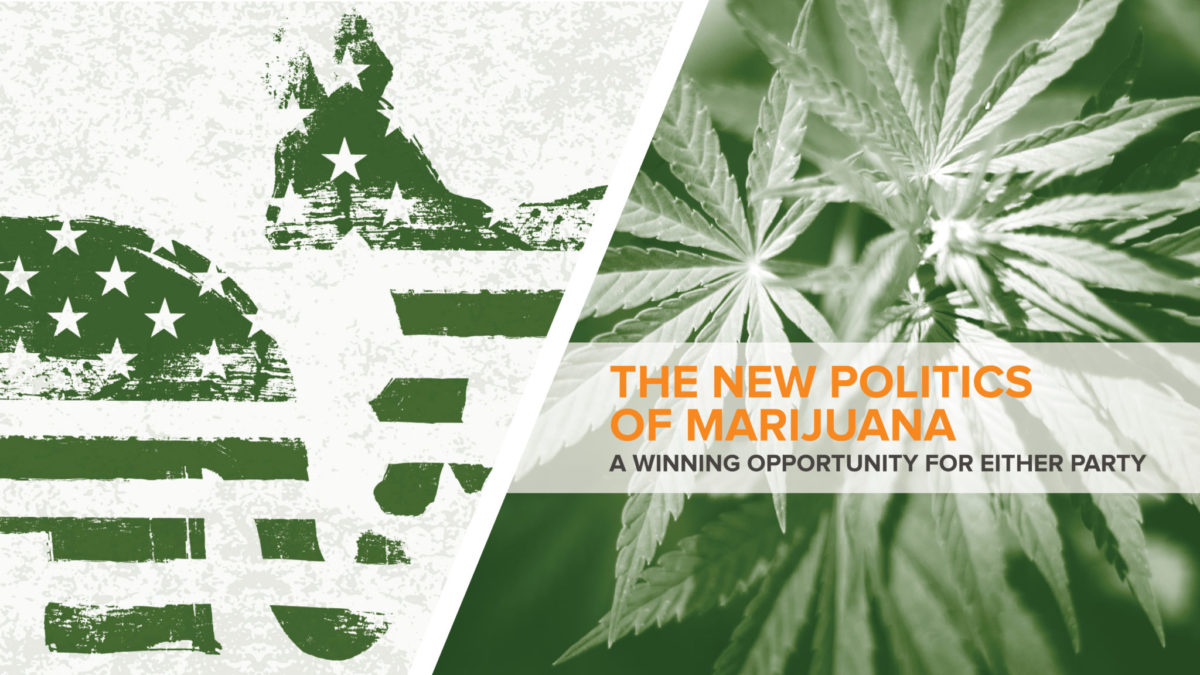
NCIA’s “The New Politics of Marijuana: A Winning Opportunity for Either Party,” highlights the significant voter support for marijuana policy reform and the legal cannabis industry through thoughtful examination of recent public opinion polling and electoral wins.

 The National Cannabis Industry Association’s
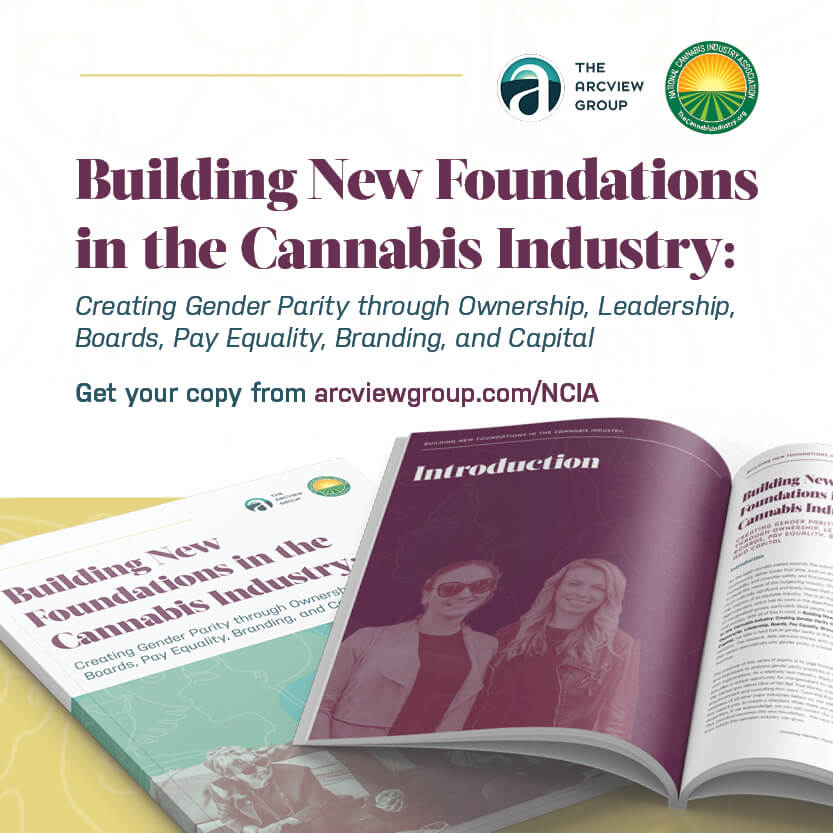
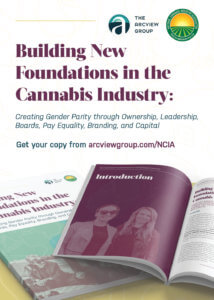 Building New Foundations in the Cannabis Industry: Creating Gender Parity through Ownership, Leadership, Boards, Pay Equality, Branding, and Capital, takes a hard look at gender parity in the U.S. cannabis industry. The research, data, personal stories, and case studies in this series demonstrate why gender parity is crucial to business success. The purpose of this series of papers is to urge businesses and individuals to embrace gender parity practices in their own organizations.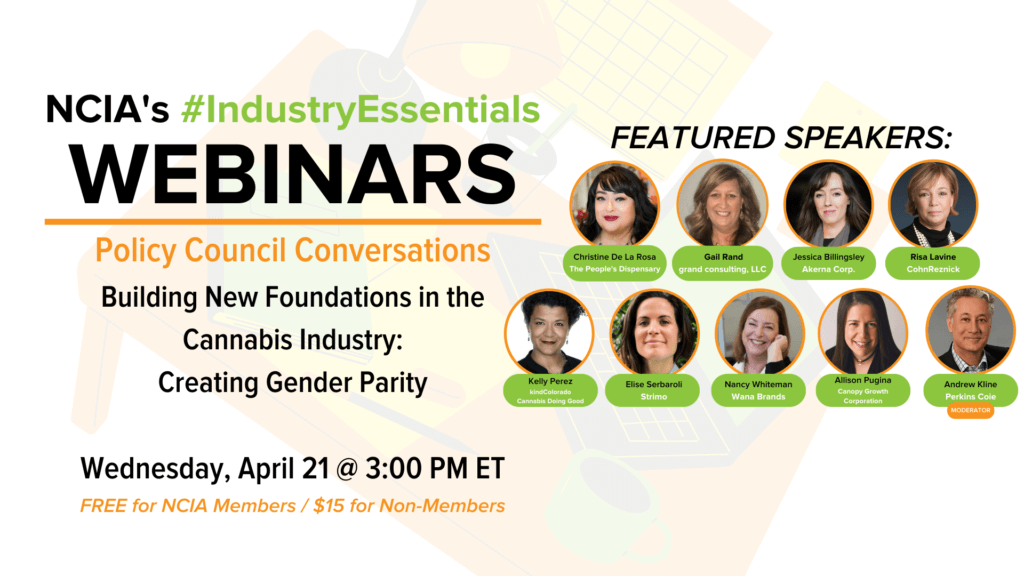

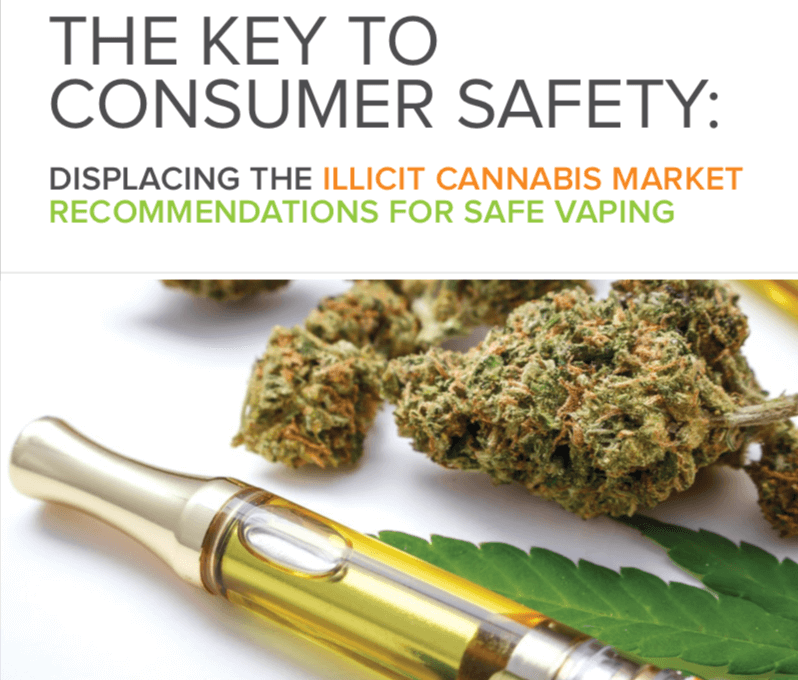
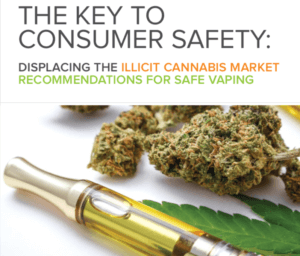 As reports began to appear of a potential linkage between lung injuries and use of nicotine and/or cannabis vaping products, NCIA’s Policy Council established a Safe Vaping Task Force to provide a consistent response on behalf of the concerned members of the regulated cannabis industry. The Task Force’s mission was to communicate clearly in response to press reports and governmental actions, and articulate the state-legal cannabis industry’s fulsome efforts to act with integrity as responsible actors.
Follow NCIA
Newsletter
Facebook
Twitter
LinkedIn
Instagram
News & Resource Topics
–
This Just In
Member Blog: What Consumers Really Want in a Pre-Roll
Member Blog: The Evolving Cannabis Legal & Regulatory Landscape in 2026