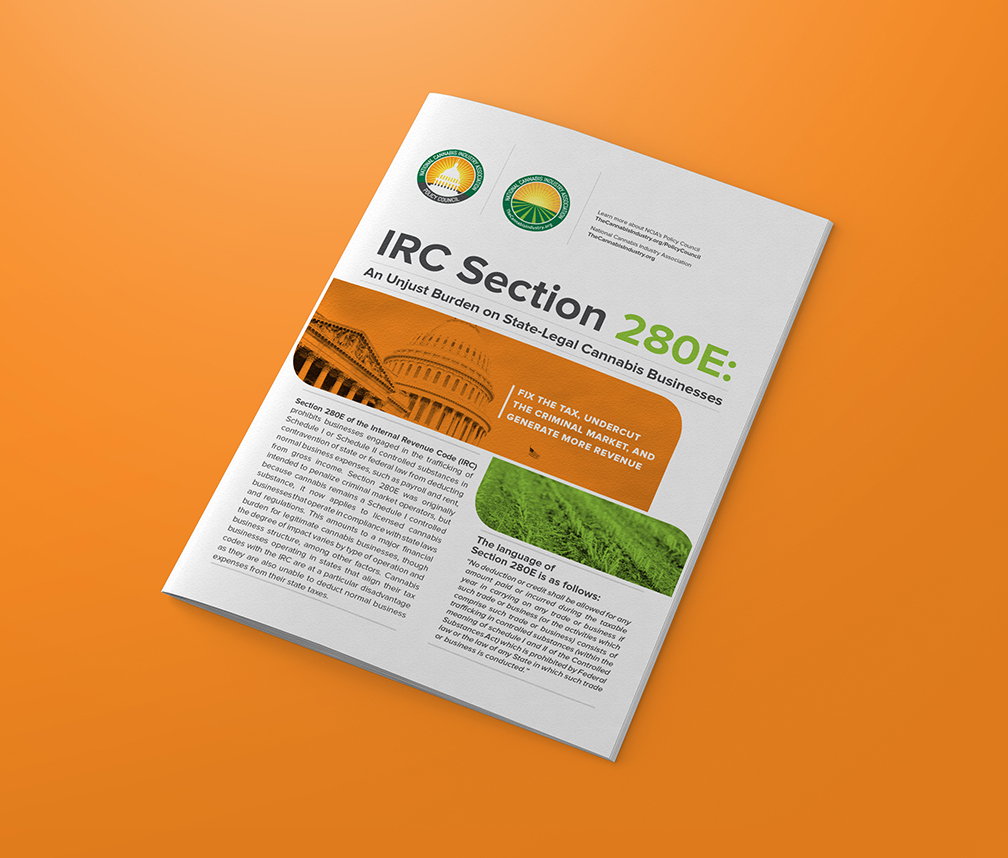
Leveling the Playing Field: The Case for §280E Reform and Retroactive Relief
Download NCIA’s new white paper and join the movement to protect the future of the cannabis industry.
For decades, cannabis operators have shouldered an impossible burden: paying taxes on terms no other industry faces. Section 280E strips away the ability to deduct ordinary business expenses, forcing compliant operators to pay effective tax rates that can exceed 70%. This inequity doesn’t just stifle growth—it threatens the very survival of the businesses that built the legal market.
NCIA’s latest white paper breaks down the urgency of reform and the path forward. Inside, you’ll find:
-
The origins of §280E and why today’s licensed operators were never its intended target
-
The economic impact of inflated tax burdens on growth, investment, and competition with the illicit market
-
Why retroactive relief is essential to keep early operators, equity licensees, and small businesses alive
-
NCIA’s solution: a straightforward fix that delivers fairness, stability, and opportunity to the industry
This is more than a policy paper—it’s a blueprint for survival and growth. By understanding the issue, you’re better positioned to protect your business and strengthen the regulated market.
Download your copy today and be part of the collective push to end 280E’s stranglehold on our industry.
Three Things Regulators and Policymakers Can Do to Undercut Criminal Markets and Support Legal Main Street Cannabis Businesses

The simple truth is that regulated cannabis markets are not working for the vast majority of small businesses, including equity businesses.
Regulators increasingly understand that these businesses are struggling, but face the daunting challenge of knowing where to start with the many, many, many voices calling for attention. Of course, regulators are also wary of accepting a rescue plan for Main Street businesses from lobbyists exclusively paid for by the handful of large Wall Street backed businesses that can afford such slick-talking representatives.
Providing a credible voice for those Main Street businesses is at the core of NCIA’s mission.
As a result, our Policy Co-Chairs Khurshid Khoja and Michael Cooper recently traveled to the annual external stakeholders meeting of the Cannabis Regulators Association (better known as CANNRA), where they were invited back to address state and local cannabis regulators from across the country. Michael and Khurshid spoke on issues of crucial importance to the future of the industry, including the challenges facing small businesses, the successes and failures of social equity programs, the potential pitfalls of rescheduling without addressing FDA oversight in advance, and establishing a level playing field between state-licensed cannabis businesses that provide highly regulated delta-9 THC marijuana products, and unregulated actors that provide equivalent products with equally potent, psychotropic and/or chemically analogous cannabinoids derived from hemp.
Regulators were clear at the meeting that they need more credible, tangible solutions for the challenges facing these markets, and they wanted to hear directly from the nation’s oldest, largest and still most representative non-profit trade association for the regulated cannabis industry.
Today, NCIA is proud to offer the first of a series of policy papers that offer specific steps that regulators and policymakers across the nation can take to help these struggling markets.
Want to help NCIA fix the challenges you’re facing? Existing members are encouraged to contact us at Membership@thecannabisindustry.org to provide feedback or learn how you can get involved with this project. Not a member? No problem. Sign up here, and roll up your sleeves to join the fight.
Risk Management and Insurance Manual: A Novel Cannabinoid Conundrum – Loopholes, Liability, and Legislation

 The National Cannabis Industry Association’s Risk Management & Insurance Committee is a multidisciplinary group of risk management professionals convened to draw on the expertise and experiences of professionals dedicated to the cannabis community.
This is the third in a series of insurance manuals that will help guide you through the various coverages and definitions used in the cannabis insurance industry. This edition of the RMIC Insurance manual frames the issues surrounding novel cannabinoids and the risk and insurance considerations around them. Read the first edition here, as well as the second edition here.
Risk Management and Insurance Manual: An Introduction to Cannabis Insurance – Part Two
The National Cannabis Industry Association’s Risk Management & Insurance Committee is a multidisciplinary group of professionals working in the cannabis and insurance industries. We have created this manual to help business owners operating in state-legal cannabis industry gain a basic understanding of risk management, particularly insurance.
Every business faces numerous risks. Cannabis businesses, in principle, are no different. Of course, “plant-touching” businesses face additional risks associated with federal prohibition, and often extremely burdensome regulation at the state level, and these risks are definitely unique to cannabis (and mostly uninsurable). Moreover, to some degree or another, our whole industry is affected by the lingering stigma of prohibition, which continues to limit our access to capital, banking, insurance, and other business services that other industries pay less for and can usually take for granted. It provides a unique challenge for our industry.
NCIA Response to Senate Discussion Draft of Cannabis Administration and Opportunity Act (CAOA)

On July 14, 2021 Senate Majority Leader Chuck Schumer (D-NY), Senate Finance Committee Chair Ron Wyden (D-OR), and Senator Cory Booker released a discussion draft of the Cannabis Administration and Opportunity Act (CAOA), proposed language that would remove cannabis from the federal list of controlled substances and empower states to implement their own cannabis laws. In addition, these Senate offices solicited public comment on this language to “spur a robust discussion among stakeholders in order to inform Sponsoring Offices as they work to craft a final legislative proposal.”
We applaud these three Senate pioneers for their courage and leadership on this important issue. The future of the CAOA will mark the moment when cannabis reform at the federal level took its next great leap; creating the next great American industry while also providing restorative justice to those most harmed by the racist war on drugs.
Environmental Sustainability in the Cannabis Industry: Impacts, Best Management Practices, and Policy Considerations
 The NCIA environmental committee was formed to write a technical report on “Environmental Impacts, Best Management Practices and Policies for the Cannabis Industry” necessary to position the cannabis industry as a leader in environmental sustainability at the local, state, and national levels and to help inform environmental policy.
In this report, we provide a review of the impacts cannabis has on soils and land use, water, energy generation and consumption, air quality, and the challenges associated with waste. Each respective section explores current and emerging best management practices and their corresponding policy considerations. In many cases, existing policies can be broadened or modified to include the cannabis industry. However, the cannabis industry is as unique as the plant itself, and particular growing, processing, and packaging practices may benefit from cannabis-specific policies outlined herein. Legalization of cannabis is an unprecedented opportunity for environmentally sustainable practices to be adopted as the national industry standard from the outset, positioning the cannabis industry to emerge as a leader in environmental sustainability.
NCIA suggests that forward-thinking standard-setting bodies, self-regulatory organizations, and government regulators take note and create workable standards with supporting resources to set the cannabis industry apart as a leader in environmental sustainability. Any such standards should take cost into account, as we don’t want to further encourage illicit market actors by creating unfunded mandates for state-legal operators.
Making Sense Of State And Local Cannabis Insurance Regulations

Deciding what insurance is needed for your cannabis operations can be difficult. This decision is further complicated by the variation in what insurance is mandated by state and local cannabis regulations. This paper attempts to provide some clarity on specific insurance requirements mandated by state and local authorities in several states including California, Colorado, Illinois, Massachusetts, Michigan, Nevada, Oregon, Vermont, and Washington.
State Cannabis Laws: A Progress Report (2019 Update)
This 2nd edition comprehensive report provides an overview of the successful state programs that have replaced marijuana prohibition with a tightly regulated market as well as the challenges those programs face due to outdated federal laws. (May 2019)
Implementing An Initial Trade Credit Policy For An Emerging Cannabis Related Business
The cannabis market is evolving and more and more companies in all segments of the market that have previously operated only in a cash/COD environment are now starting to extend credit terms to their customers either by choice or due to market competition. This is not an unusual situation. Accounts receivable is often the largest asset on a company’s balance sheet.
Implementing a formal process for managing credit & collections and accounts receivable is commonly referred to as a Trade Credit Policy or just a Credit Policy. In this White Paper by NCIA’s Finance and Insurance Committee, we will detail the steps required to implement a Trade Credit Policy. This process may assist with placing your company on a sound financial basis by giving better control of a major asset and making it easier for you to secure external financing.
Cannabis Packaging And Labeling: Recommendations For Sensible And Consistent Regulations Across States And Nations (February 2019)
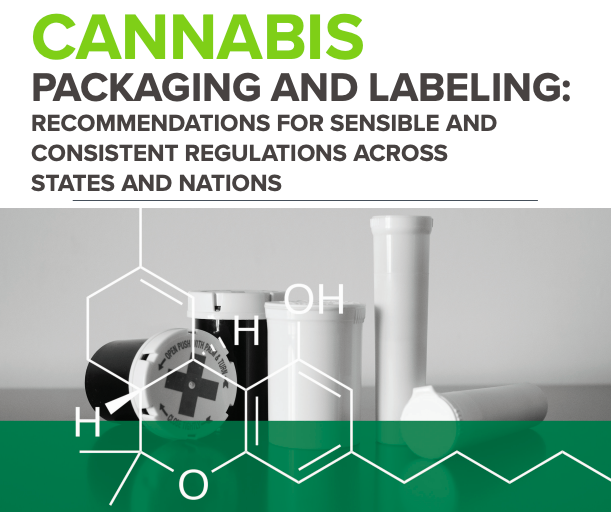
An update of a paper that was previously released by the Policy Council on Responsible Cannabis Regulation and produced in collaboration with the National Cannabis Industry Association. This paper presents regulatory recommendations and model regulations that emerged from a critical assessment of sub-optimal and inconsistent state regulations in one specific area: cannabis packaging and labeling. The overarching goal is to encourage greater consistency and judiciousness in cannabis rulemaking by providing state regulators with model packaging and labeling regulations supported by in-depth research, analysis, and input from diverse stakeholders and experts.
Crisis Communications Manual: A Guide for Crisis Communication in Cannabis (July 2018)
Prepared by the Crisis Manual Subcommittee of the Marketing & Advertising Committee, this manual includes proper crisis preparedness and management processes that can help protect a brand’s reputation and market share. This guide includes industry specific tools for crisis resistance, responsiveness, and resilience.
Cannabis Testing Policy: Recommendations For More Thoughtful And Consistent Regulations

In this report prepared by NCIA’s Policy Council, we explore recommendations for cannabis testing policies including requirements for proficiency, contaminants, potency and active ingredients, as well as records retention and laboratory accreditation.
Stakes are High for Marijuana Businesses Navigating New Advertising and Marketing Regulations in Massachusetts

In this paper, prepared by Ian Stewart and Kara Thorvaldsen of Wilson Elser LLP for NCIA’s Finance and Insurance Committee, within the Risk Management Subcommittee, Massachusetts’ new regulations governing branding and marketing by adult-use marijuana businesses and related risk exposures are examined.
How the U.S. is Falling Behind in the Global Cannabis Market
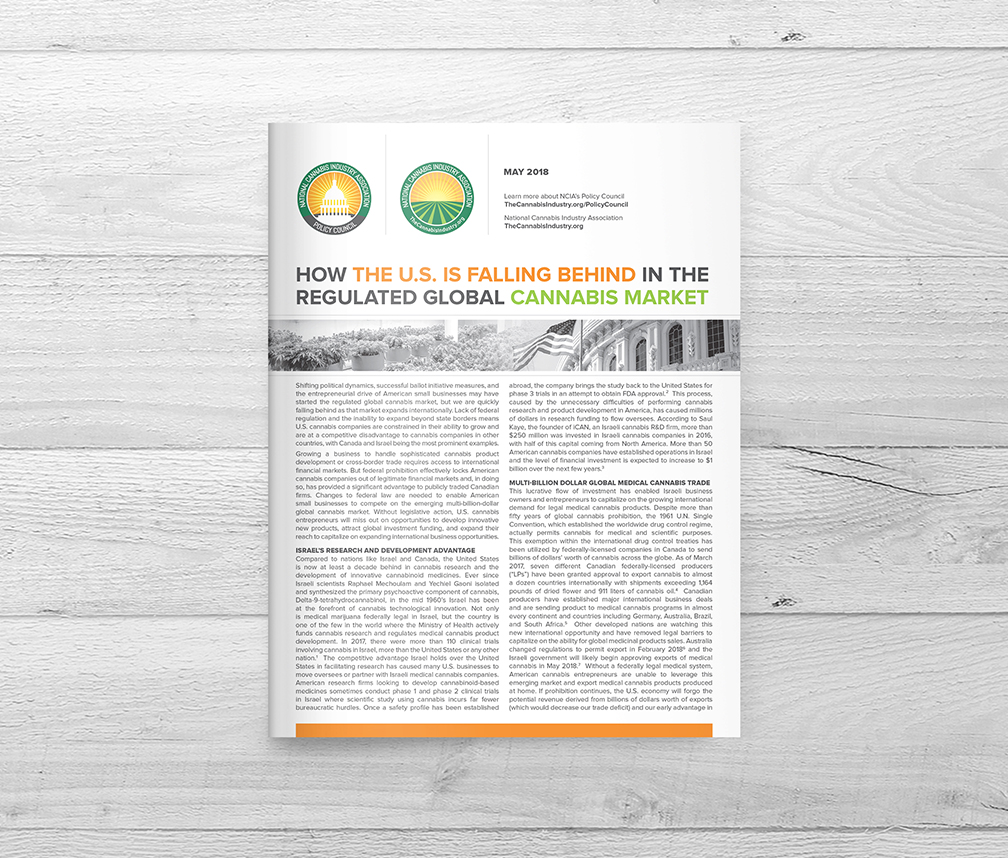
In this paper produced by NCIA’s Policy Council, we explore how the lack of federal regulation and the inability to expand beyond state borders means U.S. cannabis companies are constrained in their ability to grow and are at a competitive disadvantage to cannabis companies in other countries, with Canada and Israel being the most prominent examples. (October 2018)
The Future of the Accounts Receivable and Credit Function in the Emerging Cannabis Industry

Produced by NCIA’s Finance and Insurance Committee, within the Risk Management Subcommittee
Protecting Your Cannabis Business: A Commercial Insurance Overview

Produced by NCIA’s Finance and Insurance Committee, within the Insurance Subcommittee. (April 2018)


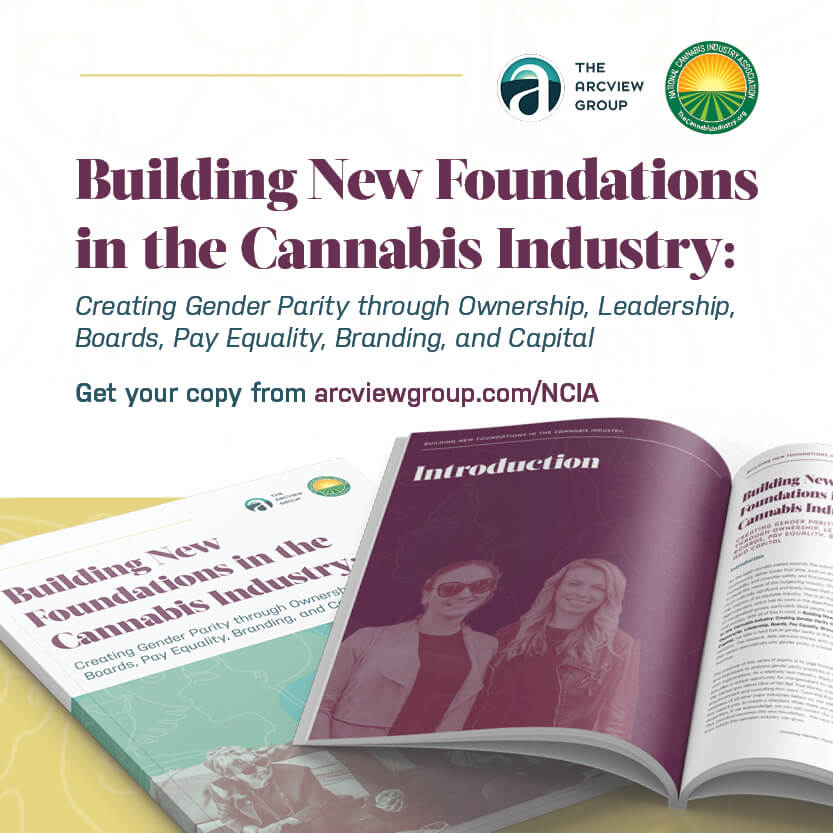
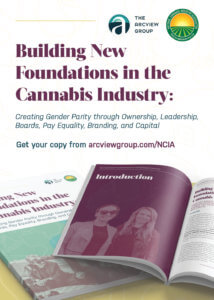 Building New Foundations in the Cannabis Industry: Creating Gender Parity through Ownership, Leadership, Boards, Pay Equality, Branding, and Capital, takes a hard look at gender parity in the U.S. cannabis industry. The research, data, personal stories, and case studies in this series demonstrate why gender parity is crucial to business success. The purpose of this series of papers is to urge businesses and individuals to embrace gender parity practices in their own organizations.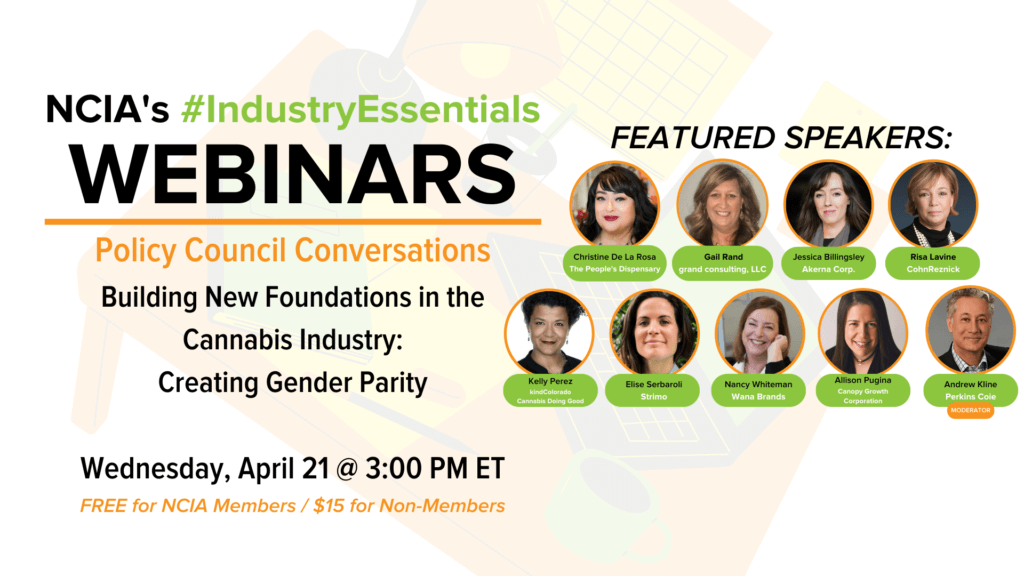

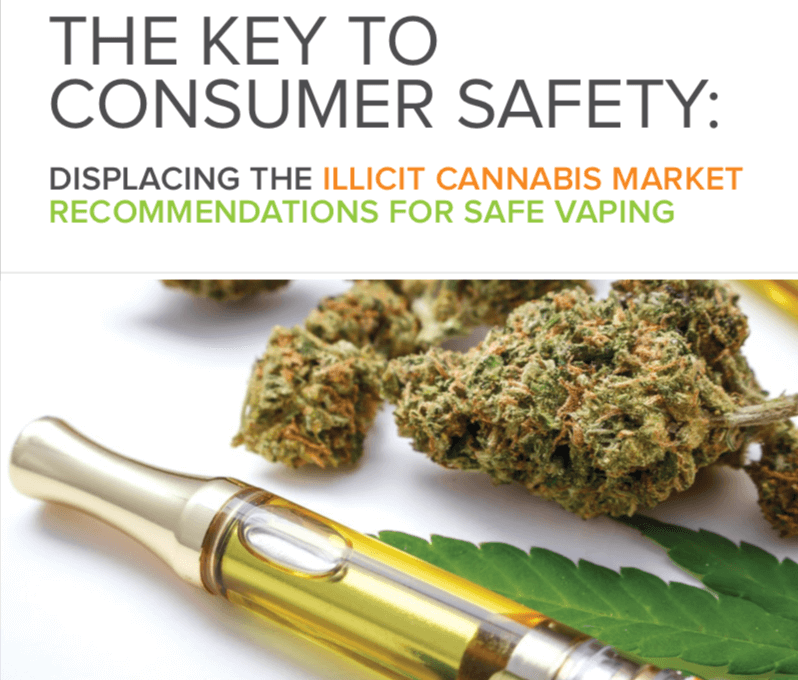
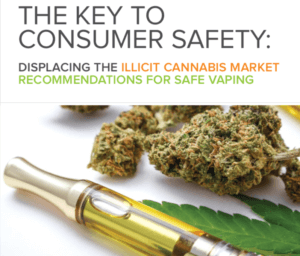 As reports began to appear of a potential linkage between lung injuries and use of nicotine and/or cannabis vaping products, NCIA’s Policy Council established a Safe Vaping Task Force to provide a consistent response on behalf of the concerned members of the regulated cannabis industry. The Task Force’s mission was to communicate clearly in response to press reports and governmental actions, and articulate the state-legal cannabis industry’s fulsome efforts to act with integrity as responsible actors.
Follow NCIA
Newsletter
Facebook
Twitter
LinkedIn
Instagram
News & Resource Topics
–
This Just In
NCIA Applauds Reintroduction of SAFE Banking Following Lobby Days
Beyond Rescheduling: Inside NCIA’s 14th Annual National Cannabis Industry Lobby Days