by Michelle Rutter Friberg, NCIA’s Deputy Director of Government Relations
Over the last month, I’ve been taking a retrospective look at the progress NCIA has made in the ten years since its inception. While it’s been fun to look back at those early years, this week I’m excited to look at a time when cannabis policy was getting really active: 2016-2017! While this timeline is by no means a comprehensive look at everything that’s happened in cannabis policy during those years, here are some highlights:
January 2016
District judge dismisses lawsuit against the Fed, filed by the Fourth Corner Credit Union, says Congress must fix the cannabis banking problem. The same month, President Obama announces that cannabis reform is not on his agenda in 2016.
March 2016
The Supreme Court dismisses Kansas’ challenge to Colorado marijuana laws. The 6-2 vote meant the nation’s highest court would not rule on the interstate dispute, and Colorado’s legal cannabis market remains safe. “Since Colorado voters overwhelmingly passed legal recreational marijuana in 2012, we have worked diligently to put in place a regulatory framework — the first in the world — that allows this new industry to operate while protecting public health and safety,” then- Gov. John Hickenlooper (D) said following the decision. “With today’s Supreme Court ruling, the work we’ve completed so far remains intact.”
An AP poll shows that 61% of Americans support legalizing cannabis. The most recent Gallup poll on the issue, published in October 2019, shows that approval number has risen to 66%.
April 2016
U.S. Senate Caucus on International Narcotics Control holds a hearing titled “Is the Department of Justice Adequately Protecting the Public from the Impact of State Recreational Marijuana Legalization?”
May 2016
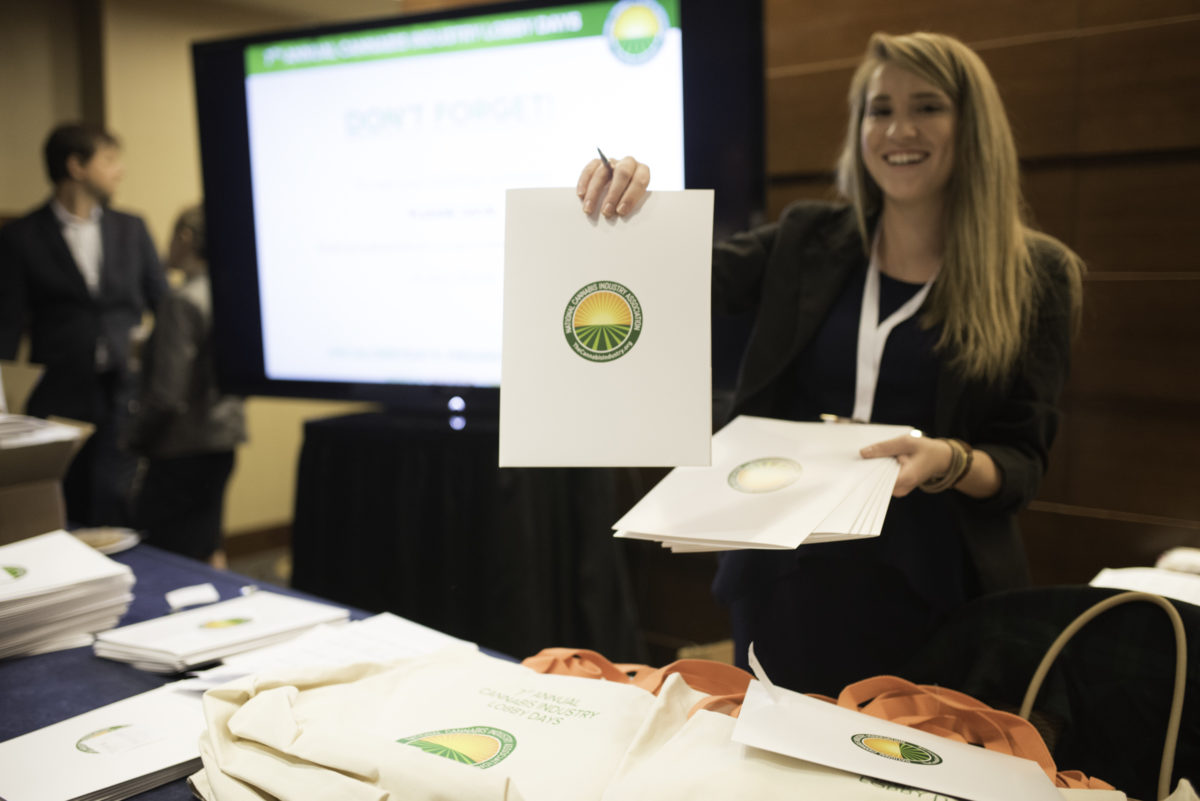
NCIA holds its 6th Annual Cannabis Industry Lobby Day in D.C., garnering over 150 attendees and participating in more than 200 scheduled meetings on Capitol Hill. That same month, the Tax Foundation reports a legal marijuana industry could mean up to $28 billion in federal, state, and local tax revenues.
June 2016
NCIA hosts our 3rd Annual Cannabis Business Summit in Oakland with 3,000+ attendees. That same month, the U.S. Senate Appropriations committee narrowly approved a marijuana banking amendment. Ultimately, the amendment did not make it into law. The amendment has not passed this specific Committee since, though we continue to try!
July 2016
Showing increased interest and momentum on this issue, the U.S. Senate Judiciary Committee holds a hearing on the potential benefits of medical marijuana. The same month, the Democratic Party included reclassifying cannabis in the party’s platform.
August 2016
This was an exciting month because we got to really see our efforts at work in the real world. Four years ago this month, the Ninth Circuit Court of Appeals ruled that due to the Rohrabacher-Farr amendment, the Department of Justice cannot use funds to enforce federal law against state-legal medical cannabis businesses.
September 2016
U.S. Attorney General Loretta Lynch says that marijuana is not a gateway drug, but that same month, FBI data showed that there is one cannabis arrest every 49 seconds in the U.S. The majority of those individuals are Black and brown and are arrested four to eight times more than their white counterparts.
October 2016
Members of Congress and the campaigns to legalize cannabis in various forms enter the final push. That month, a report also showed that Colorado’s marijuana industry had a $2.39 billion financial impact and created more than 18,000 jobs in the state.
November 2016
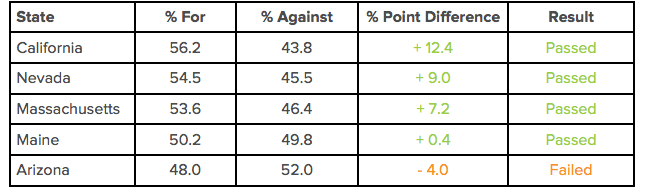
Five states (Arizona, California, Maine, Massachusetts, and Nevada) voted on ballot initiatives to legalize, tax, and regulate marijuana for adult use. Four of those initiatives passed, and three of them passed by more than seven percentage points.
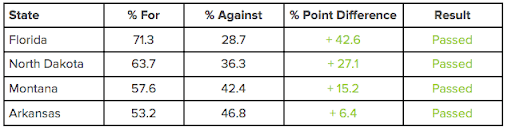
Four states (Arkansas, Florida, Montana, and North Dakota) voted on ballot initiatives to create or expand legal medical marijuana programs. All four of those initiatives passed, with an average victory of 26.3 percentage points.
Of course, November 2016 is also when Republicans took control of both chambers of Congress and candidate Trump became president-elect Trump.
January 2017
NCIA establishes the Policy Council to serve as the industry’s “think tank” in D.C., developing and publishing policy papers to educate policymakers and other stakeholders on topics relevant to the cannabis industry. The same month, Sen. Jeff Sessions (R-AL) begins his confirmation hearing to become U.S. Attorney General. He is subsequently confirmed, bringing uncertainty to the cannabis space.
February 2017
White House press secretary Sean Spicer said that he expects states to see “greater enforcement” of the federal law against marijuana use, a move that would be at odds with a growing number of states’ decisions to legalize it. Spicer, taking questions from reporters at the daily briefing, differentiated between the administration’s positions on medical marijuana and recreational marijuana. Funnily enough, Spicer’s career lasted about as long as it takes me to smoke a joint.
The nation’s first-ever Congressional Cannabis Caucus is formed by Reps. Rohrabacher (R-CA) and Blumenauer (D-OR) with help from friends Reps. Polis (D-CO) and Young (R-AK). In the 116th Congress, Rohrbacher and Polis left Congress and were replaced by Barbara Lee, a Democrat from California, and David Joyce, a Republican from Ohio, as co-chairs.
May 2017
NCIA’s D.C. team grew from two (myself and Mike) to three, with the addition of Maddy Grant, who was our Government Relations Coordinator at the time. Since then, Maddy has become one of my best friends and was even one of my bridesmaids! If you know Maddy, you know she’s the best and NCIA is lucky to have her!
NCIA held its 7th Annual Cannabis Industry Lobby Days in Washington, D.C., where 250 industry professionals coalesced on Capitol Hill to attend over 300 scheduled meetings. Following that, there was a substantial increase in the number of cosponsors on cannabis-related bills compared to the previous Congressional session.
July 2017
The Senate Appropriations Committee voted on their equivalent of the Rohrabacher-Farr amendment, sponsored by the committee’s vice chairman, Patrick Leahy (D-VT). That amendment passed on a voice vote and was the first time ever that a cannabis-related amendment passed in such a manner. At the end of July, the Senate Appropriations Committee also adopted an amendment that would allow the Department of Veterans Affairs to recommend medical cannabis in states. That amendment passed by a vote of 24 to 7 – the most votes this measure has ever received in the Senate. The veterans’ measure did not end up becoming law.
September 2017
The House Rules Committee held a hearing to discuss amendments to the upcoming appropriations bill that will fund the federal government for the upcoming fiscal year and chose not to vote on the amendment that protects medical cannabis businesses, patients, and programs. Since the protections for medical cannabis businesses were included in the Senate’s version of the budget bill but are not included in the House’s versions, it came down to a conference committee to negotiate its inclusion, and ultimately, the provision remained in law.
December 2017
Senate Republicans passed their tax reform package into law. Sen. Cory Gardner (R-CO) introduced two amendments to the bill that targeted 280E, however, he withdrew both amendments before the final bill was voted on.
If you think reminiscing on all that was a lot, make sure you keep an eye on our blog and future issues of NCIA’s Cannabusiness Leader to learn more about 2018-2019 and the progress we’ve made more recently as we wrap up this series!
#10YearsOfNCIA: A message from our co-founder & CEO
Ten years ago, a small group of cannabis pioneers and I setout to launch the cannabis industry’s first national trade association. At the time, only 14 states had legalized medical cannabis, none had adult-use laws, no states had regulated their medical cannabis markets, and there was virtually no interest in federal marijuana reform in Congress.
As NCIA closes out our tenth year advancing the interests of the cannabis industry, all but three U.S. states have some kind of cannabis law on the books, 10 have regulated the commercial production and sale of cannabis for adults, two-thirds of Americans support national legalization, and Congress is closer than ever to making that a reality. And, thanks to hundreds of NCIA members, our organization has grown to become the gold standard for cannabis industry advocacy, education, and community. This incredible progress hasn’t happened on its own — it’s a direct result of the forward-thinking cannabis professionals who have invested in reform efforts and joined forces with NCIA as members over the years. We also still have a lot of work to do and it’s more important than ever that our industry maintains a strong presence in our nation’s halls of power during this era of global pandemic, economic downturn, and outrage over systemic racism.
If you run a cannabis business and share our view that the industry should be treated fairly under federal law but haven’t yet become a member of your industry’s trade association, I invite you to help us move the industry even further by joining today. In addition to the investment in vital advocacy efforts, NCIA members enjoy a myriad of networking, information, and educational benefits to gain a competitive advantage over isolated cannabis businesses.
Already a member or not quite ready to join just yet? That’s okay, you can still contribute to our work by making a generous donation today. Consider it not only an anniversary gift to NCIA but also a simple investment in the future of legal cannabis commerce that we are creating through our ongoing public affairs work. Every dollar counts.
Thank you for your commitment to defending and expanding the regulated cannabis marketplace. Together, we will establish a legal cannabis industry that is forever prosperous, sustainable, and inclusive.
Here’s to another ten years! Aaron Smith Co-founder & CEO
National Cannabis Industry Association
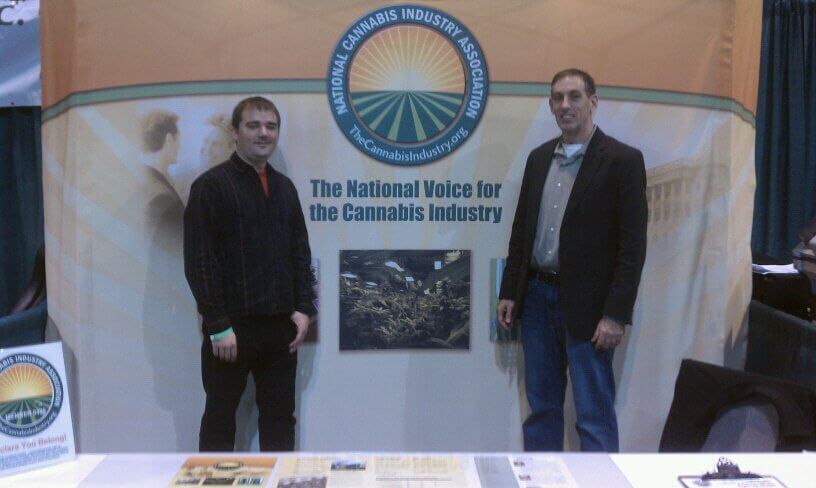
*Feature Photo: NCIA co-founders Aaron Smith (left) and Steve Fox (right) meeting up before the organization’s first board meeting in December, 2010.
Looking Back On #10YearsOfNCIA: 2009-2013
Photo By CannabisCamera.com
by Michelle Rutter Friberg, NCIA’s Deputy Director of Government Relations
As NCIA continues into our tenth year advancing the interests of the cannabis industry, all but three U.S. states have some kind of cannabis law on the books, 10 have regulated the commercial production and sale of cannabis for adults, two-thirds of Americans support national legalization, and Congress is closer than ever to making that a reality.
I started with NCIA nearly six years ago, so I’ve witnessed much of the progress we’ve made firsthand — especially the strides forward we’ve made in policy and in the halls of Congress! Let’s take a look back to the early years of NCIA (2010-2013) to see just how far we’ve come in the last decade.
October 2009
The Ogden Memo is released by the Justice Department, directing prosecutors not to prioritize the use of federal resources to prosecute patients with serious illnesses or their caregivers who are complying with state laws on medical marijuana, laying the groundwork for a new national industry. Personally, I consider the Ogden Memo to be the mother of the now-rescinded Cole Memo.
November 2010
NCIA is formed as the cannabis industry’s only national trade association by long-time marijuana policy reform leaders Aaron Smith and Steve Fox.
March 2011
Six association members join Smith and Fox for NCIA’s 1st Annual Cannabis Industry Lobby Days in Washington, D.C. Now, Lobby Days brings hundreds of cannabis industry professionals to D.C. and includes VIP Day, receptions, and opportunities to mingle with over a dozen members of Congress and their staff.
May 2011
The Small Business Banking Improvement Act of 2011 (H.R. 1984), which would exempt state-legal cannabis businesses from Suspicious Activity Report requirements, is introduced in the U.S. House of Representatives by then-Rep. Jared Polis. This bill was the precursor to the Marijuana Businesses Access to Banking Act, which was the precursor to the SAFE Banking Act.
May 2011
The Small Business Tax Equity Act of 2011 (H.R. 1985), which would correct the unfair tax burden of Section 280E, is introduced in the U.S. House of Representatives by Rep. Pete Stark (D-CA). That bill has been re-introduced in every congressional session since 2011. Today, the Small Business Tax Equity Act (H.R. 1118) has 11 cosponsors (compared to over 40 last session), but don’t think it’s because 280E isn’t important– advocates and congressional staff have simply been focused this session on passing SAFE Banking.
June 2011
Rep. Barney Frank (D-MA) and Rep. Ron Paul (R-TX) introduced the Ending Federal Marijuana Prohibition Act of 2011 (H.R. 2306) with NCIA’s support. The bill would have ended prohibition and legalized cannabis at the federal level by amending the Controlled Substances Act. It would then transfer the authority to regulate cannabis from the Drug Enforcement Administration to the Bureau of Alcohol, Tobacco, Firearms, and Explosives.
November 2012
Colorado and Washington become the first two states to legalize marijuana for adult use and sales via voter initiative. NCIA, while an infant of an organization, proudly supported both of these initiatives even as some in the industry didn’t support full legalization at that time. In fact, our co-founder Steve Fox was one of the primary authors of Colorado’s Amendment 64 and our former Deputy Director, Betty Aldworth, was a campaign spokesperson just before joining NCIA.
April 2013
NCIA hosts conservative tax reform champion, Grover Norquist, at its third annual Cannabis Industry Lobby Days in Washington, D.C. While there, Norquist discussed Americans for Tax Reform’s (ATR) release of a white paper titled Legal Cannabis Dispensary Taxation: A Textbook Case of Punishing Law-Abiding Businesses Through the Tax Code. The paper discussed Section 280E of the tax code, which is still misapplied to legal cannabis businesses and creates an effective tax rate two to four times that of other small businesses. Norquist also announced ATR’s endorsement of the Small Business Tax Equity Act.
July 2013
Congressional cannabis champion Rep. Ed Perlmutter (D-CO) introduces the Marijuana Businesses Access to Banking Act of 2013 (H.R. 2652) in the House of Representatives. This bill was the precursor to the SAFE Banking Act which has been approved (twice) by the House of Representatives in the last year.
August 2013
James M. Cole, the Deputy Attorney General, issues new guidance regarding marijuana enforcement and banking, referred to as the “Cole Memo.” The memo indicated that prosecutors and law enforcement should focus only on the following priorities related to state-legal cannabis operations:
Preventing the distribution of marijuana to minors;
Preventing revenue from the sale of marijuana from going to criminal enterprises, gangs, and cartels;
Preventing the diversion of marijuana from states where it is legal under state law in some form to other states;
Preventing state-authorized marijuana activity from being used as a cover or pretext for the trafficking of other illegal drugs or other illegal activity;
Preventing violence and the use of firearms in the cultivation and distribution of marijuana;
Preventing drugged driving and the exacerbation of other adverse public health consequences associated with marijuana use;
Preventing the growing of marijuana on public lands and the attendant public safety and environmental dangers posed by marijuana production on public lands; and
Preventing marijuana possession or use on federal property.
September 2013
Sen. Leahy (D-VT), Chairman of the Senate Judiciary Committee holds an oversight hearing on federal marijuana policy. Both Attorney General Eric Holder and Deputy Attorney General James Cole testified. The hearing, titled “Conflicts between State and Federal Marijuana Laws” came just months after two states, Washington and Colorado, legalized small amounts of cannabis for personal use by adults over 21. At the time, twenty states and the District of Columbia had legalized medicinal cannabis.
November 2013
NCIA hires a Director of Government Relations in Washington, D.C., the first-ever full-time lobbyist on behalf of cannabis businesses at the federal level. That was the man, the myth, the legend: Michael Correia, who is still here nearly seven years later! The Washington Posteven profiled the nation’s first full-time cannabis lobbyist.
Looking back, those early years of NCIA were without a doubt integral to where we are now in cannabis policy. Make sure you read next week’s edition to learn more about 2014-2016 and all the progress we made during those years!
Meet The Team: Madeline Grant – NCIA’s Government Relations Manager
by Madeline Grant, NCIA’s Government Relations Manager
It’s funny how things just happen… one day, like any normal day, I was working the lunch shift at a restaurant called Carolina Ale House in Columbia, South Carolina. At first, I was worried about how much I would make in tips that day, as anyone with experience in the service industry can relate to, but then I started chatting with one of my tables… small talk, really. I told them how I was a sophomore at the University of South Carolina studying journalism and mass communications with a focus in public relations and a minor in women and gender studies. One man asked, “Well what do you want to do after college?” A question I thought about often but never had an answer to. He handed me his business card and asked if I was interested in politics. A few days later, I reached out, interviewed with the firm partners, and successfully scored the internship.
As I entered the political realm, I knew close to nothing but had a desire to learn as much as possible. Growing up, I was never really introduced into the world of politics as my parents didn’t say much about it – it was a whole new world to me! I attended caucus meetings, sat in the Senate and listened, followed legislation pertaining to their clients, researched, etc. My boss walked in one day and said he had an interesting project for me: to research and find everything I can about medical cannabis. I discovered so many fascinating miracle stories such as the effectiveness of medical cannabis for children with epilepsy. Seeing the great benefits and possibility, I kept thinking: why is this classified a Schedule 1 substance?
Fast forward to the classic “college graduate in search of a job” situation. I moved back home to Frederick, Maryland and started as an intern on Capitol Hill. After two months of interning, I landed a job on Capitol Hill and fell passionately in love with health issues (every staffer that went the legislative route had their assigned issues to become experts on). I began to learn more about cannabis and the detrimental effects of its Schedule 1 status.
Cannabis being classified as a Schedule 1 substance deems it to have a high potential for abuse, no currently accepted medical treatment use, and lack of accepted safety for use under medical supervision. Because of this classification, we can’t fully explore the medicinal benefit that it can in fact offer.
As I started taking more meetings with cannabis advocates, lobbyists, and patients, there was one significant group that stuck with me: a group of mothers and children with debilitating chronic diseases. The mothers were there to advocate on behalf of their children who significantly benefited from CBD oil. They told me a story about a family that uprooted their entire lives for their epileptic child because CBD was the only medicine that was working to reduce the seizures. On that day, I realized how important cannabis is for patients and how it truly can make an unlivable life livable. And that was JUST CBD. Can you imagine what we could gain from the whole plant? If we had the ability to research every single component of the plant, we could begin to know the full, true potential of medical cannabis.
The Schedule 1 status of marijuana hinders research and that needs to change, but thankfully, I can help.
As the Government Relations Manager at NCIA, I passionately lobby for those patients and businesses. I’ve been at NCIA for nearly three years and slowly but surely I’ve seen a significant change in the stigma associated with cannabis on Capitol Hill. It is my job to educate members of Congress, Hill staffers, and the public on all issues the cannabis community faces. This can include anything from cannabis business getting access to banking to educating members on the injustice the war on drugs had on Americans. My job is to educate and tell your stories which I do with great honor. I’m proud to represent you and what you do in the cannabis community.
As we are at home, I would love to meet with you virtually!
As I am unable to be on Capitol Hill right now, I want to use my time to compile your stories to forward to Hill offices, so please reach out if you are able and willing to tell your story. Stay safe and healthy.


 It’s funny how things just happen… one day, like any normal day, I was working the lunch shift at a restaurant called Carolina Ale House in Columbia, South Carolina. At first, I was worried about how much I would make in tips that day, as anyone with experience in the service industry can relate to, but then I started chatting with one of my tables… small talk, really. I told them how I was a sophomore at the University of South Carolina studying journalism and mass communications with a focus in public relations and a minor in women and gender studies. One man asked, “Well what do you want to do after college?” A question I thought about often but never had an answer to. He handed me his business card and asked if I was interested in politics. A few days later, I reached out, interviewed with the firm partners, and successfully scored the internship.
Follow NCIA
Newsletter
Facebook
Twitter
LinkedIn
Instagram
News & Resource Topics
–
This Just In
Member Blog: The Evolving Cannabis Legal & Regulatory Landscape in 2026
How THCa Vapes Are Changing Consumer