Social Equity Members Head to D.C. to Lobby for A More Inclusive Industry
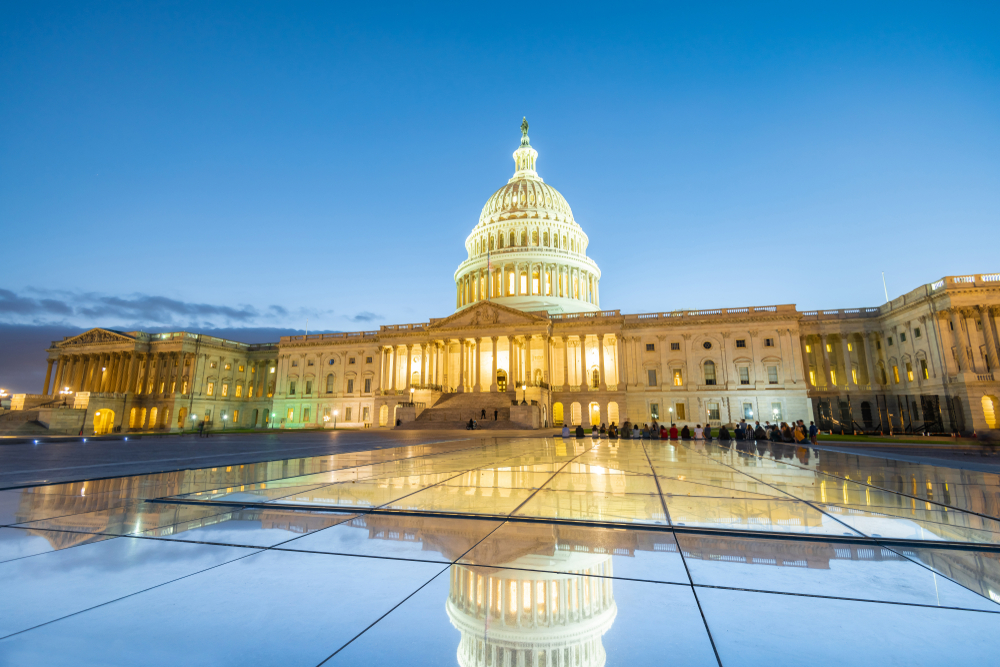
by Mike Lomuto, NCIA’s DEI Manager
NCIA is proud to announce that for the first time, thanks to the support of our members, we have awarded nine Lobby Days Equity Scholarships to support our Social Equity members with travel expenses to attend NCIA’s Lobby Days in Washington, D.C., on September 13-14. These Social Equity applicants and operators from around the country are leaders and active contributors to NCIA’s Sector Committees, our DEI Initiatives (particularly policy-related ones), and to advocacy efforts in their local and/or state municipalities.
Lobby Days provides the opportunity for NCIA members to come together to advocate for the issues most important to small cannabis businesses — from SAFE Banking to federal de-scheduling — and to share their personal stories with national lawmakers.
Our delegation includes:
Dr. Adrian Adams, Ontogen Botanicals CBD
Ambrose Gardner, Elev8
LaVonne Turner, Puff Couture
Michael Diaz-Rivera, Better Days Delivery
Osbert Orduña, The Cannabis Place
Raina Jackson, Purple Raina
Toni MSN, RN, CYT, Toni
We asked our DEI delegation why attending Lobby Days was important to them. Here are some of their responses:
 “I want our elected officials to hear my story which gives a voice to so many others, who like me, grew up in areas that have disproportionately borne the brunt and weight of cannabis enforcement. Children and young adults, whose only crime was being poor and of color, faced the indignity of being stopped and frisked hundreds of times. Now after paying the ultimate entry price, we can not get in the door of the cannabis industry because of a lack of banking and lending opportunities that continue to shut us out of the cannabis market.
The de-scheduling of cannabis, the passing of SAFE Banking, or the repeal of IRC 280E all would immediately increase the opportunities for small cannabis businesses like mine to have a true opportunity for success, growth, and economic empowerment of our communities.”
– Osbert Orduña, The Cannabis Place
 “As the industry grows and moves towards federal legalization, our elected officials must hear constituents’ voices. It’s important that my energy, face, and voice are present, representing the need for safe banking, health equity, and policies that support federal legalization. As states continue to legalize adult recreational cannabis usage, there will be an increased need for cannabis health equity to address the social, political, and economic conditions in underserved communities.
I’m committed to increasing awareness of the importance of education, employee retention, and community wellness in these communities.”
– Toni MSN, RN, CYT, Founder of Toni
NCIA’s Education Committee & Health Equity Working Group
 “I have begun to work on lobbying at a local level. Federal legalization, descheduling, decarceration, social equity, health equity, and safe banking are some of the areas that I would like to learn how to lobby for at the national level.”
– Michael Diaz-Rivera, Owner/Operator, Better Days Delivery
 “We should not stop at using the SAFE Banking Act merely to provide legal and regulatory protection for financial institutions. That will enable, but not ensure, increased banking services for minority-owned cannabis and hemp companies.
As the regulatory gaps between state and federal governments are addressed, there must be mechanisms to prevent predatory practices while opening access to capital.”
– Dr. Adrian Adams, Ontogen Botanicals CBD
It is important to the NCIA, and its membership for Main Street Cannabis to continue to develop in as diverse, equitable, and inclusive a manner as we can achieve. As the industry has thus far failed at creating tangible Social Equity, it’s important to ensure our efforts this September to include these voices and the communities they represent.
This is where the DEI delegation comes in.
As the official DEI delegation, the Lobby Days Equity Scholarship recipients will provide a foundational understanding of matters related to DEI in the industry for all NCIA members present at Lobby Days. The DEI delegation will ensure that there are members present speaking up on matters of DEI from within an important national trade association and within the context of Main Street Cannabis.
NCIA’s Government Relations team has organized a full day of meetings with Lawmakers and their Offices. New citizen lobbyists will receive online training before the event and are grouped together with experienced industry leaders who can help them find their voice. There will be an opening networking reception for all attendees, and a closing event featuring some of NCIA’s most important allies in Congress.
We are still accepting sponsorships to fully fund Lobby Days Equity Scholarships to ensure our recipients have their travel and lodging expenses covered while in Washington, D.C. Contact MikeLomuto@TheCannabisIndustry.org for more information.
Let’s keep building a better industry together, as we bring our voices to Washington, D.C.
NCIA’s 9th Annual Lobby Days – Strength in Numbers, Power in Progress
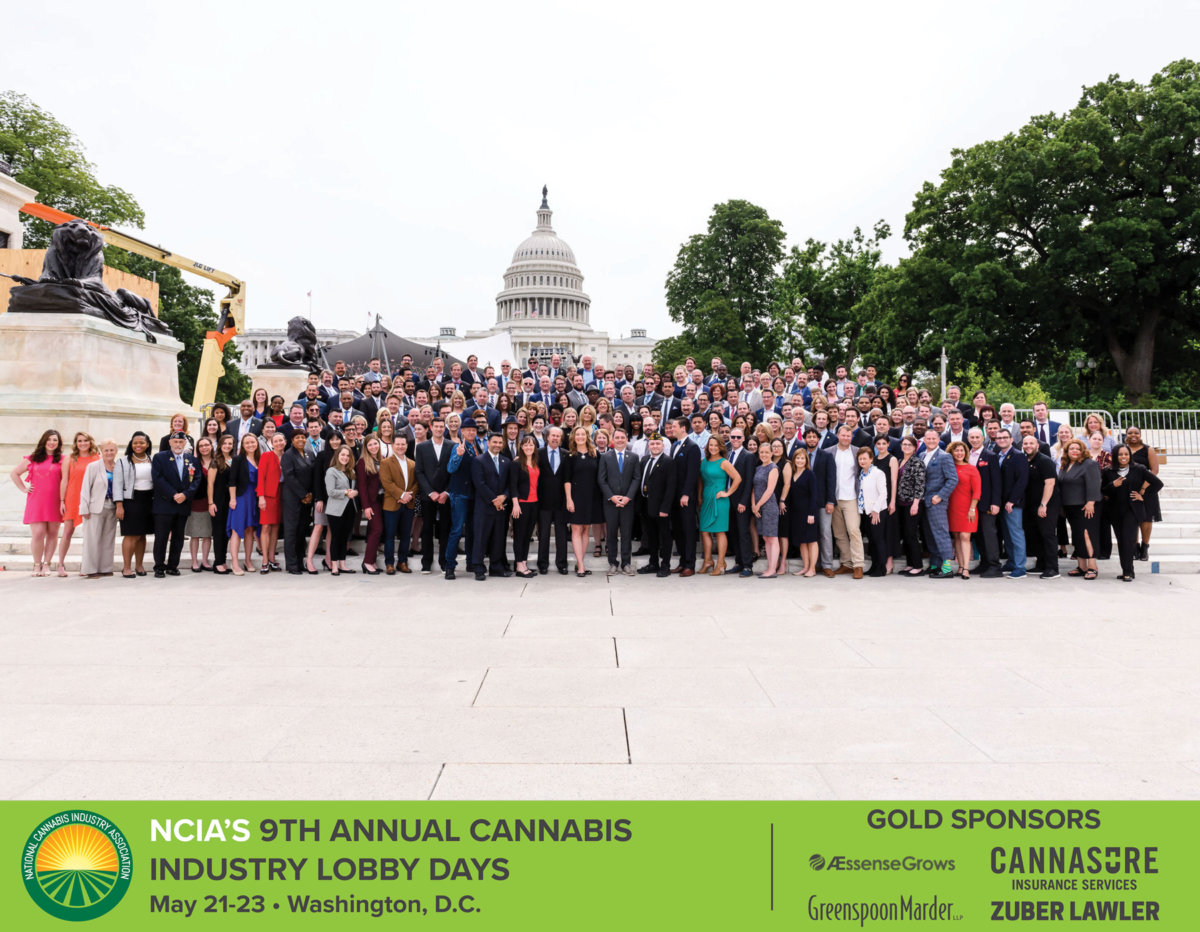
Just two short weeks ago, NCIA hosted our 9th Annual Cannabis Industry Lobby Days. This impactful event brought over 250 NCIA members to our nation’s capital to advocate and lobby on important issues facing our industry like access to financial services, amending IRC Section 280E, and addressing social equity.
Over the course of 48 hours, attendees met with nearly 300 congressional offices to share their stories and experiences, and dropped off informational materials to 200 offices that we did not schedule meetings with. In addition to these meetings, we had two briefings, held a PAC fundraiser, and hosted our first-ever VIP Day for members of our Leadership Circle. Let’s take a look at some of the highlights from this important event:
To kick off our first-ever VIP Day, we held a briefing at the House of Representatives entitled “SAFE Banking: Where We Are, and Where We’re Going,” where Congressman Ed Perlmutter (D-CO), the lead sponsor of HR 1595, the Secure and Fair Enforcement (SAFE) Banking Act, kicked off the day. On the panel was Tanner Daniel of the American Bankers Association, Becky Dansky of SARBA, and Gail Rand of ForwardGro, while attendees included NCIA members, congressional staff, and members of the press.
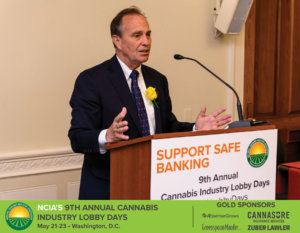
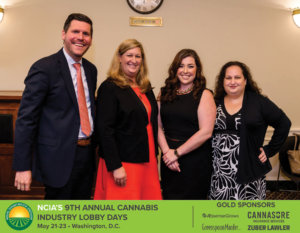
Following the briefing on banking, VIP Day attendees were shuttled to a luncheon featuring Reps. Joe Neguse (D-CO), Katie Porter (D-CA), Gil Cisneros (D-CA), and Steven Horsford (D-NV). All of these members of Congress are freshman who support cannabis reform, and talked about the importance of advocacy and the use of political action committees like the NCIA-PAC that they rely on.
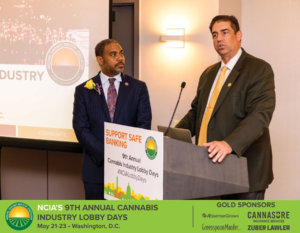
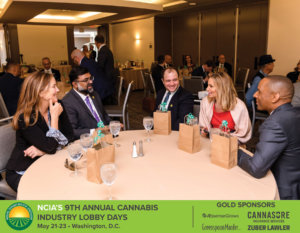
After lunch, VIP Day attendees were shuttled back to Capitol Hill, where teams met personally with members of Congress, committees of jurisdiction, and congressional leadership.
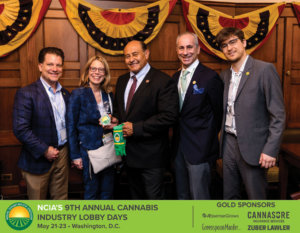
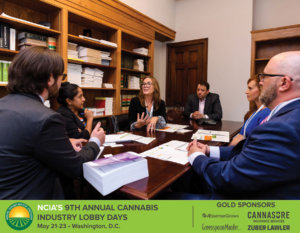
Our first ever VIP Day was a huge success, and we thank the members of NCIA’s PAC Leadership Circle for their dedication to advocacy.
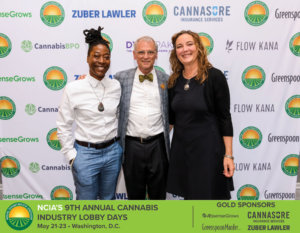
Lobby Days then officially started with a Welcome Reception attended by other advocates in Washington, D.C., NCIA members, and even congressional staff!
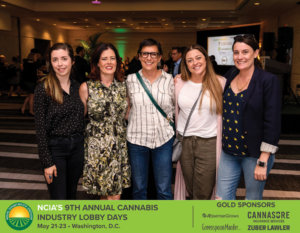
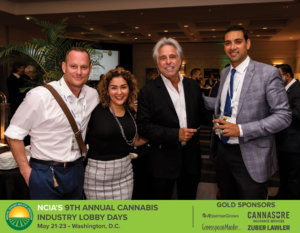
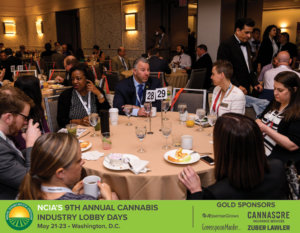
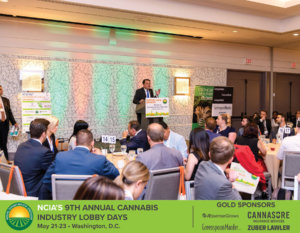
The following day, the work really began at our breakfast training. There, attendees met with the groups that they would be in for the day, were taught talking points on various bills and issues, and learned about how to use the app that housed all of their meeting information.
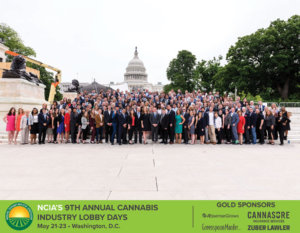
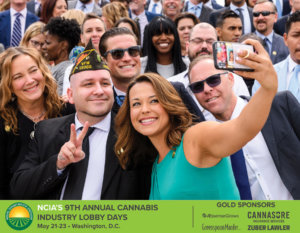
Washington, D.C. is full of great photo ops, so after our breakfast training, all of our attendees shuttled over to the Capitol… and snapped a few selfies, of course!
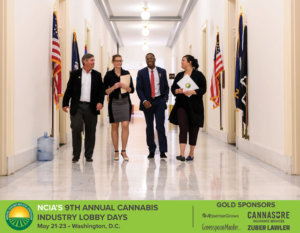
Meetings on Capitol Hill went from 12pm to 4pm. Each of NCIA’s 54 lobbying teams had at least four meetings over that course of time. Some groups were even lucky enough to sit down with members of Congress to talk about the issues that affect them and their businesses the most.
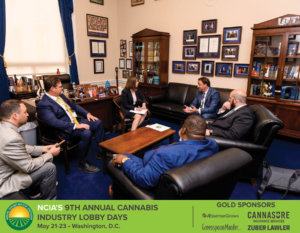
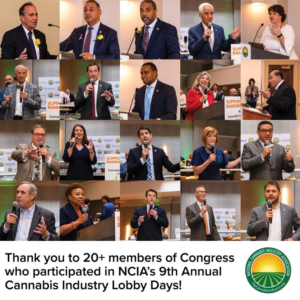
The day concluded with a fundraiser for the NCIA-PAC. This year’s event was wildly successful, as we had 15 members of the House of Representatives (Reps. Porter (D-CA), Charlie Crist (D-FL), Josh Harder (D-CA), Earl Blumenauer (D-OR), Ruben Gallego (D-AZ), Salud Carbajal (D-CA), Jared Huffman (D-CA), Jason Crow (D-CO), Brendan Boyle (D-PA), Diana DeGette (D-CO), Denny Heck (D-WA), Barbara Lee (D-CA), Dina Titus (D-NV), Susie Lee (D-NV), Matt Gaetz (R-FL)) attend and speak, as well as Sen. Jeff Merkley (D-OR).
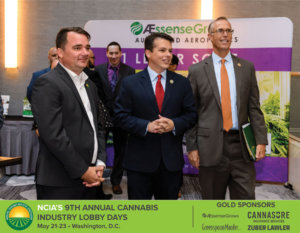
The final day of Lobby Days began with a standing-room-only briefing that focused on NCIA’s new white paper titled “Increasing Equity in the Cannabis Industry” that our Policy Council worked on with the Minority Cannabis Business Association (MCBA). Opening remarks were given by MCBA’s President, Shanita Penny along with the Principal of Greenbridge Corporate Counsel, Board Vice-Chair of the National Cannabis Industry Association, and Co-Chair of the Minority Cannabis Business Association Policy Committee, Khurshid Khoja. We were also joined by two members of the Congressional Hispanic Caucus, Rep. Lou Correa (D-CA), and Rep. Ruben Gallego (D-AZ).
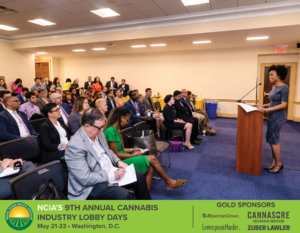
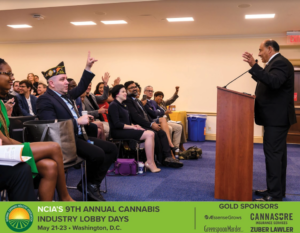
Lobby Days wrapped up with small groups dropping off folders with informational materials to congressional offices that we were unable to schedule meetings with. While some may think these drop-ins are ineffective, they actually prove to be incredibly helpful long after our attendees go home.
The dates for NCIA’s 10th Annual Cannabis Industry Lobby Days have already been chosen, so mark your calendars for our biggest year yet, happening May 19-21, 2020!
Be sure to check out the full photo album from this year’s Lobby Days!
The Small Business Tax Equity Act: Supporting a Just Cause at NCIA Lobby Days

by NCIA Editorial Staff
The American cannabis industry should be proud of generating thousands of jobs and billions of dollars in tax revenue for America- but can you imagine how much more we could do without the 280E tax burden?
While it’s an exciting time to be in the cannabis industry, our businesses are struggling under crippling federal taxation. It’s all due to Section 280E of the IRS tax code. A provision originally set out to penalize bad actors in criminal market. Unfortunately for our industry, the federal government has yet to remove the plant from its list of scheduled drugs and continues to deny cannabis as a fully legal product with medical benefits. In sum, if your business touches the plant then you’re in danger of losing your profits under Section 280E of the IRS tax code. It’s a critical time for us to come together and demand change for the industry at the federal level so our business owners can do what they do best; grow their business and give back to the community.
Despite the 280E difficulties, Portland’s MindRite dispensary was voted the most charitable cannabis store by DOPE magazine. Owners Shea and Jaime Conley said they would give even more if their business was taxed like any other industry.
MindRite can’t write off their tens of thousands of dollars in charitable donations because 280E hinders it. “It’s coming out of our profits but its just something we do and has never been up for debate because we believe it’s the business owner’s responsibility to make the community around them better, said Shea. The Conley’s also said they would jump through even more hoops and regulations because it’s a privilege to be able to work in an industry they are so passionate about. But the fact remains, “if 280E wasn’t over our heads,” he said, “we would’ve expanded our business by now.” Without 280E they would reinvest the money they paid the government. “We could have two more dispensaries open,” said Shea.
As tax professional Jim Marty of Bridge West explained, businesses can normally retain profits from usual business deductions such as; employee salaries, utilities, facility rent, payments to contractors, and health insurance premiums. For those in the green space, anything outside of the cost of goods sold is not deductible. In efforts to level the playing field, Jim works with clients and lobbyists at the state level to allow for deductions. “We’ve testified in front of committees,” he said, “and some state tax rates are lower than the federal.” In prior interviews with CNBC and FOX Business, his advice is to understand your business plan because 280E creates an impossible situation for legitimate cannabis businesses.
State tax rates may be lower than federal in states like Colorado and Oregon, however, it’s not enough to offset the penalty they pay at the federal level. “We are aware of every dollar that goes out and comes in, it’s a must if you want longevity for your business,” said Shea. The dispensary deals with razor-sharp profit margins in anticipation of paying their penalty to the IRS every April.
It’s frustrating for business owners and employees. Mitch Woolheiser of Northern Lights Cannabis said his business growth is stunted as a direct result of the issue. “I can’t give my employees raises. I can’t put money back into my business. Instead, I’ve been hoarding cash in anticipation of what the IRS is going to take,” he said. In total, cannabis businesses are paying taxes on gross income which often amounts to paying rates that are 70% or higher. Comparatively, the corporate tax rate established by The Tax Cuts and Jobs Act of 2017 is only 21%.
That’s why we are once again taking to the steps of Congress in May for our 8th annual Lobby Days in Washington D.C. While in D.C., Jim said he hopes to meet with President Donald Trump. He said if the executive branch has authority to reschedule marijuana, he’d ask President Trump to categorize cannabis as a Schedule 3 substance or unschedule it completely because it would ensure that section 280E would no longer apply.
We also encourage everyone in support of a healthy, prosperous cannabis industry to talk to their Senators and Representatives about The Small Business Tax Equity Act. The amendment would exempt compliant cannabis businesses from the 280E provision which we believe would inevitably lead to in an influx of employment opportunities with more competitive salaries.
Policy Council: IRC Section 280E – An Unjust Burden on State-Legal Cannabis Businesses
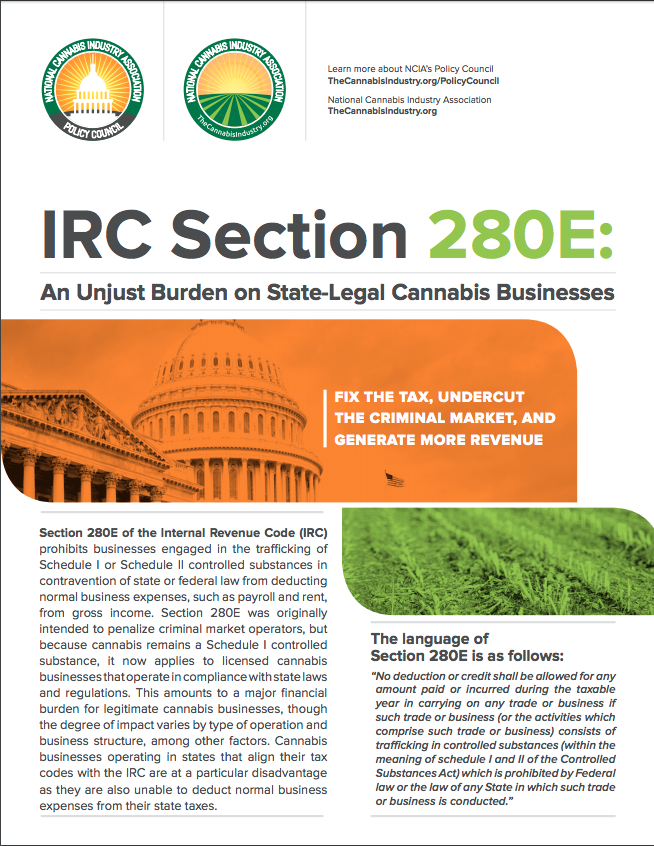
NCIA’s Policy Council, comprised of industry leaders selected by NCIA’s Board of Directors, play a critical role in the development of cannabis policy at the federal level. The Policy Council recently produced a white paper titled “IRC Section 280E: An Unjust Burden on State-Legal Cannabis Businesses” which is now available in an easy-to-read design with the intention of utilizing this in conversations with policymakers, the media, and the industry.
“Fixing Section 280E of the Internal Revenue Code has been a policy priority for NCIA since its founding in 2010,” said Steve Fox, co-founder of NCIA and director of the Policy Council. “It is therefore appropriate that the fist Policy Council paper is focused on this issue. The information contained in this paper will be useful in lobbying efforts as Congress continues to debate tax reform. In particular, the projections contained in the paper, showing that reforming 280E could actually result in a net increase in tax revenue for the federal government, should be especially eye-opening.”
Click the image below to view the report.
Follow NCIA
Newsletter
Facebook
Twitter
LinkedIn
Instagram
News & Resource Topics
–
This Just In
NCIA Applauds Reintroduction of SAFE Banking Following Lobby Days
Beyond Rescheduling: Inside NCIA’s 14th Annual National Cannabis Industry Lobby Days