Cannabis State Ballot Measures – Facts & Figures

by Morgan Fox, NCIA’s Director of Media Relations
Arizona
 Ballot: Proposition 207, Smart & Safe Act (adult use)
Summary: https://smartandsafeaz.com/about/
Full language: https://mk0adassociatioy1jbg.kinstacdn.com/wp-content/uploads/2019/10/I-23-2020.pdf
Main backers: Smart and Safe Arizona
Possession: Adults 21+, 1 ounce flower or 5 grams concentrate
Home cultivation: YES, adults 121+ may have up to 6 plants in an enclosed locked location out of public view.
Licenses:
- Issue no more than one marijuana establishment license per 10 pharmacies;
- Issue no more than two marijuana establishment licenses in counties that contain no registered nonprofit medical marijuana dispensaries;
- Issue no more than one marijuana establishment license in counties with one nonprofit medical marijuana dispensaries; and
- Issue 26 licenses, notwithstanding the other limits, to entities qualified under the Social Equity Ownership Program.
Social Equity:
Department of Health Services would be required to establish a Social Equity Ownership Program to promote cannabis business ownership and employment for individuals from communities disproportionately impacted by the enforcement of previous marijuana laws.
Proposition 207 would establish a fund called the Justice Reinvestment Fund (JRF). Revenue in the JRF would be allocated as follows:
- 35 percent to local public health departments in proportion to the county’s population for the purpose of providing justice reinvestment programs or giving grants to nonprofits to provide justice reinvestment programs within the county’s area.
- 35 percent to DHS to provide grants to nonprofits to provide justice reinvestment programs in the state.
- 30 percent to DHS “for the purpose of addressing important public health issues” that affect Arizona.
Taxes & Revenue:
Transaction Privilege Tax (currently 5.6%)
Specific 16% excise tax (non-medical)
Revenue from the excise tax and license fees would be deposited into the Smart and Safe Arizona Fund. First, revenue would be used to implement and enforce marijuana regulations. The remaining revenue would be allocated as follows:
- 33.0 percent for community college districts;
- 31.4 percent for municipal police and fire departments, county sheriff departments, and fire districts;
- 25.4 percent for the state’s Highway User Revenue Fund;
- 10.0 percent for the new Justice Reinvestment Fund; and
DONATE NOW
Additional Resources: Proposition 7 Information, FAQ
Mississippi
Ballots: Initiative 65 (medical), Alternative 65A (medical, terminally ill patients only)
Summary:
Full Language:
Main Backers:
Possession:
- Initiative 65 – Qualifying patients may purchase/possess up to two and a half (2.5) ounces every 14 days
- Alternative 65A – Undefined, no explicit protections
Home Cultivation: NO
Licensing:
- Initiative 65 – TBD by Dept. of Health; no limits on number of treatment centers; may not be located within five hundred (500) feet of a pre-existing school, church, or licensed child care center
- Alternative 65A – Undefined
Social Equity: None explicitly included in either initiative.
Taxes & Revenue:
- Initiative 65 – Dept. of Health may authorize taxes up to the level of the state sales tax (currently 7%); revenue to be used for special operating fund and may not revert to state general fund
- Amendment 65A – Undefined
DONATE NOW
Additional Resources: Overview and Sample Ballot Question – IMPORTANT! These questions are worded in a confusing manner on ballots.
Montana
 Ballots: Initiative 190 Marijuana Legalization Initiative (adult use), CI-118 Allow for a Legal Age for Marijuana Amendment
Summary:
- Initiative 118 would allow legislation or a citizen initiative to set the legal age limit for possession at an age higher than the state definition of adulthood (18 years old).
- Initiative 190 would regulate cannabis for adults age 21 and older.
- Summary of both initiatives is available here.
Full Language:
Main Backers: New Approach Montana
Possession: Adults 21+, up to one ounce of flower or 8 grams of concentrate
Home Cultivation: YES, up to four (4) plants per adult, maximum eight (8) per household.
Licensing:
The Department of Revenue shall develop rules and regulations regarding licensing of providers, marijuana-infused products providers, and dispensaries for adult use. For the first 12 months, only existing medical cannabis licensees may apply. Provider licenses are established in tiers based on canopy size and also include micro-business licenses. Applicants must have resided in Montana for at least one year prior and may not have been convicted of a felony involving fraud, deceit, or embezzlement or for distribution of drugs to a minor within the past 5 years. Cannabis businesses may not be located within 500 feet of a school or place of worship unless permitted by the local jurisdiction.
Social Equity: Persons convicted of behavior permitted by Initiative 190 may apply for resentencing or expungement.
Taxes & Revenue:
- Specific sales tax – 20%
- Revenue will be used to fund operating costs of regulation as well as to support conservation efforts, substance abuse treatment and education, veterans programs, local governments, the general fund, and other programs. More information is available here.
DONATE NOW
Additional Resources: Initiative 190 Information
New Jersey
 Ballots: Question 1, Marijuana Legalization Amendment (2020)
Summary: https://www.njcan2020.org/whats-on-the-ballot/
Main Backers: NJ Can 2020
Possession: 21+, limits TBD by Legislature
Home Cultivation: TBD by Legislature
Licensing: TBD by Legislature, regulated by existing Cannabis Regulatory Commission
Social Equity: TBD by Legislature
Taxes & Revenue: Standard state sales tax of 6.625%; Legislature can authorize municipalities to impose up to an additional 2% local tax
DONATE NOW
Additional Resources:
South Dakota
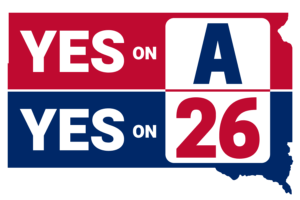 Ballots: Measure 26 (medical), Amendment A (adult use)
Summaries: https://www.southdakotamarijuana.org/the-initiatives
Full Language:
Main backers:
Possession:
- Measure 26 – Registered patients, up to three (3) ounces
- Amendment A – Adults 21+, up to one ounce
Home Cultivation:
- Measure 26 – Patients with home cultivation certification may grow 3 plants minimum or a number determined by their physician
- Amendment A – 3 plants per person (6 max per household) in jurisdictions with no licensed retail stores
Licensing:
- Measure 26 – TBD by Dept. of Health
- Amendment A – TBD by Dept. of Revenue
Social Equity: None explicitly included in initiative language
Taxes & Revenue:
- Measure 26 – TBD by Dept. of Health and Legislature
- Amendment A – 15% sales tax, split evenly between public school fund and state general fund after implementation and operation costs are covered.
DONATE NOW
Additional Resources:
From The Ballot Box: Post-Midterm Election Analysis
by Michelle Rutter, NCIA Government Relations Manager
Last night, Americans all over the country let their voices be heard at the ballot box. Voters in Michigan cast their votes for the legalization of adult-use cannabis, increasing momentum of our movement. At the same time, voters in Missouri and Utah were successful in legalizing medical cannabis, becoming the 32nd and 33rd states to do so, and despite significant hurdles.
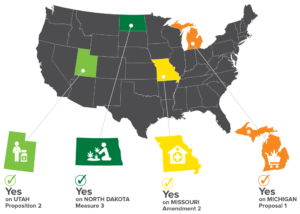 MICHIGAN
Appearing on the ballot as Proposal 1, this initiative passed by a whopping 55% and made Michigan the first state in the Midwest to legalize adult-use cannabis for those over the age of 21. The proposal outlined an excise sales tax of 10%, which will be levied on sales at retailers and micro-businesses, and then be allocated to local governments, K-12 education, and road and bridge maintenance. In the future, municipalities will be given the authority to to ban or limit cannabis businesses and establishments within their boundaries. Michigan’s prominent Midwest location, as well as the size of the projected adult-use market, make it a game-changing initiative to watch for cannabis reform. Michigan is the only adult-use state that also gave it’s electoral votes to President Trump in the 2016 election.
NORTH DAKOTA
In North Dakota, Measure 3, or the Marijuana Legalization and Automatic Expungement Initiative, appeared on the ballot and failed by only receiving 40% of the vote. This measure would have made cannabis legal in the state of North Dakota for people 21 years of age or older and, unlike other initiatives, also created an automatic expungement process for individuals with convictions for a controlled substance that has been legalized. Advocates and policy organizations were initially stunned when the campaign submitted enough signatures to appear on the ballot, and immediately recognized the importance of a staunchly, dependably conservative state choosing to legalize the adult-use of cannabis. Both of the candidates who ran for Senate in the state, Rep. Kevin Cramer (R) and Sen. Heidi Heitkamp (D) stated that they opposed the measure.
UTAH
In Utah, the Medical Marijuana Initiative (Proposition 2) appeared on the 2018 ballot and passed with 53% of the vote. This initiative legalized the medical use of marijuana for individuals with qualifying medical illnesses such as epilepsy, HIV, and and multiple sclerosis, among others. In October, the proponents and opponents of the measure, Mormon church leaders, and elected officials met to discuss the possibility of passing a medical cannabis law through the state legislature– regardless of the result for Proposition 2, which it was determined, would remain on the ballot. State lawmakers plan to hold a special session to work out details for how to make Utah the next medical cannabis state. Utah is a perfect example of a traditionally conservative state choosing to reform their cannabis laws to be more compassionate — Utah has given its electoral votes to Republican presidents in every election since 1968.
MISSOURI
In Missouri, three separate medical cannabis initiatives appeared on the ballot last night– including two proposed constitutional amendments and one statutory measure– with Amendment 2 triumphing with 65% of the vote. The other two medical cannabis initiatives failed. The winning Amendment 2, backed by New Approach Missouri, was favored by national advocacy groups such as NCIA, MPP, and NORML. The initiative legalized cannabis for medical purposes, creates a licensing system for cultivation, testing, and dispensing of medical cannabis and sets up a 4% tax on cannabis sales. State tax revenue garnered will be spent on healthcare services for veterans. Voters in Missouri also elected Josh Hawley (R) to replace sitting Sen. Claire McCaskill (D). Interestingly, Amendment 2 received over 300,000 more votes than Senator-elect Hawley — proving that cannabis is a winning issue across partisan lines.
OUTLOOK: 2019 AND THE 116TH CONGRESS
 These stunning victories have implications in Washington, D.C. and set the stage for federal reform in the 116th Congress. In addition to the ballot initiatives that were passed last night, Democrats took control of the House of Representatives, while Republicans maintained their control of the Senate. While this development surely means that cannabis policy will progress further than ever in the House, it also means that anything passed through that chamber will face significant hurdles in the more conservative Senate.
HOUSE
This year’s midterm election was one of the most highly anticipated in modern American history.
Last night, the House of Representatives switched from a Republican majority to a Democratic majority: as of Wednesday morning, Democrats held 220 seats, while Republicans held 194.
Republican leadership in the House of Representatives over the last two years has blocked even popular reforms such as banking access from receiving hearings or votes.
With a Democratic majority in the House of Representatives, cannabis legislation will likely move at an unprecedented rate. Because Democrats have traditionally been more friendly to cannabis reforms, there is the possibility that hearings will be held, bills will move through committees, and even possibly be voted on and passed on to the Senate.
Most, if not all, of last night’s House races will have implications for cannabis policy in the 116th Congress. Notable cannabis opponent and chairman of the powerful Rules Committee Pete Sessions was defeated in a stunning victory by Colin Allred, who has stated his clear support for medical cannabis. At the same time, cannabis advocates saw the loss of longtime cannabis champion Rep. Dana Rohrabacher (R-CA), marking the end of an era. While the loss of Rep. Rohrabacher will be felt by many, his challenger Harley Rouda has stated his unequivocal support for adult-use cannabis.
SENATE
As polls indicated prior to Election Day, Republicans maintained their control of the Senate, and in fact strengthened their majority. As of Wednesday morning, Republicans had gained two members in the Senate, holding a total of 51 seats, with three races still in play. While the Democrat-controlled House of Representatives may be able to move pro-cannabis amendments and legislation through that chamber, anything that moves on to the more conservative Senate will face significant hurdles.
One of the most closely watched Senate races in the country was in Nevada, where sitting Sen. Dean Heller (R) faced Rep. Jacky Rosen (D). While Sen. Heller has signaled his support for cannabis reform in the past, he currently does not co-sponsor any pro-cannabis legislation in the Senate. Rep. Rosen, however, is a co-sponsor of multiple bills in the House, including the SAFE Banking Act (H.R. 2215), the Small Business Tax Equity Act (H.R. 1810), and the STATES Act (H.R. 6043), among others. In addition, Rep. Rosen replied to an NCIA candidate survey and stated, “I was proud to support Nevada’s marijuana ballot initiative in 2016 and our state has already seen the positive impacts of this industry, including thousands of jobs and millions of dollars in tax revenue.”
With more on the line than ever before, political donations and investments in our industry are vital. NCIA’s political action committee (NCIA-PAC) is proud to have donated to 41 of the winning candidates on election night.
The 116th Congress will arrive in Washington, D.C. in January. With the change in leadership in the House of Representatives, cannabis policy and reforms will be able to advance in a way never seen before. At the same time, any pro-cannabis bills or amendments sent to the Senate will still face challenges, but as recent elections have proved, anything is possible.
 It is more important than ever to get out and vote. Our government relations team works hard in our nation’s Capital to achieve legislative victories at the federal level; however, achieving legislative victories at each state is just as important. It is through each successful ballot initiative at the state that provides the proof and support for legislative change and policy reform at the federal level. States are moving forward; therefore, we must be on Capitol Hill. We must keep fighting the good fight and get out and show our support for cannabis policy reform.
Follow NCIA
Newsletter
Facebook
Twitter
LinkedIn
Instagram
News & Resource Topics
–
This Just In
Member Blog: What Consumers Really Want in a Pre-Roll
Member Blog: The Evolving Cannabis Legal & Regulatory Landscape in 2026