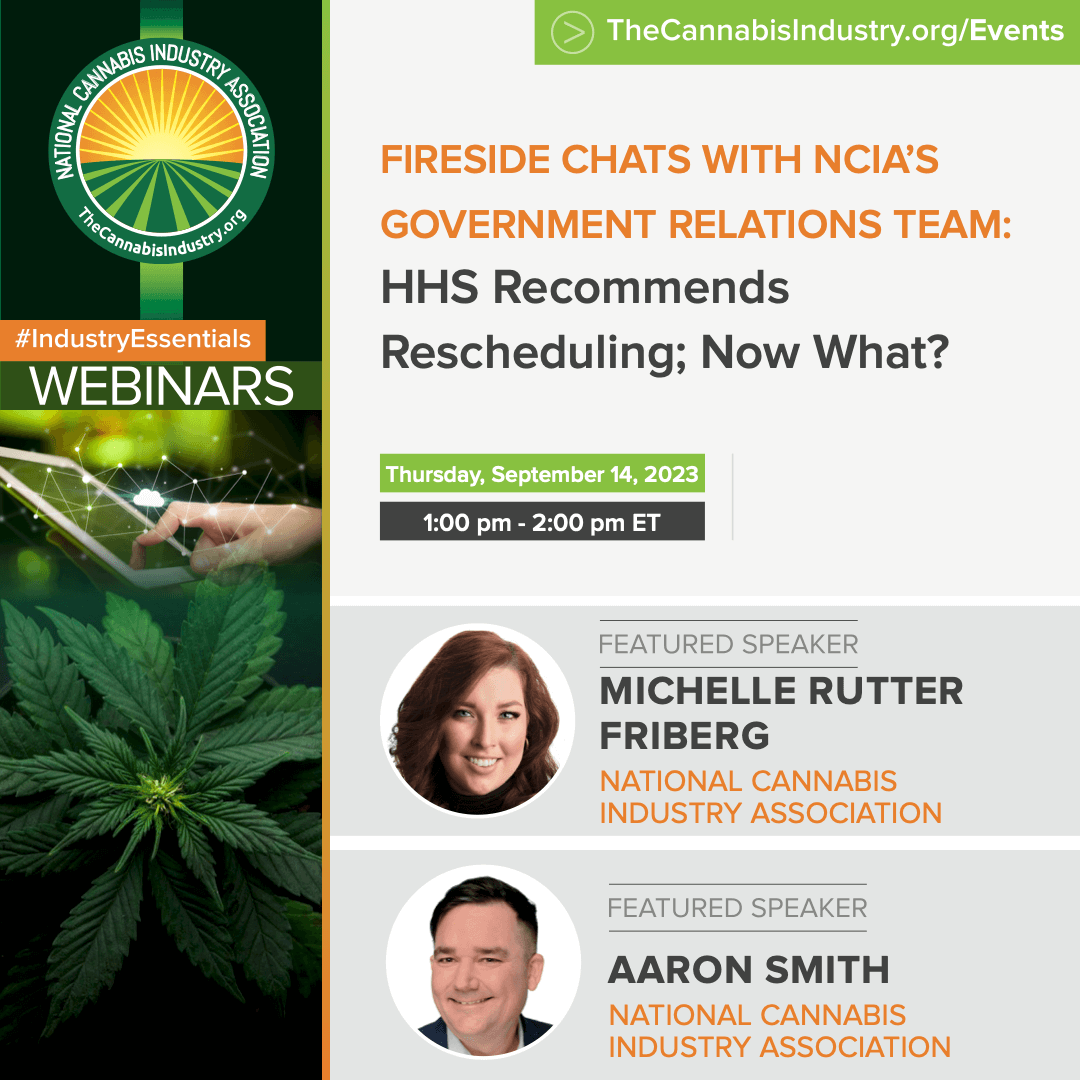
HHS Recommends Rescheduling: Now What? | 9.14.23 | Fireside Chats with NCIA’s Government Relations Team
NCIA’s #IndustryEssentials webinar series is our premier digital educational platform featuring a variety of interactive programs allowing us to provide you timely, engaging and essential education when you need it most. The Fireside Chat series of NCIA’s #IndustryEssentials webinars are an opportunity for industry professionals to hear from our government relations team and guests about the latest developments in federal policy LIVE.
For more than fifty years, the federal government has maintained that cannabis is a Schedule I drug, meaning that it has a high potential for abuse and no accepted medical value.
That recently changed when the Department of Health and Human Services (HHS) recommended to the Drug Enforcement Administration (DEA) that cannabis be placed in Schedule III, meaning that it has moderate to low abuse potential, a currently accepted medical use, and a low potential for psychological dependence.
There’s no doubt this move was an historic one– but what does it mean? What’s next? How will it impact your business? Join NCIA’s Aaron Smith and Michelle Rutter Friberg as they unpack all these questions surrounding cannabis rescheduling impact and more!
By Michelle Rutter Friberg, NCIA’s Deputy Director of Government Relations
October has been a mixed bag in Washington, D.C. in terms of cannabis policy: there hasn’t been much news from Capitol Hill, but the Biden Administration shocked everyone when they made a big announcement earlier this month. As we draw nearer to the midterm elections in November (don’t forget to register!), let’s take a look at where things stand currently:
On Capitol Hill:
SAFE Banking Act
The SAFE Banking Act (S. 910) has been held up in the Senate for more than a year now. Many Senate Democrats (including Leader Schumer) have been pushing for changes to the bill to create a “SAFE +” bill that includes justice-focused provisions. As with all things in politics, a delicate balance must be kept in order to reach 60 votes in the hyper-partisan Senate.
The good news: Leader Schumer and other Democrats have been in negotiations with lead-Republican co-sponsor Sen. Steve Daines (R-MT) and others to determine what “SAFE +” could look like. Those discussions have been occurring for a few weeks now and will continue.
The bad news: those negotiations are taking time. As a result, you shouldn’t expect any legislative movement to occur until after the midterm elections.
There’s also the National Defense Authorization Act (NDAA) to consider. The House passed and sent the FY2023 NDAA to the Senate months ago and the large package did include the language of the SAFE Banking Act (as currently written). It’s unclear how the SAFE+ negotiations may impact cannabis banking’s chances in the NDAA: Leader Schumer could make sure the language is not in the NDAA if he feels confident about SAFE+’s chances.
CAOA
Unfortunately, there’s no substantive news regarding the Cannabis Administration and Opportunity Act (CAOA), or comprehensive reform broadly on Capitol Hill right now. While NCIA and others continue to push for descheduling and responsible regulations from Congress, the upcoming election and Senate timeline have taken precedent. It’s unlikely that CAOA will move this legislative session given the number of legislative days left in the year.
From the Administration:
Earlier this month, President Biden made an unprecedented announcement that his administration would begin the process for the pardoning of thousands of people with nonviolent marijuana use or possession convictions, and would begin the process of working with the Department of Health and Human Services to reclassify marijuana from a Schedule I drug in the Controlled Substances Act.
This announcement comes on the heels of NCIA’s successful 10th Annual Cannabis Industry Lobby Days held in mid-September, where 100 cannabis industry professionals, representing small and medium-sized businesses including social equity operators, met with more than 100 Congressional offices to discuss barriers faced by the industry stemming from marijuana prohibition.
It’s no coincidence that when NCIA members show up to D.C., big things happen! Make sure to stay informed as we head towards the lame duck session via our newsletter and social media platforms and don’t forget to register for NCIA’s upcoming 11th Annual Cannabis Industry Lobby Days in May 2023!
Video: NCIA Today – Thursday, July 28, 2022
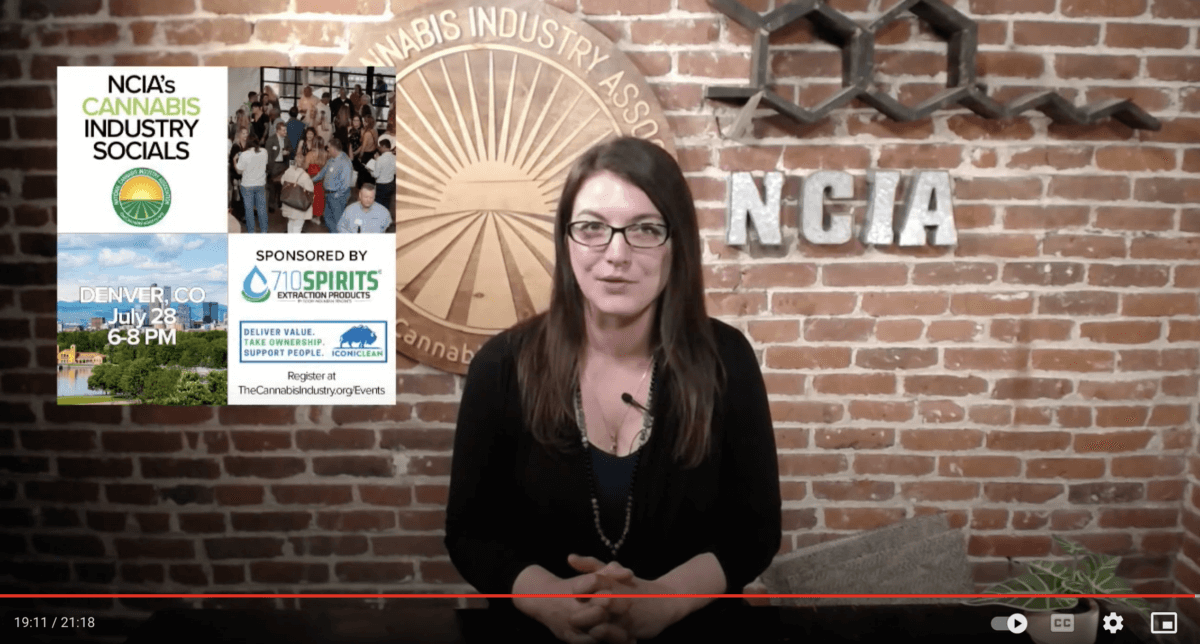
NCIA Director of Communications Bethany Moore checks in with what’s going on across the country with the National Cannabis Industry Association’s membership, board, allies, and staff. This week Bethany is joined by NCIA CEO Aaron Smith and Deputy Director of Government Relations Michelle Rutter Friberg. Join us every other Thursday on Facebook for NCIA Today Live.
Mixed Bag in D.C. – SAFE Banking and New Bills
Photo By CannabisCamera.com
by Michelle Rutter Friberg, NCIA’s Deputy Director of Government Relations
There’s no getting around it: last week was a mixed bag for cannabis policy in Washington, D.C. While there was excitement around the introduction of two bills in the House of Representatives, it was tempered by the fact that congressional leaders removed the SAFE Banking Act language from the America COMPETES/USICA trade bill.
SAFE Banking: what happened and what’s next?
The cannabis industry (and many others) were disheartened to learn that the SAFE Banking Act language that had been attached to the House’s America COMPETES Act was stripped out during negotiations last week. Over the last couple of months, both parties have been scrambling to negotiate the legislation into something that could pass both chambers and get across the President’s desk. Unfortunately, Majority Leader Schumer (D-NY), Minority Leader McConnell (R-KY), Speaker Pelosi (D-CA), and Minority Leader McCarthy (R-CA) decided to put the SAFE Banking Act on the chopping block again despite pleas from businesses, financial institutions, and numerous state officials.
While SAFE will not be included in this legislative package, lead sponsor Rep. Ed Perlmutter went to Twitter to talk about what’s next:
“By excluding the#SAFEBankingAct from the#USICA/#COMPETES bill, the Senate continues to ignore the public safety risk of forcing cannabis businesses to deal in all cash. In the wake of the Senate’s inaction, people continue to be killed and businesses continue to be robbed. I will continue to push for#SAFEBanking to be included in COMPETES, other legislative vehicles, or for the Senate to finally take up the standalone version of the bill which has been sitting in the Senate for three and a half years.”
But don’t give up just yet: there’s been much talk on Capitol Hill about a “SAFE+” package of some type. Read more about that here.
New bills: the CLIMB Act and the Veterans Equal Access Act
Last week, we saw the introduction of two cannabis bills in the House: one was a new bill that’s never been introduced, while the other has been introduced in many Congress’ past. The former: the Capital Lending and Investment for Marijuana Businesses (CLIMB) Act; the latter: the Veterans Equal Access Act.
Led by Reps. Troy A Carter, Sr. (D-LA) and Guy Reschenthaler (R-PA), the CLIMB Act looks to:
Provide safe harbor for private financial institutions to offer lending services state-legal American businesses. Due to federal prohibition, a majority of American banks will not offer loans or lending options to small, minority and veteran-owned cannabis businesses.
Protect government agencies such as Community Development Financial Institutions (CDFI) and the Small Business Administration (SBA) and Minority Business Development Association (MBDA) from issuing grants and other sources of government funding. The CLIMB Act will allow entrepreneurs and small businesses to apply for funding to start and grow their business in the cannabis industry, particularly in areas most adversely impacted by the War on Drugs.
The Veterans Equal Access Act has been introduced in the past; this session, the bill is again led by champion Rep. Earl Blumenauer (D-OR) and newcomer to the legislation and Cannabis Caucus co-chair Brian Mast (R-FL).
The bill states that the secretary of the VA must “authorize physicians and other health care providers employed” by the department to 1) “provide recommendations and opinions to veterans who are residents of states with state marijuana programs regarding the participation of veterans in such state marijuana programs” and 2) “complete forms reflecting such recommendations and opinions.”
The bill has previously cleared the House Veterans’ Affairs Committee and was then turned into an appropriations rider; however, it has never been passed into law.
One thing is clear: we have our work cut out for us as we look to the last six months of this Congress. Want to get more involved with our government relations efforts? Consider becoming an Evergreen Roundtable member today, and mark your calendar for September 13-14, as we return in-person for lobby days in Washington, D.C.!
Video: NCIA Today – September 3, 2021
NCIA Deputy Director of Communications Bethany Moore checks in with what’s going on across the country with the National Cannabis Industry Association’s membership, board, allies, and staff. Join us every Friday here on Facebook for NCIA Today Live.
Video: NCIA Today – July 23, 2021
NCIA Deputy Director of Communications Bethany Moore checks in with what’s going on across the country with the National Cannabis Industry Association’s membership, board, allies, and staff. Join us every Friday here on Facebook for NCIA Today Live.
Video: NCIA Today – July 2, 2021
NCIA Deputy Director of Communications Bethany Moore checks in with what’s going on across the country with the National Cannabis Industry Association’s membership, board, allies, and staff. Join us every Friday here on Facebook for NCIA Today Live.
Registration to our Midwest Cannabis Business Conference in Detroit is now open with special limited-time super early bird pricing on tickets available.
NCIA Deputy Director of Communications Bethany Moore checks in with what’s going on across the country with the National Cannabis Industry Association’s membership, board, allies, and staff. Join us every Friday here on Facebook for NCIA Today Live.
Video: NCIA Today – April 23, 2021
NCIA Deputy Director of Communications Bethany Moore checks in with what’s going on across the country with the National Cannabis Industry Association’s membership, board, allies, and staff. Join us every Friday on Facebook for NCIA Today Live.
State Cannabis Policy Update: Can You Keep Up?
By Michelle Rutter Friberg, NCIA’s Deputy Director of Government Relations
Photo By CannabisCamera.com
Last week was an historic one for cannabis policy around the nation. The second largest adult-use market, New York, successfully legalized cannabis and has already been signed into law by Governor Andrew Cuomo (D). New Mexico’s legislature also passed adult-use legislation which awaits Governor Michelle Lujan Grisham’s (D) signature shortly. Lastly, Virginia Governor Ralph Northam (D) signaled that he wants the state’s new adult-use cannabis laws to go into effect sooner than originally anticipated. Keep reading below for a brief summary of what’s happening in each of those states, and what it means for federal policy.
New York
Last week, New York became the 16th state to approve a law creating a regulated adult-use cannabis market when Gov. Cuomo signed the Marijuana Revenue and Taxation Act (MRTA). This legislation would make possession of up to three ounces and limited home cultivation legal and will automatically expunge convictions for behavior that is legal under the new law. Notably, the new law also allows for cannabis consumption almost everywhere that tobacco consumption is allowed.
Equity was at the forefront of New York’s bill: forty percent of tax revenue will be directed toward communities disproportionately impacted by cannabis prohibition, and provisions in the MRTA seek to award half of all business licenses to social equity applicants. The importance of this can’t be overstated: nearly 60,000 people – the majority of whom are people of color – are arrested for marijuana violations in New York every year, the effects of which can permanently damage their ability to obtain employment, housing, and education, among other collateral consequences.
A 2020 report by Arcview Market Research and BDSA projected that the New York cannabis market will be worth more than $1.6 billion by 2025. The state plans to tax cannabis at 9% at the state level with an additional 4% made available to cities and counties, and with additional incremental taxes levied based on the type of product and the amount of THC contained in them.
New Mexico
New Mexico is now poised to become the 17th state to legalize adult-use cannabis upon Gov. Lujan Grisham’s signature. The legislature advanced two measures to the governor’s desk: the first legalizes and regulates cannabis possession, production, and sales for adults over the age of 21, while the second facilitates the automatic review and expungement of the records of those convicted of low-level marijuana offenses.
The state’s Cannabis Regulation Act allows for the possession of up to two ounces of cannabis for adults 21 and over, permits the home cultivation of up to six plants, and, unlike New York’s legislation, prevents local governments from opting out of retail sales. Legal retail sales are scheduled to begin in New Mexico on April 1st, 2022 (no jokes here!).
Marijuana Business Daily projects an adult-use cannabis market in New Mexico could generate $350 million in annual store sales by its fourth year of operation.
Virginia
You’ll remember that back at the end of February, Virginia’s General Assembly convened a special session where they passed adult-use cannabis legislation. The legislation detailed the regulatory and market structures for the state, outlined social equity provisions, repealed criminal penalties for the plant, and, perhaps most importantly, is subject to a second review and vote by the Assembly in 2022. Lawmakers also established a January 1, 2024 enactment date for the law, however, much of this is now in flux thanks to Gov. Northam.
Last week, Northam asked the General Assembly to speed up the legalization of marijuana in the state, making it lawful for an adult to possess up to one ounce on July 1, 2021, instead of waiting until early 2024. Additionally, Northam has proposed a quicker route for expunging marijuana-related incidents from criminal records and allowing home cultivation of up to four plants per household also as of July 1, 2021.
The Governor’s request is in the form of a proposed amendment to the legalization bill the General Assembly passed last month. It’s also important to note that Northam’s proposals include changes to several other aspects of the legislation. One would empower the Cannabis Control Authority — the new regulatory agency that will be created to oversee the industry in the state — to suspend the licenses of businesses that don’t allow workers to organize, pay less than a prevailing wage, or classify more than 10 percent of workers as independent contractors.
The General Assembly will take up these proposals when it reconvenes April 7 for a one-day session to consider any vetoes or amendments Northam has proposed to this year’s legislation.
What’s It All Mean?
Once New Mexico and Virginia’s cannabis legislation is signed into law by their respective governors, nearly 45% of Americans will live in a state with legal cannabis, and it could reach a majority before the end of the year. This has what I like to call a “trickle up” effect for members of Congress, meaning that federal legislators begin to pay much more attention to cannabis-related issues once these policies are passed in their home states. You can certainly expect more members to begin signing onto legislation like the SAFE Banking Act and signaling support for comprehensive legislation like the MORE Act and the upcoming Schumer/Booker/Wyden bill that have yet to be introduced but are highly anticipated. As always, the NCIA team in DC will continue to keep our finger on the pulse to keep you and your business informed!
Video: NCIA Today Weekly Episode – March 5, 2021
Tune in LIVE on Facebook every Friday afternoon, or catch our now-weekly NCIA Today video updates to hear what’s new in cannabis policy reform and here at NCIA.
This week, we’re catching up on all the action that went down last month, including Senate confirmation hearings and how those could impact cannabis policy reform down the road.
Let the 117th Congress Begin
by Madeline Grant, NCIA’s Government Relations Manager
There is momentum brewing in Congress as we enter the 117th session. With Democrats controlling the House of Representatives, Senate, and White House, we certainly feel a hopeful shift in Washington that is exciting for the cannabis community. Last Congress, we saw various cannabis reform bills move through the legislative process on the House side, however, those efforts were then stalled in the Republican-controlled Senate. As we enter a new year, there’s also a new congressional dynamic and that gives us hope, for some different outcomes.
Last Friday, our Government Relations team met virtually with Senate Majority Leader Chuck Schumer (D-NY), Senate Finance Committee Chair Ron Wyden (D-OR), Sen. Cory Booker (D-NJ), and various stakeholders and advocates. These three key Senators are preparing to release new progressive, comprehensive cannabis legislation sometime in the early part of this year. The group discussed a wide variety of topics related to reform and focused primarily on cannabis justice and removing marijuana from the Controlled Substances Act. We, the National Cannabis Industry Association, are here to be a resource as Congress moves the ball forward and we’re proud to represent your business in Washington, D.C.
On February 1, the three Senators released a joint statement. They stated, “The war on drugs has been a war on people — particularly people of color. Ending the federal marijuana prohibition is necessary to right the wrongs of this failed war and end decades of harm inflicted on communities of color across the country. But that alone is not enough. As states continue to legalize marijuana, we must also enact measures that will lift up people who were unfairly targeted in the war on drugs.”
“With the launch of our DEI initiatives, NCIA is committed to ensuring that restorative justice and opportunities for Black and brown entrepreneurs in the burgeoning cannabis industry are at the center of our work,” said Tahir Johnson, NCIA’s Business Development Manager, and DEI Program Manager. “As the industry’s leading trade association, we’ve taken strides to ensure that not only our membership but also the Board of Directors and thought leadership is representative of that work. Through our policy and government relations work, we aim to make certain that social equity remains at the forefront of legislative conversations this session.”
Undoubtedly, there is a lot of work that needs to be done, and as a unified front, we can accomplish this successfully. As the government relations team discussed cannabis policy in a virtual meeting last Friday, we saw an open discussion for all organizations, advocates, and others. The Senators underscored the importance that we are united in our efforts to pursue reform.
Michelle Rutter Friberg, NCIA’s Deputy Director of Government Relations, attended the virtual meeting. She said, “The meeting with Leader Schumer and Senators Wyden and Booker was phenomenal. Beyond that, it was historic. I’m looking forward to working with those offices on issues like tax policy, regulations, and creating a diverse and equitable industry that allows businesses of all sizes to thrive. I’m also honored to work alongside the other stakeholders included on the call (and others) this session to pass exciting, groundbreaking legislation.”
The NCIA Government Relations team hopes to hear from you, our members, about any questions or concerns you have. As we continue to meet with lawmakers, we will keep you attuned to policy reform moving forward. If you haven’t checked out NCIA Connect, our online platform for networking with your fellow NCIA members, make sure you log in today to stay even more inspired, informed, and connected.
Meet The Team: Michelle Rutter Friberg – Deputy Director of Government Relations
by Michelle Rutter Friberg, NCIA’s Deputy Director of Government Relations
I grew up in rural King George County, Virginia, where I lived until I went to college. Let me just say: if you had asked me in high school where I saw my career going, I would not have guessed the cannabis industry! But, it turns out life had other plans for me.
When I began my time at James Madison University (go Dukes!), my major was undeclared. As time went on, I decided to study Political Science with a minor in History. I learned about our government, political theory, lobbying, and focused primarily on domestic politics. Working on all those papers and assignments for class during my undergraduate studies was where my knowledge of cannabis policy began.
When I was told one day that I could choose any topic to do a research project in one of my PoliSci classes, I somehow came across cannabis. It seemed too easy to write about — you’re telling me this drug is Schedule I but has never killed anyone? But from then on, every time I got to choose a topic, it was cannabis, so I began learning more and more. By the time I graduated, I had a decent understanding of the history behind prohibition, but my mind had turned to the same question everyone I knew was having: what was I going to do now that I had graduated? At the time, the Great Recession had unemployment close to 10%, so I did what many college-aged kids do: spent a month traveling around western Europe! Side note, my favorite city that I visited on that trip was Amsterdam, but not just because of the accessibility to cannabis!
When I came home, it was time to find a job. Eventually, I was lucky enough to be offered a job at a government affairs company in Alexandria, Virginia, where I researched state and local regulations for various clients. After a little more than a year, one of my coworkers mentioned in passing that a gentleman from the cannabis industry was coming in the next day to talk about our services. Before I could stop myself, I asked if I could sit in on the meeting. Lucky for me, they said yes, and that’s where the story of my career in cannabis began.
The gentleman who came in was (and still is!) NCIA’s Director of Government Relations, Mike Correia. While the company I worked for pitched him on their services, all I could focus on was Mike who elaborated on the incredible work NCIA was doing, about how he was a one-man government relations team and working from home. All I heard was: this guy is going to need to hire someone, and I knew it had to be me! After talking to my boss and getting his blessing to reach out to Mike, we set up a time to grab a drink and talk more about the industry. Lucky for me, Mike and I were like old friends catching up, and though NCIA didn’t have the budget at the time to hire another government relations staffer, he said he would keep me in mind. About six months later, NCIA was ready to expand the D.C. team and I applied for the job of government relations coordinator. Words can’t explain to you how happy I was when I received the offer to join NCIA’s team in October 2014.
A lot has happened since I was hired almost six years ago. Nine more states have elected to implement adult-use cannabis programs, and many others have opted to allow for medical marijuana or CBD. The way I was received on Capitol Hill with chuckles about “munchies” or “weed” are long gone, as NCIA and the cannabis industry are now received like any other business sector in D.C. We passed appropriations amendments in both chambers, planned many lobby days for our members, and passed the SAFE Banking Act out of the House of Representatives, just to name a few accomplishments. I went from government relations coordinator, to government relations manager, and worked hard to recently become NCIA’s deputy director of government relations. Not only that, but our government relations team has grown, and what was once just Mike, then Mike and I, has now become Mike, Michelle, and Maddy. The “3Ms” as we are often called are my best friends.
I remember thinking when I started with NCIA: what am I supposed to do now that I’ve gotten my dream job? Now, all these years later, I can tell you: I’m just getting started.
Webinar Recording: A Spring Federal Policy and Government Relations Update
In this webinar from the morning of Friday, March 27 at 10:00 AM MT, NCIA’s Director of Public Policy, Andrew Kline, presents an update focused on federal cannabis policy issues taken up by NCIA’s Policy Council, including vaping illnesses, highlights of the findings from the Illicit Market Summit, and comments to be submitted to the DEA and NIDA. We also explore the COVID-19 responses across the United States.
Michelle Rutter Friberg, NCIA’s Deputy Director of Government Relations, shares information about how to stay politically active on behalf of cannabis policy reform while still practicing physical distancing during the COVID-19 pandemic. We explore the impact that COVID-19 is having on small cannabis businesses, plus an update on the action and movement we’ve seen in Congress, including a recent letter sent regarding Small Business Administration loans for cannabis businesses.
Speakers
Michelle Rutter Friberg
Deputy Director of Government Relations, National Cannabis Industry Association
Michelle Rutter Friberg is deputy director of government relations for the National Cannabis Industry Association. Prior to working for NCIA, Michelle was a research analyst at a government affairs firm in Washington, D.C., where she analyzed and tracked legislation on numerous issues. Michelle graduated from James Madison University in 2012, receiving her Bachelor of Arts degree in Political Science with a minor in History. During her studies, she held a year-long internship with Virginia House of Delegates member Tony Wilt (R). There, she communicated with constituents, businesses, and government officials alike, facilitating meaningful conversations. Michelle was also a member of a pre-law fraternity where she planned events and hosted social functions that sought to encourage long-lasting professional and personal relationships with members. A native Virginian, Michelle currently resides in the Washington, D.C. neighborhood of Capitol Hill.
Andrew Kline
Director of Public Policy, National Cannabis Industry Association
Andrew Kline is NCIA’s Director of Public Policy. In this new role established in early 2019 at NCIA, Andrew leads NCIA’s substantive public policy efforts, striving to prepare and protect the state-legal cannabis industry. He will also lead NCIA’s Policy Council, a group of NCIA members focused on influencing federal and state public policy. Kline most recently served as President of the National Association of Cannabis Businesses (NACB), the first self-regulatory organization for the high-growth cannabis industry. At the NACB, Andrew led the creation of national standards for the state-legal cannabis industry, oversaw its standards governance board, and led day to day operations and strategic planning. Kline has a deep and celebrated background in public policy, law enforcement, and coalition creation/management. He is renowned for his ability to create solutions to complex domestic and global public policy issues that appeal to both private and public constituencies.
Committees And Coalitions: Legislative Update On The SAFE Banking Act
by Michelle Rutter Friberg, Deputy Director of Government Relations
Photo By CannabisCamera.com
While you may not have seen or heard much news recently about the SAFE Banking Act (H.R. 2215, S. 1152), NCIA has been hard at work behind the scenes gathering intel, lobbying offices, and educating lawmakers and their staff. The bill is currently stalled in the Senate, however, there have been many discussions between lawmakers, committee staff, and advocates to encourage the legislation’s swift passage through the chamber. This week, let’s recap where the bill stands currently and what we’re doing to get the bill to the next step in the legislative process.
In September, the SAFE Banking Act (H.R. 2215) became the first piece of cannabis reform legislation to ever pass out of the United States House of Representatives by an astounding bipartisan vote of 321-103. The first iteration of the bill, named the Marijuana Businesses Access to Banking Act, was introduced to the 113th Congress back in 2013 and has made a long journey to get to this point in the legislative process.
After the SAFE Banking Act passed the House, its journey continued in the more conservative, Republican-controlled Senate. NCIA and other advocates. Then, just before Christmas, Senate Banking Committee Chairman Mike Crapo (R-ID) issued a press release detailing his opposition to cannabis policy reform — including the SAFE Banking Act as it’s currently written. In the release, Chairman Crapo said,
“I remain firmly opposed to efforts to legalize marijuana on the federal level, and I am opposed to legalization in the State of Idaho. I also do not support the SAFE Banking Act that passed in the House of Representatives. Significant concerns remain that the SAFE Banking Act does not address the high level potency of marijuana, marketing tactics to children, lack of research on marijuana’s effects, and the need to prevent bad actors and cartels from using the banks to disguise ill-gotten cash to launder money into the financial system.”
NCIA is continuing to work with Sen. Crapo, congressional and committee staff, coalition partners, and the bill’s cosponsors to ensure that all parties have the materials and information that they need in order to solve this pressing public safety issue and pass the SAFE Banking Act.
But, that’s not all we’re working on for SAFE Banking! In addition, NCIA and a coalition of more than 30 national and state cannabis industry organizations sent a letter last month to Sen. Crapo urging him to advance the House-approved version of a bill aimed at addressing the state-legal cannabis industry’s lack of access to banking and other financial services.
NCIA has collected over a thousand signatures from cannabis and ancillary businesses on a similar letter that is on its way to Sen. Crapo’s office this week. Lastly, but perhaps most importantly, NCIA is currently in the process of taking a deep-dive into Sen. Crapo’s concerns that he listed in December, and replying to them line-by-line to ensure that he and his staff have all of the relevant information necessary to pass this bill out of Committee and send it to the Senate Floor.
We will continue working on your behalf in D.C., but here are a few ways you can help, too:
If your business is not yet a member of NCIA, the best way you can help this effort is by joining today so that our team in D.C. can start the year off stronger than ever in our efforts to move sensible banking reform through the Senate and to the president’s desk.
Make sure you’ve signed up to attend one of our upcoming Cannabis Caucuses, happening nationwide in March, where you can get updated on the latest with the SAFE Banking Act and all of our other congressional priorities.
Mark your calendar for May 19-21 for NCIA’s 10th Annual Cannabis Industry Lobby Days! Registration will be opening soon, so keep an eye out for more information on how you can join us in Washington, D.C. to make 2020 the biggest year yet for cannabis policy reform!
While we still have work to do in the Senate, the NCIA team is excited about the opportunities ahead for 2020! Thank you to the nearly 2,000 member businesses of NCIA that help make this critical work possible.


 There is momentum brewing in Congress as we enter the 117th session. With Democrats controlling the House of Representatives, Senate, and White House, we certainly feel a hopeful shift in Washington that is exciting for the cannabis community. Last Congress, we saw various cannabis reform bills move through the legislative process on the House side, however, those efforts were then stalled in the Republican-controlled Senate. As we enter a new year, there’s also a new congressional dynamic and that gives us hope, for some different outcomes.
 I grew up in rural King George County, Virginia, where I lived until I went to college. Let me just say: if you had asked me in high school where I saw my career going, I would not have guessed the cannabis industry! But, it turns out life had other plans for me.
  The gentleman who came in was (and still is!) NCIA’s Director of Government Relations, Mike Correia. While the company I worked for pitched him on their services, all I could focus on was Mike who elaborated on the incredible work NCIA was doing, about how he was a one-man government relations team and working from home. All I heard was: this guy is going to need to hire someone, and I knew it had to be me! After talking to my boss and getting his blessing to reach out to Mike, we set up a time to grab a drink and talk more about the industry. Lucky for me, Mike and I were like old friends catching up, and though NCIA didn’t have the budget at the time to hire another government relations staffer, he said he would keep me in mind. About six months later, NCIA was ready to expand the D.C. team and I applied for the job of government relations coordinator. Words can’t explain to you how happy I was when I received the offer to join NCIA’s team in October 2014.

Follow NCIA
Newsletter
Facebook
Twitter
LinkedIn
Instagram
News & Resource Topics
–
This Just In
How THCa Vapes Are Changing Consumer
Announcing NCIA’s 2026-2028 Board of Directors