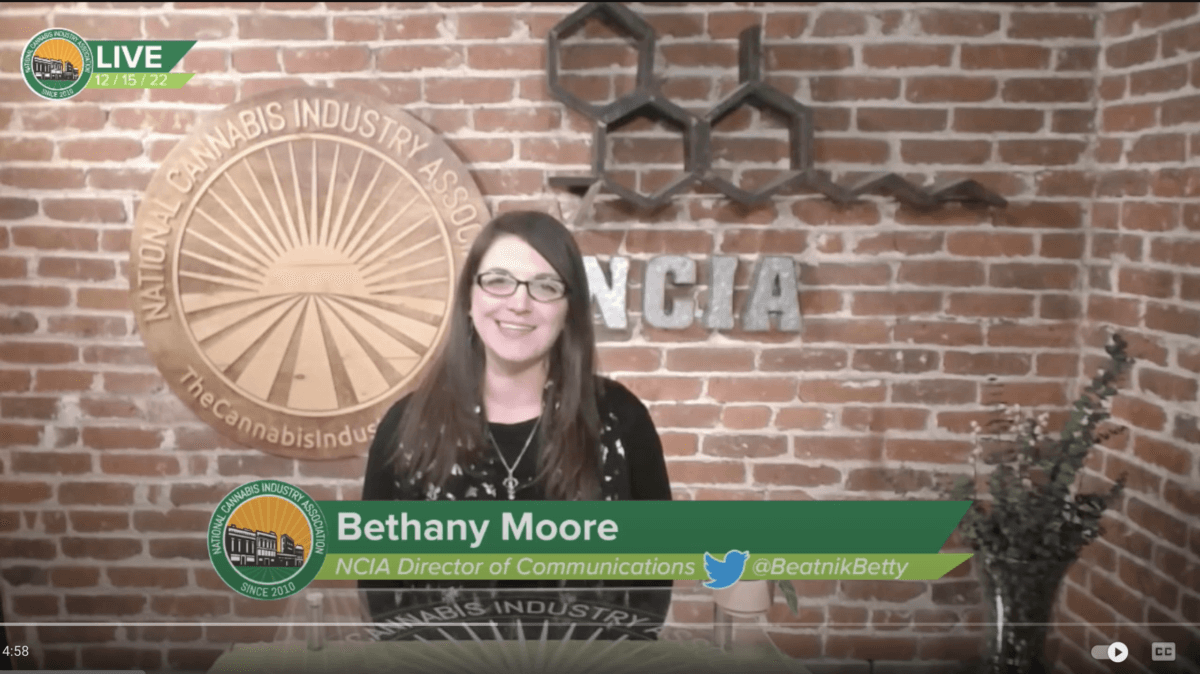
It’s the final episode of NCIA Today for the year 2022! NCIA Director of Communications Bethany Moore checks in with what’s going on across the country with the National Cannabis Industry Association’s membership, board, allies, and staff. Join us every other Thursday on Facebook for NCIA Today Live.
Reform Whiplash in Washington
Photo By CannabisCamera.com
By Michelle Rutter Friberg, NCIA’s Deputy Director of Government Relations
Last week, cannabis advocates were dealt another blow with the exclusion of the SAFE Banking Act (SAFE+) in the National Defense Authorization Act (NDAA). That being said, all hope is not lost—the government runs out of funding this Friday, 12/16, and members of Congress are working hard to craft an omnibus bill that may present another opportunity for SAFE+.
Earlier this year, the House of Representatives passed their version of the NDAA — which did include the language of the SAFE Banking Act. Since then, all eyes have been on the Senate, where negotiations over the inclusion of “SAFE+” to the NDAA have been the focus. There was much discussion over what exactly the “plus” in SAFE+ would include, but there was no doubt that theHOPE Act would be a part of that, and potentially theGRAM Act. As of a few weeks ago, NCIA and other advocates were feeling cautiously optimistic about the possibility of SAFE+ being passed via the NDAA.
That was until Senate Minority Leader Mitch McConnell (R-KY) took to the Senate floor last Tuesday to specifically call out SAFE+. He said:
“House and Senate Democrats are still obstructing efforts to close out the NDAA by trying to jam in unrelated items with no relationship whatsoever to defense. We’re talking about a grab bag of miscellaneous pet priorities — making our financial system more sympathetic to illegal drugs or the phony, partisan permitting reform and name-only language that’s already failed to pass the Senate earlier this year. If Democrats wanted these controversial items so badly, they had two years to move them across the floor. Heck, they could have scheduled those matters for votes this week. But no, we’re doing more mid-level nominations, while Democrats keep threatening to take our Armed Forces hostage over those extraneous matters.
Leader McConnell even gloated about the exclusion of SAFE+ later in the week, saying, “just as Republicans insisted, just as our service members deserve, this NDAA is not getting dragged down by unrelated liberal nonsense. Good smart policies were kept in and unrelated nonsense like easier financing for illegal drugs was kept out.”
While the NDAA is slated to pass the Senate and be signed into law over the coming days, NCIA is continuing to pursue all options for passing SAFE+, including the omnibus bill that Congress is negotiating (currently) behind closed doors.
In other political news, the runoff election between Sen. Raphael Warnock (D) and Hershel Walker (R) was held in Georgia last week, with Sen. Warnock winning. This meant that Democrats held a 51-49 majority over Republicans; that is until Sen. Kyrsten Sinema decided late last week to change her party affiliation from Democrat to Independent. Like the other two Independent Senators (Angus King [ME] and Bernie Sanders [VT]), she plans to caucus with the Democrats. Regardless, the announcement came as a surprise to many.
While the clock may be running out, NCIA won’t stop advocating for SAFE+ and other cannabis issues to be passed into law.
Midterm Election Wins, Losses, and the Lame Duck Session
Photo By CannabisCamera.com
by Michelle Rutter Friberg, NCIA’s Deputy Director of Government Relations
Last week, the long-anticipated 2022 midterm elections (finally) took place. In addition to the usual House and Senate elections, five states voted on cannabis ballot initiatives: Arkansas, Maryland, Missouri, North Dakota, and South Dakota – with only two of those passing successfully. Let’s take a look at what transpired and what it means for the lame duck session and possibly the 118th Congress:
Ballot Initiatives
Voters in Arkansas, Maryland, Missouri, North Dakota, and South Dakota were all faced with a similar question on election day: whether or not to legalize cannabis for adult use. Unfortunately, three of the five initiatives did not gather enough support to pass: Arkansas, North Dakota, and South Dakota.
The results for Maryland’s referendum came in early on election night with a decisive victory: more than 65% of voters cast their ballots in support. They were asked “Do you favor the legalization of the use of cannabis by an individual who is at least 21 years of age on or after July 1st, 2023, in the state of Maryland?” Now that the measure has been approved by voters, it will require the legislature to put forth a bill that will set basic regulations for the adult-use cannabis program.
Missouri voters also approved Amendment 3, which would legalize cannabis for adults 21 and over, as well as impose a six percent tax on recreational cannabis sales and use the revenue to facilitate automatic expungements for people with certain non-violent marijuana offenses on their records. The amendment garnered 53% of the vote.
This gives advocates an increase in the number of representatives and four more Senators from legal states, most notably those from Missouri, who are both avid conservatives and have not supported cannabis reform broadly in the past.
House of Representatives
Although Republicans are still projected to win the House, the margins are shaping up to be narrower than initially predicted. It takes 218 seats to win a majority in the chamber, and as of publication, Republicans hold 212 with a number of districts still yet to be called.
The change in party control means a change in leadership and shake-ups at the committee level. Minority Leader McCarthy is expected to run for Speaker of the House, while Minority Whip Steve Scalise has thrown his hat in the ring for Majority Leader – but there’s much uncertainty and infighting within the caucus.
Senate
Control of the Senate will remain in the hands of Democrats. Over the weekend, Nevada’s Senate race was called for incumbent Catherine Cortez Masto – making Georgia’s runoff election slightly less contentious.
A closely watched Senate race in Pennsylvania flipped in favor of Democrats: legalization advocate John Fetterman (D) defeated TV-personality and New Jersey resident Dr. Oz (R). We continue to closely monitor the races in Alaska and Arizona and what their outcomes may mean for cannabis reform.
Lame Duck Session
The likelihood of a split Congress means that the lame duck session happening between now and January will be jam-packed. In addition to must-pass legislation like the National Defense Authorization Act (NDAA) and a budget/omnibus bill of some type, Democrats will also be focused on other topics like judicial nominations, the debt ceiling, and hopefully the SAFE Banking Act.
Biden’s Announcement, SAFE Banking, and the CAOA
Photo By CannabisCamera.com
By Michelle Rutter Friberg, NCIA’s Deputy Director of Government Relations
October has been a mixed bag in Washington, D.C. in terms of cannabis policy: there hasn’t been much news from Capitol Hill, but the Biden Administration shocked everyone when they made a big announcement earlier this month. As we draw nearer to the midterm elections in November (don’t forget to register!), let’s take a look at where things stand currently:
On Capitol Hill:
SAFE Banking Act
The SAFE Banking Act (S. 910) has been held up in the Senate for more than a year now. Many Senate Democrats (including Leader Schumer) have been pushing for changes to the bill to create a “SAFE +” bill that includes justice-focused provisions. As with all things in politics, a delicate balance must be kept in order to reach 60 votes in the hyper-partisan Senate.
The good news: Leader Schumer and other Democrats have been in negotiations with lead-Republican co-sponsor Sen. Steve Daines (R-MT) and others to determine what “SAFE +” could look like. Those discussions have been occurring for a few weeks now and will continue.
The bad news: those negotiations are taking time. As a result, you shouldn’t expect any legislative movement to occur until after the midterm elections.
There’s also the National Defense Authorization Act (NDAA) to consider. The House passed and sent the FY2023 NDAA to the Senate months ago and the large package did include the language of the SAFE Banking Act (as currently written). It’s unclear how the SAFE+ negotiations may impact cannabis banking’s chances in the NDAA: Leader Schumer could make sure the language is not in the NDAA if he feels confident about SAFE+’s chances.
CAOA
Unfortunately, there’s no substantive news regarding the Cannabis Administration and Opportunity Act (CAOA), or comprehensive reform broadly on Capitol Hill right now. While NCIA and others continue to push for descheduling and responsible regulations from Congress, the upcoming election and Senate timeline have taken precedent. It’s unlikely that CAOA will move this legislative session given the number of legislative days left in the year.
From the Administration:
Earlier this month, President Biden made an unprecedented announcement that his administration would begin the process for the pardoning of thousands of people with nonviolent marijuana use or possession convictions, and would begin the process of working with the Department of Health and Human Services to reclassify marijuana from a Schedule I drug in the Controlled Substances Act.
This announcement comes on the heels of NCIA’s successful 10th Annual Cannabis Industry Lobby Days held in mid-September, where 100 cannabis industry professionals, representing small and medium-sized businesses including social equity operators, met with more than 100 Congressional offices to discuss barriers faced by the industry stemming from marijuana prohibition.
It’s no coincidence that when NCIA members show up to D.C., big things happen! Make sure to stay informed as we head towards the lame duck session via our newsletter and social media platforms and don’t forget to register for NCIA’s upcoming 11th Annual Cannabis Industry Lobby Days in May 2023!
A Full Plate For Congress – Status Update for SAFE Banking, MORE Act, CAOA, and Veterans
Photo By CannabisCamera.com
by Michelle Rutter Friberg, NCIA’s Deputy Director of Government Relations
I’m not sure if you’ve seen the news, but Congress has had a lot on its plate recently: negotiations over infrastructure, the budget, the debt ceiling, reconciliation, not to mention the ongoing COVID-19 pandemic! And while the path to cannabis reform has been slightly overshadowed by some of these larger issues, for the time being, the NCIA team is continuing to work tirelessly and incessantly on your behalf to enact legislation that would help you and your business. Let’s take a look at some of the more recent developments from Washington, D.C:
SAFE Banking:
Last month, the House passed the language of the SAFE Banking Act for the fifth time via the must-pass National Defense Authorization Act (NDAA). NCIA and our allies on Capitol Hill are always trying to be creative and come up with new, different avenues to advance our policy priorities, and the NDAA was a great opportunity that we were able to take advantage of! NCIA will continue to work with members of the Senate Armed Services Committeeand other stakeholders to push for the SAFE Banking Act to be included in the final bill language. Stay tuned as the NDAA process unfolds throughout the remainder of autumn.
The MORE Act:
Also last month, the House Judiciary Committee passed the MORE Act out of committee by a vote of 26-15 but the bill still has a long journey ahead of it. It’s unlikely that committees like Ways and Means and Energy and Commerce will waive their jurisdiction again, and it’s critical to remember that the chamber actually became slightly more conservative following the 2020 election. Committee schedules are jam-packed right now, however, we continue to meet with those with jurisdiction over the MORE Act and encourage them to take up this important piece of legislation.
CAOA:
The discussion draft of the Cannabis Administration and Opportunity Act (CAOA) was unveiled back in July by Senate Majority Leader Schumer (D-NY), Finance Committee Chairman Ron Wyden (D-OR) and Sen. Cory Booker (D-NJ). In the following month, NCIA worked diligently with our Evergreen Roundtable, board, committees, social equity scholarship members, and others to provide detailed feedback on various topics as requested by the Senators. NCIA continues to be a resource for the Sponsoring Offices and committees of jurisdiction, however, official bill introduction likely won’t happen until early-2022.
Veterans:
Last week, the House Veterans Affairs Committee: Subcommittee on Health held a hearing on a number of bills; among them H.R. 2916, the VA Cannabis Research Act of 2021. While this bill is not a piece of NCIA priority legislation, we applaud the committee, longtime sponsor and ally Congressman Correa (D-CA), and their teams for discussing this important topic. Of note is testimony from Dr. David Carroll, Executive Director at the Office of Mental Health and Suicide Prevention at the Department of Veterans Affairs (VA). His testimony is only about a page long, but the gist is that the VA does not support this bill. I’d also like to highlight the statement Rep. Correa submitted for the record, which you can find here.
Even though Capitol Hill’s bandwidth is stretched, NCIA will continue our work in Washington, D.C. to get these (and other) cannabis provisions enacted into law. Have questions or thoughts? Find me over on NCIA Connect!
House Floor Debates, Markups, and Beyond for SAFE Banking and MORE Act
Photo By CannabisCamera.com
By Michelle Rutter Friberg, NCIA’s Deputy Director of Government Relations
Usually, things are somewhat slow when it comes to cannabis policy reform in Washington, D.C., but the last week has been quite the whirlwind! In the span of one week, the SAFE Banking Act was included in (and passed via) the must-pass National Defense Authorization Act (NDAA) and the House Judiciary Committee marked up and subsequently passed the Marijuana Opportunity, Reinvestment, and Expungement (MORE) Act!
Last week, the House passed the language of the SAFE Banking Act for the fifth time via the must-pass NDAA. NCIA and our allies on Capitol Hill are always trying to be creative and come up with new, different avenues to advance our policy priorities, and the NDAA was a great opportunity that we were able to take advantage of! At first, there were some concerns that the language (proposed as an amendment to the larger package) would not be ruled germane, however, we were able to clear that hurdle in the House Rules Committee, allowing the provision to move forward for Floor debate and a vote.
The amendment was then debated for a short period of time on the House floor and for the first time ever, passed via voice vote! This is incredibly exciting and reinforces the strong, bipartisan support that this legislation has.
SAFE’s inclusion in the Senate’s version of the bill is a bit more uncertain. Currently, the Chair and Ranking Member of the Senate Armed Services Committee (which has jurisdiction over the NDAA) have circulated their draft of the package that differs in many ways from the House’s bill. Here at NCIA, we will be working with Senate allies to determine what’s next for the NDAA in that chamber and collaborating with other stakeholders to ensure that the SAFE Banking language is included and passed into law. I’ll be the first to admit that I am not (nor have I ever been) a defense lobbyist, however, I’m definitely getting a crash course now!
Then, less than 24 hours later, the House Judiciary Committee announced that they would be holding a markup on the Marijuana Opportunity, Reinvestment, and Expungement (MORE) Act. You’ll recall that the MORE Act was marked up in that committee in November 2019 (during the last Congress), and passed by a vote of 24-10. Then, after all of the other relevant committees waived their jurisdiction, the MORE Act was brought to the House Floor in December 2020 and passed 228-164.
While the MORE Act passed out of the Judiciary Committee this session by a vote of 26-15, the bill still has a long journey ahead of it. It’s unlikely that committees like Ways and Means and Energy and Commerce will waive their jurisdiction again, and it’s critical to remember that the chamber actually became slightly more conservative following the 2020 election. Additionally, there is no companion legislation in the Senate as of publication.
As always, NCIA will continue to work with our allies and stakeholders on and off Capitol Hill to get these policies enacted into law. Have questions? Find me on NCIA Connect. Want to become more involved with policy at NCIA? Learn more about our new Evergreen Roundtable here.


Follow NCIA
Newsletter
Facebook
Twitter
LinkedIn
Instagram
News & Resource Topics
–
This Just In
Committee Blog: Access to Capital in the U.S. Cannabis Market Outlook
Member Blog: The Risks of Removing a Regulated Cannabis Market