Across the Country – State Cannabis News and Movement
by Madeline Grant, NCIA’s Government Relations Manager
As the deadline to submit feedback for the Cannabis Administration and Opportunity Act approached last week, our Government Relations team worked tirelessly to submit a detailed analysis and recommended improvements on behalf of the legal cannabis industry. The full comments and an executive summary can be downloadedhere.The Cannabis Administration and Opportunity Act (CAOA), submitted in July by Majority Leader Charles Schumer (D-NY) and Senators Cory Booker (D-NJ) and Ron Wyden (D-OR), would remove cannabis from the schedule of controlled substances, create a regulatory structure and federal guidelines for cannabis products and state-legal markets, and is intended to support restorative justice for the people and communities that have been disparately hurt by prohibition while ensuring fair opportunities in legal cannabis markets for small businesses and marginalized communities.
The introduction of the comprehensive draft language was a pivotal moment for the United States Senate and NCIA will continue to do whatever we can to ensure value-driven policies for the cannabis industry. Meanwhile, we continue to see movement at the state level as support for cannabis legalization efforts continues to grow. Here are some important updates happening at the state level.
California
California officials announced that they are soliciting proposals for a program aimed at helping small marijuana cultivators with environmental clean-up and restoration efforts. The California Department of Fish and Wildlife’s (CDFW) Cannabis Restoration Grant program will release applications this fall and remain open through spring 2023. The $6 million in potential funding, which comes from cannabis tax revenue, must go to government agencies, California nonprofits, or Native American tribes who would then work with cultivators on environmental efforts.
New York
The newly inaugurated governor of New York says she wants to “jumpstart” the implementation of cannabis legalization. Governor Kathy Hochul took a major step by making two key regulatory appointments to oversee the state’s cannabis market. Soon after they were quickly confirmed by the Senate during a special session. Former New York Assemblywoman Tremaine Wright (D) will serve as chair of the Cannabis Control Board, and former Drug Policy Alliance (DPA) staffer Christopher Alexander will be the executive director of the state’s Office of Cannabis Management.
Ohio
Ohio activists can begin collecting signatures for a 2022 ballot initiative to legalize marijuana in the state. The Coalition to Regulate Marijuana Like Alcohol (CTRMLA) launched its ballot effort last month. The new initiative is a statutory proposal and if supporters collect 132,887 valid signatures from registered voters, the legislature will then have four months to adopt the measure, reject it, or adopt an amended version. In the case of lawmakers not passing the proposal, an additional 132,887 signatures will be required to place the proposal before voters on the ballot in 2022.
Missouri
Another adult-use legalization proposal has been filed. Legal Missouri 2022 submitted the latest measure to the secretary of state’s office, and it will now go through a review period before potentially being certified.
New Mexico
The Cannabis Control Division announced applications are now open for businesses interested in legal cannabis producers licensed by the state of New Mexico. After an application is submitted, regulators will have 90 days to issue a determination.
Colorado
Colorado voters will decide on an initiative in November that would raise cannabis taxes to fund programs that are meant to reduce the education gap for low-income students. The secretary of state confirmed that the campaign behind the measure collected more than the required 124,632 valid signatures to make the ballot. The measure would give low and middle-income families a $1,500 stipend to have school-aged children participate in afterschool programs, tutoring, and summer learning programs.
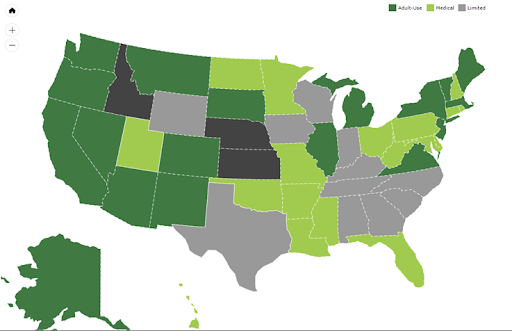
As states continue to legalize medical and adult-use cannabis, be sure to check out our state policy map for updates. Our Government Relations team will continue to educate congressional offices as states move forward. It’s vital to have accurate information and resources for members and Congress and staffers on Capitol Hill. With advancements at the state level, we continue to relay the importance of cannabis legalization at the federal level. Please stay tuned for more updates from our Government Relations team.
From Sea To Shining Sea: State Cannabis Policy Update
By Madeline Grant, NCIA’s Government Relations Manager
Over the past couple of weeks, we’ve talked a lot about what is happening at the federal level – with the passage of the SAFE Banking in the House of Representative, the reintroduction of the Marijuana Opportunity Reinvestment and Expungement (MORE) Act, and the introduction of many bills, we’ve seen the momentum continue to rise in the 117th Congress. So this week, I’m going to go over numerous updates happening at the state level. When we see movement at the state level, this directly correlates to success at the federal level, although not immediate. Think about it… more constituents voting in support of cannabis initiatives and more state legislators speaking in favor of moving cannabis measures means more overall support in the United States. That support at the local and state levels streamlines up to members of Congress at the federal level. So let’s take a look at a few updates in the states.
Wyoming
In Wyoming, lawmakers failed to pass a bill to legalize marijuana this session. However, last week two measures were submitted to the state to place medical cannabis legalization and adult-use decriminalization measures before voters on the 2022 ballot.
Connecticut
Last week, Governor Ned Lamont (D) said he’ll be upset if the legislature fails to deliver him a bill to legalize marijuana in a special session that is set to take place this week. The Senate approved a legalization proposal in the final days of the regular session last week, but an expected House vote was called off as time ran short in the face of Republican opposition and threats to a filibuster.
Ohio, South Carolina, and West Virginia
The Sensible Movement Coalition (SMC), an Ohio-based marijuana group, is helping campaigns in West Virginia and South Carolina get cannabis decriminalization on their local ballots this year. SMC has traditionally pushed for reforms within Ohio – and has seen multiple successes in getting decriminalization enacted there – they’re now lending expertise to activist-led campaigns in other traditionally conservative states.
Nebraska
Marijuana activists are gearing up for a “mass scale” campaign to put medical cannabis legalization on the state’s 2022 ballot after the state legislature failed to pass a bill to enact the reform this session.
Rhode Island
For the first time in Rhode Island, a bill to legalize cannabis for recreational use has advanced in the state. The Judiciary Committee approved a marijuana legalization bill that’s being championed by leadership in the chamber.
Texas and Louisiana
The governors of Texas and Louisiana on Thursday separately indicated that they will sign marijuana reform bills that have recently been delivered to their desks.
Delaware
A vote on a marijuana legalization bill that was scheduled in the House of Representatives was canceled, despite attempts to propose amendments to reach the three-fifths supermajority support. Rep. Edward Osienski (D), who filed the measure, said lawmakers need more time to consider a series of proposed changes before reaching a consensus and moving forward.
Texas
A newly formed progressive coalition that’s being led by two former Democratic congressional candidates, Julie Oliver and Mike Siegel, is aiming to take cannabis and other issues directly to voters by putting reform measures on local ballots across the state. Although Texas legislators made progress this session on some marijuana policy changes, activists were hoping for more. The new coalition, Ground Game Texas, works to engage voters on issues like marijuana reform that are popular among young people and Democrats.
These are just a few of the many updates that are happening state by state. It’s extraordinary to see the momentum building throughout the country with the help of advocates and public support. I implore you to get involved with state initiatives to propel cannabis policy reform forward, as every person has a voice to be heard. To keep updated on what’s happening at the state level please be sure to check out our state policy map that can be found HERE. Additionally, I would love the opportunity to hear from you about the difficulties you face in the cannabis space. If you have the time please feel free to email me at Madeline@TheCannabisIndustry.org.
2018 NATIONAL CANNABIS INDUSTRY FORECAST
Michelle Rutter, NCIA
by Michelle Rutter, NCIA Government Relations Manager
With the beginning of 2018, we start another election year. Multiple states in the midwest are running medical cannabis ballot initiatives, while Vermont is set to become the first state to legalize adult-use cannabis through the state legislature. In Washington, D.C., policy moves at a slower pace, but with Attorney General Jeff Sessions in office, it’s important to remain vigilant. Let’s take a look at what may happen in cannabis policy across the country:
MEDICAL CANNABIS POLICY
UTAH
The Utah Patients Coalition (UPC) is leading a 2018 ballot campaign to establish a medical cannabis program. The initiative seeks to protect terminally and seriously ill patients with specific debilitating medical conditions, including HIV/AIDS, PTSD, and chronic pain, among others. In addition, the initiative allows for caretakers to administer medical cannabis and would issue four types of licenses if passed: cultivation facilities, processing facilities, independent testing laboratories, and dispensaries.
The Chairman of the Senate Finance Committee, Orrin Hatch (R-UT) has introduced a medical cannabis research bill, and has even said on the Senate floor that medical cannabis can be an alternative to opioids. Passing the 2018 ballot initiative in his home state of Utah will be critical to furthering advocates’ work at the federal level.
A recent poll done by the Salt Lake Tribune found that 3 in 4 Utahns support legalizing medical cannabis. The campaign must collect 113,143 signatures from registered voters in order to qualify for the ballot. As of October 2017, the coalition had already garnered 20,000 signatures.
MISSOURI
A group called New Approach Missouri has formed and is in the process of collecting signatures for a proposed constitutional amendment to their state constitution that would legalize medical cannabis. The initiative would create a statewide system for production and sale of medical cannabis and provides for limited and regulated patient cultivation. Interestingly, the initiative levies a four percent retail tax, but all revenue in excess of the cost of regulating the medical cannabis program will go towards Missouri’s veterans.
New Approach Missouri must to collect 160,199 valid signatures from registered voters in order to be placed on the ballot. As of December 2017, the campaign had collected roughly 100,000 signatures. A poll done in 2015 showed that 85% of Missourians support implementing a medical cannabis program.
OKLAHOMA
Oklahomans for Health is the proponent of the upcoming state question SQ788, which would create a medical cannabis program. Obtaining a state-issued medical marijuana card would require a board-certified physician’s signature, though there are no specific qualifying conditions. The measure would enact a seven percent tax on marijuana sales, with revenue financing regulatory costs. Any surplus would be distributed: 75% to the General Fund to be used for education, and 25% to the Oklahoma State Department of Health to be used for drug and alcohol rehabilitation.
The initiative has already qualified, and will appear on the ballot in November 2018. Polling data is scarce, however, a 2013 poll showed that 71% of Oklahomans supported legalizing medical cannabis.
SOUTH DAKOTA
A group known as New Approach South Dakota is behind an effort to legalize medical cannabis in 2018. The group was also hoping to submit signatures to legalize adult-use cannabis, but was unsuccessful. The measure would set an excise tax on marijuana that would include a $50 per ounce tax on cannabis flower for buyers, and would have other taxes apply to buying immature plants and other parts of the cannabis plant.
In November 2017, New Approach South Dakota submitted roughly 15,000 signatures to qualify for the ballot- that’s just 1,000 more than required. The state hopes to review submitted ballot initiatives in the coming months.
ADULT-USE CANNABIS POLICY
MICHIGAN
The Coalition to Regulate Marijuana Like Alcohol has officially submitted ballot language to the State of Michigan that would legalize consumption and possession of marijuana for adults 21 and over in Michigan. The proposal enacts an excise tax on marijuana at the retail level in addition to the standard state sales tax and provides for state regulators to grant business licenses for cultivators, processors, testing facilities, secure transporters, retail stores and microbusinesses.
In November 2017, the Coalition to Regulate Marijuana Like Alcohol turned in more than 360,000 signatures to qualify for the ballot– that’s 100,000 signatures beyond the 252,000 required by the state. Polling done in early 2017 showed that 57% of Michiganders would support legalizing cannabis.
VERMONT
Vermont is poised to make history and become the first state to legalize adult-use cannabis through the state legislature in early 2018. In December 2017, Vermont House Speaker Mitzi Johnson (D) said, “It will be up for a vote in early January. I expect that it likely will pass in early January.”
The state came incredibly close to passing language that would have legalized adult-use cannabis back in 2017, however, the legislature was unable to make changes Governor Phil Scott (R) requested before the session ended. The Governor has since stated that he is “comfortable” with signing legalization legislation.
OHIO
The group that unsuccessfully ran a ballot initiative in 2015 to legalize cannabis in Ohio is making a comeback in 2018. In December 2017, a team announced that they will work to place a cannabis legalization measure on the ballot in 2018. Known as the Regulate Marijuana Like Alcohol Amendment, the measure would allow people over the age of 21 to purchase and use cannabis legally. The amendment would also create a taxed and regulated cultivation, processing, and sales system.
Valid signatures from 305,592 registered voters are required before July 4, 2018, in order to qualify the measure for the ballot.
NEW JERSEY
Unlike New Jersey’s Governor Chris Christie (R) , Governor-Elect Phil Murphy (D) is setting a positive tone on cannabis in the state. Murphy has advocated for legalization multiple times, and even made one of his campaign promises to legalize adult-use cannabis in his first 100 days in office.
Democrats in the state legislature have already introduced multiple bills to tax and regulate adult-use cannabis, predicted to be worth more than $1 billion in the state. The full legalization bill currently being considered is S3195, sponsored by state Senator Nicholas Scutari (D). Sen. Stephen Sweeney (D), the state senate’s president, has already promised to pass the bill within the first three months of Murphy’s administration.
Recent polling shows that over 60% of New Jersey residents support legalizing cannabis.
CANNABIS DECRIMINALIZATION
VIRGINIA
In November 2017, voters in Virginia elected Ralph Northam (D) as their next Governor. Northam made cannabis decriminalization a centerpiece of his gubernatorial campaign, and has even spoken about the hemp cultivation and the medical benefits of cannabis.
Virginia lawmakers considered but did not act on decriminalization legislation during the 2017 session. However, with the State Crime Commission conducting a study on the effects of decriminalization in the state at the request of the Republican Senate majority leader, advocates remain hopeful in 2018.
FEDERAL CANNABIS POLICY
While 2018 is shaping up to be a busy year for cannabis policy at the state level, things will likely move slowly in Washington, D.C. NCIA will be working to ensure language protecting medical cannabis patients (the Rohrabacher-Blumenauer amendment, formerly known as the Rohrabacher-Farr amendment) remains in federal law. NCIA will also be lobbying to expand that language to apply to adult use states (McClintock-Polis amendment) and to include a banking amendment that would allow cannabis businesses access to financial services (Heck amendment).
As leadership in both houses of Congress continue to negotiate the final version of the tax reform bill, there will be opportunities next year for Congress to make additions and changes on future individual tax legislation. NCIA will be looking at any possible avenues to have 280E legislation be included in future bills if the opportunity arises. Action on the cannabis banking bill is unlikely in 2018, however, NCIA will continue to advocate for a committee hearing, gather more cosponsors on HR 2215: The SAFE (Secure and Fair Enforcement) Banking Act, and work to identify a Republican lead sponsor for the bill in 2019.
NCIA will also be working to ensure that the Cole Memo remains in place. Attorney General Jeff Sessions has recently said that the Department of Justice will be reviewing current memos, and that “Guidance documents can be used to explain existing law… but they should not be used to change the law or to impose new standards to determine compliance with the law… This Department of Justice will not use guidance documents to circumvent the rule-making process, and we will proactively work to rescind existing guidance documents that go too far.” While Attorney General Sessions is very clearly personally opposed to cannabis, it’s important to note that personal feelings are not official Justice Department policy.
In addition, NCIA is working behind the scenes to educate the Trump Administration on cannabis policy, maintain the Cole Memo, protect cannabis patients and consumers, and make positive remarks regarding medical cannabis in 2018.
Partner Blog: Ohio’s Medical Marijuana Program Begins Taking Shape
by Thomas Rosenberger, Executive Director of NCIAO
More than a year after Ohio legalized medical marijuana, the first licenses have finally been awarded. The Ohio Department of Commerce ended months of speculation by announcing 12 level II cultivator license winners on November 3rd, and 12 level I cultivator license winners on November 30th.
These 24 winners are now responsible for growing the supply of medical marijuana Ohio’s patients will use, a population estimated to be in the hundreds of thousands. The medical marijuana market in Ohio is expected to be worth $300-400 million once it matures, making the limited number of licenses available immensely valuable.
While we now know who the 24 cultivators will be, Ohio’s medical marijuana program is still nine months away from its September 8th, 2018 deadline to be operational. Processing, dispensary and testing licenses have all yet to be awarded, and already controversy and lawsuits are threatening to derail and delay the program.
It’s a scenario we’ve seen repeatedly in other states such as Maryland, and a scenario for which the industry must work together to prevent in Ohio. The National Cannabis Industry Association of Ohio was formed in July to foster collaboration between members, promote best practices and to serve as the voice of the industry in Ohio.
We’ve spent the past 5 months advocating for the industry and working to provide feedback to state regulators on various aspects of the program. Moving forward, our priority will be on ensuring Ohio’s program meets its statutory deadlines and licensed cannabis businesses are able to begin serving Ohio’s patients by September 8th, 2018.
Now more than ever, it’s crucial the industry come together to ensure Ohio’s medical cannabis program is not delayed. Ohio’s patients have waited long enough for relief, and the industry has a responsibility to ensure they wait no longer.
NCIAO is the Ohio affiliate of the National Cannabis Industry Association, the nations only industry-led organization engaging in legislative efforts to expand and further legitimize the legal cannabis market in the U.S.
Member Spotlight: Apeks Supercritical
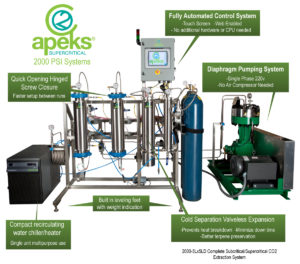
This month’s NCIA Member Spotlight takes us to Ohio to speak with Andy Joseph, founder and president of Apeks Supercritical, whose company manufactures botanical oil extraction systems utilizing subcritical and supercritical CO2. Apeks recently became Regional Winner and National Finalist of the EY (Ernst & Young) Entrepreneur of the Year — recognized for outstanding leadership, ingenuity and entrepreneurial spirit.
NCIA Member Since:
August 2013
Tell us a bit about you and why you founded Apeks Supercritical?
Andy Joseph, Founder and President of Apeks Supercritical
I had been building botanical extraction equipment in my barn on weekends for about ten years as a side business to help pay college expenses for my five children. I saw an opportunity to grow my Apeks business with the sky-rocketing demand for extraction equipment as legalization of cannabis expanded. Along with that, after talking to many physicians, I became inspired to have a role in helping provide patients with cannabis that’s safer to consume with products processed from non-toxic CO2 subcritical and supercritical extractions.
So I left my job as Director of Welding and Testing Labs at Edison Welding Institute (EWI) to go all in with manufacturing CO2 extraction equipment, primarily for the cannabis industry. Apeks plans to eventually expand into other industries as well. We want to bring CO2 extraction to the masses.
How do you provide unique benefits to cannabis business owners?
Apeks Supercritical Systems
CO2 extractions offer greater safety on two levels: processing and consumption. CO2 is not flammable or explosive so our equipment is safer to operate for our customers, and they don’t have to worry about processing requirements associated with butane and ethanol. In addition, our customers can offer their customers purer extractions because there are no residuals in the extracted material when using CO2 as a solvent.
CO2 is environmentally friendly and recyclable which saves operating expenses for our customers.
Our extraction systems deliver processing efficiencies. Our Diaphragm Compressor Technology provides faster and more energy-efficient extractions and our patented Valveless Expansion Technology (no decompression valves) removes the risk of product getting clogged.
Also, in-house financing to customers. This is especially helpful given the difficulty people in the cannabis industry have in getting financing from banks for large capital purchases. We’ve provided financing for 40 to 50 customers.
As a business owner, you’re very involved in not only federal, but also state and local politics. Can you tell us more about the progress being made on behalf of cannabis policy in your home state of Ohio?
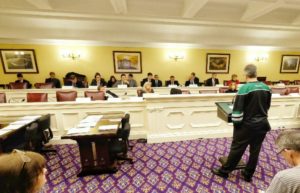
Last year’s ballot initiative in Ohio was so misguided, I had to speak out against it. Since then, I’ve been proactive in educating state and local legislators about the multi-faceted factors surrounding legalization of medical marijuana, even arranging for Dr. Sue Sisley of Arizona and other experts to testify on the benefits of medical cannabis. Now that Governor Kasich has signed a bill legalizing medical marijuana, I am lobbying to be appointed to the state’s Medical Marijuana Advisory Commission to help to ensure the program is properly administered.
Andy Joseph testifying to Ohio House of Representatives
There needs to be a proper balance between patient access to safe, tested medical cannabis and the requirements placed on the businesses that make it available. For patients to have the access they need, there must be an appropriate list of qualifying conditions, physician protection, and access to dispensaries. Likewise, regulatory measures on businesses must be reasonable. If licensing or taxation is too burdensome, businesses will not be sustainable, especially given that many start-ups in this industry already struggle to get the financing they need.
Why did you join NCIA?
I joined soon after NCIA was established because I appreciated its focus on supporting businesses in this fledgling industry. Now that medical marijuana is legal in Ohio where we manufacture our equipment, Apeks will begin processing as well. So I appreciate even more the work of NCIA in lobbying for federal policy reform, particularly 280E tax and banking solutions, as Apeks transitions from an ancillary business into the processing side as well.
 by Madeline Grant, NCIA’s Government Relations Manager

 These 24 winners are now responsible for growing the supply of medical marijuana Ohio’s patients will use, a population estimated to be in the hundreds of thousands. The medical marijuana market in Ohio is expected to be worth $300-400 million once it matures, making the limited number of licenses available immensely valuable.

Follow NCIA
Newsletter
Facebook
Twitter
LinkedIn
Instagram
News & Resource Topics
–
This Just In
Member Blog: What Consumers Really Want in a Pre-Roll
Member Blog: The Evolving Cannabis Legal & Regulatory Landscape in 2026