Breaking Down the Recent Cannabis Rescheduling Recommendation
For more than fifty years, the federal government has maintained that cannabis is a Schedule I drug, meaning that it has a high potential for abuse and no accepted medical value. That changed last week (somewhat) when the Department of Health and Human Services (HHS) recommended to the Drug Enforcement Administration (DEA) that cannabis be placed in Schedule III, meaning that it has moderate to low abuse potential, a currently accepted medical use, and a low potential for psychological dependence.
Why now?
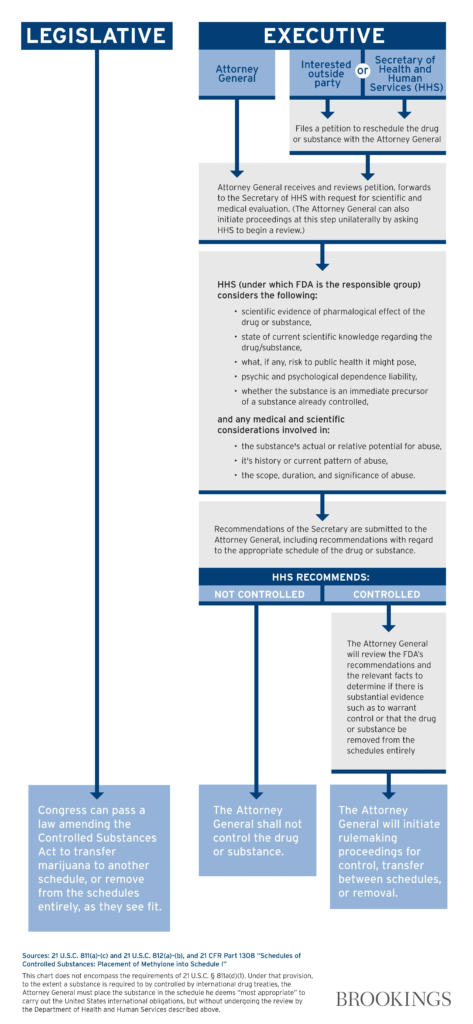
In October 2022, the Biden Administration announced that it would ask the Secretary of HHS and the Attorney General to initiate the administrative process to review expeditiously how marijuana is scheduled under federal law. As the Brookings Institute outlined years ago, the Executive process for rescheduling is much more complex than the Legislative path.
It’s no secret that the presidential election is barely more than a year away, and the President seems to be looking to make good on his campaign promise to reform the nation’s marijuana laws.
What does this mean?
First off, it’s critical to note that HHS’ recommendation to DEA is just that: a recommendation. It is non-binding. The DEA may come to the same conclusion that HHS did, but is not required to.
If cannabis is moved to Schedule III of the Controlled Substances Act, one positive outcome would be that 280E would no longer apply to plant-touching businesses, removing an incredibly punitive and debilitating provision in the tax code.
According to NCIA’s board chair emeritus, Khurshid Khoja, Esq., “…it’s important to remember that rescheduling would not apply the federal Food Drug and Cosmetic Act (FDCA) to marijuana for the first time—it applies right now, and like the federal Controlled Substances Act (CSA), would continue to apply after rescheduling. But absent any statutory authority permitting FDA to do otherwise, the FDCA would continue to apply after descheduling too, just as it does to hemp products.”
Others claim that the shift to Schedule III would have minimal impact on businesses and individuals. Here at NCIA, we’re cautiously optimistic but recognize that moving cannabis to schedule III could have some limited benefit but does nothing to align federal law with the 38 U.S. states which have already effectively regulated cannabis for medical or adult use.
What now?
Now that HHS has made their recommendation, the DEA will begin its scheduling review process.
Many are divided about what a move to Schedule III would actually look like. Yes, there would be the elimination of 280E, but what about enforcement priorities? Interstate commerce? Criminal penalties? There are so many unknowns.
NCIA has previously produced a common sense, workable roadmap for that federal comprehensive reform and provided detailed feedback on legislative efforts. It is time for Congress to follow the will of the American people. Don’t get me wrong, there’s no doubt that this recommendation is a step in the right direction and is long overdue. But we can’t lose sight of the ultimate goal: removing cannabis from the Controlled Substances Act entirely.
Have questions?
Join NCIA on September 14 at 1 pm ET for an engaging webinar where we will unpack all your questions! Register today and don’t miss your chance to hear more about what this means for the cannabis industry and your business.
2016: What’s Next?
by Michelle Rutter, Government Relations Coordinator
This year is arguably the most crucial yet for the burgeoning cannabis industry, especially as it relates to policy. Although NCIA primarily advocates for cannabis reform at the federal level, what happens in each individual state is vital to the stances Members of Congress take on our issues.
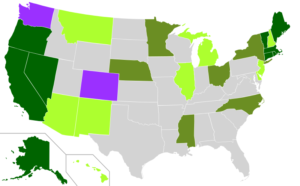
Members of Congress care deeply about issues that directly affect their specific state or district. It’s imperative that more states enact cannabis reform legislation so that more Members have a vested interest in protecting their constituents. While cannabis reform is sweeping the nation at an almost unprecedented rate, it takes time for politicians in Washington, D.C., to catch up with public opinion back home. If all of the federal lawmakers representing just the 15 states mentioned below were to vote positively on pro-cannabis legislation, it would add up to more than 180 Representatives and nearly 30 Senators.
Take a look below and see what’s coming up next in 2016. Remember that by becoming a member of NCIA, you are adding your voice to the coordinated and unified campaign at the federal level to allow cannabis businesses access to financial services, fix tax section 280E, and ultimately end federal cannabis prohibition.
The United States of Cannabis
- Arizona activists remain ahead of schedule and have nearly gathered the 150,000 signatures needed to put the state’s Campaign to Regulate Marijuana Like Alcohol initiative on the November 2016 ballot. (The campaign ultimately aims to collect 230,000 in order to insure against signature drop-off.) It’s estimated that Arizona’s adult-use market could be worth up to $480 million.
- With a multi-billion-dollar cannabis industry in California alone, passing an adult-use legalization initiative in the state is vital to ending federal prohibition. The most prominent full retail initiative gathering signatures for the November 2016 election is the Adult Use of Marijuana Act, which is backed by billionaire Sean Parker and the Marijuana Policy Project.
- Legalize Maine and the Marijuana Policy Project have joined forces to legalize adult-use cannabis in 2016. Legalize Maine has already collected 80,000 signatures. Only 61,000 signatures are necessary to place the measure on a statewide ballot, but the organization’s goal is 95,000, to insure against drop-off. The deadline to submit signatures is February 1st.
- Last August, a pair of cannabis advocacy groups separately filed paperwork to get adult-use legalization on the 2016 ballot in Massachusetts. The state recently confirmed that a measure to legalize recreational cannabis next year has enough valid signatures to force the legislature to consider the measure. If the legislature decides to pass, then the campaign will have to collect another 10,792 signatures to formally make the November ballot.
- There’s no question that adult-use legalization will be on the ballot this year in Nevada. Initiative Petition 1, which would tax and regulate marijuana similarly to alcohol, has been certified for the 2016 ballot. Backers had previously collected nearly 200,000 signatures to either force legislators to enact their initiative or put it on the ballot. When state lawmakers abstained from voting on the issue, the measure was automatically forwarded to this year’s ballot for a popular vote.
- In Florida, the group United for Care received clearance from the state Supreme Court for a 2016 ballot measure that would legalize medical marijuana. The group nearly succeeded in legalizing medical marijuana in 2014, garnering 58% of the vote but falling barely short of the state’s constitutionally mandated 60% margin needed to pass,
- The nation’s capital continues to debate cannabis. In December’s federal budget bill, the taxation and regulation of marijuana in Washington, D.C., was blocked by Congress again, though possessing and gifting cannabis remains legal in the city.
- This month, Hawaii will begin accepting applications for medical cannabis businesses. The bill signed into law last summer opens the door for up to 16 dispensaries on the islands.
- It was recently announced that Illinois saw approximately $1.7 million in medical cannabis sales during November and December of 2015. There are already petitions being circulated in the state that would expand the law’s qualifying conditions.
- Maryland will award cannabis cultivation, processing, and dispensary licenses this summer. Industry advocates were pleased with the amount of interest the state’s program garnered: more than 1,000 applications were submitted.
- Officials in Michigan have approved language for three different adult-use cannabis legalization initiatives for the 2016 ballot. In order to have the best chance of passing, it’s important for these groups to coalesce behind one initiative.
- At the end of 2015, New Hampshire began issuing medical marijuana cards to qualifying patients. It’s expected that the state will open medical dispensaries in 2016.
- After a long and arduous journey, New York’s medical cannabis program became operational this month. The cannabis industry expects the program and the law’s qualifying conditions to expand this year.
- In the first week of 2016, Oregon began accepting adult-use cannabis business license applications. The state has no limit on how many licenses they will decide to award.
- Vermont may become the first state to legalize adult-use cannabis through the legislative process in 2016. The proposed bill would allow for up to 86 storefronts and five different business license types.
Bonus: Election 2016 – Yes, We Canna
- As we all know, a new president will be elected this November, and with that a new administration will assume power next January. It is very crucial that Congress pass more pro-cannabis legislation before then.
- It’s probable that Attorney General Loretta Lynch will be replaced in 2016 or early 2017. This is important because it is the Department of Justice that enforces and prosecutes federal marijuana laws.
- Another possibility for 2016 is that the acting head of the Drug Enforcement Administration, Chuck Rosenberg, could be replaced as well. Rosenberg is notorious for his gaffe last year when he called marijuana “probably” less dangerous than heroin.
- On New Year’s Eve, officials from the Substance Abuse and Mental Health Services Administration posted a notice on the Federal Register that calls for a report “presenting the state of the science on substance use, addiction and health” to be released in 2016. Industry advocates are hopeful that this report could be the first sign of re- or de-scheduling cannabis from the Controlled Substances Act.
- During 2016, NCIA will continue working with D.C.-based public affairs firms Heather Podesta + Partners, and Jochum Shore & Trossevin PC to magnify our efforts to address the industry’s top federal priorities: access to basic banking services and fair federal taxation.
In addition to NCIA’s lobbying and advocacy efforts, NCIA exists to connect and educate our members on all facets of the cannabis industry. Our industry supports tens of thousands of jobs, tens of millions in tax revenue, and billions in economic activity in the United States. Our core mission is to ensure that our members are treated like businesses in any other American industry. Join NCIA today to get involved and be a part of the cannabis revolution!
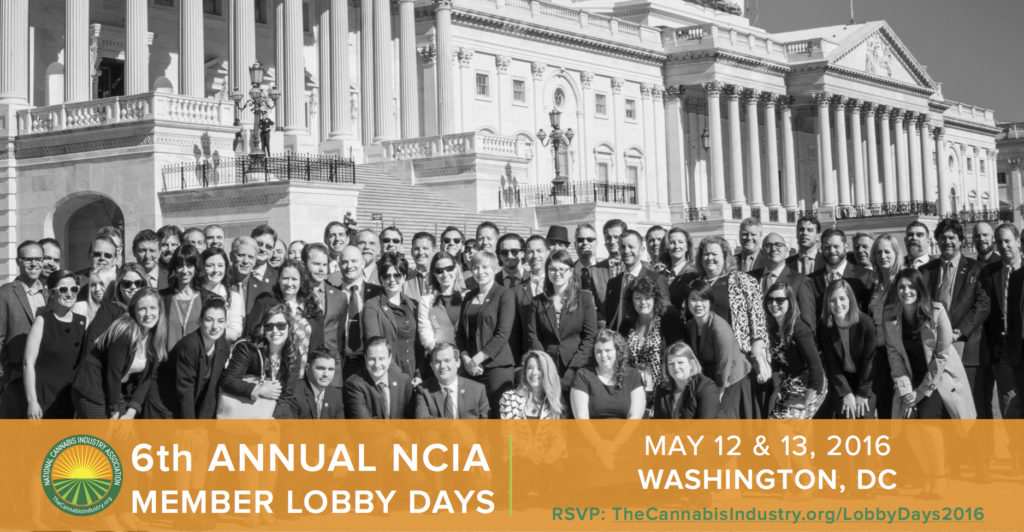
Join us for our 6th Annual NCIA Member Lobby Days in Washington, D.C. on May 12 & 13, 2016.
Follow NCIA
Newsletter
Facebook
Twitter
LinkedIn
Instagram
News & Resource Topics
–
This Just In
NCIA Applauds Reintroduction of SAFE Banking Following Lobby Days
Beyond Rescheduling: Inside NCIA’s 14th Annual National Cannabis Industry Lobby Days