Historic Victory in the House: The MORE Act
by Madeline Grant, NCIA’s Government Relations Manager
On Friday, December 4, the House of Representatives made history by voting to approve H.R. 3884, the Marijuana Opportunity, Reinvestment, and Expungement (MORE) Act. The MORE Act would remove marijuana from the federal Controlled Substances Act and work to repair the social and personal harms caused by federal marijuana enforcement. This is the first time since marijuana was made federally illegal that either chamber of Congress has held a floor vote on- or approved- a bill to make the substance legal again. The final vote count of 228-164 fell mostly along party lines, with five Republicans crossing the aisle to support, and six Democrats voting to oppose.
This monumental victory shows just how far Congress has come over the years. Although this vote more closely aligns the House of Representatives with the majority of voters who overwhelmingly support cannabis legalization, the Senate is a different story.
As we have seen over and over again, the Senate Republicans continue to obstruct cannabis reform measures. The House passed the SAFE Banking Act in September 2019 and included the SAFE Banking language in two COVID-19 relief packages, however, there has been little activity on these topics in the Senate. Republican Senators have repeatedly spoken out in opposition of bringing up cannabis policy amidst the pandemic, stating that it’s not the time or place. But as I mentioned before, it’s also important to note that the House has passed not one, but two COVID relief packages in the last 6+ months that the Senate (namely, Leader McConnell) has refused to take up. That being said, despite a global pandemic, support for cannabis reform remains strong, a recent Gallup poll showed a record 68% of Americans support making cannabis legal. On Election Day, voters in Arizona, Montana, and New Jersey approved measures to regulate cannabis for adults, while Mississippians overwhelmingly approved a medical cannabis referendum, and voters in South Dakota passed both adult-use and medical initiatives. The vote and passage of the MORE Act on the House show that House leadership is listening.
The MORE Act, sponsored by the House Judiciary Committee Chairman Jerry Nadler (D-NY) and 120 cosponsors, would not only mitigate the federal-state conflict by removing cannabis from the Controlled Substances Act, but it would also require the expungement of past federal cannabis convictions. The bill would also establish a Cannabis Justice Office to administer a program to reinvest resources in the communities that have been most heavily impacted by prohibition, funded by a tax on state-legal cannabis commerce. It would also allow the Small Business Administration to provide loans and grants to cannabis-related businesses and support state and local equity licensing programs, permit doctors within the Veterans Affairs to recommend medical cannabis to patients in accordance with applicable state laws, and prevent discrimination based on cannabis consumption during immigration proceedings.
When the House version of the MORE Act was originally introduced in 2019, it was referred to eight Committees (with the Judiciary Committee being primary). Each Committee had provisions of the bill that fell under its jurisdiction and had authority to hold hearings and or amend specific jurisdictional provisions. Two Committees (Energy and Commerce and Ways and Means) were expected to be very active on language affecting regulations and taxes. The Energy and Commerce Committee even held a legislative hearing on MORE in January, and were expected to hold more… and then COVID hit… and priorities changed.
Before the Floor vote, the main sponsor of MORE, Judiciary Chairman Jerry Nadler, offered a “manager’s amendment.” The majority of the language was taken straight from H.R. 1120/S. 420: the Marijuana Revenue and Regulation Act. It included a graduated tax, and language on federal permitting and bonding. During debate, Congressional leaders gave assurances to include the cannabis industry advocates in future discussions and listen to cannabis industry concerns. Although passage of the MORE Act is historic, no legislation is perfect and NCIA staff will continue working with congressional champions to improve MORE and eventually get it passed into law.
Now, as we near the end of the 116th Congress, the NCIA team will continue to work and strategize various ways forward in Washington, D.C– on SAFE Banking, the MORE Act, and beyond. As we see more and more legislative victories each Congress, it is important to relish in our success and continue to propel the momentum forward (we could all use a moment to celebrate after 2020!). The MORE Act vote, being the most comprehensive cannabis bill on Capitol Hill, gives us the momentum to accomplish more in the next congressional session. Thank you to each and everyone one of you who took the time to call your Representative. Stay tuned for the 117th Congress!
What to Watch in the Lame Duck Session
by Madeline Grant, NCIA’s Government Relations Manager
 Following the presidential election, we’ve entered the lame-duck session. This occurs after an election, but before new members are sworn in, and allows for time on the legislative calendar for Congress to pass additional legislation. Before Congress heads home for the holidays, a new administration takes office, and the 117th Congress returns, let’s take a look at what to keep an eye on during the lame-duck session.
Banking Access
The House of Representatives has approved the SAFE Banking Act in some form THREE times in just over a year. The text of the Secure and Fair Enforcement (SAFE) Banking Act has passed through two different COVID-19 relief packages on the House side: the HEROES Act, and the HEROES Act 2.0, and also passed as standalone legislation in September 2019. However, in the upper chamber, we’ve seen Senators criticize including marijuana components in coronavirus legislation, arguing that it is not germane to the issue at hand. Specifically, Senate Majority Leader McConnell (R-KY) took to the floor to complain that the House bill provides “special treatment to the marijuana industry,” stating that the legislation “mentions the word ‘cannabis’ more times than the words ‘job’ or ‘jobs.’” Regardless, it’s evident that SAFE banking has bipartisan support and could help mitigate the spread of the virus by ending the industry’s reliance on cash transactions.
Additionally, Senate Minority Leader Chuck Schumer (D-NY) introduced a coronavirus relief bill last month that contains the SAFE Banking Act. We’ve seen pushback from the Republican-controlled Senate and the Trump administration, however, Senator Schumer’s inclusion of cannabis provisions is a positive sign that Democrats will make an effort to continue to push for these provisions. As Congress and the Trump Administration continue to negotiate coronavirus relief legislation, we will continue to keep our eyes on banking. Also, a friendly reminder to call our representatives and senators and encourage them to support cannabis banking reform. If they are already a champion on our issues, thank them for their support.
The Marijuana Opportunity, Reinvestment and Expungement (MORE) Act
Regardless of all of the trials and tribulations that 2020 has brought, there is still great excitement and optimism around the MORE Act! House Majority Leader Steny Hoyer (D-MD) confirmed that marijuana legalization is still on the table before the presidential transition and will get a vote in December. Previously, Representative Hoyer announced this past summer that the chamber would vote on the MORE Act in September, but that plan was postponed following pushback from certain offices who were concerned about the optics of advancing cannabis reform before passing another coronavirus relief package.
The MORE Act is the most comprehensive cannabis legislation to date. The bill would: federally deschedule cannabis, completely removing it from the Controlled Substances Act, expunge the records of those with prior marijuana convictions and impose a federal give percent tax on sales, revenue from which would be reinvested in communities most impacted by the drug war. Additionally, the legislation would also create a pathway for resentencing for those incarcerated for marijuana offenses, as well as protect immigrants from being denied citizenship over cannabis and prevent federal agencies from denying public benefits or security clearances due to use. The fact that we have a potential vote on the MORE Act before the end of the 116th Congress is exciting news for the cannabis community. As we gear up to the end of the year, look out for updates on the MORE Act, and remember, please call your representative and senators and urge them to support this significant piece of cannabis legislation.
Success Through Hardship in the 116th Congress
This year has been unlike any other year we’ve faced as a country. Since March, Congress has exhausted their legislative efforts to agree on coronavirus relief bills. With differences on both sides of the aisle and with the administration reaching any sort of legislative success seems near impossible. However, on a positive note we’ve seen our champions on Capitol Hill not give up on cannabis-related provisions. Although we are faced and halted by frustrations in the Republican-controlled Senate, we still see members of Congress working to include the much-needed cannabis reform our nation is calling for. Not to mention Election Day – Arizona, Montana, New Jersey, and South Dakota all passed measures making cannabis legal and regulated for adults, while Mississippi and South Dakota chose to legalize medical cannabis. Every success and victory in cannabis policies around the country creates more momentum for Congress to fix the out-dated cannabis laws. As we wrap up the 116th Congress, we will be left with more momentum than ever before to enter the 117th Congress to reach new legislative victories.
The 116th Congress – What To Expect
by Michelle Rutter, NCIA Government Relations Manager
As the 116th Congress begins, the momentum behind cannabis reform has reached an unprecedented level. Let’s take a look at the top three things you can expect from cannabis legislation in the newest congressional session:
Successes in the House of Representatives, but an uphill climb in the Senate. The 116th Congress is the first time in eight years that Democrats have held control of the House of Representatives. As a result, it is expected that cannabis legislation will garner hearings, appropriations amendments will be expanded, and a bill could even be reach the Floor and be voted on! That being said, it’s important to remember that the Senate is still controlled by the more conservative Republican battle, and any cannabis amendments or legislation that reaches that chamber will have a very serious uphill battle prior to passage.
More cosponsors. In the 115th Congress, the House’s SAFE Banking Act (H.R. 2215) had a record breaking 95 cosponsors, while the Senate version (S. 1152) had 20. That’s nearly a quarter of the House of Representatives and a fifth of the entire Senate! Bills to reform IRC Section 280E saw a similar spike– at the end of 2016, the House’s Small Business Tax Equity Act had a mere 18 cosponsors, while the Senate version had four. At the end of December, the Small Business Tax Equity Act (H.R. 1810) has 46 cosponsors, while the Senate’s version (S. 777) has six. In the 116th Congress, you can expect these bills and others to continue to gather record-breaking numbers of cosponsors- in both the House and Senate.
New bills. There are cannabis bills that are introduced every session, like the banking bill, 280E bill, and various pieces of states’ rights legislation. In the 115th Congress, advocates saw multiple new cannabis bills get introduced, like the Marijuana Data Collection Act, the Marijuana Justice Act, and the MAPLE Act. As the 116th Congress continues, you can expect almost all of the cannabis related bills from last session to get reintroduced, but will likely also see a plethora of new legislation be filed that will address many different issues.
While the opportunities for cannabis reform are numerous, one thing is for sure: the 116th Congress will be one for the history books.
Join us on May 21-23, 2019 for NCIA’s 9th Annual Cannabis Industry Lobby Days in Washington, D.C., to make our voices heard on Capitol Hill! This event is complimentary and exclusive to NCIA members. Registration opens February 11.
End of Year Appropriations Deadline Looms
By Michelle Rutter, NCIA Government Relations Manager
As 2018 comes to an end, so does the 115th Congress. But, before the 116th Congress is sworn-in in January, an appropriations agreement must be reached before December 7, when the continuing resolution (CR) that is in place expires. That means if Congress doesn’t pass appropriations legislation by December 7, a partial government shutdown will occur.
Passing the bill in less than ten days will be an uphill battle. The President wants $5 billion appropriated towards a border wall and has threatened to veto the bill should it not include it. The Republican-controlled Senate has also asked for $1.6 billion worth of “pedestrian fencing” at the southern border. Should a shutdown occur, it will be the last chance for the President to win wall funding before Democrats take over the House majority in January.
There are a couple of different scenarios that could occur, but both bode well for cannabis advocates. First, Congress could pass another continuing resolution, which would include the current protections in place for medical cannabis patients, programs, and businesses. Alternatively, Congress could choose to pass an appropriations package that includes the Subcommittee on Commerce, Science, and Justice (CJS) bill, which also includes those same medical cannabis protections. Essentially, either way, medical cannabis protections remain in law.
This simple, one sentence appropriations amendment is the only thing standing in the way of the Department of Justice from prosecuting medical cannabis businesses and patients, and the process of getting it included into the federal appropriations bill every year can be incredibly difficult.
Moving into 2019, NCIA will continue to focus on ensuring that these protections remain in place, but also work to expand them to include adult-use cannabis businesses. In addition, NCIA will be using the appropriations process to advance other areas of cannabis policy, like curtailing the Treasury Department from prosecuting banks that choose to service the legal cannabis industry, and prohibiting the Department of Veterans Affairs from punishing veterans that choose to use cannabis in states where it’s legal.
All of these amendments will have good chances of passage in the Democratic-controlled House, but will face challenges in the Republican-controlled Senate.
From The Ballot Box: Post-Midterm Election Analysis
by Michelle Rutter, NCIA Government Relations Manager
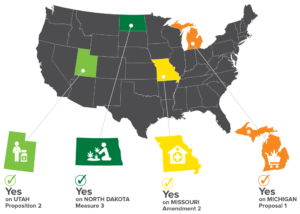
Last night, Americans all over the country let their voices be heard at the ballot box. Voters in Michigan cast their votes for the legalization of adult-use cannabis, increasing momentum of our movement. At the same time, voters in Missouri and Utah were successful in legalizing medical cannabis, becoming the 32nd and 33rd states to do so, and despite significant hurdles.
 MICHIGAN
Appearing on the ballot as Proposal 1, this initiative passed by a whopping 55% and made Michigan the first state in the Midwest to legalize adult-use cannabis for those over the age of 21. The proposal outlined an excise sales tax of 10%, which will be levied on sales at retailers and micro-businesses, and then be allocated to local governments, K-12 education, and road and bridge maintenance. In the future, municipalities will be given the authority to to ban or limit cannabis businesses and establishments within their boundaries. Michigan’s prominent Midwest location, as well as the size of the projected adult-use market, make it a game-changing initiative to watch for cannabis reform. Michigan is the only adult-use state that also gave it’s electoral votes to President Trump in the 2016 election.
NORTH DAKOTA
In North Dakota, Measure 3, or the Marijuana Legalization and Automatic Expungement Initiative, appeared on the ballot and failed by only receiving 40% of the vote. This measure would have made cannabis legal in the state of North Dakota for people 21 years of age or older and, unlike other initiatives, also created an automatic expungement process for individuals with convictions for a controlled substance that has been legalized. Advocates and policy organizations were initially stunned when the campaign submitted enough signatures to appear on the ballot, and immediately recognized the importance of a staunchly, dependably conservative state choosing to legalize the adult-use of cannabis. Both of the candidates who ran for Senate in the state, Rep. Kevin Cramer (R) and Sen. Heidi Heitkamp (D) stated that they opposed the measure.
UTAH
In Utah, the Medical Marijuana Initiative (Proposition 2) appeared on the 2018 ballot and passed with 53% of the vote. This initiative legalized the medical use of marijuana for individuals with qualifying medical illnesses such as epilepsy, HIV, and and multiple sclerosis, among others. In October, the proponents and opponents of the measure, Mormon church leaders, and elected officials met to discuss the possibility of passing a medical cannabis law through the state legislature– regardless of the result for Proposition 2, which it was determined, would remain on the ballot. State lawmakers plan to hold a special session to work out details for how to make Utah the next medical cannabis state. Utah is a perfect example of a traditionally conservative state choosing to reform their cannabis laws to be more compassionate — Utah has given its electoral votes to Republican presidents in every election since 1968.
MISSOURI
In Missouri, three separate medical cannabis initiatives appeared on the ballot last night– including two proposed constitutional amendments and one statutory measure– with Amendment 2 triumphing with 65% of the vote. The other two medical cannabis initiatives failed. The winning Amendment 2, backed by New Approach Missouri, was favored by national advocacy groups such as NCIA, MPP, and NORML. The initiative legalized cannabis for medical purposes, creates a licensing system for cultivation, testing, and dispensing of medical cannabis and sets up a 4% tax on cannabis sales. State tax revenue garnered will be spent on healthcare services for veterans. Voters in Missouri also elected Josh Hawley (R) to replace sitting Sen. Claire McCaskill (D). Interestingly, Amendment 2 received over 300,000 more votes than Senator-elect Hawley — proving that cannabis is a winning issue across partisan lines.
OUTLOOK: 2019 AND THE 116TH CONGRESS
 These stunning victories have implications in Washington, D.C. and set the stage for federal reform in the 116th Congress. In addition to the ballot initiatives that were passed last night, Democrats took control of the House of Representatives, while Republicans maintained their control of the Senate. While this development surely means that cannabis policy will progress further than ever in the House, it also means that anything passed through that chamber will face significant hurdles in the more conservative Senate.
HOUSE
This year’s midterm election was one of the most highly anticipated in modern American history.
Last night, the House of Representatives switched from a Republican majority to a Democratic majority: as of Wednesday morning, Democrats held 220 seats, while Republicans held 194.
Republican leadership in the House of Representatives over the last two years has blocked even popular reforms such as banking access from receiving hearings or votes.
With a Democratic majority in the House of Representatives, cannabis legislation will likely move at an unprecedented rate. Because Democrats have traditionally been more friendly to cannabis reforms, there is the possibility that hearings will be held, bills will move through committees, and even possibly be voted on and passed on to the Senate.
Most, if not all, of last night’s House races will have implications for cannabis policy in the 116th Congress. Notable cannabis opponent and chairman of the powerful Rules Committee Pete Sessions was defeated in a stunning victory by Colin Allred, who has stated his clear support for medical cannabis. At the same time, cannabis advocates saw the loss of longtime cannabis champion Rep. Dana Rohrabacher (R-CA), marking the end of an era. While the loss of Rep. Rohrabacher will be felt by many, his challenger Harley Rouda has stated his unequivocal support for adult-use cannabis.
SENATE
As polls indicated prior to Election Day, Republicans maintained their control of the Senate, and in fact strengthened their majority. As of Wednesday morning, Republicans had gained two members in the Senate, holding a total of 51 seats, with three races still in play. While the Democrat-controlled House of Representatives may be able to move pro-cannabis amendments and legislation through that chamber, anything that moves on to the more conservative Senate will face significant hurdles.
One of the most closely watched Senate races in the country was in Nevada, where sitting Sen. Dean Heller (R) faced Rep. Jacky Rosen (D). While Sen. Heller has signaled his support for cannabis reform in the past, he currently does not co-sponsor any pro-cannabis legislation in the Senate. Rep. Rosen, however, is a co-sponsor of multiple bills in the House, including the SAFE Banking Act (H.R. 2215), the Small Business Tax Equity Act (H.R. 1810), and the STATES Act (H.R. 6043), among others. In addition, Rep. Rosen replied to an NCIA candidate survey and stated, “I was proud to support Nevada’s marijuana ballot initiative in 2016 and our state has already seen the positive impacts of this industry, including thousands of jobs and millions of dollars in tax revenue.”
With more on the line than ever before, political donations and investments in our industry are vital. NCIA’s political action committee (NCIA-PAC) is proud to have donated to 41 of the winning candidates on election night.
The 116th Congress will arrive in Washington, D.C. in January. With the change in leadership in the House of Representatives, cannabis policy and reforms will be able to advance in a way never seen before. At the same time, any pro-cannabis bills or amendments sent to the Senate will still face challenges, but as recent elections have proved, anything is possible.
Follow NCIA
Newsletter
Facebook
Twitter
LinkedIn
Instagram
News & Resource Topics
–
This Just In
Member Blog: What Consumers Really Want in a Pre-Roll
Member Blog: The Evolving Cannabis Legal & Regulatory Landscape in 2026