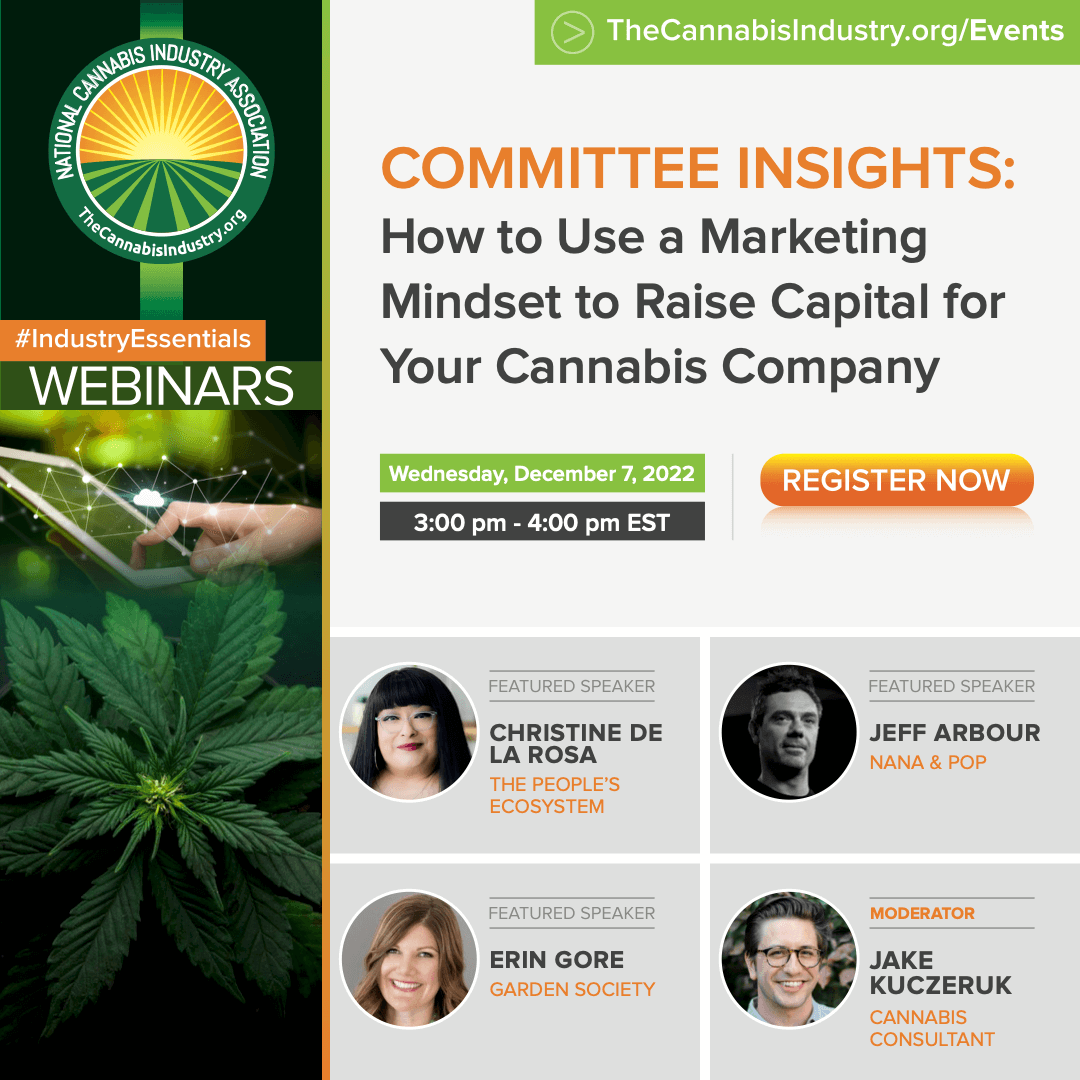
Committee Insights | 12.7.22 | How To Use A Marketing Mindset To Raise Capital For Your Cannabis Company
NCIA’s #IndustryEssentials webinar series is our premier digital educational series featuring a variety of interactive programs allowing us to provide you timely, engaging and essential education when you need it most.
In this edition of our NCIA Committee Insights series, originally aired on December 7 and produced by NCIA’s Marketing & Advertising Committee, our panel of cannabis finance specialists, leading operators and capital raising experts will guide you through best marketing practices and considerations to deploy when fundraising in the cannabis industry from a marketing perspective.
Learn tips and tricks and do’s and don’ts from marketing pro’s and industry insiders to best position your company to get the attention of investors in the current market conditions just as you’ve done when targeting consumers.
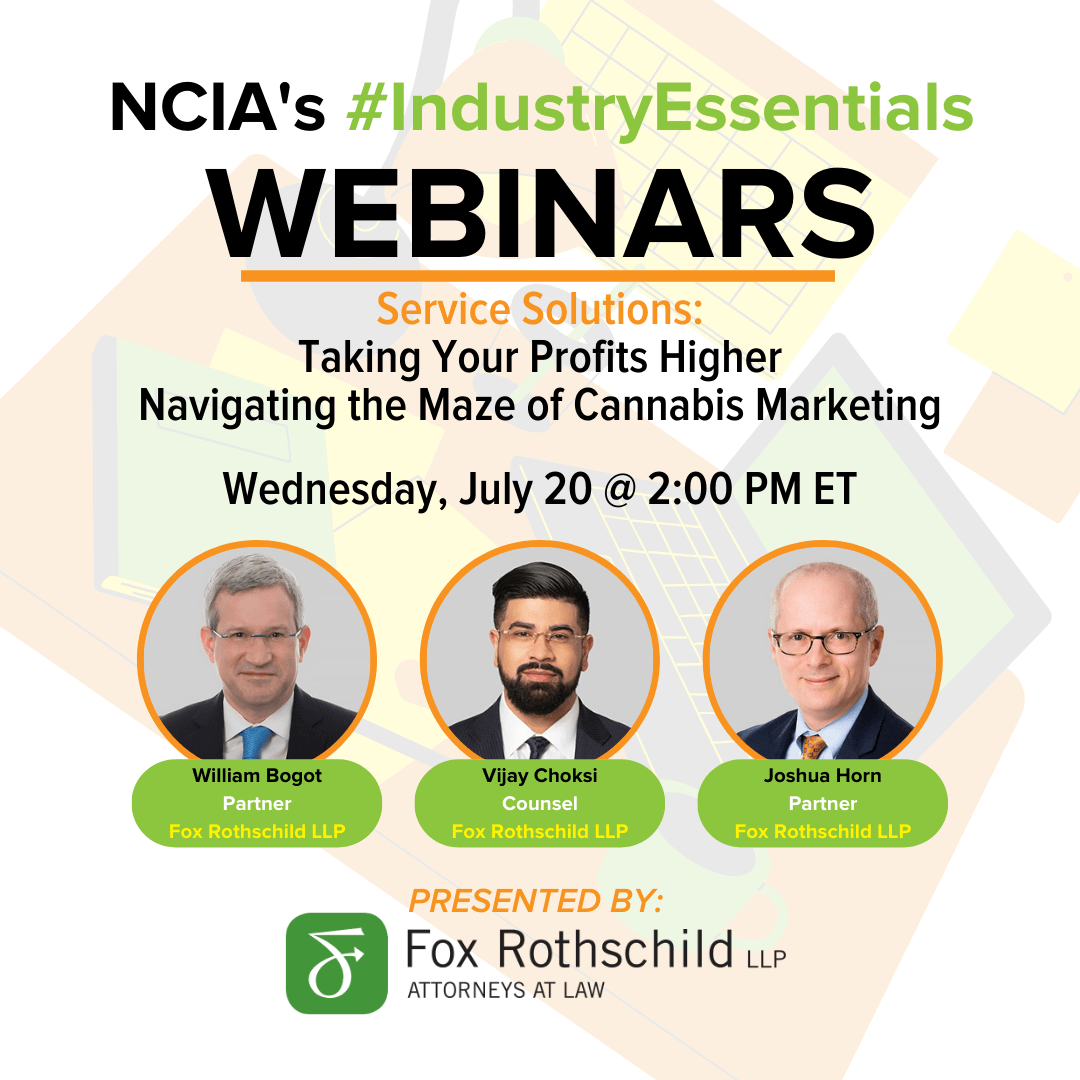
Service Solutions: Taking Your Profits Higher – Navigating the Maze of Cannabis Marketing
NCIA’s Service Solutions series is our sponsored content webinar program which allows business owners the opportunity to learn more about premier products, services and industry solutions directly from our network of established suppliers, providers and thought leaders.
In this edition originally aired on Wednesday, July 20, 2022 we were joined by Fox Rothschild LLP whose national cannabis team discussed discussed how agencies and companies can comply when marketing products.
A successful business relies on marketing and advertising to grow and bring in new customers. But what happens when those promotional efforts are heavily regulated or even restricted? These are questions and hurdles cannabis businesses face, but there are ways to navigate this maze.
04:04 – How is marketing & advertising cannabis different than other industries?
07:45 – How is marketing & advertising for cannabis different from state to state?
13:40 – Are these state restrictions for cannabis OK under the First Amendment and do similar state constitutional free speech protections exist or apply here?
15:25 – Virginia State Board of Pharmacy & Thompson Case
16:26 – Central Hudson Case & The Four-Part Test for Commercial Speech
19:57 – Equal Protection Challenges on the Horizon
26:00 – California Cannabis Consumption Event Permitting Process
31:39 – How is marketing & advertising for hemp-based CBD products different than other industries?
37:28 – What is a curative healthcare claim and how can cannabis (or CBD-based) companies develop creative methods to comply while still distinguishing themselves?
41:40 – What trends and challenges do you see on how cannabis products are being advertised and sold?
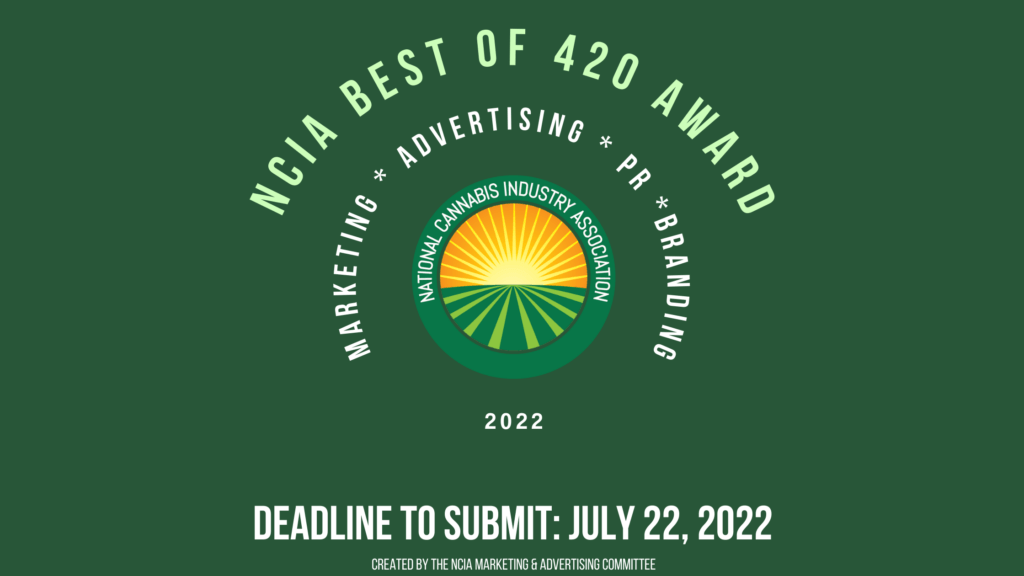
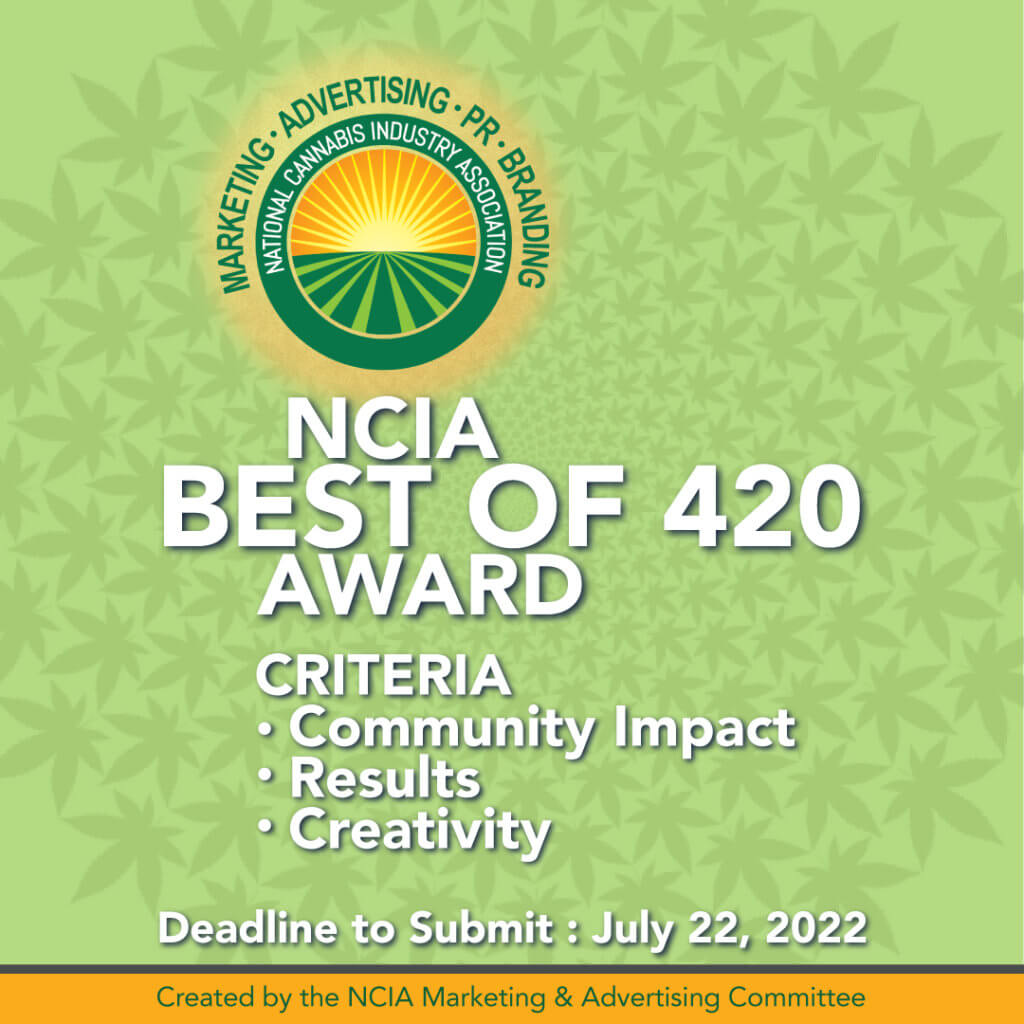
Committee Blog: Announcing The NCIA Best of 420 Clio Cannabis Award
The Clio Cannabis Awards, September 29, 2022 in Las Vegas at the MGM Grand
During the winter of 2021, when vaccines were not yet widely available, and many people were still in lockdown, the NCIA Marketing and Advertising Committee was determined to shine a light on those in our community who were fueling opportunity and growth during a difficult time for many businesses.
MAC Chair Kary Radestock of Hippo Packaging assembled a subcommittee tasked to amplify top member marketing efforts and thus the Best of 420 Award program was born. The 2021 event received dozens of submissions from all over the U.S. across all business sectors and budget sizes and was conducted and presented virtually. See last year’s winners here.
For 2022, NCIA and the Marketing and Advertising Committee are bringing it back and this year, it’s going to hit differently.
Through the guidance of our subcommittee co-chaired by Melinda Adamec of Gabriel Marketing and myself, Tara Coomans of Avaans Media, we’ve also enlisted Michael Kauffman of the Clio Awards, Angela Wong of The People’s Ecosystem, and Vanessa Valdovinos of Hush Chicago to provide support to this year’s process and expand this award.
The winning honoree will be presented live at the 2022 Clio Cannabis Awards to be held on September 29th at the MGM Grand in Las Vegas.
What’s Staying The Same:
NCIA invites all cannabis companies and brands, both B2B and B2C to submit their 420 campaigns—NCIA membership is not required. Budgets of all sizes and companies of all types, B2B and B2C, are encouraged to apply.
It’s still FREE
A jury of NCIA members and peers who will evaluate submissions and recognize the top entry.
What’s Changing:
Winners: There will be one winner and this winner will be chosen based on three criteria.
Judging Criteria
Criteria: Judges will evaluate entrants in three ways: Community Impact, Creativity, and Results.
Community Impact: How did your campaign bring your community together? How did it highlight the best of the cannabis community to others? Did it support an advocacy campaign such as DEI, sustainability?
The cannabis industry is showing the world how an industry-aligned can create positive change. How does your campaign positively impact either the cannabis industry, your customers, the environment, underserved or unrecognized cannabis users, or businesses?
Creativity: How creative was your overall 420 campaign? How creative are you in getting out your message and implementing the campaign?
Results: Was it an effective campaign by your own goals and KPIs?
This category is one of the most important because our judges will judge the results based on your goals. Regardless of budget size or market size, show us your results. Results are those KPIs that are important to YOU. Make sure you grab those baselines so we can see your progress!
Judges:
Selected from a diverse slate of NCIA members, including past winners and NCIA committee members from a cross-section of perspectives, including the Sustainability Committee, the Diversity and Equity Committee and the Marketing and Advertising Committee.
Submission Process and Deadline
Submit your company’s campaign today by following the link below! Act fast as entries will be collected over the following six weeks, with a deadline to submit by Friday, Jul 22, 2022.
Good luck to everyone and have a fantastic 420! Submissions are being accepted now! We look forward to seeing your exceptional campaigns!
About Clio Clio is the premier international awards competition for the creative business. Founded in 1959 to celebrate creative excellence in advertising, Clio today honors the work and talent at the forefront of the industry in a variety of specialized fields, including: sports, fashion, music, entertainment, cannabis, and health. As a leading authority on the diverse and ever-changing creative landscape, Clio celebrates creativity 365-days-a-year via its global ad database Ads of The World and its content platform Muse by Clio. https://clios.com/ https://musebycl.io/ https://www.adsoftheworld.com/
About Clio Cannabis Expanding on Clio’s enduring reputation for establishing best-in-class programs honoring creative ideas in a variety of specialized verticals, Clio Cannabis celebrates the creators at the forefront of cannabis marketing and communications. Launched in 2019, Clio Cannabis sets the bar for creative work in a rapidly growing industry, builds a greater understanding of a developing category, and elevates creative contributions from top talent and agencies. https://www.cliocannabisawards.com/
Media Partner
For hints and tips on winning award programs, with hints and tips from the entire Marketing and Advertising Committee, listen to the replay of our recent webinar:
Committee Blog: Do’s and Don’ts of Cannabis Influencer Marketing on Social Media
By NCIA’s Marketing and Advertising Committee, Helen Mac Murray, Mac Murray & Shuster LLP, and Dan Serard, Cannabis Creative Group
The requirements and restrictions surrounding paid advertising on social media are hardly a secret. Cannabis businesses have to tread carefully to avoid getting shut down or banned completely from online platforms.
However, there is one popular way to leverage the power of social media without risking your account: Influencer Marketing.
An influencer is any public figure, celebrity, creator, or individual that has the power to affect the purchasing decisions of others because of their authority, knowledge, position, or relationship with the audience. Influencers are typically content creators that actively engage in a select niche online, such as Lifestyle, Fashion, and even Cannabis.
Influencer marketing is a fantastic way for cannabis brands and dispensaries to leverage the power of social media without getting tangled up in the mess of rules and regulations. However, that doesn’t mean there are no rules and regulations for influencer marketing.
Here are some do’s and don’ts of cannabis influencer marketing on social media:
DO select your influencer partners carefully.
Marketers and business owners can be quick to forget that influencers are not just marketing tools, but rather, people as well. In that regard, influencers are their own brand. Their entire digital presence is curated carefully to align with their unique values and interests.
This means that when cannabis brands are interested in working with influencers, they have to be extremely careful who they choose. Not only does their character reflect on your brand, but also because it’s going to cost you a pretty penny.
Therefore, focus on building meaningful relationships with influencers and popular creators. Add value to their community and don’t view them as a tool in the toolkit. When you manage these relationships the right way, you turn one-time influencers into long-time brand ambassadors.
If you are partnering with someone who will be making claims about your brand or promoting your product in any way, be sure to:
Examine their credentials
Make sure they actually use and love your product
Evaluate whether their values align with your brand’s values
Check that their engaged audience is your target audience
One of the biggest benefits of influencer marketing across industries is that it is a relatable way to sell products. If your influencer partners or brand ambassadors do not actually use and love your product, the partnership will lose its value. Both your brand and the influencer will lose credibility.
When selecting influencers to partner with on campaigns, take time to do your research. Observe their regular social media activity as a follower, be patient during the agreement phase, and understand that this is a long-term partnership.
DON’T run or re-run any paid influencer ads without consent.
After the Borat debacle in Massachusetts, cannabis brands have (rightfully) become paranoid about using influencers or celebrities in their marketing campaigns.
While memes on social media are perfectly fair game, a disclaimer or two never hurt anybody if you want to cover your tracks. However, paid ads are a completely different ball game.
For those who are wondering what you can and can’t do when it comes to using a celebrity or cannabis influencer’s image or likeness, here’s a general rule to keep in mind: Do not run or re-run any paid advertising with a public figure without express legal consent.
When it comes to influencers, this means you need to be very specific on the terms of your engagement. For instance, if you are simply looking for a one-time product endorsement on their own channels, you can share these assets from their account to yours. However, you are not allowed to take those assets and use them in future campaigns, especially paid ones, unless you have explicit permission from the influencer.
In other words, if you want to be able to run any cannabis advertising campaigns with partner content, be sure to let the influencer know during the agreement phase, and prepare your budget accordingly.
DO make sure your influencer partners disclose your relationship with their audience.
Disclaimers are extremely important on social media and other marketing platforms when working with influencers. They provide your audience with transparency and protect all parties from any legal backlash.
If you have any relationship with a cannabis influencer of any kind (celebrities, bloggers, etc.), make sure they disclose that to their own audience when engaging in formal partner campaigns with your brand.
Using a descriptor in the caption or image, like #ad
Disclosing any paid travel, stay, or product exchanges
Add disclaimers in both the text and the media
Disclosing material connections with a brand is an important requirement for influencers, but brands are also liable for influencer posts that violate the law. You never want your cannabis brand to be associated with anyone that might find themselves in hot water, so be sure to make these terms clear when partnering with influencers.
DON’T run ads without proving your product claims.
This may go without saying, but when it comes to paid advertising in cannabis, throwing spaghetti at the wall and seeing what sticks isn’t really a good idea. When you’re running ads – whether it is on a traditional medium, like a billboard, or a digital medium, such as pay-per-click ads – it is important to do your due diligence.
Don’t wait to prove your product claims until after the ads have run. Not only will this get you in trouble with the FTC, but you will appear deceitful to your customers and quickly lose their trust.
Instead, ensure you have third-party lab testing, credible experts (like cannabis doctors or budtenders) able to speak to your specific product, and/or the receipts to back up your claims if challenged.
DO be cautious when using consumer testimonials about your product.
Existing customers are the best marketers for your brand. Using reviews to show social proof of your product is a great idea. In fact, any cannabis marketing professional will tell you that it is encouraged to show off testimonials on social media, websites, email lists, and more.
Only use the words of your customers if you have express permission to use them on other channels, or if they are already posted in public forums, such as Google Reviews.
It is also highly recommended that you only use testimonials if they reflect the results of most of your customers. You can’t use consumer testimonials if you do not have substantiation that the endorser’s experience is representative of what consumers will generally achieve unless the advertisement clearly and conspicuously discloses the generally expected performance in the depicted circumstances, and the advertiser must possess and rely on adequate substantiation for that representation.
While it’s always helpful to highlight benefits that real people have experienced, disclaimers should always be made if anything sounds too close to a health claim. For instance, if a customer comments on an Instagram post that your product has made their anxiety disappear, you’ll want to gain express permission from them to use their words as a testimonial, and you should add a note when posting that such claims one customer’s unique experience and can’t be interpreted as medical advice.
DON’T bring on a marketing company only for damage control.
Cannabis marketing agencies are a powerful tool for a brand or dispensary. From social media and email marketing to search engine optimization, branding, website design and development, and more, these companies are experts at crafting a digital presence for your business.
However, good marketing only goes so far. Even the best cannabis marketing professional or influencer can’t cover up for false information, a bad product, poor customer service, or just bad business overall.
Additionally, even when marketing companies have industry-specific expertise, they are not lawyers. As a brand, you can’t rely on your agency to know the exact letter of the law.
Instead of using social media or your marketing efforts as damage control, be intentional about building a high-value brand and bringing on a marketing agency that can make you stand out from the crowd in good conscience.
That means, start from the ground up, provide accurate information, and protect yourself and your brand from any liability by being cautious of any cannabis advertising and marketing rules and regulations.
Using cannabis influencers for your social media marketing campaigns
Developing a strong presence on social media isn’t just impressive, it’s important for your audience and potential customers to buy into your brand. Whether it’s paid or organic, influencer marketing is a great workaround to some of the more harsh realities of social media rules and regulations for cannabis brands and dispensaries.
When you harness the power of these public figures and their engaged communities online, you can take your brand to new heights.
Member Blog: Business SMS Basics for Cannabis
by Matt Hostacky, Regional Sales Manager, Flex IP Solutions/Cannabiz Text
Text messaging is the next wave of communication to customers. 98% of all texts get received. 92% are read within 5 minutes. And 45% receive a response, and if you think that your customers want to engage their favorite businesses this way, you’d be correct. 85% of people polled want text message marketing from their favorite companies.
But how do you get started? How does it work? Are there technology requirements? Etc. Here are some of the common questions we get to help you navigate this great communication tool for your business.
What are the technology requirements? An internet connection and a computer with a web browser are all that is required for most systems.
We’re not tech-savvy, is the SMS system difficult to use or learn?No, most systems are very user friendly and intuitive. Most systems work through your web browser and can be set up and used in minutes with little more than a user guide.
Can I use my existing business phone number? Yes, most platforms support text enabling your 10 digit business number. This helps people recognize who the text is coming from and build brand awareness.
What are some of the common features of an SMS system? Series (drip campaigns), Surveys (polls), Time-Texts (schedule now, send later), Contact Segments (Tags or Identifiers), Compliance tools, Reports, and Keywords (Text “Vegas” for a chance to win a trip to Vegas). Above and beyond these key features you may want to consider having 2-way chat and/or automations capabilities for your business to help answer any questions your patrons may have.
Who can I market to? Existing customers or those that have “opted-in” in some way to receive your promotions and communications. You may have new prospects or customers text a keyword to get opted in for example. However, if you acquire a list of telephone numbers for outbound communications they are considered SPAM under the TCPA and CAN-SPAM acts and you should not message these numbers.
Do I need to stay compliant?And how? Yes. Most systems (or at least the good ones) have some form of compliance automation and tracking to help keep you covered. At a bare minimum you need to have a “please reply stop to opt-out” message in each outbound marketing message.
What are the costs associated with an SMS marketing system? This is probably the hardest thing to compare apples to apples. Typically, an SMS system is a monthly charge either per text or as a package of texts. Some systems lockdown certain features and charge extra for them a’ la carte. Other systems are part of a CRM or POS system and either charge per text or a fee to unlock that feature.
What should my business have in advance of getting started with an SMS system?
1) Make sure you’re collecting phone numbers from your customers today.
2) Have a marketing disclosure statement that customers sign either electronically or physically so you are legally allowed to market to them.
3) Have said customers and phone numbers in or able to be exported to an excel or .csv file so you can upload them as contacts.
4) Have a plan. Don’t just set up a system and start sending texts. Understand why you want to text, how you will text your customers, and what you will be texting your customers.
Compliance
So why is compliance so important? We’ve all received annoying texts we didn’t ask for letting us know we’ve won a cruise or there is a sale on cheap erectile function pills. The FCC and Mobile carriers are already working to put more measures in place to mitigate the number of robo-texts and SPAM that is being sent. This is called 10DLC Campaign Registry. 10DLC Campaign Registry is too much to cover in this blog but you can find out more here 10DLC Campaign Registry.
If you’re soliciting anything to your existing customer base you must have consent, see the TCPA and CAN-SPAM acts. The best practice for this is what is called a “double opt-in”. A double opt-in is having the customers’ consent twice. The first form of consent is typically in some marketing waiver that is signed or checked during the buying process, it’s no different than getting consent to call or email promotions. The second opt-in is during the texting process. Typically, the first text received will have a message that asks the customer to reply “YES” to continue to receive texts. You usually see this with keywords that ask the person to text a word to a specific number, when that happens an automated message will then ask the person to reply with “YES” to continue to receive messages.
Another form of compliance is opting out. You must always have a “please reply “STOP” to stop receiving texts…” message in your messages. The first question you should ask about any SMS/texting solution is if this is built into it, meaning if someone replies back with STOP at any time, does it remove them from your marketing list even if you don’t have the wording in the text? If the answer is no, it’s not a system you want to use. Once again the TCPA and CAN-SPAM acts mandate that you give the consumer a way to opt-out of receiving messages from your business. And you’ll want a system that captures and can report on this as well.
Something to understand is that certain things are still illegal to promote via text, i.e cannabis. Mobile carriers (the companies that transport the SMS messages) like ATT, TMobile, and Verizon have filters that are looking for hot button or trigger words. So words like cannabis, marijuana, weed, edibles, and ganja are going to get flagged. This doesn’t mean that you can’t still use text message platforms. It just means that instead being obvious about what you text out you become a little more vague. Your customers will still know there is a sale on edibles if you say something like “2 for $20 on ABC brand yummy treats this week”.
Compliance doesn’t have to be all doom and gloom. Make it fun. The most successful businesses do an initial promotion or giveaway to get folks to opt-in to their text marketing. Another great tip is to put your business’ name at the front of the text with a colon so everyone knows who the text is coming from. i.e. ACME: Acme widgets on sale this week 20% off! Remember your customers want to hear from you, they want to stay informed of any new products or promotions… that’s why they’re your customers. They just don’t want to be bombarded with SPAM on their personal devices at all hours. So be courteous and make sure the number of text promotions is not too much and are being delivered at appropriate times.
Additional Use Cases
By now most folks are aware of the two most prominent use cases for business texting, 1) marketing and 2) appointment reminders. But there is a wide world of other use cases for texting that you may not have even thought about. And these use cases can help separate your business from others by delivering a “wow” customer experience.
Customer Service
Instead of phone calls, why not answer questions about your product or service using texts? The advantages of using text for customer service are:
Customers don’t have to wait on hold for the next agent
There is always a record for that customer to refer to
Your employees can handle multiple chats at one time unlike voice calls
You can automate answers to the most frequently asked questions.
Sales
Yes, this is different from marketing because marketing is one-way. With two-way texting you can interact with your customers the same as you would in-person or via a phone. Your sales force can provide the presales support that your customers expect but with the convenience of a text or picture message.
Delivery Notices
If you’re in the business of deliveries or in-home service these are a must for a great customer experience. Send pictures of your delivery driver in advance. Let your customers know when their package will be or has been delivered.
Alerts
During the COVID-19 lockdown, almost every business’ processes changed. Masks needed to be worn, social distancing observed, and a lot of businesses went to calling or texting when a customer or patient could be seen. The businesses that had an SMS platform ready to go didn’t miss a beat. There were signs like “Text our main number to let us know you’ve arrived” for things like veterinarian offices, healthcare, retail stores, and restaurants.
Business SMS is still relatively new, but the use cases continue to grow. Communication has moved to a person’s mobile device now and we don’t check or pay attention to email like we used to. People expect real-time alerts and notifications on their phones. Leveraging business SMS in multiple ways can provide a memorable customer experience to your patrons which will, in turn, create repeat customers.
Matt Hostacky, Regional Sales Manager, Flex IP Solutions/Cannabiz Text
Matt Hostacky, an IT and telecommunications industry veteran, takes a consultative approach to solve real-world business challenges with technology solutions. He serves as Regional Sales Manager for FlexIP Solutions Inc., a provider of managed communications services customized for businesses of all sizes and optimized for best value and performance. Hostacky advises customers on communications and collaboration strategies that leverage solutions, such as Cloud PBX, Unified Communications as a Service, Contact Center as a Service, Collaboration as a Service, SIP Trunking, Secure SD-WAN, Business Continuity and Disaster Recovery, and Business Text Messaging.
Committee Blog: Five Best Practices to Future-Proof Your Cannabis Brand on Social Media
By Jake Setlak, Receptor Brands on behalf of NCIA’s Marketing & Advertising Committee
Social media platforms can be perilous for cannabis businesses. Every brand feels the need to have a presence on social media. Their typical approach is to accumulate followers by posting what you think those followers want to see. Then one day, without notice, those followers — and the platform algorithm’s understanding of why your brand was relevant to them — vanishes. Cannabis brands on social media are surrounded by so much gray area, it’s hard to know what makes your presence vulnerable to risks of suspension or worse. To help brands avoid those gray areas, here are five practices to help cannabis marketers future-proof their brands on social media.
1. Embrace standards.
Brands are held to higher standards on social media than users are. This is especially true for brands in regulated categories like cannabis. Why? Standards help protect against fraud and deception. These protections serve both consumer (users) and commercial (brands, businesses) interests across a wide variety of media channels. Think: truth in advertising and consumer protection laws. Get familiar with the federal, state, and municipal or regional laws that apply to all commercial interests where your cannabis brand operates (or find someone to do this on your behalf).
2. Think about your reputation.
How you behave on social media says a lot about your brand. There’s more than content to consider — bad behavior can permanently discolor your brand’s reputation. Why? Everyone can see what you’re doing. Openly engaging in deceptive practices shows consumers, partners, and regulators that your brand isn’t trustworthy. Those duplicate and back-up Instagram profiles? They signal to the rest of us that you know you’re taking risks. That could be all it takes to inspire someone to flag or report you. Social platforms notoriously rely on users to police the community — if users like you don’t report violations, the platforms tend not to know about them.
3. Safeguard your brand’s presence.
This is worth repeating, regardless of being in cannabis or another category: avoid getting banned. Why? No back-up profile can magically restore lost followers and engagement. When social media platforms decide to allow cannabis brands to use paid advertising, you’ll be locked out. This is why it’s important to set clear goals and objectives for maintaining your brand’s social presence.
Establish a compliance strategy for your social media efforts with three must-haves:
Social Media Policy for Employees
Community Management Guidelines & Protocols
Legal Counsel (professional advice regarding cannabis category regulations, truth-in-advertising standards and consumer protection laws, and social media platform policies)
4. Know what you can say and how you can say it.
Be careful not to misinterpret another brand’s social media activity as setting a precedent for yours. Why? Seeing someone else break the rules is not license or permission for us to break those same rules. Plus, let’s face it — legitimate cannabis brands are already working uphill against prohibition-era prejudices. Know a bad example when you see one, and more importantly know what you can say and how you can say it on social media platforms.
What you can say:
DO stick to “social” objectives. Take the higher ground. Speak from your brand values, not necessarily what the “insta” know-it-alls might insist. Be a valuable presence in the community, not just more clutter in their feed.
DON’T antagonize the community. Remember, you’re a commercial interest and held to higher standards than users. It looks bad when brands argue with competitors, followers, or other brands. The Internet is full of trolls who prey and depend on your impulsive responses — even if it isn’t your aim to deceive or misinform, you may already be a target because of the stigma that still comes with cannabis.
How you can say it:
DO communicate generally. Make observations. Be insightful. Grow your audience. Engage the community.
DON’T advertise or promote. Explicit calls-to-action (CTAs) like “get”, “find”, “try”, or “buy” aren’t allowed for cannabis, especially on platforms where you can’t guarantee your audience is of a compliant age. This is the same reason you want to avoid depicting or promoting over-consumption.
5. Set the bar higher.
Aim to be the most upstanding citizen in the cannabis community. Why? No one knows when federal legalization will happen or how quickly a platform’s policies will change. This means no one can say it’s too soon to start preparing for such an eventuality!
There are four ways you can start raising the bar right now:
Make content that makes a difference.
Content creation for startups and small businesses doesn’t have to be overwhelming. Start with measurable objectives that justify your content creation process and budget. Scale your efforts toward more effectiveness, not merely more frequent posts. Set aside time to regularly evaluate and optimize your efforts. This is where well-placed focus will go a long way for you. It might take more effort to get beyond the “recommended” or popular approaches, but you will discover that you move faster and spend less when you go with what you know: the meaning and value your brand offers the cannabis community.
Apply paid advertising standard to organic content.
These apply to paid advertising but may in some cases also apply to organic content posted by commercial interests (brands). Platforms change frequently and without warning, so it’s wise to stay current on the policies and guidelines of the platforms you use.
Here are helpful resources for the five social platforms where many brands — regardless of category — typically start on social media. Enforcement may still be a mystery in many cases, but these policies help us understand when a post or profile might venture into gray areas and risk a suspension or worse.
Jake Setlak is a founding member and head of Creative Strategy / Brand Experience at Receptor Brands, an agency custom-made for cannabis that transforms relationships between cannabis brands and their customers. Prior to his work in cannabis, Jake spent 20 years guiding the digital transformation of some of the world’s biggest brands and their advertising agencies. He’s worked in social media channels since before they were called “social media” and invented the Facebook Comment Ad format (now known as the boosted or promoted post). Jake is a member of NCIA’s Education Committee but produced this content while a member of the Marketing & Advertising Committee and serving on its Next-Generation Advertising subcommittee.
Member Blog: Does Your Cannabis Brand Need Social Media? Yes, But Not For the Reasons You Think
Every cannabis brand needs social media. But, the reasons to be on social media, and how you should approach your accounts might surprise you.
Social media is a powerful tool for all businesses today. Even in the cannabis industry, where most paid advertising opportunities – including paid social – are off the table.
It’s an effective way to communicate with customers directly. Social media lets your cannabis brand or dispensary start meaningful conversations – it’s a place to develop and nurture a community. But should you look at social media as a primary business driver? Probably not; hear me out.
Five years ago, when I started managing social media accounts for cannabis brands, organic engagement wasn’t easy, but it was easier than it is today. Marketers (like me) remember the era of chronological Instagram feeds and simplified Facebook algorithms fondly. Five years ago, getting organic attention from your followers was more straightforward. It was also easier to build an audience quickly.
Strict regulations are a constant battle for cannabis businesses marketing on social media. We’re violating every platform’s terms of service and community guidelines just by being there. Every cannabis brand wants social dominance. I’m here to deliver unfortunate news; social media dominance is off the table for most of you.
Today, you can only expect to reach about 3%of your audience on most social media platforms. And that’s if your content is excellent. But even with amazing content, algorithms are your enemy, and hashtags only get you so far.
It can feel like an impossible challenge. We’re tasked with bolstering brands but walk a tightrope of rules to keep posts and accounts from getting the boot.
Do cannabis brands still need to be on social media? Yes. Here’s why.
You can access a limitless direct-to-consumer digital platform if you can manage to grow and maintain a social media following. But, of course, it’ll take time to build an engaged community (for many of you, it’ll take years of hard and consistent work), and you need to be realistic – don’t put all of your cannabis marketing eggs in the social media basket; there are other ways (email and programmatic advertising for example).
Still, social media is a business necessity today, just like printer cartridges or desk chairs. You must be there – even if the task is seemingly impossible.
What makes excellent social media content?
Every marketing “expert” on the internet will tell you the key to social media success is excellent content. And that’s true. But, what makes for awesome content is relatively subjective – it’s not for you or me to decide. So, who gets to decide what makes terrific content? Your customers, that’s who.
How do you determine if your customers think your content is excellent? They’ll reward you with engagement. And engagement is virtually the only thing almighty social media algorithms care about.
Maybe your customers love ridiculous memes; perhaps they prefer higher-brow lifestyle content. If you run a dispensary, your customers might love seeing their favorite budtenders highlighted on your feeds. If you’re a cultivator, your customers probably think drool-worthy strain content is excellent (be careful, Instagram is advanced enough to find flower images, and that violates TOS and community guidelines).
Here are a few social media post types you should consider:
Expert Budtender Recommendations
Cultivation Behind-the-Scenes
Aspirational Lifestyle Imagery and Content
Humorous Memes for Cannabis Enthusiasts
General Cannabis Education
Product Education
Consumption Tips and Guidelines
You need to deeply understand your customers (that’s why we’re persona development sticklers) and craft a content strategy explicitly designed for engagement. Of course, I’m vastly oversimplifying this process – it takes time and a lot of testing to determine what will work best for your cannabis brand. But the results are often worth the work. Let your customers tell you what they want.
Even with excellent content, you need to be realistic.
I’m going to break some hard news to you – even with genuinely excellent content, you can still really only expect to reach around 3% (as I mentioned earlier) of your total audience. So whoever told you that organic engagement on social media is easy lied to you.
Most people think there’s one overarching algorithm controlling what we see on our social media feeds. But, in the case of Instagram, for example, several algorithms work together, making tiny decisions in real-time to determine the posts you see.
Adam Mosseri (head of Instagram) talks about how their algorithms work in a recent blog:
“One of the main misconceptions we want to clear up is the existence of “The Algorithm.” Instagram doesn’t have one algorithm that oversees what people do and don’t see on the app. We use a variety of algorithms, classifiers, and processes, each with its own purpose. We want to make the most of your time, and we believe that using technology to personalize your experience is the best way to do that.
When we first launched in 2010, Instagram was a single stream of photos in chronological order. But as more people joined and more was shared, it became impossible for most people to see everything, let alone all the posts they cared about. By 2016, people were missing 70% of all their posts in Feed, including almost half of posts from their close connections. So we developed and introduced a Feed that ranked posts based on what you care about most.
Each part of the app — Feed, Explore, Reels — uses its own algorithm tailored to how people use it. People tend to look for their closest friends in Stories, but they want to discover something entirely new in Explore. We rank things differently in different parts of the app, based on how people use them.”
Instagram wants to personalize content for users, so it’s constantly making small decisions to reach its goal. Your job (and ours, as marketers) is to understand our customers deeply enough to create unique personalized experiences (I prefer to use the word experience over content in this scenario). Still, the algorithms pose a challenge which is why you need to understand that it’s going to take a lot of time, a lot of trial and error, and more content than you think you can possibly create in a lifetime to build and manage a loyal – and engaged – community.
It’s not impossible, but it’s not easy – many of you will fail. But still, you must be there because your customers expect you to show up for them in the places they hang out digitally. Of course, it doesn’t hurt to have the support of an experienced social media marketing team.
Aaron isHybrid Marketing Co‘s Content Director, and he loves to write blogs. He’s written so many blogs that he’s lost count. And beyond his skills as a copywriter and storyteller, he’s an obsessive reader and researcher. Aaron writes on subjects ranging from cannabis to collaboration, social equity to HR software, interior design to cybersecurity. His words attract, engage, educate, and convert. Btw, Aaron hates the phrase “content is king” (even though content is king – and queen).
Hybrid Marketing Co is a Denver-based branding and marketing agency that specializes in building custom strategies that supercharge growth and drive revenue. Working with brands and businesses across the U.S. and Canada, Hybrid’s partners run the full-spectrum of the cannabis world including dispensaries, manufacturers, cultivators, and ancillary businesses. Visithybridmarketingco.comto learn more about the Hybrid approach.
Member Blog: How Can Influencer Marketing Help Your Cannabis Business?
By Lindsey Griffith, Creative Content Specialist at ThrivePOP
It’s no secret: cannabis marketing is hard. Without federal legalization, many forms of digital advertising like Facebook, Instagram, and Google are nearly impossible. For years the industry has had to find creative ways to market cannabis while also staying compliant with current rules and regulations. As technology began to grow, influencer marketing began to take over social media platforms and rapidly became one of the most popular ways to promote your product or service.
From Kendall Jenner to Bella Hadid, major influencers and celebrities got paid in product or cash to promote to their large following. Evidence shows that for every $1 spent on an influencer marketing strategy, businesses will receive a return of over $5, more than doubling their revenue.While this was extremely popular for many years, the yearning for authenticity shifted the focus to smaller influencers. Here, we’ll discuss how that shift can be used as a pivotal tool in your cannabis marketing strategy.
Why Micro-Influencers Have The Most Power
After grasping what an influencer does and how they benefit your marketing strategyyou may be asking yourself: What’s the difference between a micro-influencer and a macro-influencer? Essentially, a micro-influencer is a social media personality with a following between 1,000 to 10,000 people. While macro-influencers generally have an audience ranging anywhere from 15,000 followers to millions of followers.
When researching a potential campaign, it’s important to consider your own cannabis brands target age, gender, lifestyle traits, and more. After identifying these demographics, now you can begin to research local influencers that you believe will best speak to that audience. Some interesting statistics that you should consider when you begin implementing your influencer marketing strategy:
84% of Micro-Influencers recommend products or services at least once a week.
77% of Micro-Influencers create content every day.
Micro-Influencers have over 7 times higher engagement rate than Macro-Influencers.
63% of marketers intend to increase their influencer marketing budget in the next year.
54 percent of influencers say they will work with brands who respect them as they would any other publisher.
91% of millennials trust online reviews as much as friends and family.
68% of bloggers prefer to work directly with a brand instead of an agency or network
When marketing a product or service you’re always striving towards building trust and authenticity. One of the biggest advantages micro-influencers have in promoting products or services to their audience is that they are deemed trustworthy sources, as opposed to a macro-influencer.
While trust in major influencers began to wane over time, it proceeded to plummet after several major scandals that caused users to question these social profile’s credibility and whether or not their recommendations were genuine. Fyre Festival anyone? This is when people started to look at smaller influencers to speak about products or services they truly valued, and to share that value with a smaller audience. No matter the marketing campaign, establishing transparency and credibility is the key to success.
Create Relationships
Collaborating with influencers doesn’t just help you create new relationships with potential customers, but it also helps grow your relationships with long-term brand partners. Once you’ve found an influencer that is the best fit, one of the best ways to build and maintain those relationships is to find ways to enrich further collaborations.
In order for your campaign to be successful, both parties need to be clear about expectations on benchmarks to measure. Disagreements and fights that come about when there is a miscommunication on the success of an ad campaign can permanently tarnish not only your relationship but can also put your brand authenticity at risk. Some of the items you need to determine before starting a campaign include:
Content imagery and verbiage.
Posting frequency and schedule.
Posting platforms and unique content curation/platform.
Establish payment (monetary or gifting product.)
Requested campaign outcome (gains of followers, purchases, engagement, etc.)
How To Reach Out
Now that you know everything it takes to rock your cannabis marketing with social influencers, it’s time to get started! If your cannabis business is ready to take a deep dive first make your dream influencer list. Once this dream list is “established” now it’s time to reach out! Consider finding an official contact email first as opposed to sending a direct message to the influencers page (this DM box is likely full and your inquiries may get lost). Make sure your message is proofed, professional, and carefully crafted. A sample collaborative email to an influencer may look something like:
“Hi [Insert Influencer Name],
I love your post(s) about [insert topic here] on Instagram. [Insert another sentence or two relating to their feed that adds a human element]!
My name is [insert name here] and I work for [insert company name]. We [insert what you do or your mantra]. I am reaching out because [insert what you saw in their feed, posts and what they are passionate about and relate it to your brand’s purpose]. We would love it if you would collaborate with us [insert any collaboration specifics in mind]!
Please let me know if you are interested and I will send more details.
No matter where you’re at within the industry, it’s no secret that cannabis marketing is both difficult and time-consuming. Consult with the movers and shakers in the marketing industry to help guide you in the best direction moving forward. Consider joining social media groups or joining cannabis business clubs within your community to learn from one another and to help grow.
Lindsey Griffith is the Creative Content Specialist at ThrivePOP, a West Michigan-based Digital Marketing Agency. As a copywriter, Lindsey has experience in creating and implementing content across several digital platforms including podcasts, webinars, blogs, and social media profiles. During her cannabis career, she has worked with several cannabis manufacturers on search engine optimization through blogging to drive traffic to their website and assist in organic social strategies to gain new followers. Lindsey received her Bachelor’s Degree In Marketing from Grand Valley State University and her work has been published across several cannabis industry platforms.
NCIA Committees: Spring 2020 Update On Achievements And Projects
NCIA’s member-driven committees are an opportunity for individuals from NCIA member companies to get directly involved in specific industry issues and sectors. These volunteer-driven efforts engage members’ expertise and passion to drill down in those areas to effect change, provide professional development opportunities, and develop best practices and guidelines that will shape the future of our industry.
We recently checked in with these various committees to learn more about what they’re up to and what projects they’re working on this term. Get updated on their activities below.
Risk Management & Insurance Committee (RMIC)
The RMIC has recently contributed to several NCIA white papers and educational webinars. They are currently working on an insurance manual. The committee has divided into sub-committees responsible for managing white papers, webinars, and the manual.
Scientific Advisory Committee (SAC)
SAC’s vision is to disseminate educational materials to NCIA members on scientific topics in the cannabis industry and to advise on other NCIA initiatives, ensuring that any formal recommendations produced are scientifically sound, sustainable, and legitimate. This term, SAC published a blog discussing why everyone should know about the endocannabinoid system.
SAC is working on other pieces addressing topics such as the recent vape illnesses from a physician’s perspective, indica versus sativa designation, how cannabis can help the opioid crisis, common scientific myths confusing the industry, and budtender and consumer education about the endocannabinoid system.
SAC is also developing a webinar that discusses what should be on a label, how to read a label, and how to associate what’s on a label with either statements on efficacy or marketing/branding.
Cannabis Cultivation Committee (CCC)
The committee has recorded two podcast episodes for NCIA’s Cannabis Industry Voice Podcast. The first was a Cultivation Best Practices Roundtable, hosted by Noni Goldman of the CCC. In that episode, Cody Hitchcock of Smokey’s 420 and James Cunningham of Fog City Farms were interviewed to shed light on their different growing styles and techniques, focusing on the ways that they implement sustainability in their operations.
The second soon-to-be-released interview was with High Times’ new CEO Stormy Simon, and was hosted by CCC Chair Mo Phenix and member Noni Goldman. This interview explored Stormy’s history and how she got to where she is today, as well as what High Times is up to, and where Stormy sees the industry going.
More podcasts to come in the next couple of months from the CCC! Keep an eye out for an episode or two on regenerative agriculture.
Packaging & Labeling Committee (PLC)
The PLC sub-committees have each contributed to a blog or presentation up to this date. The Sustainability sub-committee has worked with Kaitlin Urso and team in regards to their White Paper. A panel discussion proposal has been submitted for future NCIA conferences.
NCIA’s Northeast Cannabis Business Conference in Boston (February 2020) Panel Discussion on the Future of Cannabis Packaging went great!
State Regulations Committee (SRC)
NCIA’s State Regulations Committee has continued to produce content to help educate and inform members on the latest developments in the world of state regulation of cannabis. As the industry’s law and regulations change quickly across the country, the SRC members stay ahead of the curve and share their insight in a variety of forms. These projects include panel presentations at NCIA conventions, published blogs, and interactive webinars. In this quarter, they published three blogs, produced one webinar, presented on two panels, and participated in an NCIA summit.
As the committee strives to keep everyone updated on burgeoning legal topics, the SRC committee presented a webinar on Michigan, a newly regulated market. The webinar provided information on this key Midwestern state, “Michigan’s Adult-Use Market – What Comes Next?”
Conferences:
SRC members also traveled from across the country to share their expertise on panel sessions at NCIA’s Northeast Cannabis Business Summit in February 2020 in Boston.
The Social Equity Sub-Committee leaders, Erin Fay, Chris Jackson, and Margeaux Bruner provided helpful insight during their session, “What You Need To Know For Winning Applications and Successful Operations That Promote Diversity and Inclusion.”
Sean Donahoe and Gabriel Cross of the SRC’s Interstate Commerce Sub-Committee presented on the issues surrounding interstate commerce and strategies for preparing for this anticipated change in the cannabis industry.
Also, SRC members participated in the NCIA’s summit about tackling the illicit market.
The State Regulations Committee is excited about its work and continues to stay knowledgeable about the ever-changing legal and regulatory landscape. Their projected work includes a webinar on the Illinois adult-use market and a wide range of written projects. Stay tuned!
Banking & Financial Services Committee (BFSC)
The committee’s vision is to provide the NCIA member base with current and actionable information related to Banking and Financial Services in the State legal cannabis industry.
They have implemented monthly newsletters for the member base and have been extremely active in response to the proposed federal legislation regarding banking and the cannabis industry.
Human Resources Committee (HRC)
The Committee’s vision is to provide best practices in all disciplines of Human Resources to NCIA members. They have worked on a couple of blogs this year around the recent reduction in force trend and will be releasing a few blogs providing some recommendations for how cannabis employers can navigate CV-19 when it comes to their workforces.
The HR Committee is working on a very exciting case study. They are looking forward to releasing the first few modules of it this summer!
Marketing & Advertising Committee (MAC)
The MAC coalesces the talents of 20 of the industry’s top-tier marketing and communications professionals around three focus areas: Education, Advertising Access and 2020 political goals. The committee uses their personal, professional and business skills and networks to help build a responsible, legal cannabis industry. The committee is producing best practices, webinars, workshops and social media campaigns to aggregate and generate support from NCIA members, the public, media, government and business leaders.
The MAC Education Subcommittee has focused its energies on developing a Speakers/Expert Directory with a goal to launch by year-end.
The 2020 Subcommittee has created its first infographic covering Oklahoma’s 2020 ballot initiatives; infographics for additional states with legalization initiatives on the ballot this year will follow soon.
The Advertising Access Subcommittee is adding more states (as they come online) to their overarching list of “Do’s and Don’ts” for compliant cannabis advertising. Those are pending editing and legal review and will be published on the NCIA website soon thereafter.
The committee is also working on upcoming webinars including “Advertising Best Practices.”
Cannabis Manufacturing Committee (CMC)
The Cannabis Manufacturing Committee is focusing on reviewing existing business practices and state regulations of concentrates, topicals, vaporizers, and edibles ensuring the manufacturing sector is helping shape its destiny.
They are also working on their second publication, “Facts About Current Good Manufacturing Practices (cGMPs) And Their Role In The Cannabis Industry” which will be a resource for essential businesses.
In addition to the work the CMC is carrying out, they are collaborating with other committees to help create an NCIA resource library.
The CMC Testing sub-committee is working on writing blogs about “Positives of Testing” (from the operator’s view), and “Nomenclature: Cannabis Nomenclature Register” for publication.
Retail Committee (RC)
Members of the Retail Committee attended NCIA’s Northeast Cannabis Business Conference in Boston in February 2020 to participate in an educational panel on Retail 101. The committee has an upcoming webinar in April: “Retail: Tips and Best Practices” which will include 4 panelists that are currently license holders or working in licensed dispensaries in 3 different states (CO, CA, WA), and will also address some tips and best practices for the current CV-19 climate.
Facilities Design Committee (FDC)
Committee member David Vaillancourt of The GMP Collective appeared on NCIA’s weekly podcast, NCIA’s Cannabis Industry Voice, in February 2020 to discuss GMPs (Good Manufacturing Practices) in an episode titled “Revolutionizing How Cannabis Producers Achieve Success.”
Guest Post: Top 6 Reasons to Hire a Dedicated Cannabis Marketing Agency for Your Business
In this new and competitive multi-million dollar industry, the benefits of hiring a full-service cannabis marketing agency are many. Here are a few of the highlights that translate into higher performance and better visibility for your cannabis business.
The People
1. Time Is Money
It’s a numbers game, and the numbers work in your favor. A single marketing person in-house will have a longer turnaround time than a dedicated team from a top cannabis marketing agency sharing the work. Instead of hiring your own staff, contracting with an agency to communicate with a single member of your team makes it possible for all marketing to be completed swiftly and cohesively. If you have a marketing director, he or she can work directly with the agency to direct services such as event marketing or custom design work to further enhance your business.
2. Resourceful Talent and Talented Resources
With a full-service cannabis agency, you are able to choose the services tailored to your needs. You avoid the hassle of piecing together services from different providers, hoping they will all be on the same page to meet your vision. A dedicated agency will have a team of talented people at your disposal. Their diverse skill-sets will assist you with strategy, design, market research, search-engine optimization (SEO), social media, and more. If you’re looking to re-brand your business or simply want a print advertisement for Culture Magazine, the agency’s mission is to increase your return on investment and help your bottom line, and they will use their considerable resources to do it.
The Market
3. A Personal Ambassador for Media Buying and Cannabis Publications
A cannabis marketing agency worthy of its designation has invested in building relationships with both cannabis-specific and traditional trade publications. As such, they possess the ability to negotiate with sales representatives at various publications and leverage your media advertising buys. A dedicated marketing agency also has access to all of the latest publications’ media kits. By studying these, they can prime your marketing strategy and provide upcoming editorial and advertising trend forecasts.
4. The Power of Connection
A cannabis-savvy marketing agency has spent time and resources networking with journalists proficient in the industry, and thus they know which journalists can best pitch your brand and convey your specific message. By virtue of the constant networking involved, a cannabis marketing agency is also highly in-tune with consumer trends, and you reap the benefits of these connections.
The Laws
5. Dedication to Their Bread and Butter
By necessity, the cannabis-specific marketing agency possesses a thorough understanding of this unique marketplace. They are plugged into the wider community and are aware of current news and events, maximizing their ability to promote your brand at any given opportunity. As a member of the cannabis industry, the marketing agency is invested in the image, longevity, and future of the marketplace, and they will be highly motivated to portray your brand in the best possible light. If they’re committed to serving the cannabis industry, they should be members of the National Cannabis Industry Association (NCIA), the only industry-led organization created to serve and protect the interests of those in the business. Through banding together with other like-minded businesses, your cannabis marketing agency can be a powerful ally, helping to fund education and PR campaigns to evolve the image of cannabis-related industries and to promote friendlier laws.
6. The Law and Lay of the Land
Regulations and laws regarding cannabis are constantly changing, and it’s imperative to work with a marketing agency fluent in the ever-changing landscape of marijuana legalese. Marketing, advertising, and packaging all have their rules (for instance, marijuana edible packaging) and ignorance is no defense in the eyes of the law. A truly knowledgeable and dedicated cannabis marketing agency can be your trusted guide through the minefield of political and legal jargon and help you stay in compliance with the most current laws.
Studio 420 became a Sponsoring Member of NCIA in April 2015, and is a leading Denver-based digital marketing agency specializing in promoting high-profile marijuana retailers, dispensaries and cannabis-related products. They have experience in providing company and product branding services, website design and development, e-commerce and online shopping, as well as digital marketing strategies.
Guest Post: Say It Right – Colorado’s Retail Cannabis Advertising Regulations
By Jeff Cohn, CEO of COHN
With the Colorado market looking to reach $1 billion in sales this year, as well as Oregon and Alaska joining Washington and Colorado in regulating retail marijuana sales, the cannabis industry is exploding at unbelievable rate with no end in sight. With so many landmines to navigate in this nascent industry, we wanted to simplify the legal jargon for the Colorado advertising regulations in a quick reference guide. We hope you find this resource useful in building your brand while abiding by the regulation nuances.
Jeff Cohn is CEO of COHN, Inc., a sponsoring member of NCIA since October 2014. COHN is a Denver-based integrated marketing firm with a passion for contributing their years of retail and service business marketing experience to the cannabis industry. With COHN’s expertise, they are well positioned to help expanding businesses grow their brand and recognition.




 Matt Hostacky, Regional Sales Manager, Flex IP Solutions/Cannabiz Text

 Aaron is
 Lindsey Griffith is the Creative Content Specialist at

 Studio 420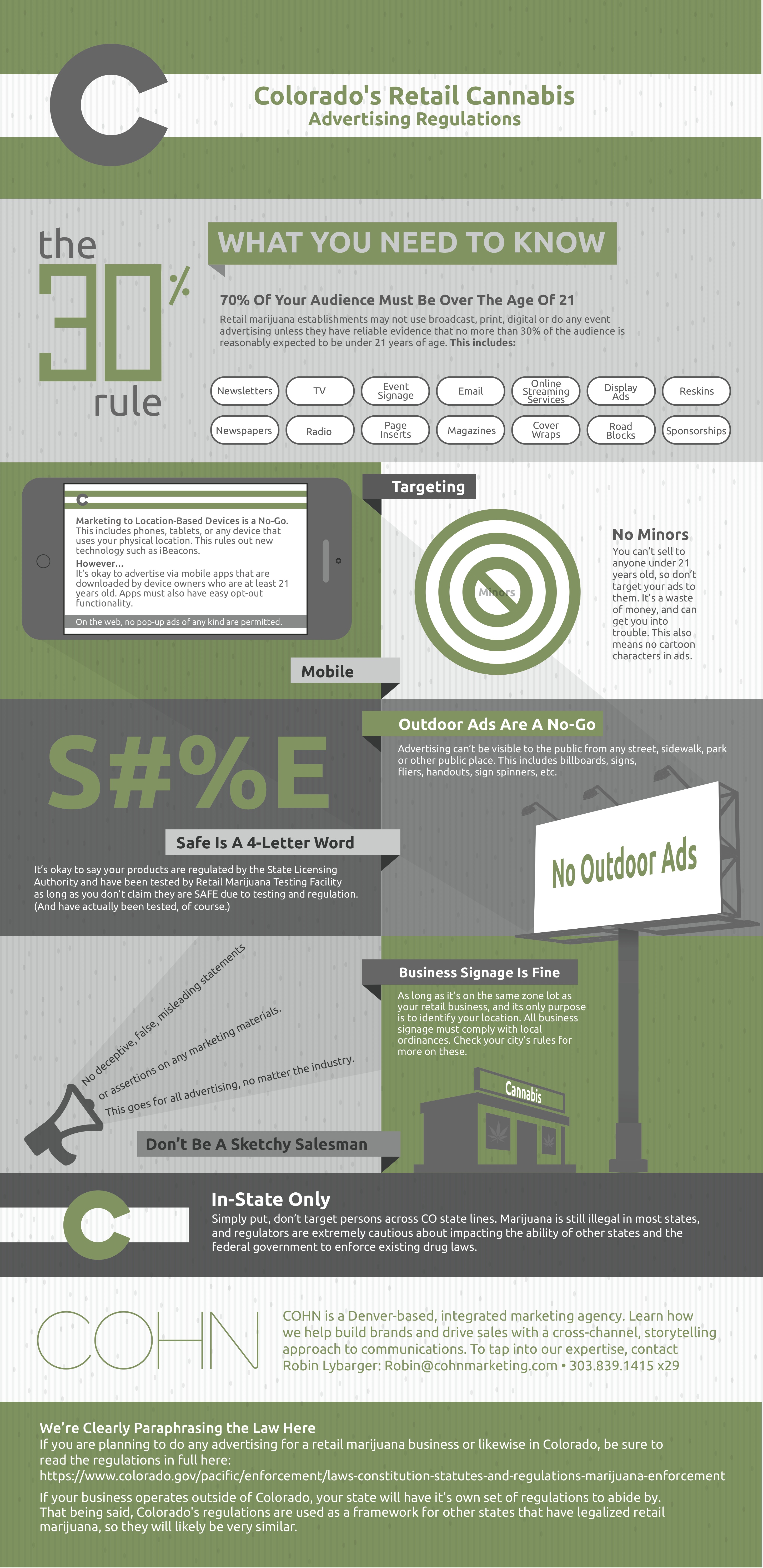
Follow NCIA
Newsletter
Facebook
Twitter
LinkedIn
Instagram
News & Resource Topics
–
This Just In
Member Blog: The Evolving Cannabis Legal & Regulatory Landscape in 2026
How THCa Vapes Are Changing Consumer