Member Blog: How to Avoid the 4 Most Common Payroll Mistakes
To achieve your goals in business, your payroll system must be flawless. It is an aspect in which you must strive for perfection whenever possible. Avoiding payroll mistakes in the cannabis industry is especially crucial due to the highly regulated nature of the industry. Compliance with payroll regulations is essential to avoid legal repercussions and penalties from governing agencies. Additionally, accurate and timely payroll ensures proper compensation for employees, and maintaining precise payroll records promotes transparency and accountability, building trust with employees and stakeholders in an industry where transparency is vital.
It is better to be safe by managing your payroll as thoroughly as possible, if not you would be sorry you didn’t. Most people have most likely made these mistakes and have had minor consequences accompanying them. If these mistakes persist, the business owner often pays dearly for them. These common payroll mistakes have cost some their business.
Having Multiple Records for a Certain Payroll
It pays to have all your payroll information in a single database. This enhances security and ensures that you know where to look for your payroll information. If this has been your practice and your business uses tools like HCM software that helps you manage your employees and other business information, then this shouldn’t be much of a problem.
All you’ll have to do is use that same software to manage and process payroll information. If your business documents are disorganized, be sure to have them all in one place.
Not Updating Needed Information
Ensure that you are not complacent by relying on automated software to do everything. The system is not aware that your employee would be changing addresses therefore such info should be entered manually.
That error could lead to mistakes in filling that employee’s taxes as the bills might arrive at the wrong address. As much as simplifying a process is great, you still need to play your path in getting things done.
It would help you to set timely reminders in the system that should help you avoid the mistake of not keeping up with the latest information.
Weak Security System
Confidential information should remain so. To avoid your system being compromised, you should be using a payroll processing system with strong cybersecurity.
This has got to be the costliest mistake common to payroll processing. Every information concerning your business that is not available on your website and to your customers, is most likely not public information. Private information about your business should remain private.
Information in payroll systems is as sensitive as can be. There’s almost every piece of information you need to know about a person, and as such strict rules should apply to keeping them safe. A weak security measure means a weak business and a weak business means trouble.
Inaccurate or Delayed Tax Payments
In calculating taxes absolute precaution is required. If you are not a tax accountant you are probably not so proficient in this calculation. Your tax accountant (if your business has one) should learn how to adequately use the system to avoid delay or inaccuracy.
Bear in mind that inaccurate tax payment makes your business a tax defaulter. Your business as a taxpayer has the duty of tax calculations assigned to an accountant. Note that taxes ought to be paid within the required time bracket. The systems are programmed to make the tax payments when due.
The human capital management system does not only process payroll information but can also tell when employees qualify for federal or state tax credits.
In Conclusion
To maintain payroll accuracy and timeliness in the cannabis industry, it is crucial to avoid payroll mistakes. By opting for a third-party payroll provider like Tesseon you can benefit from our expertise and ensure that your payroll is consistently accurate and delivered on time, regardless of any industry-specific challenges. The Cannabis industry is both very young and extremely regulated, it is imperative that businesses stay vigilant and proactive to avoid costly mistakes.
Member Blog: 2023 Cannabis Compensation Survey Announcement
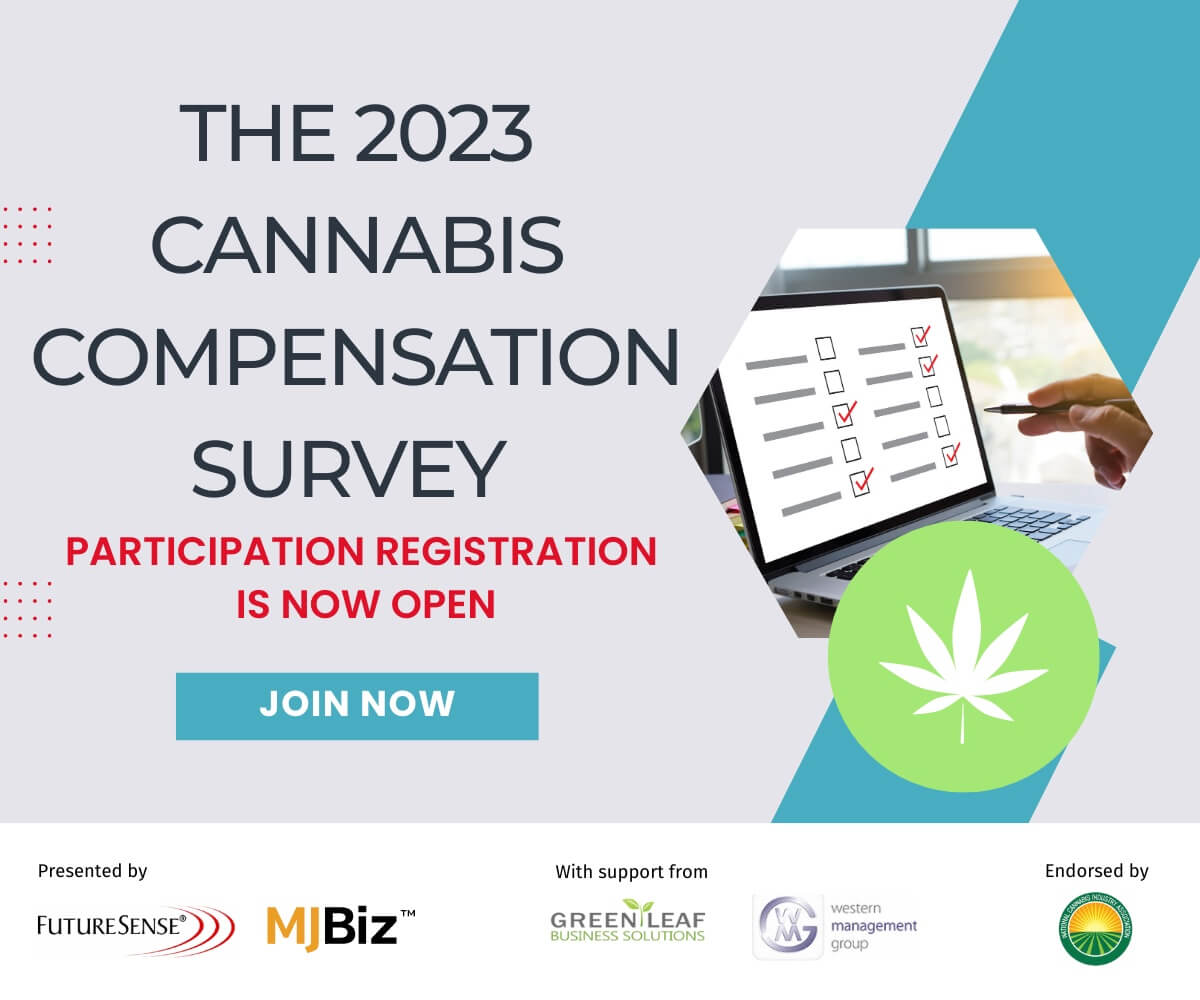
The 4th annual Cannabis Compensation Survey is open for participation registration until April 2023.
This survey analyses data provided by employers and produces industry-specific benchmarks for 140+ unique positions. It complies with federal guidelines meant to protect anonymity and ensure unbiased results.
Participation in the survey grants your organization exclusive access to the Detailed Report – containing more data, additional percentiles, and demographic breakdowns by state, headcount, and revenue. The Detailed Report is ideal for conducting internal compensation reviews and can be used to attract, engage, and retain key talent.
Per federal guidelines – the survey welcomes organization-wide submissions only (meaning no individual submissions). Typically, data submission is completed by an organization’s HR department, payroll administrator, or a representative from leadership. It is 100% free to participate.
Produced by FutureSense & Marijuana Business Daily, the project is endorsed by National Cannabis Industry Association and supported by Green Leaf Payroll & Business Services and Western Management Group. The survey’s mission is to support cannabis businesses, their operators and their employees by standardizing pay analysis for a dynamic, evolving, and important industry.
Enrollment is open through April 2023.
Data submission kits will be sent out in March 2023 and due back by May 31, 2023.
The final results will be published in August 2023.
Gain access to the latest information, trends, and data. DOJ compliant, unbiased, and ready for use.
The Cannabis Compensation Survey is back in action for its third year and is open for respondents thru mid-March of 2022.
Produced by FutureSense LLC & Marijuana Business Daily, the project will continue to be supported by Green Leaf Payroll & Business Services and is endorsed by the National Cannabis Industry Association. This year, the team has also added Western Management Group – a global leader with decades of experience in designing, developing, and executing compensation and benefits surveys – to assist with data management, calculations, and survey development.
Participation in the survey is vital. Individuals and organizations throughout the industry are realizing the value these results provide. Providing data benefits employees, employers, and the industry as a whole. Participation is easy and confidential – this survey follows all DOJ guidelines regarding confidentiality and anonymity to ensure unbiased results.
To comply with DOJ antitrust regulations, we welcome organization-wide submissions only and cannot accept individual submissions from sole employees. HR, payroll, and compensation department employees will have access to this data, as well Executives and Owners. Please contact us if you need help with coordinating participation from your team.
This year, the survey will also be focusing on the most critical and unique positions in the cannabis industry. While we recognize that all data is valuable, there are readily available survey sources for certain non-specified or non-industry-specific positions. We aim to produce the most robust and accurate look at the positions that matter most.
Enrollment is open through March 2022. Data submission kits will be sent out starting mid-February 2022 and due back by mid-March 2022. The final results will be published in May 2022.
Improved Data Submission Kit (DSK) – we have redesigned the DSK, making things easier to provide data and match jobs. We will also have job descriptions and leveling schema ready to assist with the job matching process.
Focused benchmark job title list – we are honing in on the most critical and unique jobs in the industry. With other survey data readily available for non-industry-specific jobs, we hope this will make things easier and more efficient for all participants to provide their data. The final report will have clearer and more established benchmark job titles and corresponding descriptions.
The addition of Western Management Group expands capacity to field, aggregate, and analyze data
Brand transition – FutureSense will be dropping its cannabis-forward brand BlueFire Cannabis by FutureSense, simplifying any naming confusions
FutureSense® is a consulting firm specializing in the areas of organization and people. FutureSense provides holistic people strategies that improve business performance. Our specialties include business strategy, motivation and rewards, executive, employee and sales compensation, organizational and individual assessment, leadership development and coaching, human resources, communications, change, and sustainable transformation. Visit us at www.futuresense.com
Matt Finkelstein is a Consultant with FutureSense LLC and the primary project manager for the Cannabis Compensation Survey. He has a passion for both people and plants – combining years of experience in the organic farming and cannabis communities with his work in people strategies and HR consulting. He believes in the power of cannabis to heal and strengthen individuals and communities alike, and actively works to help cannabis businesses thrive. Connect with Matt on LinkedIn: www.linkedin.com/in/matt-finkelstein-972253179 or email him at matt@futuresense.com.
Video: NCIA Today – Friday, December 10, 2021
NCIA Deputy Director of Communications Bethany Moore checks in with what’s going on across the country with the National Cannabis Industry Association’s membership, board, allies, and staff. Join us every Friday here on Facebook for NCIA Today Live.
Member Blog: Compensation in the Wild West of Cannabis
by Fred Whittlesey, Founder, President, and Principal Consultant of Cannabis Compensation Consultants
Member of NCIA’s Human Resources Committee
At the NCIA Cannabis Business Summit & Expo next week, there will be a panel session titled Cultivating Your Workforce. As a member of the NCIA Human Resources Committee, I have been actively involved in putting this together, and as a compensation expert, I wanted to ensure there is going to be, of course, a lot of discussion about compensation – executive compensation, incentive compensation, and employee ownership.
It’s appropriate that this month’s #CannaBizSummit is being held in San Francisco, arguably the historical culmination of Wild West culture, with the Gold Rush as its driver. Not unlike today’s cannabis industry – a gold rush of sorts, by federal definition a lawless community, and a community culture of moving fast and defining as we go.
As a compensation expert, I typically prefer a more orderly and well-defined world, which is why I am fascinated with working in the field of compensation in the cannabis industry. It’s challenging because I am in the business of answering clients’ questions about compensation. It’s not always easy to do in cannabis.
There are three factors that explain where we are today in understanding and analyzing compensation levels and practices in cannabis, and three driving forces that will take us from today’s Wild West to tomorrow’s still innovative, still creative, but a bit more business-like approach to compensating employees in cannabis companies.
Today
No valid compensation surveys or databases exist for the cannabis industry. There are various publications that self-label as “surveys” but are merely data compilations missing the rigor of survey methods that have been established over the past decades:
Little or no definitions of jobs
Extremely wide ranges that defeat usability
Reports of cash compensation only, some with base salary only
Very small sample sizes, often not disclosed
No list of participating companies
In short, they’re not compensation surveys. Established survey companies have not entered the cannabis market due to legal and/or stigma factors. They will, eventually. But they’ll be late to the party, so to speak.
For now, we have no real market data. Except for some executive positions…
For executive positions and equity compensation plan design details, data from public company securities filings continues to be the most valid and reliable source
Securities and Exchange Commission EDGAR filings (U.S.)
System for Electronic Document Analysis and Retrieval (SEDAR) (Canada)
Despite currency, cultural, and governance differences, combining U.S. and Canadian data makes sense given the integrated labor market for talent. But it’s no easy task.
Unlike for publicly-traded companies in the U.S., executive compensation information for cannabis companies is difficult to obtain and interpret for multiple reasons:
Most companies are listed on Canadian exchanges
The Canadian disclosure requirements are less rigorous, such as:
Lack of a single table for all forms of executive pay
No dollar value required to be calculated for equity compensation grants
Limited disclosure of the history of equity compensation grants
Companies whose shares are traded in the U.S. are not on major exchanges and not subject to the extensive disclosure requirements of NYSE and Nasdaq companies. This is changing – as exemplified by last week’s listing of the SPAC Canna-Global Acquisition Corp (NASDAQ:CNGLU) on Nasdaq, but SPAC listings have a reduced set of disclosure requirements. (full disclosure: I am an investor in CNGLU.)
Most companies are of a size and status (e.g., Emerging Growth Company) that also have reduced pay disclosure requirements.
So, despite what is a rich source of executive and equity compensation data which we have relied on for decades now, these databases are not (yet) of the same usefulness as for other industries.
And even if we didn’t have those tactical issues… the characteristics of the cannabis industry exacerbate these difficulties:
Smaller companies and private companies
High-growth stage, resulting in the lag time in reporting rendering the information significantly out-of-date
High concentration of founders and insider ownership, which results in compensation levels and practices that are not free-market based – one CEO taking zero compensation and another in the 8 figures.
Top-heavy C-level position structures, e.g., an Executive Chair and a CEO and a President and a COO – too many chiefs
So, the question of how much this company pays its top executives… is an unanswerable question. I wonder if even the company could answer that question?
Tomorrow
The turbulence in executive compensation levels and practices will lessen, and our knowledge and understanding will improve, when three trends converge:
More public companies, including SPAC deals, and continued M&A activity, bring in more outside investors with expectations of corporate governance and practices consistent with other industries in which they are invested. This also will have the effect of lessening the influence of founders as more “professional” (hired external) Board members are added to the governance structure.
With more public companies will come more market data, as we have for most industries today both in the U.S. and Canada. While limited to the top 3 or top 5 executives in each company, these disclosures provide a factual and verifiable dataset for the most senior positions, for the use of equity compensation for employees, and for the breadth of executive compensation arrangements such as new hire packages, severance and change in control agreements, and various perquisites.
And of course, legalization. With the U.S. federal restrictions and the associated stigma removed, cannabis companies will become subject to the same governance, institutional investor and proxy advisor pressures, and the large consulting firms will push them toward the ISS/Glass Lewis “playbook” approach to advising. I’m not saying that’s a good thing, because it’s not, but we already see it happening in Canada where large multinational compensation firms are overlaying the boiler-plate ABCs.
It is my hope that the innovation and creativity we see in the cannabis sector today will not suffer from these three dynamics. There’s nothing wrong with living in the Wild West, if you’re comfortable with fewer rules, fewer constraints, and less transparency. But it helps when there is a Sheriff and a couple of Deputies in town.
This conversation is not limited to executive compensation. Equity compensation for all employees is a common aspiration in cannabis companies. Equity compensation plans are always complex to design, implement, and administer and are exponentially more so in cannabis companies. Complex organization structures with public entities, private companies, LLCs, and even nonprofits all bring talent from diverse industries with vastly ranging experience with and expectations for equity compensation.
A trimmer coming from agriculture or a Dispensary Manager from specialty retail has likely not received equity as a component of their compensation in the past.
A chemist coming out of biopharma or a software developer, if told there is no equity compensation plan for all employees at your company will be, at the least, disappointed if they even continue interviewing with you.
Similarly, a candidate from the financial services world may be surprised that every employee is not participating in one or more cash incentive plans, not just the sales reps. There is a LOT of work to be done on compensation planning in the cannabis industry, and I’m thrilled to be right in the middle of it.
Fred Whittlesey is the Founder, President, and Principal Consultant of Cannabis Compensation ConsultantsTM, a Compensation Venture Group SPC company.
Fred is a member of the NCIA Human Resources Committee and the NCIA Sustainability Committee.
Fred is recognized by corporations, professional organizations, universities, media, and colleagues around the world as a compensation expert and thought leader. His ideas have been presented in numerous book chapters, journal articles, media interviews, conference and seminar presentations, and hosted blog postings.
Fred’s thought leadership in the field of compensation is evidenced by his delivery of more than 300 conference presentations, seminars, certification courses, webinars and podcasts. He has presented and taught in 26 US States, 4 Canadian Provinces, UK, Ireland, France, Germany, Netherlands, Switzerland, Turkey, and Indonesia.
He has authored more than 50 peer-reviewed journal and magazine articles, book chapters, white papers, and sponsored papers. He has been a paid writer for PayScale.com, Salary.com, InvestorJunkie.com, and SeekingAlpha.
Fred has been interviewed and quoted more than 100 times by more than 35 different media sources including Associated Press, Bloomberg, Business Week, Fortune, New York Times, Los Angeles Times, Orange County Register, Seattle Times, San Jose Mercury News, and San Francisco Chronicle. He has been retained to conduct research to support investigative journalism for The Los AngelesTimes and The Boston Globe.
Cannabis Compensation ConsultantsTM is a division of Compensation Venture Group SPC, a Washington Social Purpose Corporation. The company is a Green America Certified Business.
The firm specializes in compensation strategy, executive and director compensation, equity-based compensation, incentive design, and employee pay with a focus on sectors driven by innovation. We also provide expert witness and litigation support for civil litigation and regulatory matters. Our clients include Boards of Directors and executive teams of public and private companies, LLCs, S corporations, and foreign subsidiaries.
Our Canadian sibling consulting firm is Conscious Compensation Group Inc. in Squamish, BC.
Committee Blog: Four Elements of Compensation Strategy in High-Growth (Cannabis) Companies
by Fred Whittlesey, Founder and President, Cannabis Compensation Consultants Member, NCIA Human Resources Committee
with assistance from
Kara Bradford, Co-Founder & CEO, Viridian Staffing Chair Emeritus, NCIA Human Resources Committee
All high growth companies face the same challenge: Hiring high-quality people at a feverish pace, while dealing with all of the issues that come with that including recruiting, onboarding, training, and of course, compensation.
The cannabis sector (more than just an “industry”) has another layer of challenges rarely seen when finding and hiring the employees needed for the explosive growth underway:
Diverse segments (to use a financial reporting term) often under a common entity, or
Multiple entities housing those distinct businesses, and
Diverse occupational categories either within a common entity or spread across multiple entities.
The cannabis product lifecycle, like any consumable product, spans agriculture, processing, packaging, branding, distribution, and direct sales. A fully vertically-integrated company might employ, within a single corporate entity, agricultural workers, lab workers and extraction specialists, manufacturing workers, distribution teams, and dispensary employees. That is a challenging environment for compensation plan design.
For example, agricultural workers, including agricultural managers, virtually never receive equity compensation as an element of their pay package. Biochemists, particularly when coming from a biopharma company, expect significant equity compensation. Retail dispensary managers, no equity. VP of sales, equity.
Now, imagine those jobs and people are spread across multiple entities. Maybe the overall corporate structure is a C Corp over some LLCs. Or, like in Arizona, a nonprofit corporation with a Management Services Agreement with a C Corp which directs money through an LLC.
Or in British Columbia which, like the U.S., prohibits alcohol and cannabis sales in the same stores or from the same company, but has owners that operate in both businesses. And the stores are next door to each other. Budtender vs. sommelier? Employees talk.
But perhaps the most compelling reason to consider a broad spectrum of compensation alternatives is unique to cannabis: The non-deductibility of compensation expenses that cannot be characterized as cost of goods sold — Tax Code Section 280E. More than in any other industry, using forms of compensation that avoid incurring a nondeductible compensation expense can have a direct and immediate impact on business financial performance.
Compensation Strategy
Complex cannabis companies have to mold their pay programs to fit this broad array of entities, lines of business, and types of jobs, under an unfavorable tax environment.
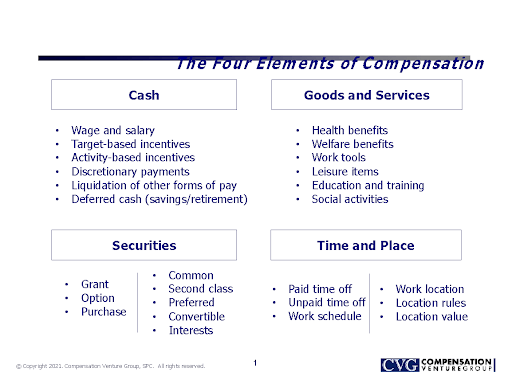
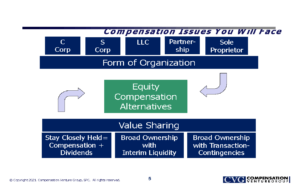
There are four, and really only four, types of compensation for employees (and independent contractors, and members of the Board of Directors, and consultants). Each of the four has many forms, but there are four types of things a company can do to pay — and hopefully continue to pay — an employee. This is a useful framework for thinking about compensation.
Cash
Wage, salary, performance incentives or bonuses, commission, 401(k) contribution (yes, a cannabis company can have a 401(k)), profit sharing, retention bonuses. Every employee will receive one or more of these forms cash payments. All require cash changing hands from the company to or on behalf of the employee.
The most common cash compensation arrangement is a base salary plus bonus as a percentage of salary that is typically dependent upon the performance of the individual, team, and/or company. Many companies have a 10% of base salary target. In the cases of budtenders and delivery drivers, tips (essentially a customer-paid commission) are common as compensation as well. Companies in some locations, such as California, continue to pay trimmers at piece rates (pay by unit production).
Goods and Services
I casually call this category “stuff” — a company gives people stuff as part of their compensation. Healthcare coverage, life insurance, job training, a laptop and a phone in the traditional model. But this category includes much more than traditional “employee benefits” — from free food to use of the company vacation home to sabbaticals, these meet employees’ needs while keeping them focused on, and sometimes physically at, work. Sometimes this free stuff is not taxable income to the employee (healthcare coverage, free food at work) and sometimes it is taxable (free gym membership). Be informed in your creativity here. Local regulations in many jurisdictions are dictating benefits coverage above the federally-mandated level.
Securities
This is by far the most complex form of compensation, and more so for cannabis companies. Whether it’s stock options, restricted stock, restricted stock units, or member interests (in an LLC) — the question is which entity is granting the compensation, and whether they are allowed to grant it to an employee in a different entity. We are beginning to see companies that compensate employees with cryptocurrency which is viewed as a “security” by both the IRS and SEC. Given the increasing social justice emphasis in the cannabis sector, equity compensation is the form of pay that truly levels the playing field across all income levels.
The choice of equity compensation will be driven by the form of organization and ownership philosophy.
Time and Place
Before COVID-19, companies in all industries were increasingly emphasizing this form of compensation. In the 1980’s, there was no “casual dress” and “working from home” was unheard of. An employee reported to the workplace at the assigned time, and there was no “flextime.” Over the past few years, companies were already experimenting with paid parental leave, unlimited vacation time, and employee-choice work location. Now, for many companies and many jobs, WFH is the model. Not for growers and not for budtenders (yet). But time and place can be highly valuable cash-free (sort of) equity-free forms of compensation.
And then…
Hiring is only half the battle. Retention of employees in the cannabis sector is as challenging as hiring. Companies need to be creative with the same four tools to retain employees. But you can’t wait until they give notice of resignation, because then it’s too late.
Your employee retention compensation program starts at the employee’s date of hire, because it is the same program.
More than any other role in an organization, the role of the Chief Human Capital/Human Resources (CHC/HR) Officer has changed. It continues to do so as organizations grow and shift. Nothing could be more accurate in this current pandemic environment. Understanding the critical need for this role and the types of capabilities you should be looking for in a candidate will help prepare you for your search and ensure that you’re evaluating potential candidates based on the real needs so that when we enter into our new normal, your organization is prepped and set up for successand not trying to play catch up based on some missteps. We’ve curated a list of the qualifications and criteria below that your top tier candidates should possess to fill this critical leadership position.
Strategic mindset and business acumen: The CHC/HR Officer is expected to be discerning, future-orientated, open-minded, commercially astute, and able to make evidence-based decisions. They will develop robust people plans aligned to the business strategy. A people plan cannot merely serve internal HR functional requirements; it must demonstrate an impact on the business.
Change and transformation management: Play a leading role in defining and adapting corporate strategies, structures, procedures, and technologies to handle changes in external conditions and the business environment. The people side of change management is often the most important element above the technical tasks necessary to enact change. When the people side of change is poorly managed, change often fails or doesn’t achieve desirable results. Driving change management and transformation requires an organization to embrace learning agility and innovation as a culture. The CHC/HR Officer is often expected to embody this agility and be the catalyst for change and transformation.
Mastery of executive compensation: Issues of pay equality continue to gain prominence in the market, and this leader must play a key role in designing competitive, equitable compensation packages. This includes innovative and sometimes creative incentive structures to attract and retain key talent. The position is to continuously test internal pay structures against the market where potential gaps and risks are identified and develop risk mitigation plans.
A clear understanding of board governance: Cannabis organizations are increasingly scrutinizing executive compensation, examining linkages of talent and performance, focusing on CEO succession, and the broad talent agenda. The Chief HC/HR role can add value to the board by bringing expertise in compensation, succession, talent, and the people-based implications of mergers and acquisitions.
External focus: Today’s cannabis HC/HR Chief has to have a good sense of the external industry and the competitive landscape. She/he should keep abreast by playing an active role in relevant industry bodies. Talent is becoming increasingly mobile-savvy, which makes it all the more important for this leader to have a strategic mindset.
Shape culture: The head of HR holds a key role in defining and co-creating the organizational culture with the executive leadership team. A company’s organizational culture can make or break the most insightful strategy. The executive leadership team and the HC/HR Chief have a shared responsibility in creating and driving a culture that is aligned with the business strategy.
Committed to diversity and inclusion: For diversity and inclusion to be successful, it has to be a top-to-bottom business-critical mission that is embedded in all aspects of the organization. Diversity and inclusion practices should be led in close partnership with the CEO, with the HR Lead playing an important role in articulating the business case for diversity alongside the CEO.
Leadership gravitas: The ideal candidate must possess significant confidence and power supported by competence and an undisputed delivery track record. This power is acquired through strong interpersonal relationship skills, the ability to influence others, and being respected and admired. This type of power is particularly important in this role since it is built on collaboration and influence rather than command and control. In addition, HR leaders must have the ability to assess risk, to demonstrate independent thinking and speak truth to power, having the courage to say “No,” when necessary.
Balance agendas of high-level stakeholders: Your ideal candidate should have experience serving multiple high-level stakeholders such as the CEO, board, shareholders, and employees who often have competing demands. The capability to effortlessly navigate and balance the various needs through effective communication, seeking alignment, and managing expectations is a must.
Visible, value-added partner: The head of HR is a critical stakeholder in the health of the organization. It’s important that your hire has an open door policy and is proactive about building teamwork and company culture. They should be seen everywhere within the organization. HR leaders must be on the pulse of the organization at all times to make unpleasant surprises less likely to happen.
These ten key areas are all critical when hiring a CHC/HR leader for your organization. If you use this list as a checklist when you hire this critical role (or evaluating your current leadership) and find positive responses to all, you should have an excellent fit for your team!
Bryan Passman is a father, a husband, a trailblazer, and Co-founder and CEO of Hunter + Esquire. My professional background before launching H+E was entirely in retained executive search for 18 years in MedTech/Pharma (15 yrs) and Food and Adult Beverage CPG (3 yrs). My deep knowledge of those highly regulated and nuanced industries has helped H+E significantly understand the needs and wants of our cannabis clients. My deep and genuine networks within those industries have helped us deliver that rare talent “unicorn” our clients desire to fit their particular needs. My client-first approach helps us provide a very customized, white-glove, headhunter treatment to client and candidate.
Member Blog: What’s new in Cannabis Compensation – CannaComp Update for 2020
By Matt Finkelstein, BlueFire Cannabis by FutureSense
Opening up the new year, NCIA and FutureSense LLC released results for the inaugural Cannabis Compensation Study. The collaborative effort sought to uncover trends in compensation and establish benchmark data, creating a singular industry-wide resource for all to use. With the initial report released, we have some exciting updates to share for the coming year’s development.
Culture Shift
The cannabis industry at-large has been transitioning from the black/traditional/legacy market to a legal one and understandably still maintains tinges of a culture of secrecy. Emerging markets also tend to be initially trepidatious about sharing critical business info, so this is especially prevalent in this line of work.
As the market expands and evolves, the need to understand trends and have accurate data supporting it is becoming more and more important. Cannabis companies can spend between 65-70% of their expenses on payroll. Being even 5% on- or off-the-mark can mean make-or-break in this highly volatile industry.
More and more cannabis companies are realizing the value of this type of market data. It is useful for establishing competitive compensation packages, setting growth trajectories, and managing tight budgets. To establish this data and reap the benefits of its findings, companies are becoming more comfortable with some transparency via an independent 3rd party service provider.
Expertise, Confidentiality, and Anonymity
FutureSense LLC brings over 30 years of compensation expertise across multiple industries. We worked with NCIA to establish a confidential and compliant salary survey that follows all Department of Justice and Department of Labor regulations to protect and ensure anonymity.
Our efforts producing the Cannabis Compensation Survey in 2019 laid out a solid foundation to continue to grow and expand the project. A couple of the key takeaways from the survey include:
Nearly 50 participating companies
Reportable data for 80+ positions in 12 job families
More than 100 additional job title benchmarks established
Growth and Development in 2020 and Beyond
In 2020, we are expanding the project by opening enrollment for submissions throughout the year, and by bringing in supporting partners such as recruiting firms and cannabis payroll applications.
Expanding participation will allow us to present data via demographic breakouts such as:
Industry sector
Location/region
Size (employee count, revenue, etc.)
We will also collect and report on benefits, incentives, sales, and equity compensation. We believe this will provide participating companies with an even deeper perspective into their own business practices and needs.
New Names
FutureSense LLC has recently established a cannabis-specific brand to support our on-going work and dedication to this industry. We brought on BlueFireHR – a human resources services firm with years of experience serving cannabis clients and other industries – and formed BlueFire Cannabis by FutureSense. BlueFire Cannabis will now be the main project partner alongside NCIA for the Cannabis Compensation Study. We’re excited to announce our other supporting partners in the very near future.
Sign-Up!
All cannabis companies with 10 or more individuals are encouraged to participate. We also welcome inquiries from other professional service firms or ancillary services about opportunities for supporting partnership.
Central to most discussions about executive compensation – not unlike any business discussion – is the question “what are other companies doing?” In compensation analyses, this guides the selection of data, typically for companies of a similar size in the same industry. Inherent in this approach is that a list of companies defines the landscape of business competitors, including competition for talent. Boards of Directors want to know – and are required to know – marketplace norms, trends, and practices as elements of their approving executive compensation.
Executive compensation in peer companies provides a guideline for determining appropriate pay levels and program design – what the other companies are doing. But these groups are typically determined by business-based characteristics – revenue, market cap, industry code, etc. In the rapidly evolving cannabis sector, these criteria may not yield a meaningful comparison group.
Most importantly, no data from a talent competitor aspect is typically included as a metric, though companies mention “talent competitors” as a criterion for inclusion in their “peer group” as we call it.
Peer Group Pressure
Proxy advisory firms (e.g., ISS, Glass Lewis) encourage and provide specific guidelines for the development of peer groups for executive compensation comparisons among public companies. In fact, they not only prefer but expect this process and disclosure. But their process may not make sense for every company as it focuses on market cap, revenue size, and industry code.
The problem for cannabis companies is:
There is no industry classification code for cannabis companies (with the exception of some suppliers that may serve multiple industries)
Most cannabis companies have not disclosed benchmarking peers
Size constraints are moot when #1 and #2 don’t exist.
And, none of this peer selection process gets to the root of the purpose: Identifying talent competitors to help guide the design of compensation programs to attract valuable employees from those competitors and keep employees from defecting to those competitors.
Complexities of a Cannabis Peer Group
Some of the largest cannabis companies are issuing proxy statements that parallel the norms for large mature companies in the U.S. For a cannabis company, constructing a peer group is a challenge given the characteristics of vertical integration of the business, merger and acquisition activity, and – most importantly – the breadth of occupational categories represented by these firms’ employees.
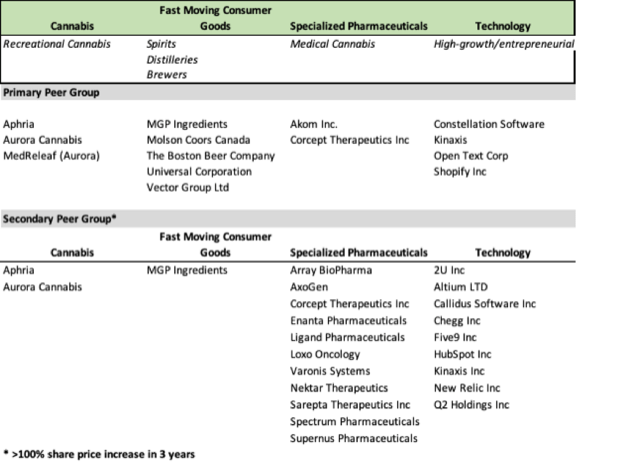
Here, for example, is the peer group disclosed by Canopy Growth – two sets of companies from four industry sectors – cannabis, fast moving consumer goods, specialized pharmaceuticals, and technology:
This is the most complex peer group structure I have seen among the hundreds and hundreds of companies’ disclosures I have reviewed. The cannabis sector poses this challenge: Covering some or all of the subspecialties that are under one roof with a group of similar companies, when there may be no similar companies
Some Recent Examples
“High Times… hires President”
“Cannabis producer Tilray taps ex-Molson, Revlon employees for Executive roles”
Interestingly, Molson Coors, Pharmaca, Revlon, Goldman Sachs, GE, and Apple have never included a cannabis company as one of their peers. That is likely because Tilray (drug manufacturers – specialty and generic) and High Times (not a public company) would not fit the criteria for those companies’ peer groups.
The peer group disclosed by Revlon (household and personal products) includes Hain Celestial (packaged goods), Clorox (household and personal products), and Tupperware Brands (packaging and containers).
Molson Coors’ peer group includes The Hershey Company (confectioners) and J.M Smucker Company (packaged foods).
Yet Molson Coors, Revlon, and other non-cannabis companies are rapidly losing executives to cannabis companies – the definition of talent competitors.
Let’s Try Peering Backwards
Maybe the current process is backwards. As cannabis companies face a limited supply of talent with cannabis experience, they will find the talent from diverse industries and then, perhaps, compile a list the companies from where those new executives came. That would indeed be a talent competitor peer group.
What would that look like? Based on publicly-available information about the previous employer of the executives in these cannabis companies, we can “peer backwards” into what their cannabis-relevant talent pool looks like.
What About Your Company?
Your company – in the cannabis sector – is hiring a new C-level executive, maybe even a CEO. Your company did not disclose a peer group because it has not thought about a peer group. Your company is vertically integrated – cultivation, extraction, distribution, branding, retail – so it is simply a matter of finding a candidate with experience in all of those, or some of those…or one of those?
Let’s continue “peering backwards” – looking at where executives have come from and having a compensation program that keeps our company off of the next company’s “from” list.
What would that look like? Based on publicly-available information about the previous employer of the executives in these cannabis companies, we can “peer backwards” into what their cannabis-relevant talent pool looks like:
Peering Backwards
Company
CEO
CFO
Tilray
Silicon Valley Bank (SVB)
Primo Water Corporation
Canopy Growth
Constellation Brands
Montana Mills
Gallo Winery
Pepsico
Charlotte’s Web
Kellogg Company
Crocs
Orbitz
Financial services, water dispensers, consumer products, bakeries, wine, soda and snacks, cereal, shoes, travel – not the usual mix of talent sources.
Cannabis Companies Finding Their Tribe
One will hear that the cannabis sector is in the “Wild West” phase, which is sort of like saying that a 14-year old is in the Wild West phase of adulthood. The only norms appearing are those carried over by the large consulting firms accustomed to consulting to mature companies. The entrepreneurial companies in the cannabis sector need not worry about self-appointed third-party opinions of their executive compensation practices – until they grow up. They can pursue practices that make sense for their business strategy, talent sourcing strategy, dispersion of locations, and other business-driven factors.
As we research executive compensation in the cannabis sector, we find a blend of compensation practices from these diverse industries, defying the notion that there is a “norm” or a “median” in the cannabis sector. Understanding executive pay in cannabis companies, for now, requires understanding executive pay in perhaps dozens of industries.
As cannabis companies grow, they will face the need for some additional structure and processes around executive compensation. But many of these companies are, and will continue to be, Smaller Reporting Companies,Emerging Growth Companies, Controlled Companies, TSX-V listed, or in another category with lesser disclosure requirements and lesser pressure from proxy advisers and institutional shareholders. With more of a grassroots shareholder base, they will have more maneuvering room in compensation design, less concern about the “optics” of a given executive compensation action or program, and more opportunities for the compensation program to fit the business, not fit a third-party’s unsolicited opinion of compensation. This is already leading to greater creativity and innovation in compensation design among cannabis companies.
Fred Whittlesey is the founder and President of Compensation Venture Group, SPC (CVG) – a Washington Social Purpose Corporation – operates as Cannabis Compensation ConsultantsTM and maintains a database of cannabis companies’ peer groups, executive pay levels, and executive hire sources. Fred Whittlesey is the founder and President of CVG, and with more than 35 years of experience in compensation, has worked for hundreds or companies across the industries that collectively comprise the cannabis sector – agriculture, biopharma, retail, distribution, manufacturing, marketing, branding, REITs, financial services, and technology.
The 2019 Cannabis Compensation Survey
NCIA is pleased to join forces with FutureSense to announce the first formally executed survey created for the cannabis and hemp industries. A growing number of companies have been looking for data and best practices for their executives and employees. This survey provides benchmark data to better understand compensation trends and remain competitive for talent in the marketplace.
2020 may be filled with unpredictable and new challenges. Compensation data and best practices are the foundation of any human resources and growth initiative. Pay is an effective supporting tool for any employee-oriented effort. As participation in the survey increases, so will our understanding of what is working and why it is effective.
We encourage you to read through the preliminary results laid out in the report and then consider taking the survey yourself by clicking on the links at the bottom of each page.
A new data release is planned for the first quarter of 2020. It will be followed by quarterly updates for the remainder of the year. We are accepting rolling submissions of the survey and will update and rerelease results on a quarterly basis. Participation is easy and we can help! If you’d like to participate simply go to www.CannaCompensation.com, select the “I Want To Participate” button, and fill in your information. FutureSense will contact you with instructions.
Closing out 2019, jobs in the cannabis industry have been at the forefront of a national conversation. With more states coming on board with medical and adult-use legislation, the industry is continuing to grow. Industry leaders are looking to attract and retain talent from within and outside of the industry by using competitive compensation strategies.
Several companies launched salary surveys in 2019, including us – FutureSense, LLC. We started on this journey to offer our compensation consulting clients accurate survey data. Surveys happen to be one of our areas of expertise. We partnered with the National Cannabis Industry Association (NCIA) to launch the first-ever comprehensive, compliant, and actionable compensation survey to be released in January 2020.
As we dove deeper into the industry, we found that there were several other surveys in action. We also learned that our survey holds a few essential components that other surveys were missing.
These components include:
Compliance – Creating a compliant survey is not easy. Other surveys provide no acknowledgment of DOJ and DOL regulations around reporting pay data. Most other data sets do not indicate as to how many incumbents represent each data point, nor how heavily weighted any one company was in the data. Our survey follows all DOJ and DOL regulations.
Broad & deep data – At first, other surveys represented these values as minimums, averages, or maximums. Further research showed extreme data points that were not in line with normalized data. Based on our 30+ years of survey experience, these are clear signs of thin data. Our data has always been presented in percentiles, showing breadth and depth.
Usable & actionable data – Companies need much more than a handful of “hot jobs” to build out their compensation programs. HRT and compensation professionals need detail and ranges. Our survey provides extensive ranges and detail for professionals and companies to understand the market and put these findings into action.
When reviewing final survey data, we generally expect there to be data for a minimum of 25th, 50th, and 75th percentiles, each calculated using standard statistic formulas. We also expect there to be a normalized difference between each level of no more than one or two standard deviations from the norm. In much of the other industry data, there are only minimums, maximums, and averages reported. Even more concerning is the wide range of pay for some jobs. In certain cases, we have seen data with no ranges (clearly data for only one or two individuals). In other cases, we have calculated rough deviations of six or even ten standard deviations from the norm.
As an example: one of the industry’s premier recruiting firms did a great job outlining the current trends in the industry and providing info on hot jobs and benefits. The narrative is great, but the pay data used to support their findings is limited to less than 30 positions and does not indicate whether it is compliant with all rules. It’s simply not data that businesses should use to set their pay levels. As an independent third-party survey provider, we’re aiming to provide compensation and benchmarking information that can be used to determine pay, without any bias.
Our report currently covers compliant data for more than 85 positions in 11 job families. As participation in our survey continues to grow, we will continue to expand the number of reportable job titles and family benchmarks. Our goal for 2020 is 200+ jobs with compliant and reportable data. We will also begin to present data by demographic breakouts, like location/region, company size, and revenue. The elements will make the data increasingly useful to any compensation/HR professional or executive looking for pricing for key positions and the foundations for the structure of a viable pay program for their company.
We are big believers in collaboration, not competition, and welcome the opportunity to explore designing a single set of data with other industry providers currently creating their own survey. The goal must be to represent the industry at-large. Good data is critical. Our growing industry cannot afford to promote the use of bad data any longer.
The report summary will be released to NCIA members in January of 2020. For more information or to sign up to participate please visit: www.CannaCompensation.com
Dan Walter, FGE, CECP, CEP, is a Managing Consultant at FutureSense, a holistic human capital consulting firm. He has worked in the field of compensation since 1994 and was previously the Founder and CEO of Performensation. His expertise includes equity compensation, incentive pay, executive compensation, and talent management issues. Dan is an industry thought leader for all forms of equity, including stock options, restricted shares and units, stock purchase plans, and performance-based programs. In addition to his focus on plan design, he has been the architect of software solutions and administrative and technological best practices used by many companies. Dan has coauthored several books on compensation and is a popular blogger on the topic. He is also a popular speaker and does dozens of presentations every year. Dan is also on the NCIA’s Human Resource Committee.
Matt Finkelstein, is a Consultant at FutureSense. Matt has worked in the compensation field with FutureSense for six years and has also spent thirteen years as an organic farmer & gardener. Prior to joining FutureSense, he was managing small family farms & developing educational gardens around California, with an emphasis on regenerative practices and design. As a farmer, Cannabis has always been integrated into his own operations and he has also spent a lot of time on cannabis-specific farms. Matt brings his breadth of knowledge from both fields and serves as the primary project coordinator for FutureSense’s cannabis compensation endeavors. Matt is also on the NCIA’s Cultivation Committee.
About FutureSense, LLC FutureSense provides integrated solutions to build and sustain human capacity and optimize organizational performance. FutureSense specializes in people, pay, organization, and strategy, offering unique and comprehensive services to create solutions that make a difference. For more information, visit http://www.futuresense.com.
Partner Blog: CannaCompensation – Are Recruiter Rates Accurate?
Recruiters are on the front lines in the competition for talent. When a role is critical, tough to fill, or requires specific expertise, recruiters can play an invaluable role. They have the contacts, the skills, and the persistence to get the people you need right now.
Recruiters are a special kind of farmer. They aren’t picking the low hanging fruit. They are working on selecting the very best fruit. But, quality can come at a premium price.
The cannabis industry now has several strong talent acquisition firms. They know the industry and the lingo. They have contacts, and their connections have contacts. Currently, they are also one of the few sources of compensation rates for many positions in the industry. The pay data they provide is accurate, but it may not be “right.” How can this be?
Remember, the best recruiters target the best talent. They also target people with current jobs. The best talent usually gets paid more than typical, and still perfectly acceptable, talent. Employed people cost more to hire than unemployed people. This can result in recruiter provided pay ranges that are above industry norms.
The top people in any position commonly make 10-20% more than mid-level people. Motivating someone to change companies can take twice the increase as promoting an internal employee. This means recruiter-provided pay rates are often 20-35% higher than a formal compensation survey would indicate. This is fine for critical people, but it’s a ridiculously expensive way to pay an entire staff. This is why formal compensation surveys, like CannaCompensation, are essential to your success.
Compensation is likely your biggest expense – it may eat up as much as 75% of your revenue. Saving even 5% on paying your staff can mean the difference between growth and failure. This type of savings can fund a marketing campaign, purchase new equipment, develop new products, or become the down-payment on new real estate. When you provide your pay data to the CannaCompensation Study, you are building a foundation for future success. Participating is easy and confidential.
Your recruiters will always remain a vital source of information for pricing your highest priority positions. CannaCompensation will serve as the foundation for your pay decisions. When you combine them, you will be armed to win the battle for both talent and future success.



 FutureSense® is a consulting firm specializing in the areas of organization and people. FutureSense provides holistic people strategies that improve business performance. Our specialties include business strategy, motivation and rewards, executive, employee and sales compensation, organizational and individual assessment, leadership development and coaching, human resources, communications, change, and sustainable transformation. Visit us at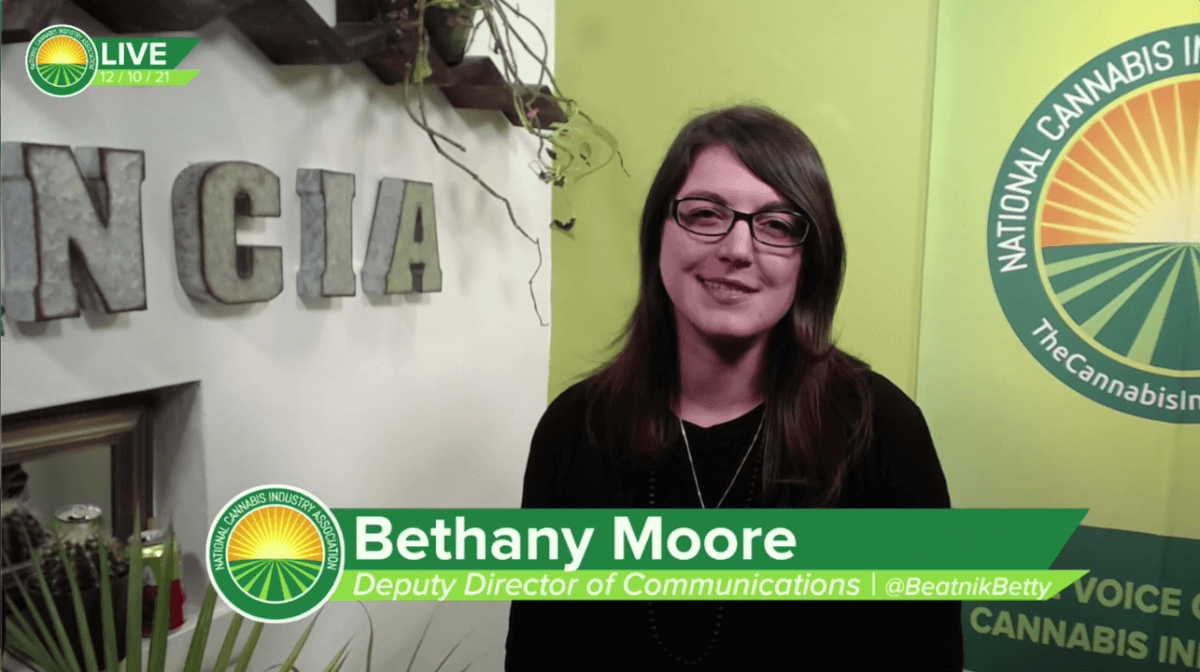

 by Fred Whittlesey, Founder, President, and Principal Consultant of




 Bryan Passman is a father, a husband, a trailblazer, and Co-founder and CEO of
 Fred Whittlesey is the founder and President of


Follow NCIA
Newsletter
Facebook
Twitter
LinkedIn
Instagram
News & Resource Topics
–
This Just In
Member Blog: What Consumers Really Want in a Pre-Roll
Member Blog: The Evolving Cannabis Legal & Regulatory Landscape in 2026