The legal cannabis industry is growing at an unprecedented rate, with more and more states legalizing its use for medical and recreational purposes. However, despite this progress, cannabis businesses face a major obstacle: Section 280E of the Internal Revenue Code. This provision is a significant burden on cannabis businesses, limiting their ability to take deductions for basic expenses like rent, utilities, and employee salaries. The result is a higher tax burden and reduced profitability, putting cannabis businesses at a disadvantage compared to other industries.
Section 280E was introduced in the 1980s as a way to prevent drug dealers from taking business deductions on their tax returns. At the time, the provision was aimed primarily at illegal drug dealers. However, when it comes to cannabis businesses, Section 280E has become a significant hurdle. The problem is that while cannabis is legal for medical or recreational use in many states, it remains a Schedule I drug at the federal level. This means that cannabis businesses are still subject to the same limitations as illegal drug dealers when it comes to tax deductions.
The impact of Section 280E on cannabis businesses is significant. Without the ability to deduct basic expenses, cannabis businesses face higher tax burdens and reduced profitability. This makes it difficult for them to reinvest in their operations and grow their businesses. In addition, the provision makes it challenging for cannabis businesses to obtain financing, as many traditional lenders are hesitant to work with them due to the regulatory environment and the industry’s status as a Schedule I drug.
The insurance industry plays a vital role in supporting the cannabis industry. With the help of insurance professionals, cannabis businesses can protect their assets, mitigate risks, and navigate the complex regulatory environment. However, insurance providers also face challenges in the cannabis industry due to the regulatory environment and the industry’s status as a Schedule I drug. For example, some insurance companies are hesitant to provide coverage to cannabis businesses due to concerns about federal prosecution.
Despite these challenges, there are insurance providers that specialize in the cannabis industry and offer tailored solutions to cannabis businesses. By working with these providers, cannabis businesses can protect their assets and minimize risks, while also demonstrating to potential investors and lenders that they are taking the necessary steps to manage their risks.
In addition to the insurance industry, there are other steps that policymakers can take to support the cannabis industry. Revising Section 280E is one of the most critical steps that can be taken. By allowing cannabis businesses to take more deductions on their tax returns, policymakers can help level the playing field and create a more equitable regulatory environment for the industry. This would enable cannabis businesses to reinvest in their operations, grow their businesses, and create jobs.
One could say that 280E could be equally or more importantly about de-scheduling cannabis than about changing a tax code. This a vital step that policymakers can take to remove cannabis from the list of Schedule I drugs. The current classification of cannabis as a Schedule I drug is outdated and based on outdated stereotypes. This is also contributing to a massive roadblock with the potential to destroy many businesses in the legal market, which only helps the illicit market thrive. Removing it from the list of Schedule I drugs would enable researchers to study cannabis more effectively and provide a clearer understanding of its medical benefits and potential risks. It would also allow cannabis businesses to operate more freely and obtain financing from traditional lenders.
Creating a more supportive regulatory environment for the cannabis industry is critical to its success.
With the help of insurance professionals, tailored solutions, and supportive policymakers, the cannabis industry can continue to grow and contribute to the economy. Revising Section 280E and removing cannabis from the list of Schedule I drugs are essential steps that can be taken to support this critical industry.
Valerie has over 16 years of experience in the insurance industry with specialized niches in cannabis, real estate, and community associations. With experience working for companies such as McDermott Costa Insurance Brokers, AmWINS Group, Inc., Commercial Coverage Ins. Agency, and Colemont Insurance Brokers, Valerie has developed a love of helping clients navigate the world of insurance by creating an understanding of the value behind insuring their business. In addition to her professional work, Valerie serves as the CREW East Bay Chair on the Programs Committee, is a National Cannabis Bar Association member, NCIA member, and volunteers in East Bay communities with Richmond Grows Seed Lending Library to show people how to save vegetable seeds and grow their own food. In 2021, Valerie received the 2021 and 2022 CREW East Bay Connections Award and was a nominee for the Elevate 2021 Industry Impact award.
With a drive and passion for helping people, Valerie has gone back to her long-standing roots in the plant medicine industry and uses her unique lens of growing up surrounded by cultivators and sellers to validate her client’s business needs. Valerie strives to break the mold of how insurance and cannabis has partnered together to give back to the community she grew up in. With a strong insurance background and an in-depth knowledge of the cannabis industry, Valerie has been a trusted advisor for over 70 cannabis clients.
For more information on Liberty’s National Cannabis Practice Group, please reach out toValerie Taylor, Vice President (National Cannabis Practice Leader), The Liberty Company Insurance Brokers.
Committee Blog: The New Licensee Insurance Checklist – Part 1
by NCIA’s Risk Management and Insurance Committee David Rahn, S2S Insurance Specialists
If you have a business in the cannabis industry, especially one that’s either newly operational or still in the pre-revenue stages, these businesses should have some sort of risk management plan put in place. Insurance is the cornerstone for any risk management plan if you want your business to recover after a financial or physical loss.
There are many types of insurance products to consider and it’s important for the business owner to have a knowledgeable Insurance broker who can help obtain tailored policies for your business. It’s important to consider the following questions below when seeking insurance for your business:
What types of insurance do I need?
When should I be getting insurance for my business?
What kind of claims are common in the cannabis industry?
What information does my insurance broker need to help me get an insurance quote?
Which types of insurance do I need?
Depending on your needs discussed with your insurance broker, all businesses should at least have some sort of property & casualty coverage. Whether the size of your business is starting in your own home, or you have a commercial or industrial space, it would be paramount to explore General Liability and Commercial property insurance, as well as Product Liability Insurance:
General Liability
A General Liability Insurance policy indemnifies against risks that nearly all business owners face. General Liability is the most critical basic coverage your business needs to protect you from a variety of claims including bodily injury, property damage, personal injury, and other situations that may arise including slander, libel, copyright infringement, and more.
Commercial Property
Commercial Property Insurance not only protects your place of business, but also its contents, including office furniture, computers and inventory, from common perils such as fire, lightning, explosion/implosion, riots, strikes and terrorism.
Product Liability
Product Liability Insurance is designed to protect your cannabis company from claims that can happen anywhere along the supply chain, including product contamination, mislabeled products, false advertising or defective products.
Once you have those three policies secured, additional types of insurance would include:
Crop Coverage
Crop Insurance is specifically designed to protect cannabis and hemp growers from natural disasters such as wildfires, hurricanes/heavy winds, and flooding/water damage. However, it can also cover incidents like theft, explosions, vandalism, and other unpredictable and uncontrollable events that result in an “interruption of service.”
Cyber Liability
Any business that has an online presence or stores customer data electronically needs Cyber Defense and Data Breach Insurance to protect yourself from legal liability and hefty fines. Given the vast amount of information that cannabis retailers and distributors are required by law to collect from customers, coupled with the fact that this is a rapidly growing industry with evolving regulations, the unfortunate reality is that cannabis businesses are prime targets for cybercrime.
Directors & Officers Insurance
Directors and Officers (D&O) Liability Insurance protects corporate directors and officers, as well as their spouses and estates, from being personally liable in the event your company is sued by investors, employees, vendors, competitors, customers, or other parties, for actual or alleged wrongful acts in managing the company.
When should I be getting insurance for my business?
It is very important to understand the right time to get your insurance. As always, it is important for you to build a good relationship with a knowledgeable insurance broker who can help you find the right time to buy insurance.
General Liability/Commercial Property
When Business owners rent or lease commercial property for their business, in the lease agreement, landlords almost always have an insurance clause stating the minimum limits the client needs to have on their GL policy in order to move in and conduct businesses. Usually around the same time you get your lease agreement is around the same time you should be considering GL and property insurance, so you know you are covered right when you move in and before your start business.
Product Liability/Crop
If you have a product-facing business, it is important to secure these policies before your product comes off the assembly line. As for Crop insurance, make sure you get your policy before you start planting and harvesting.
Cyber Liability
Typically before you launch your web presence and begin business transactions is the best time to secure your policy.
As your business grows and scales while you bring on outside investment, that’s the time when you should be considering your D&O and other management liability coverages.
What information does my insurance broker need to find an insurance quote?
It is important to always be honest and upfront with your insurance broker, especially when shopping for quotes. Your underwriting information needs to be accurate for you to obtain proper insurance coverage. You do not want to be underinsured or overinsured and pay for policies that you don’t need. A good place to start is with your business plan and projected revenues because that will help the insurance broker determine what products you may need. A well thought out business plan is the first step in being prepared in finding the right insurance.
Committee Insights | 8.16.22 | Cannabis Consumption Lounges & the Next Wave of Hospitality Disruption
In this edition of our NCIA Committee Insights series originally aired on Tuesday, August 23, 2022 members of Risk Management & Insurance Committee convened a panel of cannabis regulators and legal experts alongside leading event and hospitality operators to provide cannabusiness professionals the inside scoop on new regulations being adopted to manage/establish cannabis consumption establishments.
Dive deep into the ins & outs of Michigan’s cutting edge regulatory structure and learn from those operating in the space across the country with our panel of experts.
Learning Objectives
• Review of leading edge regulatory framework providing a model for MI consumption lounges
• Highlight the license structure for temporary events – how do consumption, sales and/or both formats function within this framework?
• How have these regulations evolved since first adoption?
• Review dram shop liability and offer an educationally lensed analysis
• Discuss how that may or may not be a good framework to apply to cannabis?
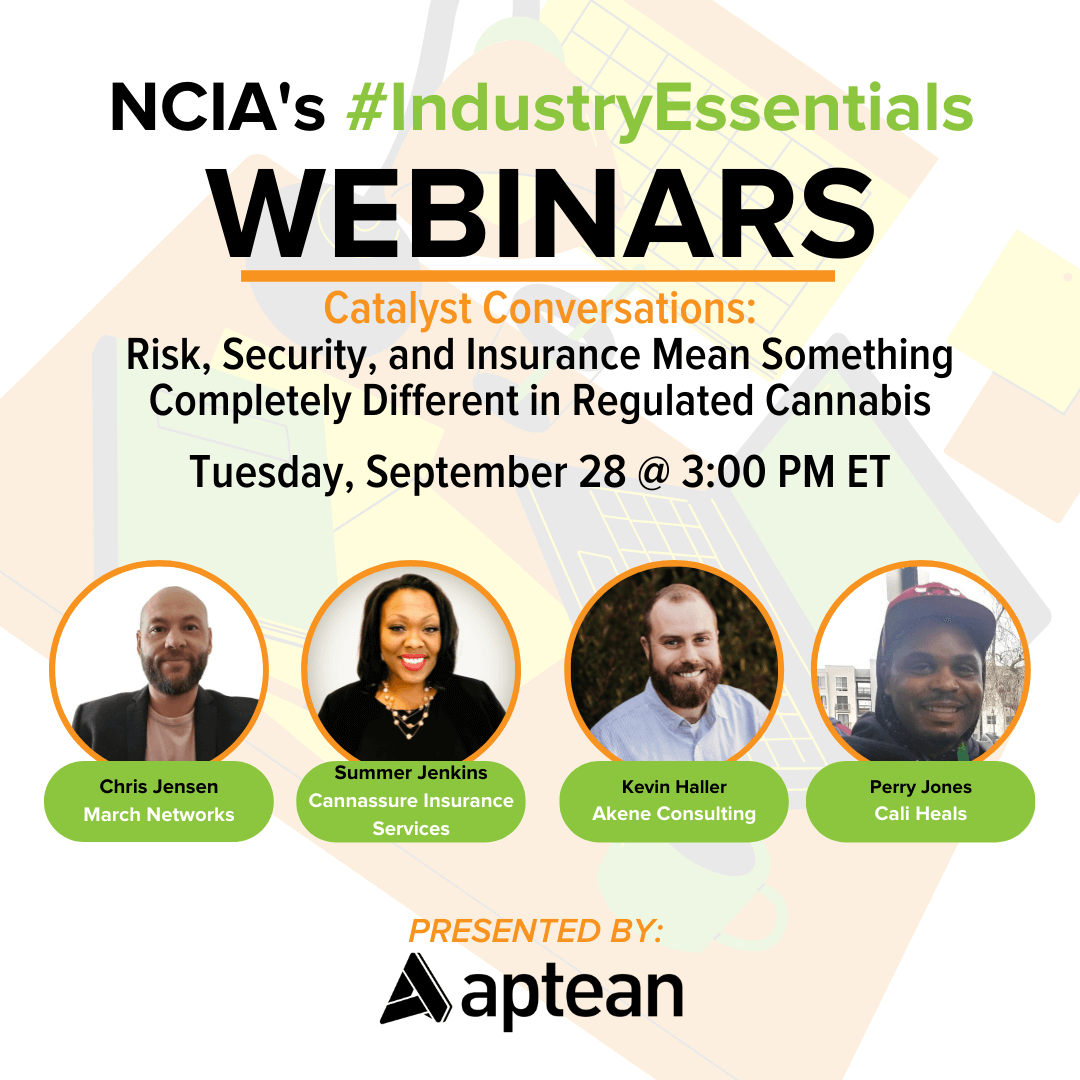
Catalyst Conversations | 9.28.21 | Risk, Security, and Insurance Mean Something Completely Different in Regulated Cannabis
NCIA’s Catalyst Conversations series is an advanced webinar series curated to give enrollees in our Social Equity Scholarship program the opportunity to network and gain access to valuable knowledge that will help them excel in the cannabis industry.
In this edition of our Catalyst Conversations series originally aired on Tuesday, September 28, NCIA’s Risk Management and Insurance Committee teamed up with the Diversity, Equity, and Inclusion Committee to create a powerful discussion every Social Equity operator should join in on.
Legacy and Social Equity operators face many hurdles. One of the biggest hurdles is creating a risk management strategy and gameplan in the regulated industry, which can prove to be very different from the risk management strategies that may have gotten them here in the first place. In the regulated industry, the greatest risks to survival aren’t always so obvious, and the ways to mitigate those risks can often seem too expensive, or even worse, the service providers may be difficult to trust. The still-existent impact of the War on Drugs cannot be underestimated in the role it plays in this dynamic.
During this webinar, we host a lively discussion about the very real threats to the survival of small cannabusinesses, and the ways to mitigate those risks.
Attendees will walk away with these key insights:
• Understand the current state of Security and Insurance in the regulated industry
• Get pragmatic information on what to look for when vetting Security and Insurance firms and coverage
• Learn how to incorporate simple tactics into your current business strategy.
• Understand how the impact of the War on Drugs and making the transition from Legacy markets may affect your outlook on Security and Insurance in a unique way, and what you can do about it
• Recognize the importance of assessing and mitigating financial risk in the regulated industry
A special thank you to the benefactors of NCIA’s Diversity, Equity and Inclusion Program which are listed below!
New Risk Management and Insurance Committee Manual: Introduction to Cannabis Insurance
The cannabis industry is one of the fastest-growing industries in the U.S., maturing at more than 25% annually. As the cannabis industry continues to emerge and flourish from state to state, there remains uncertainty as to the immediate future of federal legislation to remove cannabis from the schedule of controlled substances.
The cannabis industry will continue to experience the convergence between state and federal government regulations until a uniform regulatory and compliance framework can be established. Fundamental services such as banking, financing, and insurance, along with IRS 280E tax regulations, will continue to burden state-regulated cannabis businesses. And, with the industry still in its relative infancy, emerging and shifting regulatory backdrops create risks to these businesses.
Cannabis businesses can manage these risks in a variety of ways. Perhaps the foremost among them are the procurement of appropriate insurance coverage. While just a few years ago, insurance coverage options for cannabis operators were incredibly limited, today there are dozens of insurance carriers serving the industry.
Cannabis operators have to be proactive in developing a risk management program that conforms to local and state compliance and security requirements. As the industry continues to evolve, we will need to be more diligent in controlling and managing risk.
To assist with this process, NCIA’s Risk Management & Insurance Committee (RMIC) is pleased to provide the first in a series of Insurance Manuals that will help guide you through the various coverages and definitions used in the cannabis insurance industry. This first edition of the RMIC Insurance Manual will outline the basic and entry level knowledge base for the cannabis insurance industry, and explore the various insurable risks attributed to the cannabis supply chain. Future additions will dive deeper into more specific insurance topics.
NCIA’s Risk Management & Insurance Committee is a multidisciplinary group of risk management professionals convened to draw on expertise and experiences of professionals dedicated to the cannabis community. Primary contributors for the first installment of the Insurance Manual include:
Committee Blog: Why Insurance Companies Should Cover Medical Cannabis Now
by Carol Welch & Jim Gerencser NCIA’s Risk Management & Insurance Committee
Cannabis was legalized for medical use in California in 1996. Since then, 47 states, the District of Columbia, and three territories (Puerto Rico, Guam, and CNMI) have legalized some form of cannabis, leaving only three states with no legal use. Thirty-six states have an effective medical use law in place. The main reason insurance companies haven’t had to consider providing coverage for patients is because federally cannabis is still listed as a Schedule 1 drug. Even though the likelihood of cannabis being legalized nationally seems bound to happen within the next few years, insurance companies should start planning to incorporate new cannabis policies into their plans now.
Here are five great reasons to cover medical cannabis:
SAVES MONEY
Science has proven that cannabis helps over 60% of epilepsy patients decrease the frequency and severity of seizures. Cannabis products should cost less than traditional epilepsy medications, especially when taking into account the added prescriptions often needed to combat the side effects of currently available prescription drugs.
Compared to the traditional cost of cancer treatment, patients opting to skip conventional treatments for cannabis could save their insurance companies thousands in initial cancer treatment, and potentially will have less recurrence and costly maintenance prescriptions.
Insurance companies are paying billions in healthcare costs to include doctor visits, lab tests, hospital admissions and prescriptions for conditions that cannabis has shown to improve dramatically. Chronic pain, depression and PTSD are all treatable with cannabis, and cannabis is much less dangerous than the opioids that are commonly prescribed in chronic pain cases.
SAVES LIVES
There are no known deaths reported from cannabis consumption alone. According to the CDC, there were 70,630 deaths due to drug overdose in 2019. In addition, there are estimates of over 1.5 million hospitalizations per year from adverse drug reactions that don’t cause death but are still costly to many people. Insurance companies can avoid some of the negative PR, potential litigation and upset related to deaths caused by pharmaceuticals, while providing patients with a solution that works for many conditions.
Research is increasingly showing that certain strains and compounds within the cannabis plant can have a significant positive effect on several conditions. For instance, breast cancer responds very well to FECO (full extract cannabis oil), with lab tests showing how cannabis causes cancer cell death. More study is still needed, and that is currently being conducted in Israel where there are fewer legal barriers to research.
REDUCES MEDICARE SPENDING
Data from all prescriptions filled by Medicare Part D enrollees from 2010-2013 showed a significant decrease in prescriptions being filled for symptoms for which cannabis could serve as an alternative treatment. Overall reduction in Medicare spending in states that implemented medical marijuana laws were estimated to be $165.2 million per year (2013). This one difference alone could mean billions in savings for insurance companies in the coming years.
IMPROVES SATISFACTION RATINGS
Let’s face it, insurance is a competitive business. Several large health insurers cover most of the country and will likely be the last to jump on board to cover medical cannabis. But for the smaller, regional or state-specific insurers out there, adding cannabis to the coverage lineup in legal states can provide a competitive advantage with employers and group plans.
Medical cannabis is listed as an eligible expense in many Canadian companies’ HSAs and islisted as an eligible medical expense by the Canada Revenue Agency. Since our northern neighbors are starting to cover it, hopefully that will encourage U.S. insurers to do the same.
IT’S THE RIGHT THING TO DO
Cancer is the #2 leading cause of death in the United States and can cost several thousand dollars for treatment. Using cannabis as a complementary treatment to traditional cancer therapies could decrease the cost of treating cancer to the patient, to the insurance companies and in the end to all of the people across the United States that contribute to Medicare and Medicaid.
If you would like to take action, contact your legislators to push for the federal legalization of cannabis or sign this petition calling on all U.S. insurers to step up and cover medical marijuana for their patients. Here’s a link to the Care2 petition: Health Insurance Companies Should Cover Medical Marijuana Now.
Committee Blog: Property Insurance – The Good, the Bad, and the Ugly.
How a Hardening Market is Limiting Coverage and How to Be Prepared.
2020 was one heck of a year. The insurance industry has experienced more claims this year than in the history of insurance with over a billion dollars in intentional property destruction alone. With the catastrophic claims from COVID-19, record-setting wildfires, civil unrest, and theft, expect property insurance rates to spike this year — and even more so if you’ve experienced a property claim.
Should an insured party that does not have a loss on their record expect an increase in their premium upon renewal? Simple answer, YES.
What is “commercial property”?
In the insurance world, commercial property is a lot more than just physical property — like cultivation equipment or a brick building. Commercial property coverage also includes (but is not limited to): loss of income, equipment breakdown, business property or equipment, inventory of others and finished stock that has been processed, packaged and ready for sale.
Commercial property insurance is not required but is highly recommended — your business could close due to a fire, theft, natural disaster, or other catastrophic loss. If your brand-new cultivation facility burns to the ground, you don’t want to be the one paying to build a new one out of your own pocket.
Property insurance is still an essential component of your insurance portfolio. There are many forms of property insurance that need to be considered. Property coverages include but are not limited to:
loss of income (sometimes known as business interruption),
tenant improvements,
real property such as the building,
business personal property,
manufacturing equipment,
cannabis inventory,
signage,
and property of others (in this case, any cannabis stock or equipment you may hold for another licensed operator).
Also, it’s important to understand the different forms of coverage available in property insurance. You can learn and understand the forms by looking at the property declaration page. There is basic, broad and special. Here is a breakdown of what each form generally covers:
Broad: Covers basic perils and more – fire, lightning, explosion, smoke, windstorm, hail, riot, civil commotion, aircraft, vehicles, vandalism, sprinkler leakage, sinkhole collapse, volcanic action), plus the following additional perils: falling objects; weight of snow, ice, or sleet; water damage (in the form of leakage from appliances); and collapse from specified causes.
Special: This is considered all risks coverage: coverage for loss from any cause except those that are specifically excluded. This is the BEST form of property insurance.
What people often don’t realize is that when you buy property coverages, these differences between Basic, Broad, and Special determine if you have coverage or not for your loss based on the peril that caused the loss.
Example: In a brush or fire area, getting Special coverage is almost impossible which is exactly what an operator in that environment needs. But when an insured asks for coverage, they usually are required by a lender or lease to have property coverage. They are usually not requiring a special form, just property coverage per the specific limits per the contract. At this time, the insureds are not concerned about Basic coverage, but that is all that they can get due to brush zones caused by recent fire areas throughout the U.S. Fire is covered, but not much else.
Any defense you can provide your property when located in these high brush areas is essential to surviving in these harsh environments. Clearance of 100 feet minimum from all structures is always recommended where possible. Water storage and proper access throughout the property is also recommended. This will help with personal defense and help support the efforts of your fire department in case a fire comes your way.
Wind and Hail coverage is another example that you need to address concerning property in the Midwest and East coast. Make sure this is addressed in your property policy if you live in these areas. These policies will have either a flat deductible or a % deductible based on the policy that is written. A flat deductible could be $5K-100K and the deductible will range from 1-5% of property coverage based on the geographics and coverage written for the policy.
Knowing it’s a hard market with higher pricing shouldn’t steer you away from purchasing this coverage — but that knowledge should make you more aware of the initial costs to properly safeguard your property.
The reason why property insurance is getting pricier isn’t that the insurance companies are out to get you… it’s that they’re busy paying for your neighbor down the road whose dispensary was targeted by criminals or whose building burnt up in a wildfire. With that in mind, savvy insurance customers are taking steps to reduce their risk profile (and their corresponding insurance premiums). If you haven’t already, take some time to check out your property and do what you can to protect yourself from fire, theft, hail, or other local worries.
Content provided by Jesse Parenti of PCF Insurance Services- Nine Point Strategies, Stephanie Bozzuto of Cannabis Connect Insurance Services, Helkin Berg of Strimo, Michael DeNault of Charles River Insurance, Summer Jenkins of Cannasure Insurance Services, and Matthew Johnson of QuadScore Insurance Services on behalf of NCIA’s Risk Management & Insurance Committee.
Sponsored Blog: What A Cannabis Focused Insurance Agent Knows That You Should
Our agency decided to enter the world of cannabis insurance in August of 2016. We made this decision partly because we saw the financial potential of the industry but mainly because we wanted to contribute our talents and services as insurance agents to a culture and industry we believed in. An industry we knew that could one day be seen on the same level as any “main street” business if given the opportunity. Our goal has always been to provide an executive level of professionalism to our clients and to provide the most up to date solutions in protecting their businesses.
While most insurance companies continue to exclude cannabis risks in their offerings, we are proud to say the few insurance carriers who have stepped up to insure cannabis have done a great job of understanding the operations of licensees and their risk exposures. Although cannabis insurance products have improved, gaps in coverage and limited availability for certain risks is still an issue for our clients.
As someone who is championing for each licensee to succeed, I thought I would share some insight in areas of risk cannabis businesses have in order to help protect their business.
Insurance Companies
Since 2016, we have seen two admitted insurance companies offer coverage for California cannabis risks with a third option being offered soon. Three standard workers comp carriers began placing coverage along with the various State Funds each state offers.
More insurance companies are offering commercial auto coverage to states where cannabis is now legal. For the more complicated areas of coverage like Directors & Officers Insurance and Employer Liability Insurance, the insurance industry is being cautious in extended commonplace coverage with premiums and terms being offered at rates much higher than typical policies by comparison.
Policy Exclusions
This is the area of insurance that can get ugly really fast.
An exclusion to a policy removes coverage from the insurance. Each cannabis approved insurance company has their own specific exclusions and no two policies are the same. When an insurance policy has a defined and specific exclusion within it the insurance company will have no duty to defend such claim. This means your company will be on the hook to investigate the claim, prepare and defend yourself in court and possibly settle financially.
Here is a sample of some of the exclusions to be aware of: class action, cancer, redefined bodily injury, vape pens, health hazards, and criminal acts.
Employee vs Employer – (Employer Practices Liability Insurance)
Managing employee workplace environments is a balance of people management and navigating law with employer responsibilities. Both areas even the most seasoned business person or company might find difficulty in doing. The reality is even with full-time HR management in place handling high turnover rates and the difficult job of firing and hiring HR cannot prevent employers from claims of employee misconduct. If a current or former employee claims discrimination or harassment, wage theft or other unlawful acts the company having coverage in place for these claims should be essential for cannabis operators.
Product Liability
While most people in the cannabis industry would agree that consuming cannabis is safe, the potential for product liability claims are massive. With the limited clinical research on cannabis long term physical and mental use and the legal ability to consume it means claiming a cannabis product is dangerous or caused injury or illness has yet to be tested in court. Although we haven’t seen lawsuits many in the industry thought we would see as of yet, my feeling is this will be the next wave of problems for cannabis operators with class-action status and illness being at the forefront of claims.
Delivery & Distribution Risks
High employee turnover and limited insurance options are driving up commercial auto insurance costs. Due to COVID-19 we have seen delivery operations grow rapidly and expand and with this the cost to cover more drivers are pushing down much-needed profits. While background checks are a best business practice at hiring, driving records checks should be done as well to verify any impact on premiums a new hire may have.
OG Cannabis Insurance began offering cannabis insurance in 2016 and quickly has become a recognized industry leader. From the beginning, our agency’s focus has been on developing an in-depth understanding of cannabis insurance products as well as being up to date on state and local cannabis license compliance requirements. Since then, we have worked with local municipalities on the shortfalls of cannabis insurance and have worked with insurance carriers who were interested in insuring cannabis but needed to know more about cannabis risks.
We decided to bring our talents and services to cannabis because we believed for the industry to thrive it must have access to knowledgeable and credible professionals representing cannabis. It is our goal to provide the cannabis industry with the most trustworthy and knowledgeable staff.
Manuel started in the insurance industry for an independent agency located in Chino CA in 1998 and was with that same agency until it sold in 2008. As his career grew, so did his knowledge of insurance products, coverage, exclusions, and terms. He began to sell Commercial Line’s policies including Workers Compensation, General Liability, and Property Insurance. His clients include Trucking Companies, Bail Bond Companies, Staffing Companies, and Contractors just to name a few industries.
When the agency he worked for sold, he started his own agency, So. Cal’s Best Insurance in 2008. Manuel has been married since 2008 and has 2 boys who keep him busy at home. He is an avid sports fan who loves boxing, the Dodgers and Lakers.
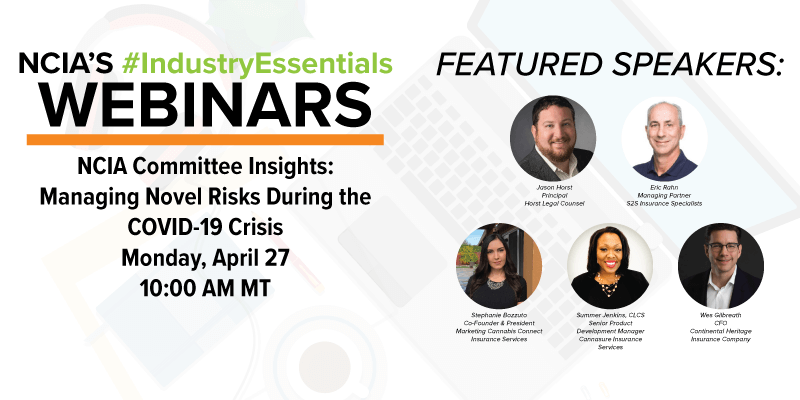
Webinar Recording: NCIA Committee Insights – Managing Novel Risks During the COVID-19 Crisis
In case you missed it, watch the recording of this webinar from April 27, 2020. NCIA’s Risk Management and Insurance Committee presents a conversation regarding how cannabis operators can mitigate the risks that the coronavirus presents to their customers, their employees, and their businesses. Get actionable advice and expert insights regarding how to manage your risk and avoid potential liability while keeping your essential business open.
Topics addressed include:
Identifying all novel risks presented by COVID-19
Addressing the availability for insurance coverage for COVID-related losses
Creating SOPs around employee and customer safety
Increased delivery exposure and SOPs around fleet management, driver safety/protection
Managing increased cyber security risks through insurance and strong SOPs
What coronavirus teaches us about the import of proactive risk management
Speakers include:
Jason Horst, Principal
Horst Legal Counsel
Stephanie Bozzuto, Co-Founder & President
Marketing Cannabis Connect Insurance Services
Summer Jenkins, CLCS, Senior Product Development Manager
Cannasure Insurance Services
Eric Rahn, Managing Partner
S2S Insurance Specialists
Wes Gilbreath, CFO
Continental Heritage Insurance Company
Eduardo Provencio, General Council
Mary’s Medicinals
NCIA Committees: Spring 2020 Update On Achievements And Projects
NCIA’s member-driven committees are an opportunity for individuals from NCIA member companies to get directly involved in specific industry issues and sectors. These volunteer-driven efforts engage members’ expertise and passion to drill down in those areas to effect change, provide professional development opportunities, and develop best practices and guidelines that will shape the future of our industry.
We recently checked in with these various committees to learn more about what they’re up to and what projects they’re working on this term. Get updated on their activities below.
Risk Management & Insurance Committee (RMIC)
The RMIC has recently contributed to several NCIA white papers and educational webinars. They are currently working on an insurance manual. The committee has divided into sub-committees responsible for managing white papers, webinars, and the manual.
Scientific Advisory Committee (SAC)
SAC’s vision is to disseminate educational materials to NCIA members on scientific topics in the cannabis industry and to advise on other NCIA initiatives, ensuring that any formal recommendations produced are scientifically sound, sustainable, and legitimate. This term, SAC published a blog discussing why everyone should know about the endocannabinoid system.
SAC is working on other pieces addressing topics such as the recent vape illnesses from a physician’s perspective, indica versus sativa designation, how cannabis can help the opioid crisis, common scientific myths confusing the industry, and budtender and consumer education about the endocannabinoid system.
SAC is also developing a webinar that discusses what should be on a label, how to read a label, and how to associate what’s on a label with either statements on efficacy or marketing/branding.
Cannabis Cultivation Committee (CCC)
The committee has recorded two podcast episodes for NCIA’s Cannabis Industry Voice Podcast. The first was a Cultivation Best Practices Roundtable, hosted by Noni Goldman of the CCC. In that episode, Cody Hitchcock of Smokey’s 420 and James Cunningham of Fog City Farms were interviewed to shed light on their different growing styles and techniques, focusing on the ways that they implement sustainability in their operations.
The second soon-to-be-released interview was with High Times’ new CEO Stormy Simon, and was hosted by CCC Chair Mo Phenix and member Noni Goldman. This interview explored Stormy’s history and how she got to where she is today, as well as what High Times is up to, and where Stormy sees the industry going.
More podcasts to come in the next couple of months from the CCC! Keep an eye out for an episode or two on regenerative agriculture.
Packaging & Labeling Committee (PLC)
The PLC sub-committees have each contributed to a blog or presentation up to this date. The Sustainability sub-committee has worked with Kaitlin Urso and team in regards to their White Paper. A panel discussion proposal has been submitted for future NCIA conferences.
NCIA’s Northeast Cannabis Business Conference in Boston (February 2020) Panel Discussion on the Future of Cannabis Packaging went great!
State Regulations Committee (SRC)
NCIA’s State Regulations Committee has continued to produce content to help educate and inform members on the latest developments in the world of state regulation of cannabis. As the industry’s law and regulations change quickly across the country, the SRC members stay ahead of the curve and share their insight in a variety of forms. These projects include panel presentations at NCIA conventions, published blogs, and interactive webinars. In this quarter, they published three blogs, produced one webinar, presented on two panels, and participated in an NCIA summit.
As the committee strives to keep everyone updated on burgeoning legal topics, the SRC committee presented a webinar on Michigan, a newly regulated market. The webinar provided information on this key Midwestern state, “Michigan’s Adult-Use Market – What Comes Next?”
Conferences:
SRC members also traveled from across the country to share their expertise on panel sessions at NCIA’s Northeast Cannabis Business Summit in February 2020 in Boston.
The Social Equity Sub-Committee leaders, Erin Fay, Chris Jackson, and Margeaux Bruner provided helpful insight during their session, “What You Need To Know For Winning Applications and Successful Operations That Promote Diversity and Inclusion.”
Sean Donahoe and Gabriel Cross of the SRC’s Interstate Commerce Sub-Committee presented on the issues surrounding interstate commerce and strategies for preparing for this anticipated change in the cannabis industry.
Also, SRC members participated in the NCIA’s summit about tackling the illicit market.
The State Regulations Committee is excited about its work and continues to stay knowledgeable about the ever-changing legal and regulatory landscape. Their projected work includes a webinar on the Illinois adult-use market and a wide range of written projects. Stay tuned!
Banking & Financial Services Committee (BFSC)
The committee’s vision is to provide the NCIA member base with current and actionable information related to Banking and Financial Services in the State legal cannabis industry.
They have implemented monthly newsletters for the member base and have been extremely active in response to the proposed federal legislation regarding banking and the cannabis industry.
Human Resources Committee (HRC)
The Committee’s vision is to provide best practices in all disciplines of Human Resources to NCIA members. They have worked on a couple of blogs this year around the recent reduction in force trend and will be releasing a few blogs providing some recommendations for how cannabis employers can navigate CV-19 when it comes to their workforces.
The HR Committee is working on a very exciting case study. They are looking forward to releasing the first few modules of it this summer!
Marketing & Advertising Committee (MAC)
The MAC coalesces the talents of 20 of the industry’s top-tier marketing and communications professionals around three focus areas: Education, Advertising Access and 2020 political goals. The committee uses their personal, professional and business skills and networks to help build a responsible, legal cannabis industry. The committee is producing best practices, webinars, workshops and social media campaigns to aggregate and generate support from NCIA members, the public, media, government and business leaders.
The MAC Education Subcommittee has focused its energies on developing a Speakers/Expert Directory with a goal to launch by year-end.
The 2020 Subcommittee has created its first infographic covering Oklahoma’s 2020 ballot initiatives; infographics for additional states with legalization initiatives on the ballot this year will follow soon.
The Advertising Access Subcommittee is adding more states (as they come online) to their overarching list of “Do’s and Don’ts” for compliant cannabis advertising. Those are pending editing and legal review and will be published on the NCIA website soon thereafter.
The committee is also working on upcoming webinars including “Advertising Best Practices.”
Cannabis Manufacturing Committee (CMC)
The Cannabis Manufacturing Committee is focusing on reviewing existing business practices and state regulations of concentrates, topicals, vaporizers, and edibles ensuring the manufacturing sector is helping shape its destiny.
They are also working on their second publication, “Facts About Current Good Manufacturing Practices (cGMPs) And Their Role In The Cannabis Industry” which will be a resource for essential businesses.
In addition to the work the CMC is carrying out, they are collaborating with other committees to help create an NCIA resource library.
The CMC Testing sub-committee is working on writing blogs about “Positives of Testing” (from the operator’s view), and “Nomenclature: Cannabis Nomenclature Register” for publication.
Retail Committee (RC)
Members of the Retail Committee attended NCIA’s Northeast Cannabis Business Conference in Boston in February 2020 to participate in an educational panel on Retail 101. The committee has an upcoming webinar in April: “Retail: Tips and Best Practices” which will include 4 panelists that are currently license holders or working in licensed dispensaries in 3 different states (CO, CA, WA), and will also address some tips and best practices for the current CV-19 climate.
Facilities Design Committee (FDC)
Committee member David Vaillancourt of The GMP Collective appeared on NCIA’s weekly podcast, NCIA’s Cannabis Industry Voice, in February 2020 to discuss GMPs (Good Manufacturing Practices) in an episode titled “Revolutionizing How Cannabis Producers Achieve Success.”


 Valerie Taylor, Producer, Vice President and National Cannabis Practice Leader, The Liberty Company Insurance Brokers
 by NCIA’s Risk Management and Insurance Committee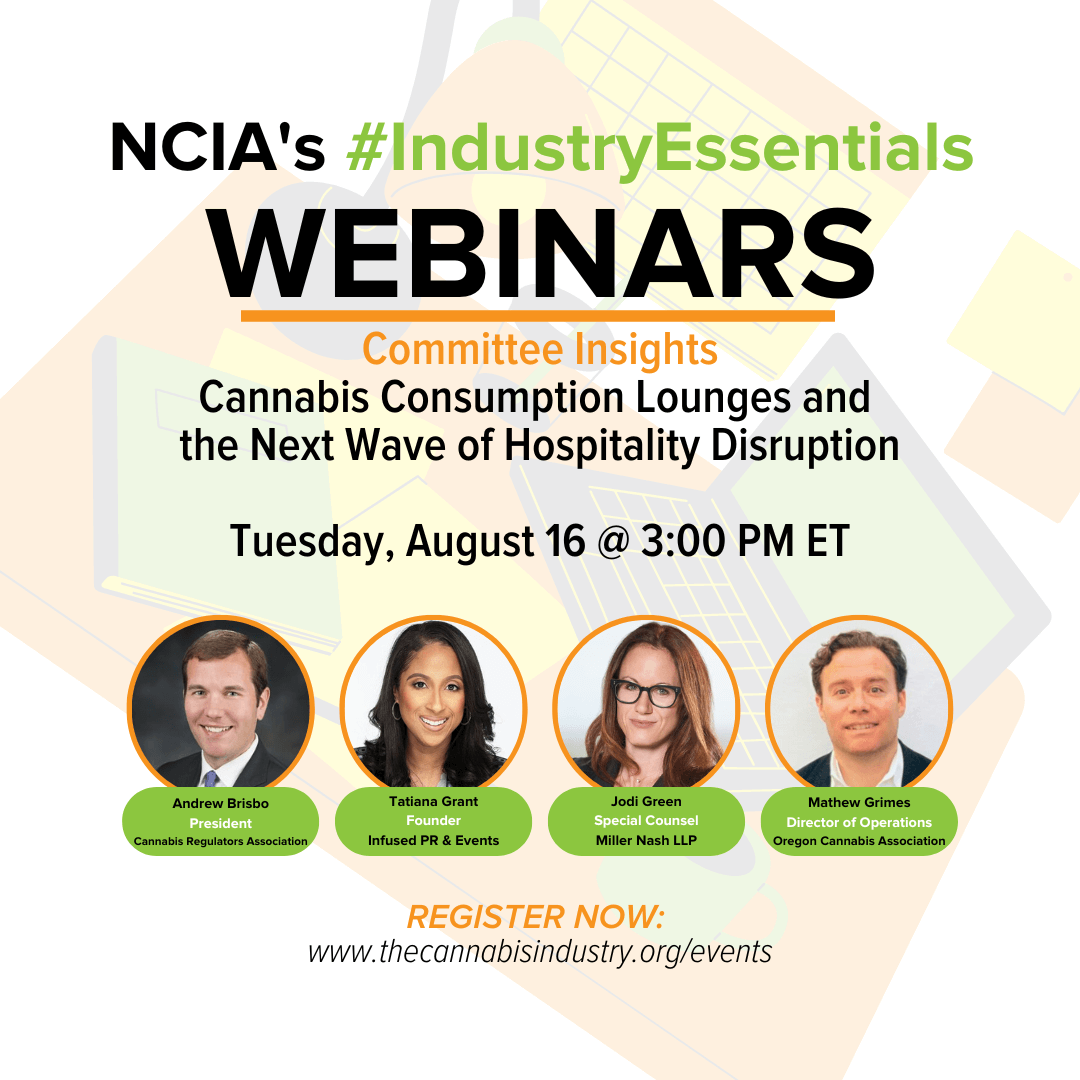






Follow NCIA
Newsletter
Facebook
Twitter
LinkedIn
Instagram
News & Resource Topics
–
This Just In
How THCa Vapes Are Changing Consumer
Announcing NCIA’s 2026-2028 Board of Directors