August Action Alerts for NCIA Members: CAOA and SMS

 by Rachel Kurtz-McAlaine, NCIA’s Deputy Director of Public Policy
STOP what you’re doing and ask yourself 2 questions:
- Have I read the discussion draft or summary of the Senate bill to legalize cannabis at the federal level and now have an opinion on how NCIA should approach the bill? (Tell NCIA.)
- Has my SMS/text messaging service gotten more expensive, become unwieldy with rules, or been taken away altogether? (Tell NCIA.)
If you answered yes to one or both of these questions, please take a quick moment to let us know! Click on the unique link next to the relevant question. If you want to learn more about either issue, keep reading.
Senate Legalization Bill Discussion Draft: Your Thoughts?
Hopefully, by now you’ve had a chance to read the discussion draft of the Senate bill released a few weeks ago, detailed in Michelle’s last blog post, Crazy for Cannabis Administration and Opportunity Act (CAOA). If not, at least read the summary so you understand what is happening with this potentially historic legislation.
We are at the precipice of federal legalization, but as you know, in such a highly regulated industry, how legalization gets implemented can have a significant impact on your business. So it’s important that your voice is heard when these laws and regulations are being discussed. We’ve created this simple form for NCIA members to easily give us feedback on the CAOA. If you’re a committee member, you can provide feedback through your committee as well.
Text Messaging Service Disruptions: the Cannabis Industry Can Fight Back
You may remember reading my article, Text Messaging (SMS) Crackdown Impacting the Cannabis Industry, published back in May, written when we were first learning the scope of the issue. Although many companies seemed to be able to move on with workarounds, we’re hearing even workarounds are disappearing. And even when businesses are still able to operate, they get charged high fees or are severely hampered in what they can do with the messages.
Because this issue has been affecting so many of our members in one way or another, we want to help, but we need to hear from you. This isn’t a law that we can lobby to change, it is a convoluted policy that telecommunications giants are enforcing on their customers, ostensibly to cut down on customers complaining about spam, but in some cases, they are applying blanket bans on cannabis companies.
As an industry, we can fight back. We are organizing a working group to take on the telecommunications giants, including a potential class-action lawsuit. If you want to be part of this or learn more, please email me.
Those workarounds going away, or extremely expensive and cumbersome. It can seem overwhelming to fight back.
At this point, time to organize and use strength in numbers against giant telecommunications companies.
Action Alert: Submit Comments to USPS and Congress about Mailing Vaping Products
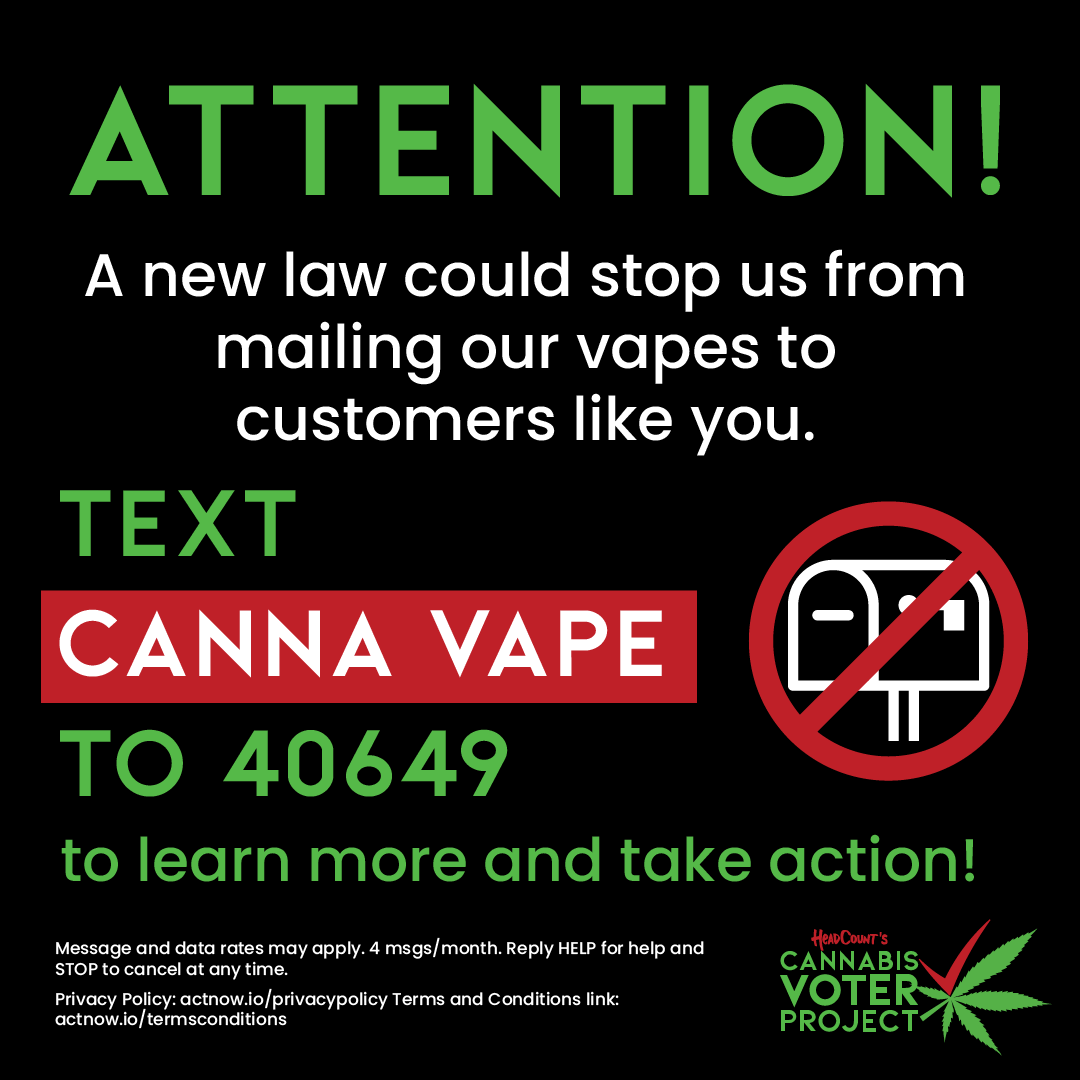
It’s time to take action!
A new law could make it illegal for companies like yours to ship vaping products or components to customers — unless the United States Postal Service clarifies the rules.
What You Need To Know
On December 21, 2020, Congress passed the Consolidated Appropriations Act of 2021, which included the Preventing Online Sales of E-Cigarettes to Children Act (the Act). The intent of the Act was to prevent underage smoking by applying the same safeguards already in place for cigarettes and smokeless tobacco products to the online sales of e-cigarettes — a mission we all support. The Act amends the Jenkins Act, which generally prohibits mailing of cigarettes to consumers through the United States Postal Service (USPS), to include Electronic Nicotine Delivery Systems (ENDS) and to subject them to the same mailability restrictions.
The Act defined ENDS as any electronic device that, through an aerosolized solution, delivers nicotine, flavor, or any other substance to the user inhaling from the device. The provisions also extend to any component, liquid, part, or accessory of an ENDS, regardless of whether sold separately from the device. Unfortunately, this definition is overly broad, and despite the name, an item can be interpreted to qualify as an ENDS without regard to whether it contains or is intended to be used to deliver nicotine — this means devices used for the vaporization of cannabis or hemp, essential oils, and other aromatics, or even water vaporizers used for babies.
We share Congress’s concerns regarding the tobacco and nicotine industries. That said, those concerns relate only to specific industries and they do not relate to Non-Nicotine Devices. The youth access problem identified by Congress is specific to certain nicotine products and not state-regulated hemp, cannabis or other products. This is clear when we look at the plain language of the ENDS definition and the legislative history of the Act. Applying the Act to Non-Nicotine Devices is not only illogical and contradictory, but it runs counter to the data-driven, science-backed approaches to youth prevention that make for good policy.
How You Can Take Action
Our friends at HeadCount’s Cannabis Voter Project want to help you make your voice heard! Text CANNA VAPE to 40649 or click the link below to find out how you can take action.
Learn more and take action here: https://p2a.co/924QhrE by Friday, March 19, 2021.
We have teamed up with Cannabis Voter Project to develop a convenient landing page that will allow you, your customers, and the rest of your network to easily submit comments to the USPS and their representatives in Congress: https://p2a.co/FyUcHVr
To maximize effectiveness, please consider the following steps:
- In your email and social media posts, have a clear call to action (e.g., “Click here to send to your comments to Congress”)
- If using Instagram, use the swipe up feature on Stories to send viewers to the landing page
Take action here https://p2a.co/924QhrE by Friday, March 19, 2021.
Follow NCIA
Newsletter
Facebook
Twitter
LinkedIn
Instagram
News & Resource Topics
–
This Just In
NCIA Applauds Reintroduction of SAFE Banking Following Lobby Days
Beyond Rescheduling: Inside NCIA’s 14th Annual National Cannabis Industry Lobby Days