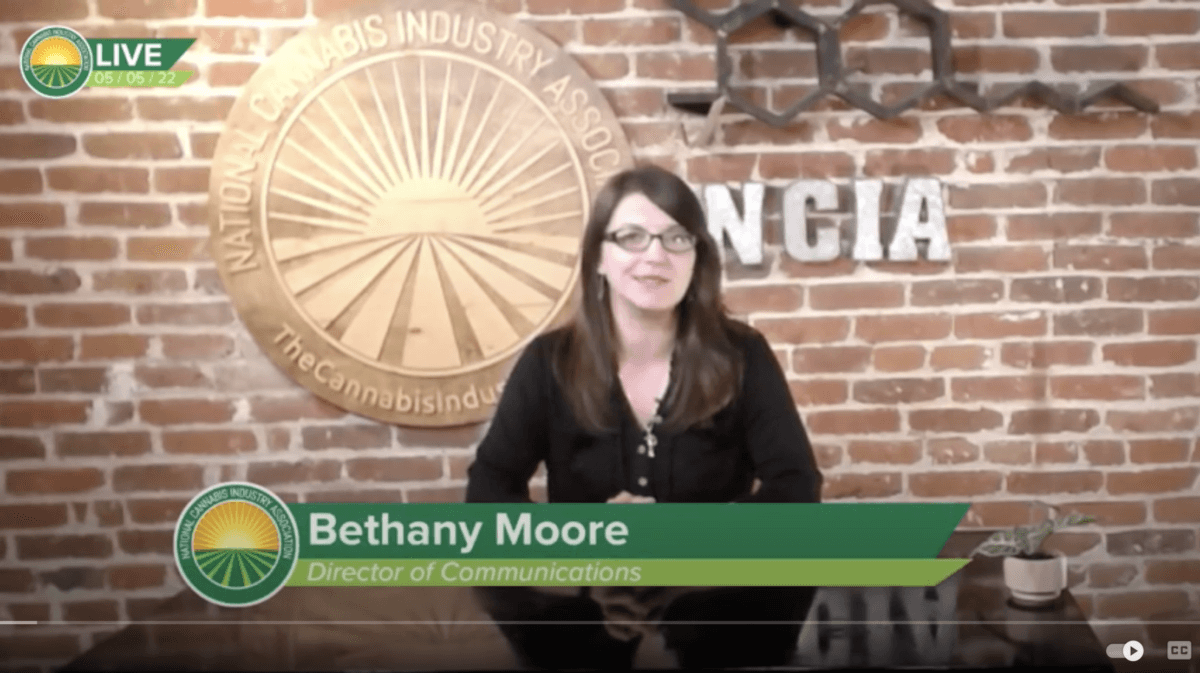
¡Happy Cinco De Mayo! NCIA Director of Communications Bethany Moore checks in with what’s going on across the country with the National Cannabis Industry Association’s membership, board, allies, and staff. Join us every other Thursday on Facebook for NCIA Today Live.
On February 2, 2022, Mississippi Governor Tate Reeves signed the Mississippi Medical Cannabis Act (SB 2095) into law, making Mississippi the 37th state to authorize the medical use of cannabis. Passage came after the voter-approved ballot measure allowing a medical cannabis program was struck down by the Mississippi State Court. The Mississippi Department of Revenue (MDOR) has 150 days from enactment to begin the process of licensing dispensaries and is working with the Mississippi Department of Health (MDOH) to design the application process. The Alcoholic Beverage Control Enforcement Division of MDOR will be the division accepting the license application and will begin accepting applications no later than July 1, 2022. Thirty days after receiving a completed application, it will have to issue dispensary licenses to qualifying applicants.
Patient Qualification and Limitations
To qualify for the program, patients must have at least one qualifying medical condition and a certification issued by a healthcare practitioner with whom they have a bona fide relationship. A “bona fide practitioner-patient relationship” means the practitioner has a treatment relationship with the patient during which the practitioner has completed an in-person assessment of the patient’s medical history and current mental health and medical condition; has consulted in person with the patient about the patient’s debilitating medical condition; and the practitioner is available to or offers follow-up care and treatment to the patient. The practitioner must be a Mississippi-licensed physician, nurse practitioner, physician assistant, or optometrist. They must believe the patient “would likely have medical or palliative benefit” from medical cannabis to treat their qualifying condition. They also must have completed 8 hours of continuing medical education on medical cannabis and complete five hours every year thereafter.
The qualifying conditions are cancer, Parkinson’s, Huntington’s, muscular dystrophy, glaucoma, spastic quadriplegia, HIV, AIDS, hepatitis, amyotrophic lateral sclerosis (ALS), Crohn’s, ulcerative colitis, sickle cell anemia, Alzheimer’s, agitation of dementia, PTSD, autism, pain refractory to opioid management, diabetic/peripheral neuropathy, spinal cord disease, or severe injury. Patients can also qualify with a chronic medical condition (or its treatment) that produces either cachexia or wasting, severe nausea, seizures, severe and persistent muscle spasms, or chronic pain, narrowly defined as “a pain state in which the cause of the pain cannot be removed or otherwise treated, and which in the generally accepted course of medical practice, no relief or cure of the cause of the pain is possible, or none has been found after reasonable efforts by a practitioner.” There also will be a petition process for patients to seek coverage for other unspecified conditions.
The program limits possession and purchases to “Medical Cannabis Equivalency Units” (MCEUs) of 3.5 grams of flower, up to 100 mg of THC in infused products, or 1 gram of concentrate. Patients’ purchases are limited to 6 MCEUs in a week and 24 MCEUs in a month. They may not possess more than 28 MCEUs at one time. Flower is limited to 30% THC, with tinctures, oils, and concentrates not allowed to exceed 60% THC.
Regulation and Business Operations
The MDOH will be the primary regulator and coordinate with the MDOR for licensing and operations. MDOH will create the applicable regulations relating to seed-to-sale tracking, recordkeeping requirements, safe processing stands, transportation, health and safety, and security. It also will be responsible for monitoring and restricting advertising, signage, and displays. All products will contain a “notice of harm” regarding the use of medical cannabis products.
Licensing will be required for dispensaries, cultivation facilities, processing facilities, transportation entities, disposal entities, testing facilities, and research facilities. Cultivators will be tiered based on size, and the law does not include a numerical cap on business licenses. No individual or business may have more than 10% ownership interest in more than one cultivation license, one processing license, and up to four dispensaries. Application fees for cultivators will range from $1,500 to $60,000 depending on the size/tier of the particular cultivator, with annual fees similarly ranging from $2,000 to $100,000. Cannabis will be taxed at wholesale at 5% of the price, in addition to standard sales taxes.
Initially, dispensaries will not be able to provide delivery or curbside pickup for patients. Still, the law does provide that MDOH and MDOR are to implement rules that include “Protocol development for the safe delivery of medical cannabis from dispensaries to cardholders.” Dispensary staff will be required to complete an initial 8 hours of education on medical cannabis and 5 additional hours of continuing education every year. They also must be over 21 and obtain a work permit for $25. They also generally have been previously convicted of a violation crime or been convicted of a felony violation of a state or federal controlled substance law within five years. A disqualifying felony offense does not include a conviction for conduct that would not have been a felony but for the conduct occurring before the effective date of the Mississippi Medical Cannabis Act.
Medical cannabis businesses are not allowed to be located within 1,000 feet of the boundary of a school, church, or childcare facility, and dispensaries must be at least 1,500 feet from another dispensary. While localities can regulate the time, place, and manner of medical cannabis businesses, they can not ban them or “make their operation impracticable” unless they opt-out of the medical marijuana program by a vote of the localities governing body within 90 days of the law’s passage. If a locality opts out, 20% or 1,500 voters (whichever is fewer) can petition to put the question on the ballot, and an election must be held within 60 days.
Committee Blog: Re-Thinking Cannabis Track and Trace Models – How State-Mandated Track and Trace Integration Capability is Failing the Cannabis Industry
This is the second in a three-part blog series. The first part can be read here.
Highly regulated industries typically require key information to be readily available to regulators related to the production, movement, and sale of products, which is the case in the cannabis industry. The two main reasons for “seed-to-sale” record keeping are (1) to reduce the diversion of cannabis products to the unregulated market and (2) to protect consumer health with an efficient track and recall product method.
However, cannabis operators are facing many challenges with the state-mandated track-and-trace requirements, causing their business operations to suffer inefficiencies, delays, and sometimes even interruptions, which can ultimately impact consumers and patients. This is the second blog in a series highlighting the issues that cannabis operators and regulators are facing with the current centralized state-mandated track-and-trace model from NCIA’s State Regulations Committee, Technology and Compliance Sub-Committee.
The point of frustration begins with the method in which the track-and-trace requirements are implemented. Most U.S. states with some form of legal cannabis sales (medical and/or adult-use) have selected a single mandated technology platform that all operators must use to track and trace their cannabis seeds, plants, and products. The track-and-trace system selected by the state is independently configured to match the adopted cannabis regulations for that region. Because each state has adopted different cannabis regulations, there are variations in what can and cannot be accomplished within the selected track-and-trace systems, even within the states that have selected the same technology provider.
What is an API?
While the definition of an API may seem complex, at its most basic level, the API is the communication pathway between two systems. API stands for “application programming interface,” which means that it is a software intermediary that allows two systems to “talk” to each other, meaning communicating and sending or receiving information. The communication pathway is intended to be two-way, with third-party business management software being able to retrieve (“GET”) information in the track-and-trace system, as well as send (“PUT”) updated information back into the system.
Let’s turn to an everyday example of an API integration that most consumers would be familiar with: travel booking applications that aggregate flight information. Let’s say you are planning a flight for a summer vacation and you have two options: go directly to each airline website to search for and compare flight options, or use a third-party travel booking application to simultaneously access all flights across all airlines within your search parameters. The ability to search and review all the available flights, across many airlines, is because of the airlines’ and applications’ APIs. When you use the travel booking application, it sends the search parameters to the airlines it is connected with via the API. The airline API then sends available flights, seats, and prices to the travel booking application. In the more sophisticated travel booking applications, you can also purchase the ticket for your flight through the travel booking application, which then also utilizes other APIs for your secure banking/payment information. If all of the APIs are open to send and receive data between the systems, then the transaction is seamless, and all of the required information (identity verification, payment method, etc.) is shared with the airline for your booking.
Understanding API Limitations in Cannabis
State regulators intend for the cannabis track-and-trace technology to serve as a way to accurately collect and record information about the flow of goods in the cannabis industry from seed to sale. What is consistent across all states, regardless of the track-and-trace technology selected, is the acknowledgment from regulators that the mandated systems are not intended to serve as an operator’s compliance solution or business management software system. The state-mandated track-and-trace systems are not built in a way that would allow a business operator to manage day-to-day operations and transactions between operators and retailers to consumers.
This acknowledgment of the business management limitations within the track-and-trace systems and the need for interoperability with operators’ own software is often stated outright by regulators and policymakers and/or codified in regulations, such as in California’s Business and Professions Code (Clauses (b) and (c)). Instead of directly managing operations within the track-and-trace systems, cannabis businesses utilize third-party software that has been vetted and certified to connect with and communicate important transaction details to the state systems. Cannabis operators are then relying heavily on third-party software and API integrations for the communication and transmittal of that important information and data.
State-Mandated Software Providers Set Regulators And Operators Up To Fail
Now let’s think about how cannabis businesses utilize APIs on a regular basis: for example, point-of-sale (POS) software. Regulations require that the cannabis retailer record all sales in the central, state-mandated track-and-trace system, but the actual on-site transaction is conducted through POS software at checkout. The retailer is therefore encouraged to use POS software that provides the necessary sales tools and controls that make running the business manageable for all employees, while also providing API integration with state-mandated track-and-trace systems.
Without the API integration, a retailer would be forced to manually enter all of the details of all of the POS transactions into the track-and-trace system on a daily basis. Hundreds of daily sales without an API integration means many hours of data entry and countless opportunities for human errors in the track-and-trace system. Opportunities abound for inaccurate reporting in the track-and-trace systems with manual entry. Regulators rely on the track-and-trace system they selected to ensure compliance and consumer safety, although operators are essentially utilizing third-party software to communicate with the track-and-trace system. This is exactly why it is important that the cannabis industry has an open and operating track-and-trace system API at all times. Any time the track-and-trace API malfunctions (limited in communication pathways, delayed in responding to POS requests for information, or just completely down), the cannabis retailer operations are severely impacted, if not altogether halted.
In current situations where the state has mandated a specific software provider, the vendor approves specific POS and other software vendors, but the agreements the vendor has with the state does not allow for direct support to the approved vendors. This causes challenges as a licensee’s POS vendor cannot talk directly to the vendor to get API issues resolved. There is also no direct line of communication to the approved vendors about changes happening in the state-mandated software provider’s system that affects the API. These types of issues can cause the licensee (cannabis operator) to be out of compliance without even knowing it.
From The Operator’s Perspective
Imagine that you are a budtender trained on your employer’s POS software, compliance and track-and-trace requirements. Very rarely will you access the statewide system directly because the POS is fully integrated with the track-and-trace API. You are working during your daily shift processing retail transactions through the POS, but unfortunately, the track-and-trace API is experiencing high call volumes from all of the other retailers in the state, and the API is not responding to your POS requests. You cannot complete the transaction in the POS as usual, so you are forced to complete and track the transaction manually. Later on, you have to spend hours manually entering which unit of product came from which box in the back storeroom, along with all of the customer’s information and time stamps. This takes hours of labor and could lead to mistakes (hey, we’re human!). As we stated, manual records and entry invite human error. Now the inventory listed in your POS software does not match the statewide track-and-trace system. You spend many more hours trying to find and correct this mistake. The circle of conducting sales transactions, recording and tracking it manually, and fixing errors, widens, all putting your cannabis business at risk.
Because cannabis businesses at every point of the supply chain (i.e., cultivation, manufacturing, distribution, and retail) rely on third-party software to manage their operations effectively and efficiently, a hiccup in the track-and-trace API has ramifications for an entire statewide industry at once. While this sounds like a “perfect storm” scenario that only happens every once in a long while, in reality, track-and-trace API performance issues happen on a regular basis.
In California, a group of third-party software integrators reviewed track-and-trace API performance over a period of six months (April 2020 through October 2020) and found that the API was generally up and fully responsive approximately 91 to 98 percent of the time. While an API performance ranking in the high nineties may seem acceptable, the technology industry considers 99.999% uptime as the standard for high availability. An availability of 94 to 98 percent means 2-6% downtime, which is effectively 3 to 8 hours of downtime per week.More recently, the California Metrc API (CCTT-Metrc) experienced consistent outages for approximately 17 consecutive days (February 16, 2021 – March 5, 2021). This extensive outage caused all third-party software integrators serious Metrc-sync issues for packages, transfers, and more. Operators were forced to keep their staff on extensive overtime for more than two weeks in order to manually enter and/or correct information that was entered into the system while sync issues were occurring. As a result, cannabis businesses suffered as operations were interrupted, additional labor was required, and additional costs were incurred that had to be absorbed by the business.
From The Regulators’ Perspective
Cannabis is a highly regulated industry and regulators are very concerned about the path from a cannabis seed to final sale to a consumer. The perceived public safety concerns are immense, which is what prompted the implementation of, and requirements, around track-and-trace. Put simply, regulators rely on the track-and-trace system they selected and the system is only as good as its uptime.
Many regulators focus on the track-and-trace server uptime reporting from their technology providers as an indication of how well things are running. If the server is up, then an operator can still access and update the track-and-trace system manually, and that is where most regulators stop in their understanding of the issues. API connectivity and performance is just as critical as track-and-trace server uptime in order to ensure business continuity and accurate data; and accurate data is the entire intent of the state’s mandated technology platforms. It is important that regulators assign key technical leads with the sole responsibility of reviewing track-and-trace API limitations and performance issues for their regulated industry.
Without skilled technical staff on the state’s side, when the track-and-trace API has issues, no one is aware of the problem besides technical teams at third-party software providers. The onus is on the software providers to notify all operators and inform the regulators. This leads to a delayed and fragmented flow of information to operators who are scrambling because their third-party business platforms are shut down. The responsibility of transparent notification around API performance should be on the state-mandated system provider, and no one else. The current lack of transparency on API performance and downtimes also leads to complete blind spots for the regulators, having also not been timely notified that cannabis operations in their state have halted due to API connectivity. The operators and the state should know the health of their track-and-trace systems at all times so that they can attempt to mitigate the amount of damage an outage inflicts on businesses. As with many other online platforms with APIs (i.e., SAP, Twitter, Intercom, etc.), this is typically done through the establishment of an API status page. At this time, there are no current API status pages for key track and trace vendors and, as stated above, performance issues are largely tracked and reported to regulators by the operators. In California, there are currently no performance reports required of Metrc for their system’s API availability (not including general server/equipment uptime).
Conclusion
The performance deficiencies of track-and-trace API’s are burdensome to the entire legal cannabis industry because it can cause third-party inventory management applications to collapse. Then operators are forced to duplicate and/or correct entries directly in the track-and-trace system. This amounts to countless hours lost and perpetuates inaccuracies of the data being entered into the system. Ultimately, the effectiveness of the track-and-trace system diminishes with any amount of downtime. Unfortunately, downtime and interruptions are all too common and the cannabis industry’s needs as a highly regulated industry demand a much higher success rate for its systems.
In our next blog in this series, we will compare the current centralized state-mandated track and trace model with the alternative distributed model.
Interested in joining us in establishing an effective and scalable track and trace framework for regulators and operators in the legal cannabis space? Click here to stay updated on the State Regulations Committee, and the efforts that its Technology and Compliance Subcommittee are taking to improve and advance track and trace nationally. Let’s close the information gap between operators and regulators, and help the entire industry move forward together.
Stay tuned for the next blog post in our multi-part series!
Committee Blog: Re-thinking Cannabis Track and Trace Models — A Sustainable and Scalable Approach
by NCIA’s State Regulations Committee Contributing authors Jennifer Gallerani, Tim Gunther, Elise Serbaroli, and Erin Fay
The COVID-19 pandemic and subsequent recession powerfully demonstrated that the cannabis industry is providing essential medicine and products to countless Americans, as well as creating jobs and tax revenue. Retail sales of medical and adult-use cannabis in the United States were on pace to eclipse $15 billion by the end of 2020, and if you include ancillary products and services, the industry is estimated to reach $68.4 billion in 2021. The U.S. cannabis industry is experiencing rapid job growth, boasting an estimated 300,000 full-time jobs in 2020. Those numbers are expected to almost double by 2024. Over the next four years, the industry is expected to add nearly 250,000 full-time equivalent positions. By comparison, roughly 271,000 people currently hold beverage manufacturing jobs. These numbers demonstrate with sureness that the U.S. cannabis industry is on a high-growth trajectory, which makes it imperative that the market operate under a practical regulatory framework that benefits both regulators and operators.
Most states that have approved some form of legal cannabis sales (medical and/or adult-use) have also selected a single, mandated technology platform that all operators must use to track and trace their cannabis seeds, plants, and end products. Some iterations of the current track and trace model — which is primarily centralized approach — sets businesses, employees, and regulators up to fail. Of course, it also further limits the competitiveness of the regulated market with the unregulated market, and the ability for policymakers to be confident that cannabis consumers in their states are obtaining taxed, tested, and regulated products.
Local governments are missing out on tax revenue, and businesses (both large and small) are forced to spend unnecessary resources on a system that is fundamentally flawed. The centralized model, contracting with one specific software provider, and mandating operators to use that software provider in order to stay compliant, is wreaking havoc on the entire U.S. cannabis industry and is not sustainable for a federally-legal and global supply chain.
As a team, the National Cannabis Industry Association’s State Regulations Committee’s Technology and Compliance Subcommittee has spoken to regulators, operators, and international technology providers in the interest of presenting a practical track and trace solution to benefit the industry as a whole. This is the first blog in a series that will highlight the issues that cannabis operators and regulators are facing because of the current centralized state-mandated track and trace model. We propose that the U.S. cannabis industry operate under a more practical framework that has a higher probability of success for regulators and cannabis businesses through slight changes and improvements based on proven best practices.
The History of Track and Trace in the U.S. Cannabis Industry
Track and trace systems serialize assets to identify where assets are (track) and to identify where assets have been (trace). Track and trace is not something new. It is the globally acknowledged standard for product movement and reconciliation in both the Pharmaceuticals and Consumer Packaged Goods (CPG) industries. A secure track and trace system combines material security and information security elements to confirm assets are legitimately produced and sourced, following a pre-defined and auditable path.
As the regulated cannabis markets started to take shape and mature in 2012, one of the driving factors that shaped the need for a track and trace system was the 2013 U.S. Department of Justice Cole Memorandum (Cole Memo). The Cole Memo indicated for the first time that the federal government would only intervene in states that failed to prevent criminal involvement in the market, sales to youths, and illegal diversion to other states.
The first four states to legalize adult-use cannabis were Colorado, Oregon, Washington, and Alaska. All four of these states instituted a market-based licensing system to regulate the commercial activity of cannabis sales. The intentions of the newly instituted policies were two-fold: protect consumer health and minimize diversion, both of which align with the core principles of the Cole Memo. To meet these intentions, the states instituted procedures for inventory control and tracking documentation using a state-mandated centralized model, in an effort to create a transparent and controlled system of oversight within the cannabis industry.
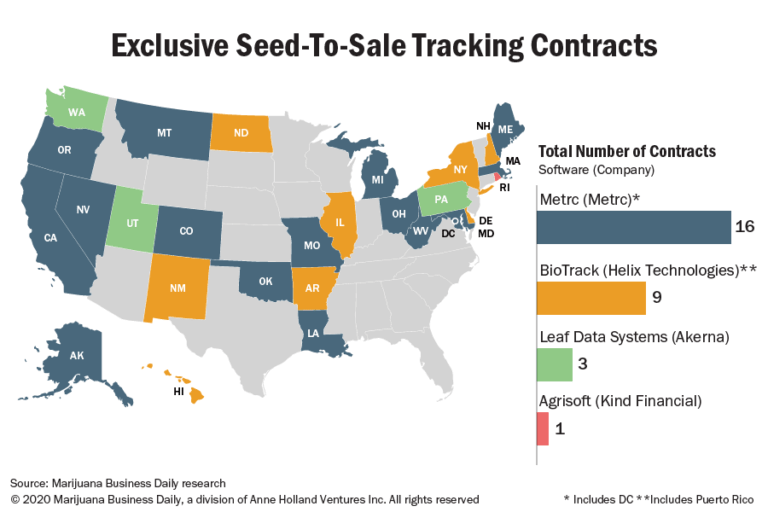
As the industry has developed over the years, most states that have approved some form of legal cannabis sales have selected a single mandated technology platform that all operators must use to track and trace their cannabis seeds, plants, and cannabis products. As shown in Figure 1, the majority of legalized states have chosen METRC as their exclusive contractor of track and trace services.
A Scalable and Sustainable Track and Trace Solution
The legal cannabis market has changed significantly since 1996 and it is important for the industry to re-evaluate the intention and implementation of track and trace. Regulatory bodies contracting with one track and trace technology provider and mandating operators to use that specific provider in order to stay compliant is problematic for many reasons. Time has shown that the current centralized model is fiscally irresponsible and ultimately counterproductive, with significant negative externalities, including ethical concerns such as anti-trust issues. Most recently, an Oklahoma cannabis operator (seeking class-action status) initiated litigation against the state’s Medical Marijuana Authority (OMMA), alleging that the state exceeded its authority by requiring licensees to pay for a state-mandated track and trace program, and that the state’s contract with METRC creates an unlawful monopoly, among other claims.
To provide an analogy, let’s think about how businesses are required to report taxes. The IRS sets out certain rules and every business must report their income and assets according to that framework. Technology providers (such as TurboTax, Tax Slayer, H&R Block, etc.) have built scalable products to support businesses in reporting their taxes. The IRS does not mandate that businesses use one single specified software in order to report their taxes. Doing so would kill competition, introduce a monopoly, and eliminate any incentive for the technology providers to improve their product. By the IRS allowing free competition over the realm of tax preparation and processing software, the public benefits from the technology companies being incentivized to update and improve their software features and benefits.
The centralized model is crippling the entire industry as system failures are occurring on a more frequent basis, and its after-effects are causing a more detrimental and wide-ranging impact as the industry grows at an exponential rate. Most recently, METRC’s integration functionality (how third-party business operations software communicates to the state’s system) was down for more than fourteen days in California, causing significant problems in the nation’s largest cannabis market. One software provider and its tag-producing partners are benefitting, while setting industry regulators and operators up to fail. One software provider cannot meet the current or future needs of regulators and operators, especially not on a national level. Meanwhile, there are many excellent software providers that specialize in track and trace. The free market should determine the most efficient and user-friendly approach to allow businesses to stay compliant and accurately report to the appropriate regulatory authorities.
By leveraging the knowledge and experience the industry has gained over the last 20 years, we can incorporate best practices from other industries’ and other markets’ track and trace systems, and set regulators and operators up for success.
Join us as we dive deeper into the issues surrounding compliance and track and trace in the cannabis industry. Our multi-part blog series provides an in-depth look into the technical shortcomings of the current centralized approach and provides a roadmap for implementing a distributed model approach. Some of the disadvantages we will cover in the subsequent posts include:
Impact of System Failure: The current centralized model provides a single point of failure: if the system goes down, all licensee operations must stop operating entirely. In some cases, operators may manually record activity during a system failure, and then manually enter the activity when the system resumes. This introduces a high risk of human error. No backup system or alternative means of recording through the use of technology exists since the state relies on only one system.
Challenges with Scalability: The history of performance with centralized track and trace systems demonstrates that there are significant challenges in scalability because of multiple system failures and shutdowns. The system would benefit from a more advanced track and trace capability, specifically with its API (Application Programming Interface). Many times it is not the technology of the licensee system, but the technology design of the state-mandated systems.
Fiscal and Environmental Impacts: Licensees are required to purchase plant and product tags from the single state-mandated vendor, which creates a fixed price system that is typically not in favor of a licensee. It is also creating a sustainability issue in the industry, as the plant and product tags are single-use. More operators are speaking up about the waste it is generating in our cannabis industry.
Interested in joining us in establishing an effective and scalable track and trace framework for regulators and operators in the legal cannabis space? Click here to stay updated on the State Regulations Committee, and the efforts that it’s Technology and Compliance Subcommittee are taking to improve and advance track and trace nationally. Let’s close the informational gap between operators and regulators, and help the entire industry move forward together.
Stay tuned for the next two blog posts in our multi-part series!
The regulated cannabis industry is inextricably linked to politics, and all politics is local — so when trying to open and operate a cannabis business, you’re almost sure to need to work with local government in some way.
To help our members understand how to start these relationships right, the NCIA State Regulations Committee hosted a webinar on how to approach local government earlier this year. That focused on identifying your relevant local authorities, how to introduce yourself, and how to properly navigate those relationships.
Once you’ve figured out who to talk to and have gotten in touch with them, they’ll often have questions about the cannabis industry, and there is plenty of good information you can proactively share as well. To help NCIA members inform their local governments about the wide range of issues surrounding our industry, we’ll be diving even deeper with a series of blog posts.
We’ll be starting this series where the whole cannabis supply chain begins: cultivation. Future posts will touch on processing, retail, and more. Even though states categorize their licenses differently, with some issuing stand-alone cultivation licenses and others combining cultivation with processing (or sometimes issuing vertically integrated licenses, with retail too), we’ll be focusing in on the various operations individually.
ECONOMIC IMPACT
When elected officials hear about a new business wanting to open in their town or city, their first question is usually, “how many jobs will it bring?” Mayors, city and town councils, departments of economic development, and other government entities are often laser-focused on building up the local economy, so explaining how your business will help them towards that goal is integral to moving your project forward.
Lucky for them, cannabis cultivation is a very labor-intensive endeavor, and you’ll likely be hiring dozens of people to staff your facility. If you’re an experienced operator who knows exactly how many people you need to hire and in what roles, let your local government know! They’ll be interested to see the range of responsibilities and necessary experience, from entry-level trimmers to mid-career managers to botanists with a Ph.D. If you’re still figuring out your exact staffing plan, providing a range of possibilities will help them understand the scale of your project. Be sure to avoid pie-in-the-sky estimates that you’ll never be able to reach — in the long run, it’s always better to under-promise and over-deliver than to make it seem like you were pulling a bait-and-switch. Also do not forget to include all the contract jobs created by constructing or retrofitting your facility.
Beyond the sheer number of hires you’ll be making, it’s important to talk about the compensation and benefits that you’ll be providing to your employees. If you’re starting everyone above the state’s minimum wage — or better yet, starting everyone at a living wage (generally thought to be at least $15/hour) — highlight that! If you’re providing health insurance or other benefits to your hourly employees, let them know! Elected officials like to see companies doing better than the bare minimum, and love to see companies that do even more.
Your physical facility will also have an economic impact on the community that’s worth talking about. If you’re buying your building, you’ll be paying property taxes, and you can let your elected officials know just how much you’ll be contributing to the tax base. Mayors and councilors always love to see unused space being occupied, so if you’re making use of a vacant or neglected building, be sure to let them know. This goes double if you’ll be making improvements to the building that increase its value (and triple if you’re using a local construction company to make those improvements).
Finally, consider whether you will be providing any additional revenue to the local government. While some state cannabis laws do allow for local taxes, these typically apply to retail rather than cultivation. Massachusetts and some other states also make heavy use of “community host agreements,” or CHAs, where a business commits a percentage of its revenues to the local government for a limited period of time. If either of these applies to you, be sure to provide elected officials with the relevant parts of state law, and the specifics you’re willing to offer. If you plan to financially support any charities, provide details — and if you’d like some guidance on what local charities are doing the most good, just ask, since most officials would be happy to tell you some of their favorites.
PUBLIC SAFETY
Elected officials also care about public safety, but usually follow the lead of their police chief and fire chief, for whom safety is their one and only priority. It’s good to proactively highlight the ways your facility will improve public safety — if you’re installing outdoor security cameras or floodlights, those can protect your neighbors as well as yourself, and there have been multiple cases where cameras on a cannabis business have helped solve an unrelated crime.
It’s important to remember that police and fire chiefs are spread thin and need to know a little about a wide variety of topics. Unless there are already cannabis businesses in their town, they probably haven’t read the state security requirements to open a facility, so providing an overview of the state law can help demonstrate how tightly regulated you will be. Knowing that the state already has rules for waste disposal, product storage, and controlled access areas can alleviate many of their initial concerns.
Once you’ve explained the security features of your building and run through the state requirements for cannabis businesses, you should address any lingering fears or questions that they may have. Two of the most common concerns are the safety of employees while transporting product or cash, and the risk of your building being targeted by burglars looking to steal product.
Regarding employee safety, explain how you will be shipping product to processors or dispensaries. Are you delivering it, are they picking it up, or are you using a third-party transporter? If you are transporting product yourself, explain both the state requirements and your own operating procedures, from GPS tracking to using two employees for each delivery.
You should also go into detail about your banking relationships. Many people outside the industry assume that it’s 100% cash, but if you’re part of the large majority of cannabis businesses with bank accounts, let your local officials know, especially the police chief. They will be much more comfortable if they know your customers will be wiring payments directly to your bank, rather than dropping off duffle bags full of cash at your facility.
Regarding burglary, be sure to re-emphasize your security measures, from cameras and fencing to access control and alarms. Explaining the cannabis life cycle may also be helpful — since plants are not useable products for most of their life, they’re poor targets for theft. This means that cultivation facilities are not prime targets for burglars, but in the rare cases that they are targeted, you can point to examples where cameras have led to burglars’ arrests.
COMMUNITY IMPACT
While economics and public safety are almost always the top two concerns of local governments, they may also be worried about other impacts on the community and how your business will affect residents’ quality of life. Common questions include whether your facility will emit any odor, and if it will increase traffic in the area.
Cannabis is famous for its strong odor, so it’s understandable that people would ask about it. Whether your state requires it or not, it’s advisable to use charcoal scrubbers or other odor mitigation technology to prevent your plants’ odor from escaping the building. Knowing that you’re taking steps to address this concern will help elected officials feel comfortable welcoming you into their community, especially if it’s in a densely populated area.
Traffic concerns may arise, especially if there are recent news stories about mile-long lines at dispensary grand openings. You can address this easily by explaining how cannabis cultivation facilities are not accessible to the public, and the main people coming to your building will be employees and inspectors, not customers.
When built and operated properly, cannabis cultivation facilities should be virtually indistinguishable from any other commercial warehouse. Unless you have very explicit signage (which we do not recommend), most people driving or walking by will not even know that you’re a cannabis business.
GOING FURTHER
Even after you have addressed all of your local government’s concerns, there will probably be even more questions — and that’s okay! This is a great opportunity to keep the dialogue open. Be sure to stay up to date on state laws and regulations so that you can serve as a resource for local officials. Because they’re spread so thin, they will appreciate having someone like you as a go-to when they have questions about cannabis politics or the industry.
If you’re able to offer tours of your facility, that’s a great way to build relationships with your local officials while educating them about your business and the cannabis industry as a whole. They may also appreciate invitations to events hosted by state cannabis regulators, or local industry conferences where they can get broader exposure to the cannabis world.
And of course, it’s important to be a good member of your community. Whether it’s participating in local projects, supporting local organizations, or organizing your own trash clean-ups or other events, staying active and visible will help the community know that they can count on you being a good neighbor.
Be sure to stay tuned for future installments in this series, where we will be addressing other cannabis license types. Our next blog will focus on processors.
WEBINAR: How to Approach Your Local Government – What You Don’t Know Could Hurt You!
Discussing cannabis and approaching government officials can both be daunting, but with a little knowledge and confidence, both can work together quite well!
Join members of NCIA’s State Regulations committee to get guidance and your questions answered so that you can be your best and help your community at the same time.
NCIA’s State Regulations Committee examines and reviews the varying cannabis industry-specific statewide regulations and work to establish best practices or guidelines for states and municipalities to facilitate the development of regulations and compliance procedures.
WEBINAR: Michigan Voted to Legalize Adult-Use Cannabis – What You Need To Know Now
On Election Day, Michigan voters resoundingly approved Prop 1 to legalize and regulate adult-use marijuana under state law. It’s an exciting time with great possibilities, but what does this mean for the future state of Michigan’s legal cannabis landscape?
Watch this recording of the webinar from NCIA’s State Regulations Committee, presenting its first-ever interactive webinar designed to help you answer the pressing questions about Michigan’s new adult-use market.
Join NCIA’s State Regulations Committee members, including Chair Maureen McNamaraof Cannabis Trainers, Committee Vice Chair Michael Cooperof MadisonJay Solutions, and Barton Morris of Cannabis Legal Group, as they help us fill in the blanks for adult-use regulations in the state of Michigan. The webinar helps answer what we currently know about the laws, any key open questions that remain, and what potential market entrants should be doing now to get ready.
Watch the webinar “Michigan Voted to Legalize Adult-Use Cannabis: What You Need To Know Now” hosted by members of NCIA’s State Regulations Committee.






Follow NCIA
Newsletter
Facebook
Twitter
LinkedIn
Instagram
News & Resource Topics
–
This Just In
Member Blog: What Consumers Really Want in a Pre-Roll
Member Blog: The Evolving Cannabis Legal & Regulatory Landscape in 2026