Midsummer Movement: The Pre-August Recess Rush in D.C.
Photo By CannabisCamera.com
By Michelle Rutter Friberg, NCIA’s Deputy Director of Government Relations
As Congress gets ready to beat the D.C. heat and leave Washington for their annual August recess, there’s at least one thing on their minds: cannabis.
Last week, Senate Majority Leader Chuck Schumer (D-NY) along with Finance Committee Chair Ron Wyden (D-OR), and Sen. Cory Booker (D-NJ) introduced their much anticipated Cannabis Administration and Opportunity Act (CAOA), which is now the Senate’s only pending legislation that would provide comprehensive cannabis policy reforms across the nation.
The landmark bill would remove cannabis from the federal Controlled Substances Act and move regulatory responsibility from the Drug Enforcement Administration (DEA) to the Alcohol and Tobacco Tax and Trade Bureau (TTB), the Food and Drug Administration (FDA), and other agencies to protect public health and safety. The bill would also institute a federal excise tax of 5-25% on cannabis on top of the already-hefty state taxes imposed on the industry, concerning advocates for small cannabis businesses and equity operators.
The long-awaited CAOA was introduced after sponsors circulated a discussion draft last year. NCIA and other advocacy organizations provided comprehensive feedback to the bill’s authors last year. Notable changes to the legislation include:
Increases the permissible THC by dry weight from the current 0.3 percent to 0.7 percent and refines the definition of “hemp,” and consequently “cannabis” by taking into account the total THC in a cannabis product, rather than just delta-9 THC.
Changes to the weight quantity to qualify a person for felony cannabis distribution or possession charge under the section from 10 pounds to 20 pounds.
Provides that a court shall automatically, after a sentencing review, expunge each federal cannabis conviction, vacate any remaining sentence, and resentence the defendant as if this law had been in place prior to the original sentencing.
Enables a noncitizen who has received a deportation order based on a cannabis-related offense to file a motion to reconsider that decision. If the motion to reconsider is filed within 30 days of the removal order, the motion may allow for the cancellation of the deportation order.
Establishes a new 10-year intermediary lending pilot program in which SBA would make direct loans to eligible intermediaries that in turn make small business loans to startups, businesses owned by individuals adversely impacted by the war on drugs, and socially and economically disadvantaged small businesses.
Removes the requirement to maintain a bond for any cannabis business that had less than $100,000 in excise tax liability in the prior year and reasonably expects excise tax liability in the current year to be below such amount.
Incorporates rules similar to rules currently applicable to permitted malt beverage producers and wholesalers.
While the historic nature of the CAOA cannot be understated, the bill has a multitude of challenges ahead of it. Not all Senate Democrats support the legislation, making the 60-vote filibuster threshold nearly impossible. Plus, with only a couple dozen legislative days between now and the end of the session, time is also working against advocates.
Dovetailing with the introduction of the CAOA, the Senate Judiciary Committee’s Subcommittee on Criminal Justice and Counterterrorism will hold a hearing titled “Decriminalizing Cannabis at the Federal Level: Necessary Steps to Address Past Harms” this Tuesday. While the witness list has not been made public as of publication, expect the hearing to focus on the newly introduced legislation and how it would affect communities most impacted by the war on drugs.
In other news, the House and Senate will vote on a revised research bill, the Cannabidiol and Marihuana Research Expansion Act, this week. The bill is expected to pass both chambers and be sent to President Biden’s desk for his signature. The Senate bill is sponsored by Sens. Dianne Feinstein (D-CA), Chuck Grassley (R-IA), and Brian Schatz (D-HI) and passed by unanimous consent in March. The House bill is sponsored by Reps. Earl Blumenauer (D-OR) and Andy Harris (R-MD), and passed 343-75 in April. One of the notable areas of compromise? The House bill would have allowed researchers to do their studies on cannabis that’s actually being sold to consumers in dispensaries. That was removed during negotiations, meaning that researchers will still have to obtain their cannabis from the University of Mississippi’s cultivation facility.
There’s still time before recess begins, so make sure you stay tuned to NCIA’s podcast, social media, and newsletter to stay up-to-date on all the latest from Washington, D.C.! Interested in making more of an impact? Don’t forget to register for our upcoming 10th Annual Cannabis Industry Lobby Days on September 13-14, 2022!
CAOA Delays, House Negotiations, and a Cannabis Festival
Photo By CannabisCamera.com
By Michelle Rutter Friberg, NCIA’s Deputy Director of Government Relations
Hopefully you’ve had a chance to recover after 4/20, but here in Washington, D.C. the work never ends!
Over the last few weeks, there have been developments on the timeline for the Cannabis Administration and Opportunity Act (CAOA), updates on the path forward for SAFE Banking, and a slew of pro-legalization events took place in the D.C. Keep reading for the latest:
More Delays for the Cannabis Administration and Opportunity Act (CAOA)
In February 2021, Senate Majority Leader Chuck Schumer (D-NY) along with Sen. Finance Committee Chairman Ron Wyden (D-OR) and Sen. Cory Booker (D-NJ) announced that they would be introducing a comprehensive cannabis bill to deschedule cannabis, enact a regulatory framework for this new industry, and seek to repair some of the harms that the war on drugs has created. In July of that year, the trio released the long-awaited, detailed discussion draft of the Cannabis Administration and Opportunity Act (CAOA) and asked for comments and feedback from stakeholders (you can read NCIA’s here) to be submitted by September 1, 2021. Since then, the Senators have been diligently reviewing and working on the legislation.
The sponsoring offices had hoped to introduce the CAOA in the beginning part of the year, and more specifically April 2022, however, they recently announced that they are continuing their diligent work and will introduce the bill before August recess.
While this announcement can be frustrating at face value, I’m happy that the Senators are being thoughtful, careful, and considerate about crafting this legislation. Precedent matters a lot on Capitol Hill, so getting it right on the first try (or attempting to!) matters.
SAFE Banking & the America COMPETES Act
The House of Representatives has passed the SAFE Banking Act three times this Congress; first in April 2021 as a standalone bill by vote of 321-101 and most recently as an amendment to the House’s version of the America COMPETES Act, which is now being negotiated by a bicameral, bipartisan conference committee.
While many in D.C. had hoped that negotiations would conclude by Memorial Day, lead sponsor Sen. Todd Young (R-IN) recently said that a more realistic timeline for the bill would be the end of summer. This week, the Senate will vote on 28 motions to instruct- these are procedural, non-binding resolutions that guide the conference committee through the negotiation process. After that, the conference committee can begin meeting
National Cannabis Festival and more!
Founded in 2016, the National Cannabis Festival is an annual event held in Washington, D.C. with a focus on cannabis and music, advocacy, education, and activism. Now boasting well over 20,000 attendees, NCIA is proud to have been involved with the event since its inaugural year, and I even sit as an advocacy committee chair!
This year, the festival was back and better than ever with an entire week of events celebrating cannabis advocacy in the nation’s capital, including an incredible Policy Summit featuring members of Congress, advocates, journalists, and more.
Like I said – the work never ends in D.C., and the NCIA team is gearing up for another busy month filled with Evergreen virtual lobby days, Hill meetings, coalition building, and more! Want to get involved? Consider becoming a member today!
NCIA Member Benefits: Advocacy, Education, and Community
by Madeline Grant, NCIA’s Government Relations Manager
Over the last year, NCIA’s Membership Department has dedicated a lot of time to revamp our membership tiers and benefits to ensure the best value for our members. We gathered feedback from members, conducted market research, and learned what value cannabis businesses sought in this fast-growing industry. I want to spend a little time today going through your benefits to be sure you are utilizing them to the fullest. As we represent the cannabis industry as a whole, we made sure there was a tier that could represent every cannabis company, small or big. Our three tiers are Seedling, Blooming, and Evergreen. To offer an array of benefits for your business, NCIA has three main buckets of benefits; networking & education, marketing & business resources, and policy & advocacy. Let’s take some time to go over all three.
Networking & Education
NCIA offers the opportunity to network and meet other cannabis professionals in the industry. It’s our job to provide events and tangible platforms so our members can grow their networks and businesses. Through our networking platform, NCIA Connect, we offer an exclusive online community to chat daily with other cannabis professionals. Here you can post questions, provide resources, share articles and utilize the platform to build relationships across the country. As an NCIA member, you are eligible to apply to speak at any NCIA virtual or in-person event. Depending on what tier you join you receive a certain amount of complimentary admissions to our trade shows and regional events, which you can check out here. As you move up to our Evergreen tier, there is the opportunity to attend exclusive VIP networking events, private meet-and-greets with celebrity keynote speakers, and a guaranteed seat on one of NCIA’s committees.
Marketing & Business Resources
As a cannabis business, it is important to have access to resources, especially as the industry is rapidly growing. Through membership, we offer discounts for Simplifya SmartCabinet compliance software, discounts on NCIA’s digital marketing and event sponsorship, a listing with a link to your company’s website in the online member directory, and access to BDSA Greenedge market intelligence platform. Through our digital platforms, we offer the ability to submit educational content to NCIA’s Industry Insights blog or post news about your business on our website and the eligibility to apply to be a guest on NCIA’s top-rated Cannabis Industry Voice and Cannabis Minority Report podcast. As we move into the Blooming and Evergreen membership levels, we offer company logo impressions and links posted to all NCIA social media platforms with over 200K total followers and featured in our newsletter sent to 40K e-mail subscribers annually. Our benefits offer great marketing opportunities to network and grow your business.
Policy & Advocacy
With momentum building across the country as more and more states are legalizing every year, we are simultaneously seeing more policy movement in Washington, D.C. It is more important now than ever to support cannabis policy on Capitol Hill. As a member of NCIA, your dues are directly supporting our ability to lobby and advocate for an industry we can be proud of while investing in the cannabis industry’s national policy agenda. All NCIA members have the opportunity to come out to our Annual Cannabis Industry Lobby Days (which is the best event to attend in my opinion). In D.C., you’ll meet with congressional offices and discuss the challenges you face as a business owner and meet other NCIA members from around the country. As a member at our highest tier, Evergreen, companies have private monthly updates with our Government Relations team, private briefings with key congressional offices, the opportunity to provide input on NCIA’s policy white papers, and direct access to NCIA’s registered lobbyist in D.C. Our support from the Evergreen tier allows us to allocate more resources to meet our goals on Capitol Hill, therefore, allowing us to continue to be as influential as possible.
Speaking of policy on Capitol Hill…
Just last month, Majority Leader Chuck Schumer (D-NY), along with Sen. Cory Booker (D-NJ) and Senate Finance Committee Chair Ron Wyden (D-OR), unveiled long-awaited draft legislation that would remove cannabis from the schedule of controlled substances while allowing states to determine their own cannabis policies.
This legislation called the Cannabis Administration and Opportunity Act (CAOA), is actually a discussion draft and has not been formally introduced (yet). If you’re interested in learning more about the bill and seeing the text, check this blog out.
But now, we need your help! As a discussion draft, we have the ability to weigh in on the CAOA’s proposed language and provide our feedback as an association. As members of NCIA, your input and expertise are essential and critical to us as we prepare our submission. Your submissions will be reviewed by NCIA and incorporated into the feedback our team is simultaneously compiling.
Use this form to send our government relations team your thoughts! I can’t wait to hear from you.
Overview
It’s important to understand and utilize all of your benefits as an NCIA member. If you ever want a quick refresh on your benefits please check out the membership matrix found here. Of course, if you have any questions please feel free to email me at Madeline@TheCannabisIndustry.org. I’d love the opportunity to hear from you!
Video: NCIA Today – July 23, 2021
NCIA Deputy Director of Communications Bethany Moore checks in with what’s going on across the country with the National Cannabis Industry Association’s membership, board, allies, and staff. Join us every Friday here on Facebook for NCIA Today Live.
Crazy for Cannabis Administration and Opportunity Act (CAOA)
Photo By CannabisCamera.com
By Michelle Rutter Friberg, NCIA’s Deputy Director of Government Relations
Last week was undoubtedly one of the most exciting weeks in federal cannabis policy ever! On July 14, Senate Majority Leader Chuck Schumer (D-NY), along with Sen. Cory Booker (D-NJ) and Senate Finance Committee Chair Ron Wyden (D-OR), unveiled long-awaited draft legislation that would remove cannabis from the schedule of controlled substances while allowing states to determine their own cannabis policies. Let’s take a look at what we know:
What is it?
You’ll recall that back in February, the trio of Senators announced that they were working on a comprehensive cannabis bill. Since then, NCIA and other advocates have (im)patiently been waiting to see what shape that would take – I was calling it the best-kept secret in Washington! However, at long last, the discussion draft of the Cannabis Administration and Opportunity Act (CAOA) was released.
A discussion draft is exactly what it sounds like – prior to introducing this language as formal legislation, the Senators have shared it in this form, allowing stakeholders, the public, and others the opportunity to weigh in and provide their expertise and feedback.
What’s in it?
As I mentioned above, the CAOA removes cannabis from the list of controlled substances, effectively legalizing it at the federal level while still allowing states to set their own policies. According to the bill’s detailed summary, it has a few goals:
“… [it will] Ensure that Americans – especially Black and Brown Americans – no longer have to fear arrest or be barred from public housing or federal financial aid for higher education for using cannabis in states where it’s legal. State-compliant cannabis businesses will finally be treated like other businesses and allowed access to essential financial services, like bank accounts and loans. Medical research will no longer be stifled.”
The bill also includes:
Restorative measures for people and communities who were unfairly targeted in the war on drugs.
Automatic expungements for federal non-violent marijuana crimes and allows an individual currently serving time in federal prison for nonviolent marijuana crimes to petition a court for resentencing.
An “Opportunity Trust Fund” funded by federal cannabis tax revenue to reinvest in the communities most impacted by the failed war on drugs, as well as helping to level the playing field for entrepreneurs of color who continue to face barriers of access to the industry.
An end to discrimination in federal public benefits for medical marijuana patients and adult-use consumers.
Respect for state cannabis laws and a path for responsible federal regulation of the cannabis industry. Like with federal regulations on alcohol, under CAOA, states can determine their own cannabis laws, but federal prohibition will no longer be an obstacle. Regulatory responsibility will be moved from the U.S. Drug Enforcement Agency (DEA) to the Alcohol and Tobacco Tax and Trade Bureau (TTB), the Bureau of Alcohol Tobacco Firearms and Explosives (ATF), as well as the Food and Drug Administration (FDA) to protect public health.
A federal tax structure – CAOA would impose an excise tax on cannabis products in a manner similar to the tax imposed on alcohol and tobacco. The general rate of tax would be 10 percent for the year of enactment and the first full calendar year after enactment. The tax rate would increase annually to 15 percent, 20 percent, and 25 percent in the following years.
What’s next?
The discussion draft comment and feedback process will be ongoing until September 1. Until then, NCIA will be working with our board, Policy Council, committees, and our members (particularly our Evergreen members!) to solicit their expert input on some of the areas the Senators have expressed interest in. After that deadline, the Senators will take their time to review submissions and subsequently formally introduce the revised language later this year. Stay tuned via our newsletter, blog, and upcoming events to learn the latest on this and how you can actually submit your thoughts to us!
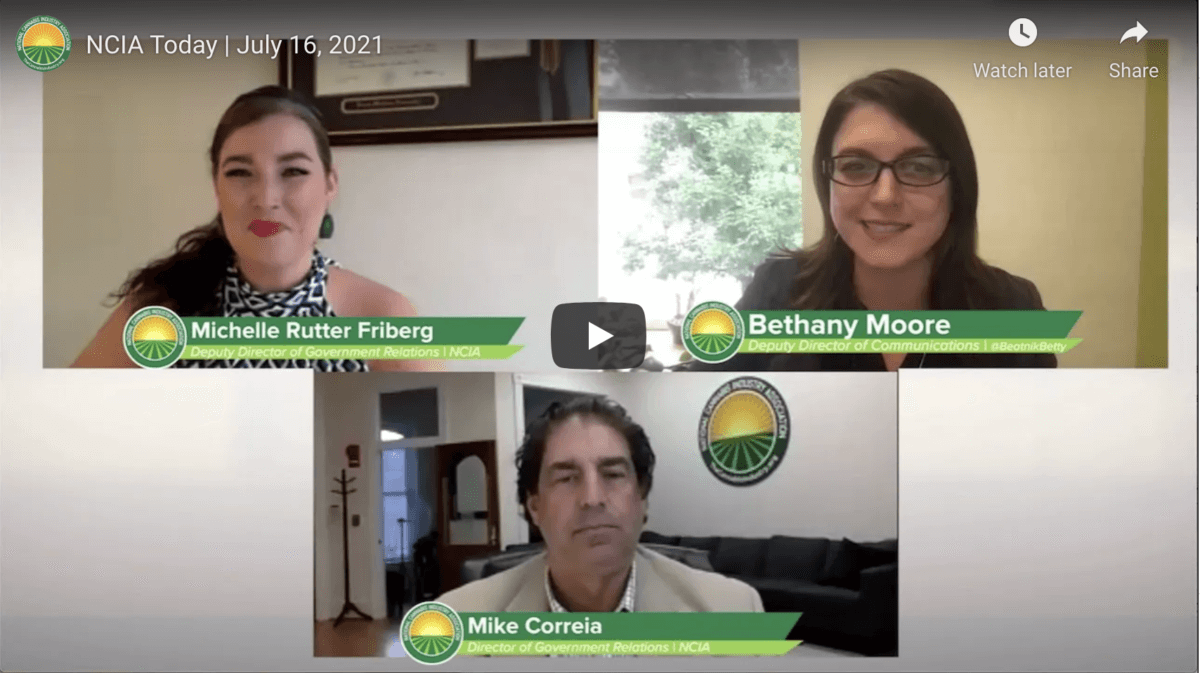
Video: NCIA Today – July 16, 2021
NCIA Deputy Director of Communications Bethany Moore checks in with what’s going on across the country with the National Cannabis Industry Association’s membership, board, allies, and staff. This week Bethany is joined by NCIA’s GR team in Washington D.C. to discuss the Cannabis Administration and Opportunity Act discussion draft introduced by Senate Majority Leader Chuck Schumer. Join us every Friday on Facebook for NCIA Today Live. Registration to our Midwest Cannabis Business Conference in Detroit is now open with special limited-time super early bird pricing on tickets available, head to www.MidwestCannabisBusinessConference.com today.
Senate Opens Doors to Federal Legalization
At long last, the day we’ve been waiting for all year has finally come! Early Wednesday morning, Senate Majority Leader Chuck Schumer (D-NY) and Sens. Cory Booker (D-NJ) and Ron Wyden (D-OR) released the discussion draft language for a comprehensive bill that would effectively make cannabis legal at the federal level while allowing states to continue to determine their own cannabis policies and work to repair the harms caused by prohibition.
While it has yet to be formally introduced in the Senate (stay tuned!), this draft legislation is designed to jumpstart bipartisan negotiations that have been building momentum in Congress since the first states chose to regulate cannabis for adults, and which came to the forefront in the wake of last year’s renewed focus on criminal justice reform and the House passage of the MORE Act at the end of the last congressional session.
You can find a summary of the language here and the full draft here.
NCIA will be carefully reviewing the details of this proposed legislation in the coming days and will be actively eliciting feedback from our members, allies, and especially our Evergreen members, Policy Council, and committees to determine what – if any – changes need to be made before the bill is introduced. Our dedicated in-house government relations team will also be working closely with lawmakers to find an effective path forward for comprehensive cannabis policy reform that helps to undo the disastrous impacts of our current federal laws in the immediate future.
Senate leadership will be taking comments and suggestions until September 1. If you would like to add your input, please contact Deputy Director of Government Relations Michelle Rutter Friberg at Michelle@TheCannabisIndustry.org.
States Still Leading The Way, With Some Stirrings In Congress
By Morgan Fox, NCIA’s Director of Media Relations
As has been so often true in the history of cannabis policy reform (but is starting to change with your help), the biggest news and progress made this week is at the state level. After a long and arduous legislative session, Connecticut lawmakers approved an adult-use bill, which Gov. Lamont signed on Tuesday!
The new law makes adult possession of up to 1.5 ounces legal and will establish a regulated licensing system. Half of all licenses are reserved for social equity applicants, who will also be able to access training, technical assistance, and startup funding. Limited home cultivation will be permitted in stages (medical first, then adults), and limited social consumption will not just be allowed – it will be mandated in municipalities with more than 50,000 residents.
Let’s put this in a national perspective. If you do not include all the years of foundation-building, activism, and lobbying that go into changing cannabis laws, it took two years for voters to approve adult use in the first four legal states starting in 2012. At that time, passing such laws through elected representatives was unheard of. Now in 2021, four state legislatures have approved adult-use bills in the first six months of the year! We’ve come a long way in terms of state policy reform and momentum is only increasing, but we still have a long way to go.
Now let’s move to Congress, where things tend to move a bit more slowly but are nevertheless picking up speed.
Earlier this month, NCIA endorsed the Drug-Impaired Driving Education Act. This bill, introduced by Reps. Kathleen Rice (D-NY) and Troy Balderson (R-OH), would provide grants and resources to states and organizations to engage in evidence-based impaired driving education. NCIA supports this bill because impaired driving is a serious issue that is most effectively combatted through early and consistent educational outreach, which this legislation promotes to the exclusion of unscientific per se limits and unproven chemical testing technology.
In somewhat related news, a massive transit bill is now awaiting a vote in the House of Representatives after recently passing a key committee. This legislation contains a number of provisions related to impaired driving education, the most important cannabis-related item is a provision that would allow researchers to access and study cannabis products that are available to consumers in state-legal markets rather than depend on federally-approved sources. While the DEA has announced that it will begin granting research production licenses to applicants – many of whom have been waiting for years for approval – there is currently only one legal federal cannabis source, and researchers have consistently complained that it is practically useless due to poor quality and contamination.
Moving on to the SAFE Banking Act, Senate sponsors Jeff Merkley (D-OR) and Steve Daines sent a letter to Banking Committee Chairman Sherrod Brown (D-OH) and Senate leadership urging them to take up the bill for consideration as soon as possible. After overwhelmingly passing in the House in April with a bipartisan vote, the bill has been awaiting review in the upper chamber, with some Democrats wanting to wait until a more comprehensive bill is introduced there.
Advocates and congressional supporters are eagerly awaiting the introduction of that legislation from Senate Majority Leader Chuck Schumer, who has been working closely with Sens. Ron Wyden (D-OR) and Cory Booker (D-NJ) since announcing that this effort would be a priority early this year.
The Senate has quite a bit on its plate at the moment, but we expect things to keep ramping up over the coming weeks and months. Stay tuned!
Hurry Up And Wait: Descheduling, DEA Licenses, And Other Reform Legislation to Watch
By Morgan Fox, NCIA’s Director of Media Relations
The cannabis world is still eagerly awaiting the introduction of Senate Majority Leader Chuck Schumer’s comprehensive descheduling legislation, but that doesn’t mean things haven’t been moving on the policy front in recent weeks!
First up, the DEA announced that it was finally moving forward with approving applications to cultivate cannabis for research purposes, which would effectively end the federal government’s stranglehold on research production. The agency spent years fending off lawsuits from applicants, who correctly asserted that not only was the monopoly limiting research, but the cannabis being grown at the single licensed facility at the University of Mississippi was basically unusable for research purposes anyway. This announcement comes several years after the DEA publicly stated that it would begin the licensing process. Better late than never.
Next, Sen. Ron Wyden, who is also working closely with Majority Leader Schumer on descheduling along with Sen. Cory Booker, introduced S. 1698 last week. While text of this bill is currently not publicly available, the name suggests that this legislation would direct the FDA to allow hemp-derived CBD, made legal under the 2018 Farm Bill, to be used as a dietary supplement or in food. Some perceive this bill as necessary to get some regulatory clarity from the FDA, which has been dragging its feet and missed several deadlines for CBD regulations. Many in the industry blame this lack of regulation for larger retailers staying out of the CBD market, which has led to massive supply gluts of the substance and has been hypothesized to be a leading cause for the recent boom in Delta 8 THC production.
And earlier this month, Rep. David Joyce, an Ohio Republican who co-chairs the Congressional Cannabis Caucus, introduced a narrowly tailored bill to remove cannabis from the schedule of controlled substances. The bill assigns regulatory responsibilities to the FDA and the Alcohol and Tobacco Tax and Trade Bureau and gives them a one-year deadline to come up with a regulatory structure similar to alcohol. It also contains provisions similar to the protections that exist in the House-approved SAFE Banking Act, calls for studies on how cannabis impacts pain and driving, and improves access for veterans. Notably, this bill does not contain any social equity or restorative justice language.
While the chances of such legislation passing in the Democrat-controlled House are slim, it could serve as a doorway to get fence-sitting Republicans into the debate. It could also be a tool to identify those members of the GOP who are steadfastly opposed to any legalization bill and out of touch with their constituents, many of whom would directly benefit from cannabis policy reforms and who are increasingly in support of ending federal prohibition.
We’re also getting word that the Marijuana Opportunity, Reinvestment, and Expungement (MORE) Act is getting reintroduced in the House this week (and may have already been at the time of this publication). This legislation made history last December when it became the first descheduling bill to receive a floor vote – and pass – in either chamber of Congress. We are hopeful that there will be some revisions from the previous bill, including the removal of a provision that would allow federal licensors to deny applications for cannabis business licenses based on prior state or federal felony convictions, and the inclusion of a more sensible and robust regulatory framework.
We are less than halfway through the calendar year, and it is shaping up to be a momentous one for cannabis advocacy! Stay tuned for more updates from Capitol Hill.
P.S. On the state side, Alabama became the latest state to approve an effective medical cannabis law. Yes, Alabama. That brings the count of medical states to 36, after unfortunately losing Mississippi to a shameful court decision. So far in 2021, four states have approved adult-use or medical cannabis legislation, and more are expected to do so in the coming weeks and months.

 by Madeline Grant, NCIA’s Government Relations Manager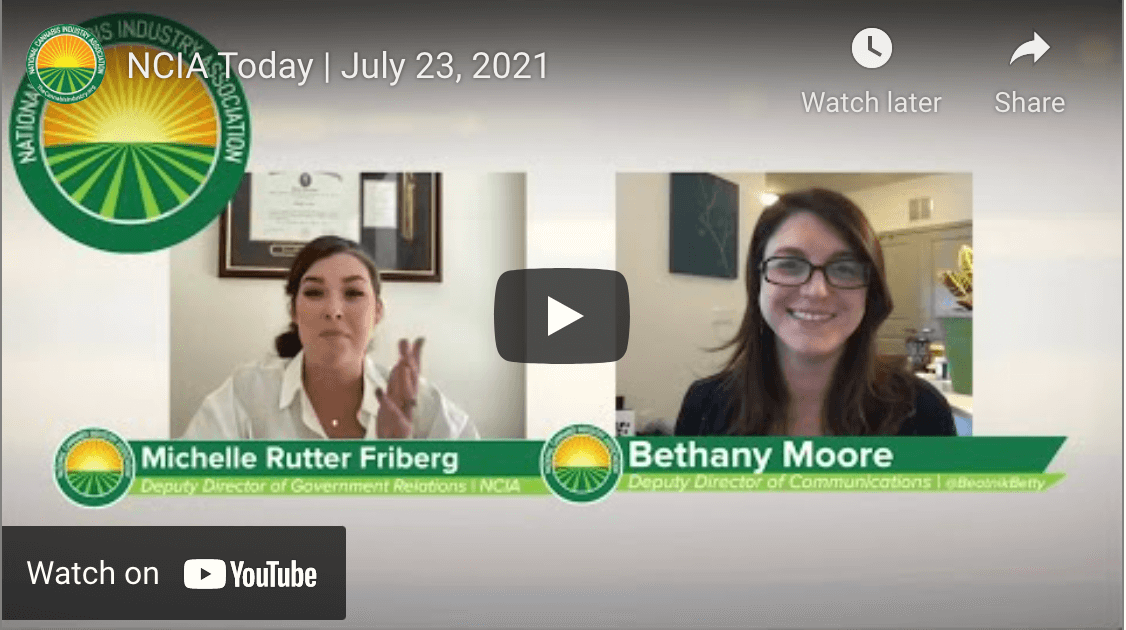

 By Morgan Fox, NCIA’s Director of Media Relations
Follow NCIA
Newsletter
Facebook
Twitter
LinkedIn
Instagram
News & Resource Topics
–
This Just In
Member Blog: The Evolving Cannabis Legal & Regulatory Landscape in 2026
How THCa Vapes Are Changing Consumer